
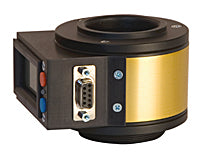

DayStar is proud to offer Sodium Na- D line (5895.9Å ) filtering systems. For visual and photographic studies. Sodium filter assemblies are designed for sub-angstrom observations with single-cavity design. Sodium lines are very narrow, but very bright. A very narrow filter of < 0.5Å is necessary to properly isolate the line from the continuum. The resulting image depicts high detail in granulation, supergranulation and P-modes.
Sodium also shows impulsive-phase flare eruption kernels. Na D is a low excitation line emitted when the low chromosphere is heated, usually at footpoints of flux loops passing through a flare, as sodium D line reflects the lower chromosphere. Visual and photographic images reveal type image as Calcium, revealing granulation, but are much brighter and more easily visible.
University series filters are designed to operate unheated on the lower of the two Na D emission lines; and can be heated to accomplish transmission on the higher of the two Na D lines, making doppler studies possible by photographing in each line and deriving difference images after subtracting an average solar velocity image. This process is referred to as a dopplergram velocity image, reveals the surface motions associated with supergranulation.

These filters have until now been primarily used for research purposes only, performing doppler and supergranulation studies. Narrow bandpass Na D line filters have also been used in deep-sky observations of IO, but with significantly larger apertures.

DayStar Filters 0.4Å Sodium D line filter

Photo by Greg Swaim
DayStar Filters 0.4Å Sodium D line filter
*
Note. These systems require an energy rejection pre-filter and F/30 focal ratio for onband operation. Standard yellow glass DayStar Energy rejection filters provide sufficient off-band energy rejection, as do dielectric ‘hot mirror’ coated pre-filters.
* HALF-BANDWIDTH: The term half-bandwidth refers to an optics industry standard of measure. On a chart depicting the peak where light is transmitted, that peak’s width is measured at the point 50% between zero and full transmission. This term is called half-bandwidth.


