
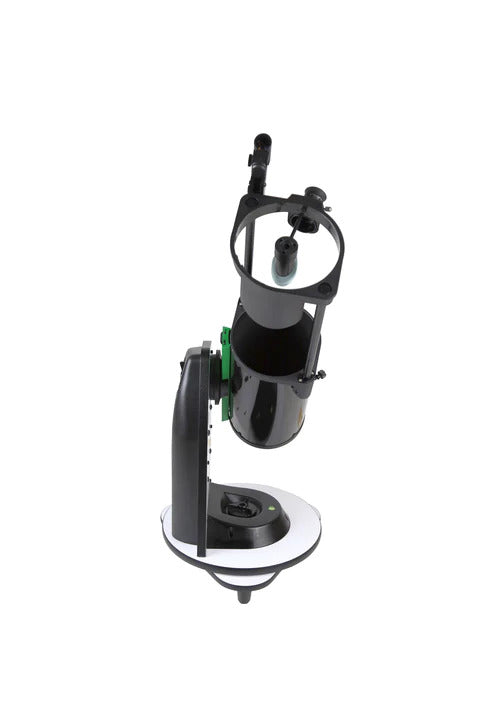


- Description
- Specifications
At a Glance
- Aperture: 130 mm
- Focal length: 650 mm
- Focal ratio: f/5
- Mirror coating: Radiant Aluminum Quartz (RAQ), 94% reflectivity
- Control: Built-in Wi-Fi, SynScan Pro app, 10,000+ object database
- Power: 8x AA batteries or external 12 V supply, neither included
Product Overview
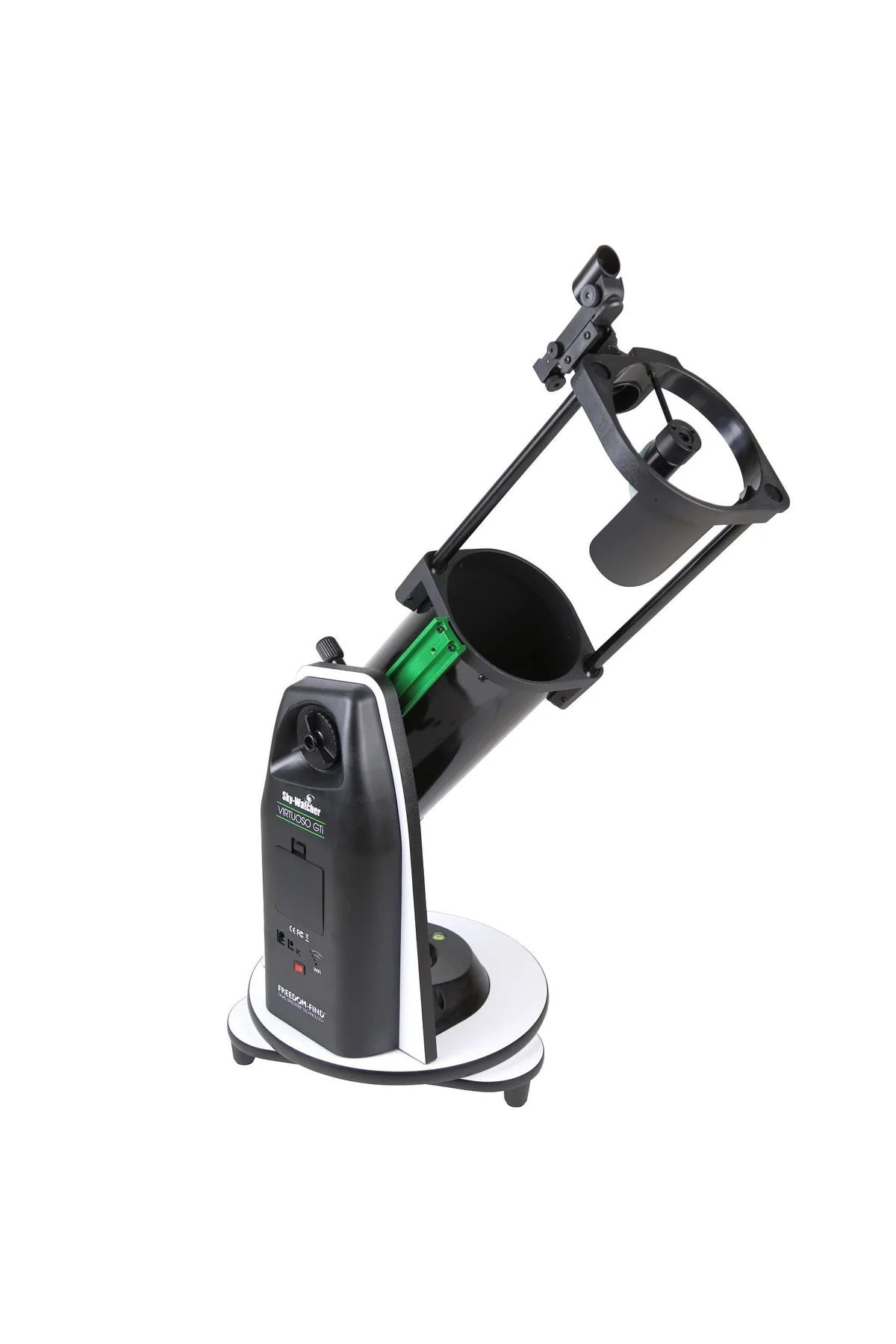
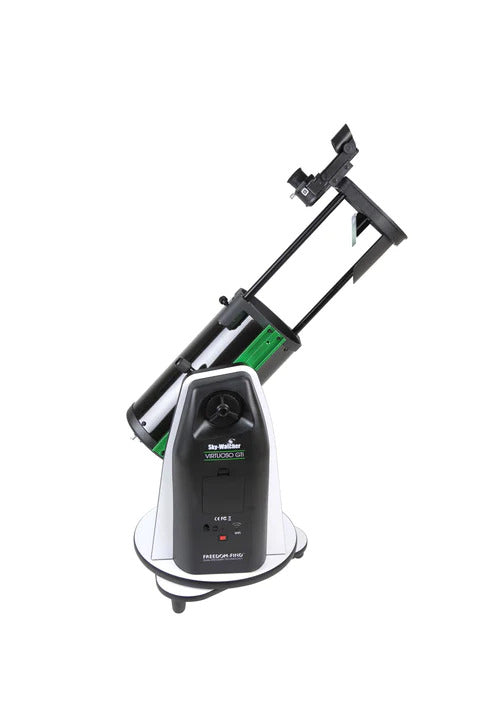
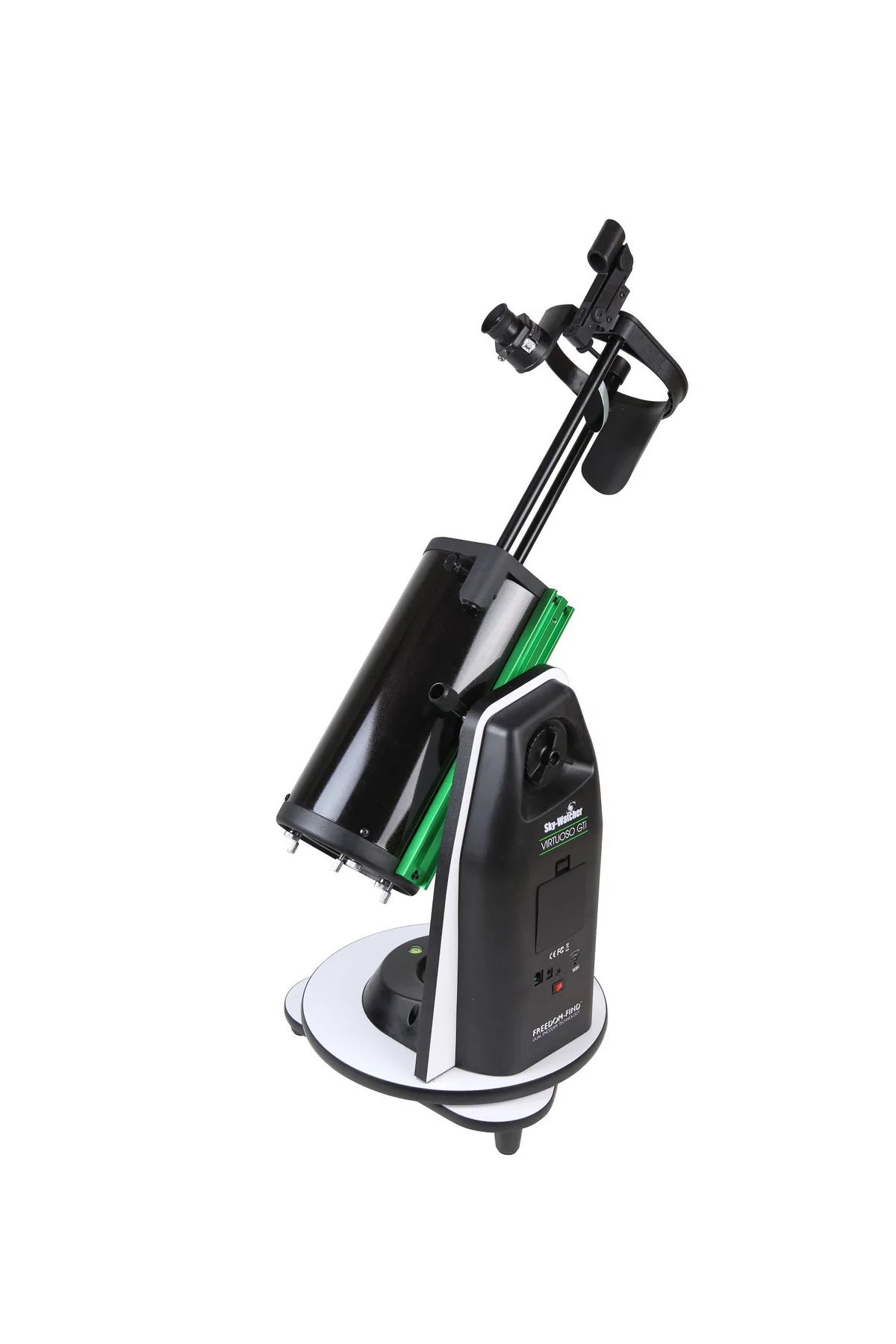
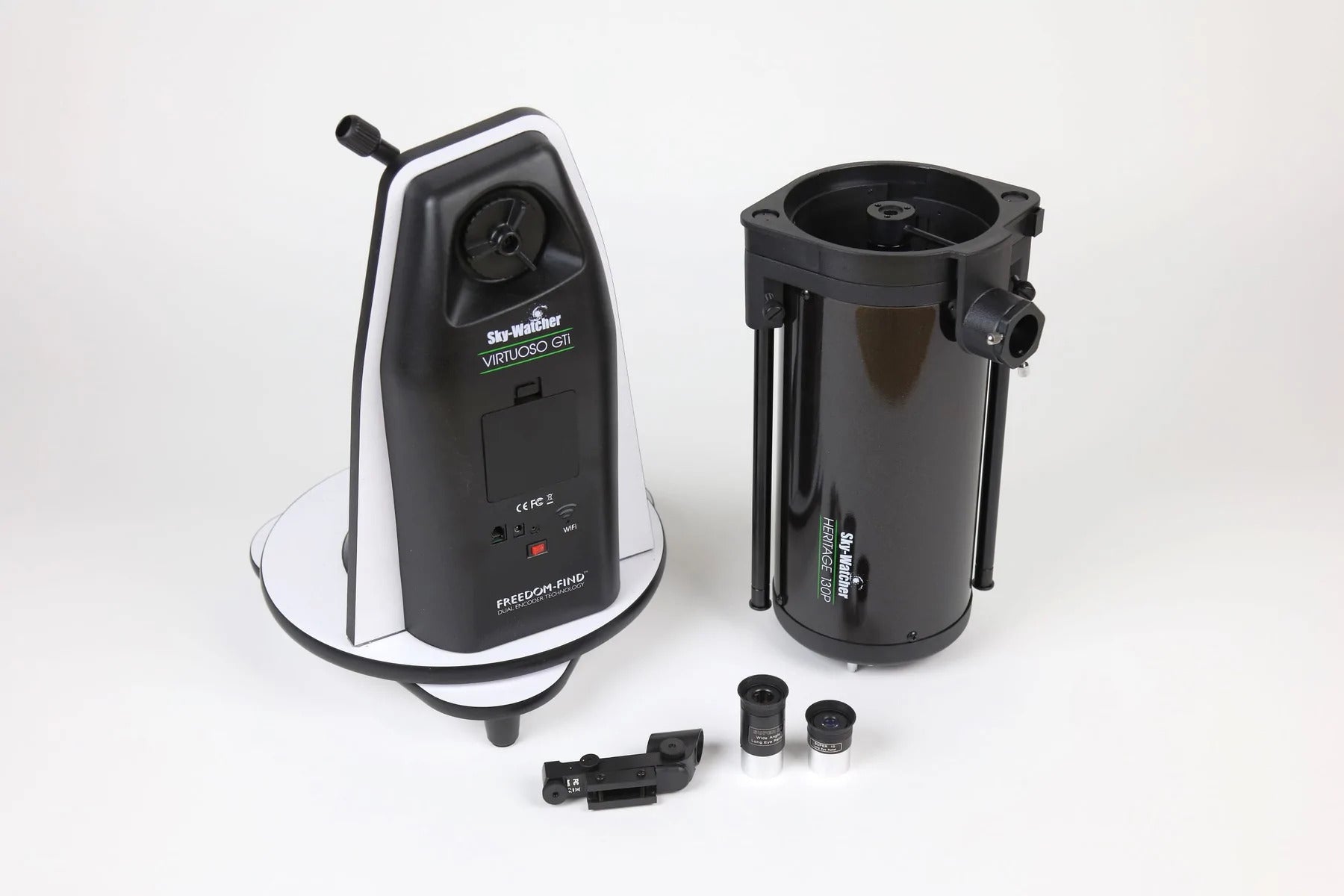
The Sky-Watcher Virtuoso GTi 130P is a 130 mm f/5 tabletop Dobsonian on a motorised GoTo base with built-in Wi-Fi. The optical tube collapses for transport, and the base is driven by an internal computer you control from a phone or tablet through Sky-Watcher's free SynScan Pro app — there is no hand controller to keep track of and no cable running to it.
Sky-Watcher describe the GTi as taking its collapsible tube design from their Flextube and Heritage Dobsonians and putting it on a driven base. At 650 mm focal length the scope stays wide-field and forgiving, the primary carries the Radiant Aluminum Quartz coating at 94% reflectivity, and the app's database runs to over 10,000 objects across the Messier, NGC, IC and Caldwell catalogues.
Who It's For
This is a good match if you want a telescope that finds things for you without becoming a project in itself. Setup is a table, four AA-powered minutes, and an alignment routine on your phone — which is a low enough barrier that the scope gets used on marginal evenings rather than only on planned ones.
It suits a first telescope well, particularly if your sky is bright enough that star-hopping is genuinely difficult. It also works as a second scope for experienced observers who want something that lives by the door for casual sessions, camping and travel, where a full-size instrument stays home.
Key Features & Design
- Wi-Fi GoTo with no hand controller: the mount creates its own network and the SynScan Pro app does the pointing, so the interface is a device you already carry and already know how to use.
- 10,000+ object database: Messier, NGC, IC and Caldwell catalogues, which is more targets than this aperture will exhaust in years of observing.
- Freedom Find dual encoders: you can push the tube by hand at any moment without losing alignment, so manual sweeping and computerised pointing coexist rather than being a choice you commit to.
- Four alignment methods: One-Star, Brightest Star, North-Level and Three-Star, so you can trade setup time against pointing accuracy depending on the evening and how much sky you can see.
- Tracking at sidereal, lunar and solar rates: objects stay centred once found, which is what makes higher magnifications usable and lets several people look in turn without re-aiming.
- Collapsible optical tube: the scope shortens for storage and travel while holding collimation, which is what keeps a driven telescope this capable genuinely portable.
- V-style dovetail saddle: the base accepts a standard V-style bar, so the mount is not permanently tied to the tube it ships with.
Optical / Mechanical Design
130 mm at 650 mm focal length gives f/5. The practical benefit is field width — the supplied 25 mm eyepiece yields 26x across a wide patch of sky, which is forgiving of pointing error and makes the GoTo system's job easier, since a target only has to land somewhere in a generous field to be visible. The 10 mm eyepiece gives 65x for lunar and planetary work.
The base carries dual encoders, one per axis, and this is what Freedom Find depends on. Because each axis reports its true position independently of the motors, moving the telescope by hand does not desynchronise the computer's model of where it is pointing. On most GoTo mounts that action forces a re-alignment; here it does not.
The mount accepts a V-style dovetail, which means the base can carry other optical tubes with a compatible bar within its capacity — useful if you later add a small refractor and want a driven mount to put it on.
Recommended Uses
Guided visual observing is the point of this telescope: choosing a target in the app, letting the scope slew to it, and looking. That is most valuable on deep-sky objects from suburban skies, where finding faint targets manually is the hardest part of a session.
Lunar and planetary observing benefits from the tracking, since the object holds still while you study it. The scope also suits outreach and family observing, camping and travel, and casual smartphone snapshots of the Moon through the eyepiece, which work well with the mount tracking underneath.
Compatibility and Accessory Notes
Sky-Watcher supply the base and mount assembly, the optical tube, a red dot finder, and 25 mm and 10 mm Super eyepieces — enough to observe on the first night without buying anything.
Power comes from eight AA batteries or an external 12 V supply, and neither is in the box. Rechargeable AAs or a small 12 V power pack are both common solutions, and sorting this out before the first clear night is worth doing.
The SynScan Pro app is free for iOS and Android and is the primary interface. The mount also has a port for a SynScan hand controller if you prefer physical buttons, though one is not included. A collimation cap is a sensible companion for any Newtonian.
If you want help choosing a power solution or additional eyepieces, tell us how you plan to use the scope and we will point you at something suitable.
Good to Know Before You Order
No solar filter is included, and the scope must never be pointed at the Sun without one. The mount offers solar tracking rates, which is genuinely useful — but only with a properly fitted, undamaged full-aperture solar filter over the front of the tube. Sky-Watcher's earlier Virtuoso shipped with a solar filter; this model does not. Ask us and we will make sure you get the right one for this aperture.
Power is not supplied. Eight AA cells or a 12 V external supply, your choice, but plan for it as part of the purchase rather than a surprise on the first evening.
It is a tabletop telescope. There is no tripod. A firm table, bench or stool at seated height is what it needs, and the observing height is set by whatever you stand it on.
Alignment happens at the start of each session. The app walks you through one of four routines and it takes a few minutes. Freedom Find means that once done, handling the scope will not undo it.
It is not a deep-sky imaging instrument. The base is alt-azimuth, so the field of view rotates during an exposure even while tracking holds the object centred. Smartphone shots of the Moon and bright planets work nicely; longer exposures on faint objects need an equatorial mount.
Frequently Asked Questions
Is it difficult to set up?
No. Put the base on a table, fit the tube, extend it, load batteries, connect your phone to the mount's Wi-Fi network, and run an alignment in the app. The first evening takes a little longer while you learn the app; after that it is a few minutes.
Do I need internet or mobile signal to use it?
No. Your phone connects directly to the Wi-Fi network the mount creates, so the system works anywhere — which matters, since the best observing sites tend to have the worst signal.
How is this different from the Heritage 130?
The optics are the same size and speed and both tubes collapse. The Virtuoso adds the motorised base, Wi-Fi control, the object database, tracking and Freedom Find, plus a red dot finder and two eyepieces. The Heritage costs considerably less and gives the same view; you are paying here for the scope to find and follow things.
What do I need to run it?
Eight AA batteries or a 12 V external supply, neither included, plus a phone or tablet with the free SynScan Pro app. A hand controller is optional and separate.
Can I still move it by hand?
Yes, and that is what Freedom Find is for. Dual encoders track the true position of each axis, so pushing the tube to look at something does not cost you the alignment. Hand control back to the app afterwards and it still knows where it is pointing.
Can I photograph with it?
Smartphone images of the Moon and the brighter planets work well with the tracking running. Deep-sky imaging is outside what an alt-azimuth mount can do, because the field rotates during long exposures. If that is where you are heading, an equatorial mount is the honest answer and we are happy to talk it through.
Bottom Line
In short: a 130 mm f/5 collapsible tabletop Dobsonian on a Wi-Fi GoTo base, driven from your phone, with dual encoders that let you move it by hand without losing alignment. It comes with a finder and two eyepieces, it needs batteries and a table, and it is built to put objects in the eyepiece on a weeknight.
| SKU | S21210 |
| UPC | 050234212106 |
| Optical Specifications | |
|---|---|
| Optical Design | Newtonian |
| Mirror Coating | Protected Aluminum |
| Reflectivity | 94% |
| Mirror Type (Monolithic/Conical/Fused conical) | Monolithic |
| Glass Type | Borosilicate |
| Primary Aperture (mm) | 130 |
| F/Ratio | 5 |
| Focal Length (mm) | 650mm |
| Secondary Diameter (minor axis) | 40mm |
| Secondary Obstruction by Diameter | 31% |
| Secondary Obstruction by Area | 10% |
| Primary cell supports (how many support points) | Edge Support |
| Optical Quality | Diffraction limited (1/4 wave) |
| Collimatable Cell | Secondary & Primary |
| Mechanical Specifications | |
| Focuser Type | Helical |
| Focuser Size | 1.25" |
| Focuser: Dual or Single Speed | Single |
| Compression Ring | No |
| Optical Tube length (exten/retract) | 25"/14.75" |
| Optical Tube weight | 6.5 pounds |
| Assembled base weight | 10.9 pounds |
| Total Weight | 17.3 pounds |
| Type of bearing used (telfon/roller) | Roller |
| Hardware included with base | Yes |
| Collapsible Tube | Yes |
| Tripod Mount | 3/8 thread block |
| Electronic Specifications (GoTo only models) | |
| Required Power | 12v/AAs (8x) |
| Power port diameter | 2.1mm |
| Freedom Find | Yes |
| Clutch Type | Hand Clutch |
| Can clutches be adjusted | Yes |
| Built-in WiFi | Yes |
| Hand Controller | Optional |
| Database | Complete Messier, Caldwell, NGC, IC and SAO catalogs, user defined objects. Total 10,000+ objects |
| Accessories | |
| Eyepieces | 25mm and 10mm SUPER eyepiece (1.25") |
| Collimation eyepiece | Yes |
| Included finder | Red Dot |
| Mounting Hardware | Dobsonian |
| Additional Accessories | None |
| Manual |
You may also like
Recently viewed
Recent Blog Posts
View all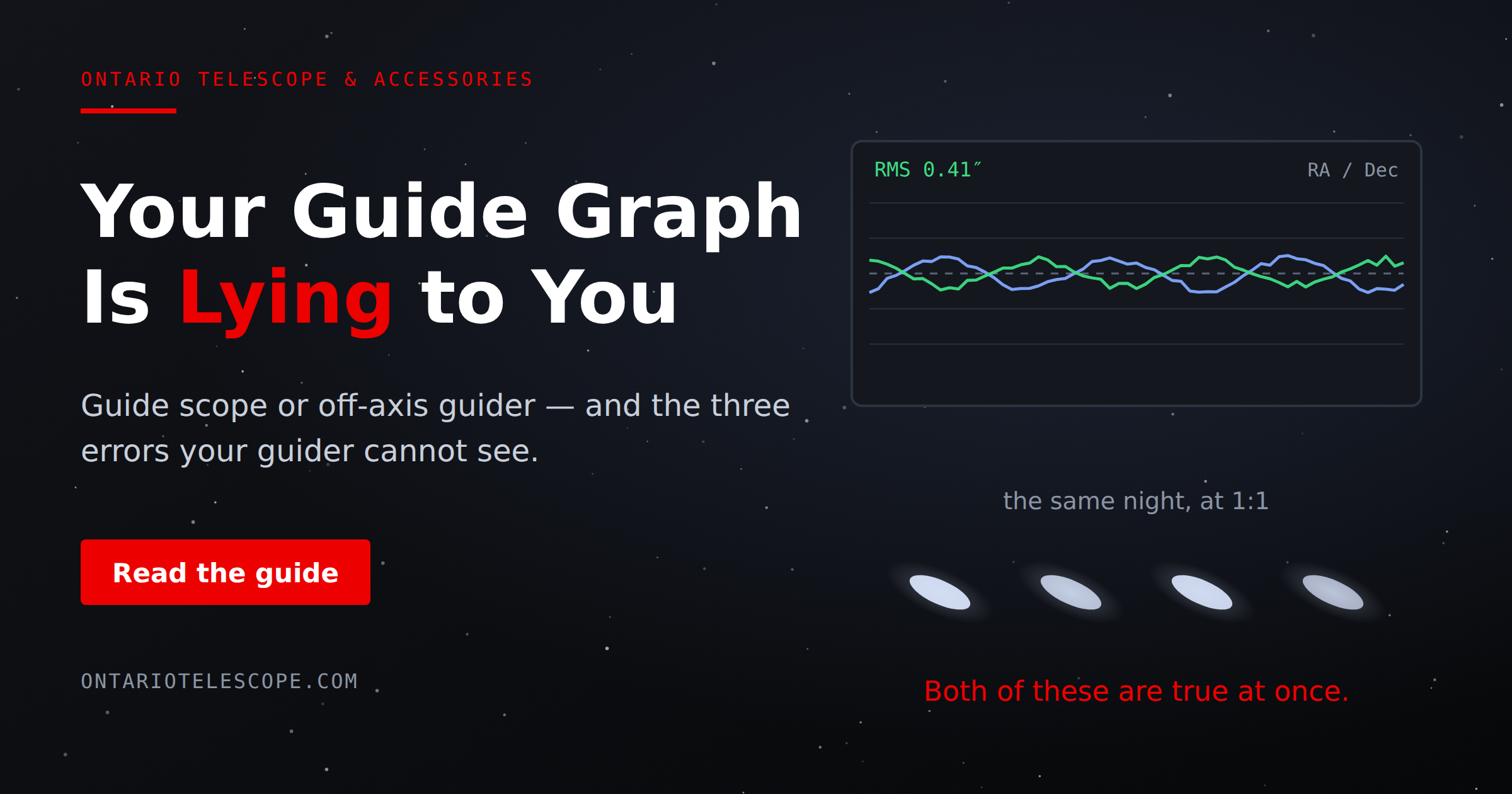
Your Guide Graph Is Lying to You
Read More
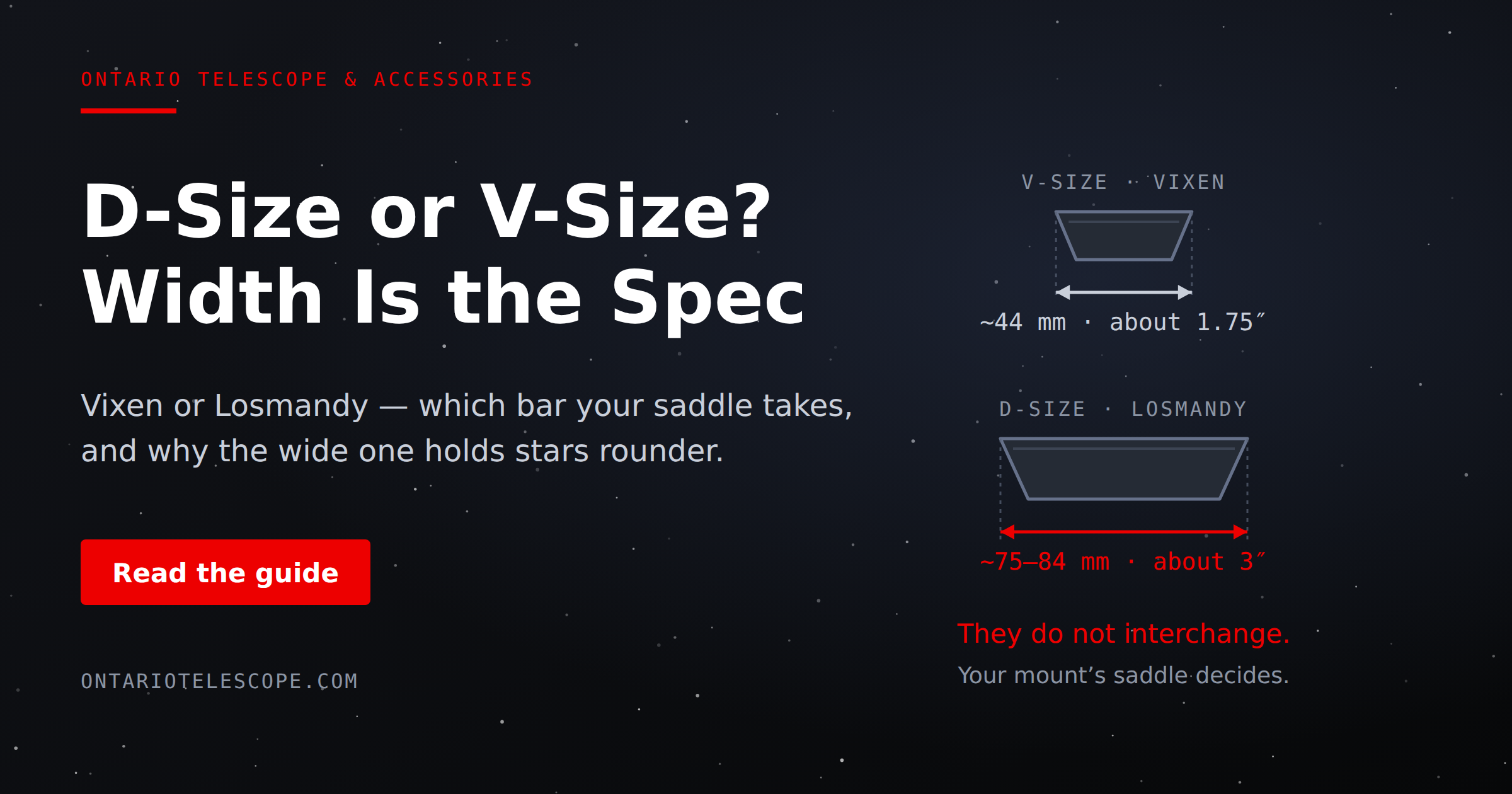
D-Size vs V-Size: A Complete Guide to Telescope Dovetail Systems
Read More
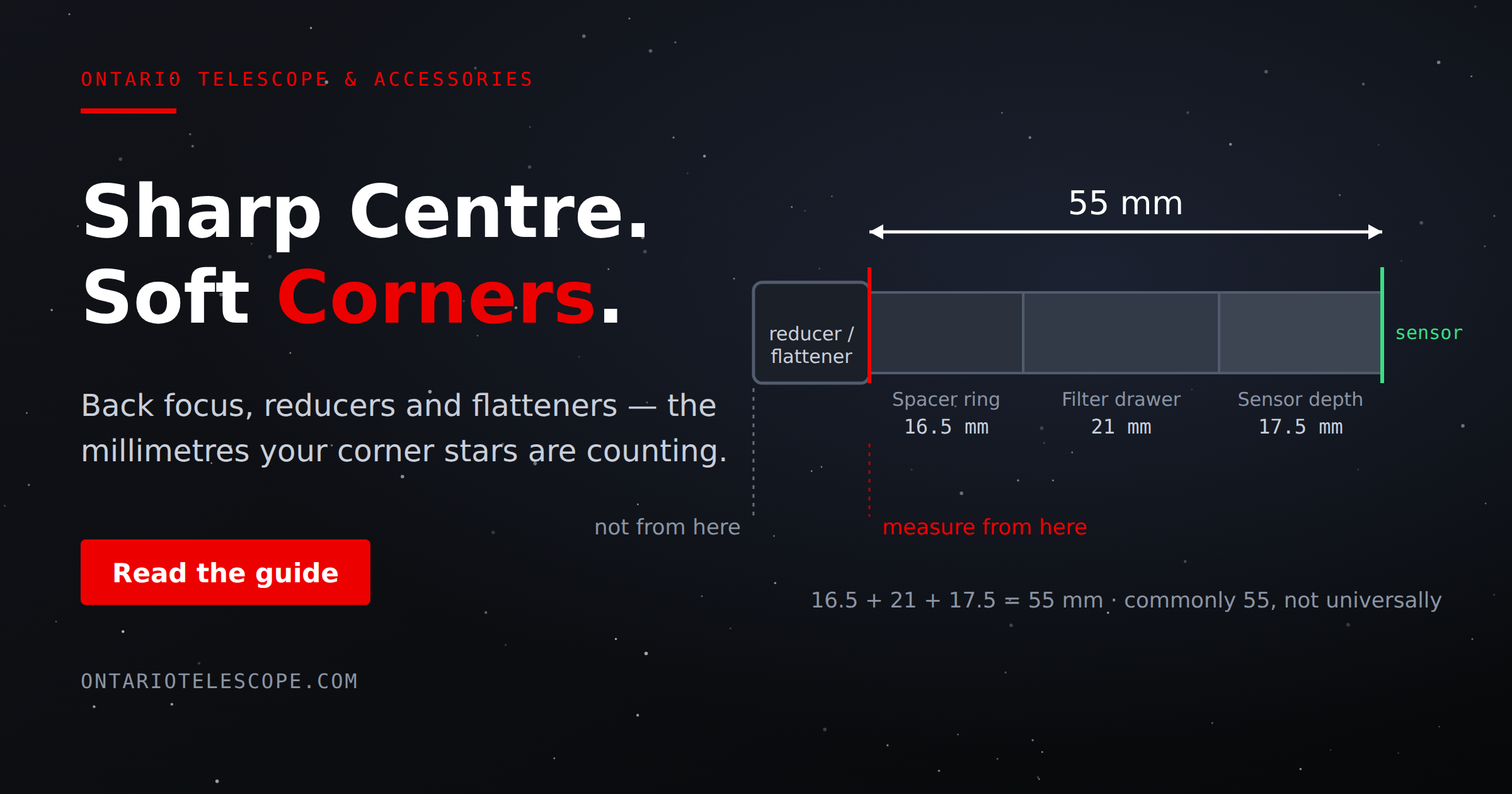
What Is Back Focus in Astrophotography? Telescope Reducers, Flatteners, and Spacing Explained
Read More