


- Description
- Specifications
Product Overview
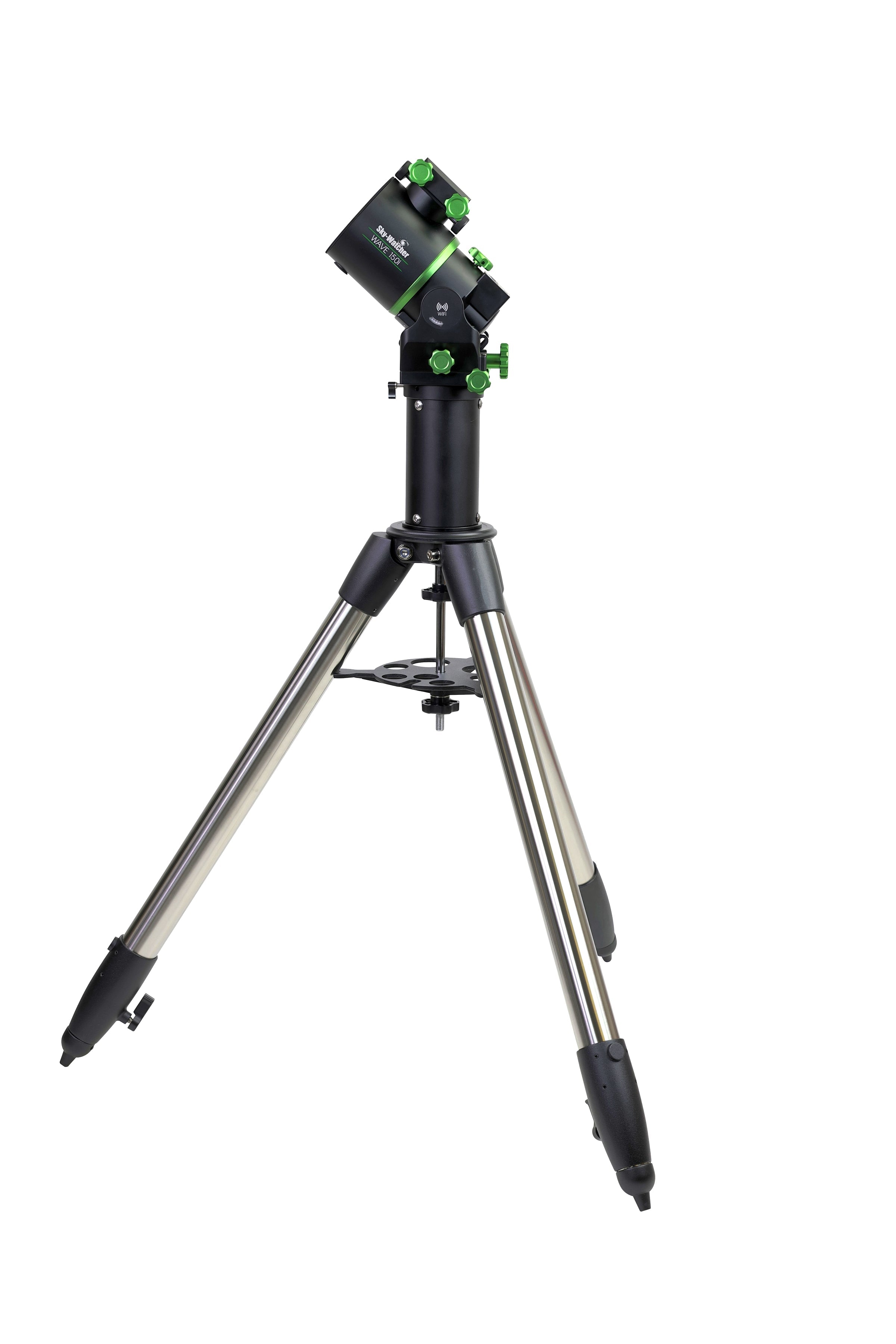
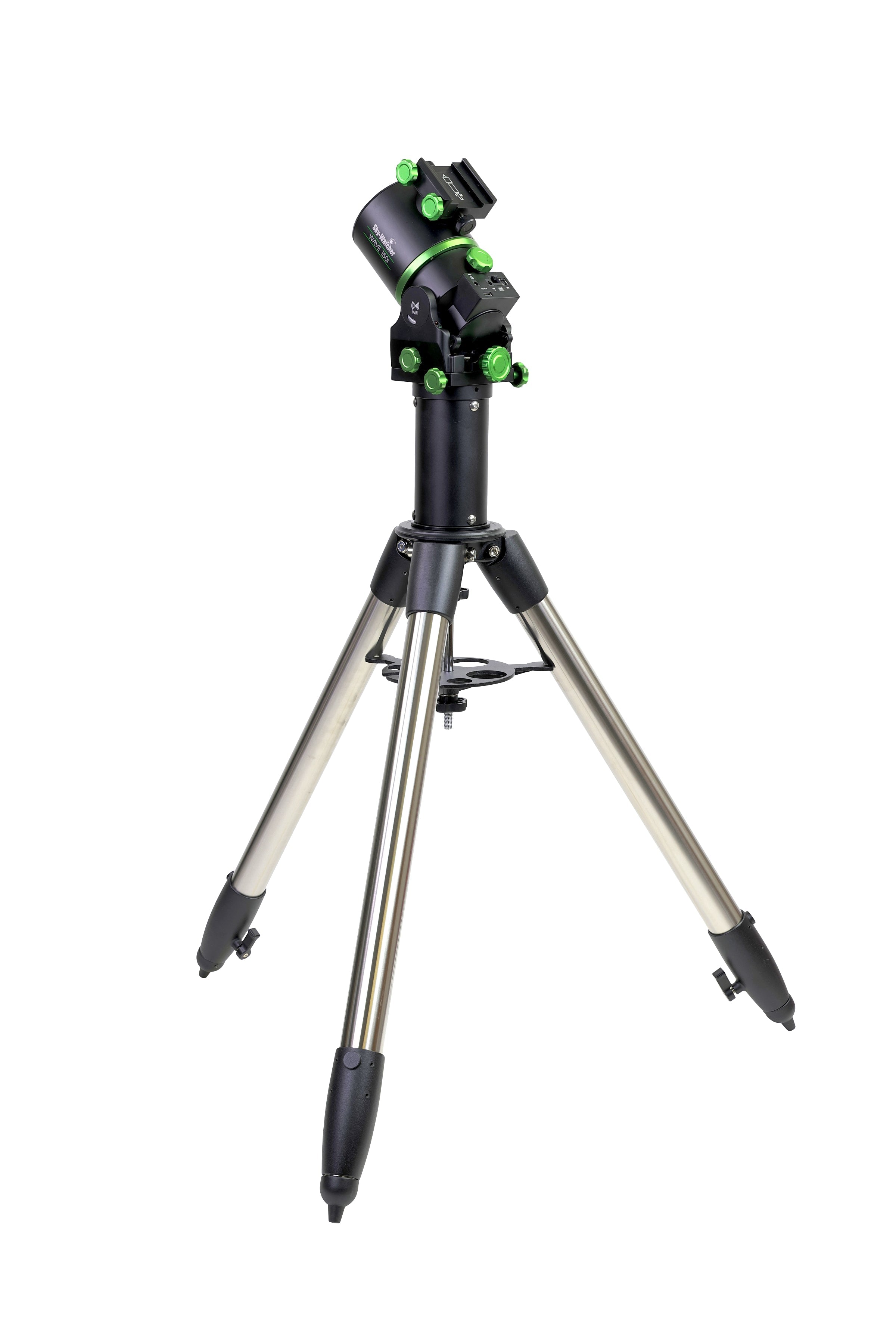
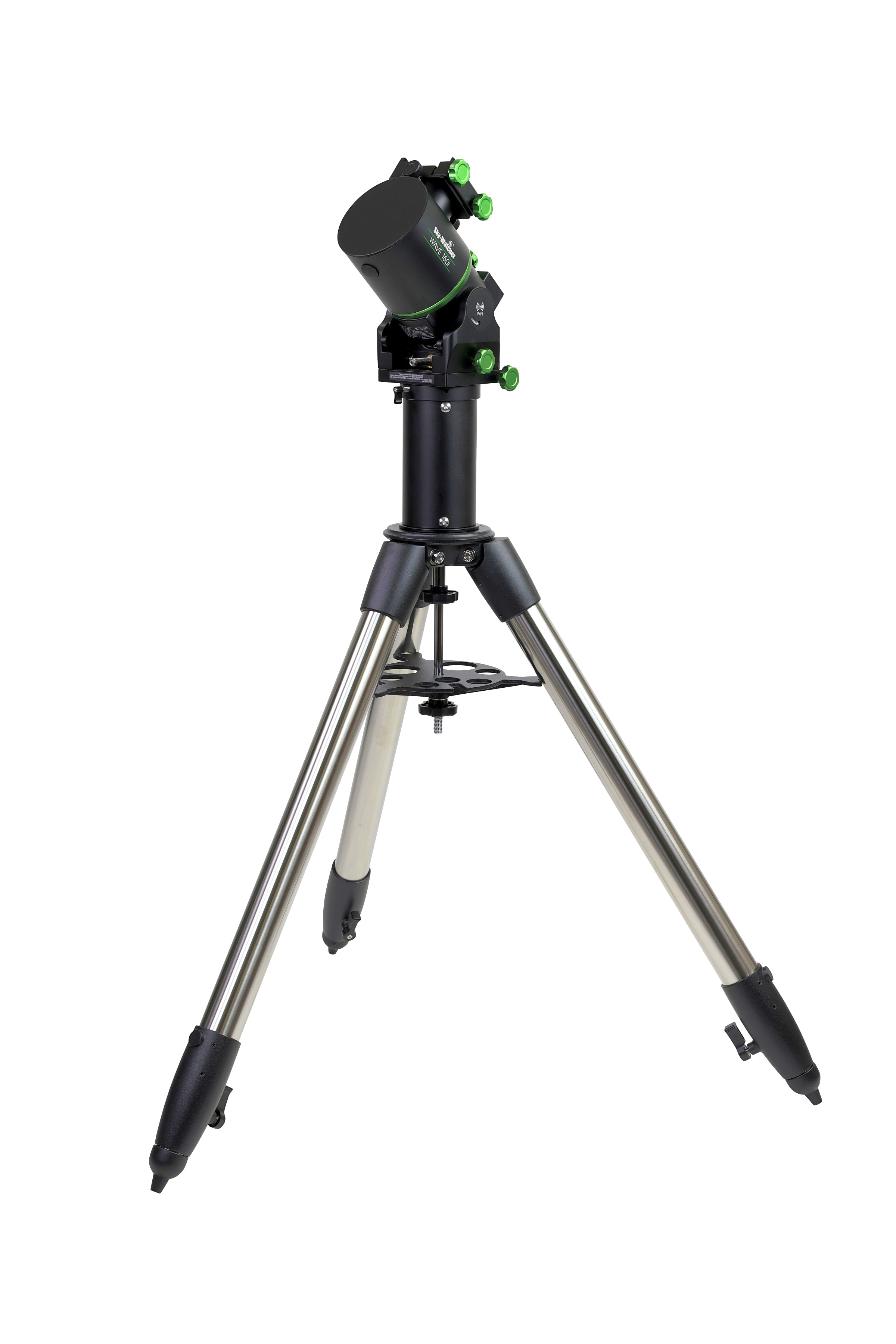
This is the steel tripod configuration of the Wave 150i Pro kit: the Wave 150i GoTo strain wave head paired with a 2-inch steel leg heavy-duty EQ6 tripod and the extension tube that adapts the Wave head to it. The complete kit ships at 34.0 lb, of which the mount head accounts for 12.8 lb (5.8 kg), and it carries 33 pounds (15 kg) of payload with no counterweight fitted anywhere in the system.
Strain wave gearing is what removes the counterweights. High torque from a compact drive means the load sits entirely on one side of the axis, so the mass a conventional German equatorial spends on weights and a heavy head goes into the tripod instead — where it does something useful. The optical tube is not included.
Who It's For
This is a good match if the mount lives in one place — a backyard pad, an observatory floor, a permanent pier position — and you would rather put the extra mass under the mount than carry it. The 2-inch steel legs of the EQ6 tripod are the heaviest and most rigid support Sky-Watcher offers for the Wave 150i, and rigidity under the mount is what settles vibration between exposures.
It also suits imagers who already own EQ6-class equipment and know that tripod. If you are running long focal lengths, a large astrograph, or working in wind, the steel legs are the reason to choose this kit over the carbon fiber one. The 33 lb payload covers glass-heavy triplets and large imaging tubes, and the optional stainless-steel counterweight kit lifts that to 55 lb (25 kg).
Key Features & Design
- Strain wave drive technology: high torque from a compact gearbox, delivering smooth precise tracking without bulky counterweights, and the reason a 12.8 lb head handles 33 lb of payload.
- 33-pound (15 kg) payload capacity: with no counterweight fitted. The optional stainless-steel counterweight kit takes it to 55 pounds (25 kg).
- 2-inch steel leg heavy-duty EQ6 tripod: the rigid support option for this kit, with the extension tube for the EQ6 tripod included to raise the head.
- Built-in cable management: through-mount cabling with a powered hub built into the saddle carrying an autoguiding port, a Dec USB port and two Dec outputs. The RA hub sits at the back of the mount and never moves, so cables do not track with the tube and do not snag.
- OTA balancing on both axes: the Wave 150i balances on RA and Dec, which is unusual among strain wave mounts and directly affects how the drive behaves under an off-centre imaging train.
- Fast slewing at 7.5 degrees per second: quick enough for satellite and space station work using the downloadable Satellite Tracker application for Windows PC on Sky-Watcher's International Support site.
- EQ and AZ modes with RA and Dec home positions: equatorial for imaging, altazimuth for visual, with repeatable home positions in both.
- Single D/V hybrid saddle: accepts both Vixen and Losmandy dovetails without changing hardware.
- 0° to 90° latitude range: usable from the equator to the pole, with a red LED backlit latitude scale and bubble level for setup after dark.
- Wi-Fi and Bluetooth: wireless control from a phone or tablet through the SynScan app, alongside the SynScan hand controller.
- RA power-off braking: the RA axis brakes when power is removed rather than swinging free.
- ASIAir compatible with the USB-B cable included: the cable that connects the mount to an ASIAir ships in the box.
Optical / Mechanical Design
A conventional German equatorial balances the telescope against counterweights on the far side of the RA axis, and those weights frequently approach the mass of the optical tube itself. Strain wave gearing makes that unnecessary. The reduction ratio and holding torque let the Wave 150i carry 33 lb entirely on one side of the axis, which is why a 12.8 lb head replaces a mount assembly several times its weight.
The 150i is the larger of the two Wave heads and carries the features that matter across a long imaging night. OTA balancing on both RA and Dec is present here and absent on the smaller head — balancing an off-centre train reduces the static load the drive holds, which changes how the mount behaves between slews. The cable architecture follows the same reasoning: the powered saddle hub terminates the guide camera, Dec cabling and USB feed at the moving end of the mount, while the fixed RA hub at the rear keeps the supply side clear of anything that rotates.
Under all of that sits the mechanical choice that defines this kit. The 2-inch steel leg heavy-duty EQ6 tripod is a mass-and-stiffness solution: steel legs of that diameter damp vibration faster than lighter materials and resist flexure under a long tube swinging near the meridian. The extension tube for the EQ6 tripod raises the head so that a long optical tube clears the legs through a full meridian pass. The trade is weight — 34.0 lb for the complete kit against 22.8 lb for the carbon fiber configuration — and that trade is the whole difference between the two versions.
Recommended Uses
- Fixed-site and backyard deep-sky imaging: steel legs and an extension tube give a settled platform for long unattended runs.
- Long-focal-length astrophotography: where vibration damping and tripod rigidity show up directly in the guiding trace.
- Heavy refractors and astrographs: a 33 lb payload without counterweights covers glass-heavy triplets and large imaging tubes.
- Automated and remote-controlled sessions: ASIAir, Eagle and StellarMate control gives plate solving and unattended imaging runs.
- Satellite and ISS tracking: 7.5 degrees per second with the Windows Satellite Tracker application.
- Altazimuth visual observing: AZ mode with a home position makes the same mount a straightforward visual platform.
Compatibility and Accessory Notes
The single D/V hybrid saddle takes Vixen and Losmandy dovetails as supplied, which covers essentially every optical tube shipped with a rail by Sky-Watcher, Celestron, William Optics and Takahashi.
Control has three routes: the SynScan hand controller, the SynScan app over Wi-Fi or Bluetooth, or a third-party platform such as ASIAir, Eagle or StellarMate. The ASIAir connection uses the USB-B cable supplied with the kit. Sky-Watcher publishes Wave firmware updates on their firmware and software page.
Power is 12V 2A and is not included. A regulated 12V supply or a lithium power pack of that rating runs the mount.
The stainless-steel counterweight kit, the pier adapter, and the carbon fiber tripod configuration are separate options in the Wave range. If you are choosing between this steel kit and the carbon fiber version, or working out whether your tube needs the counterweight kit to sit inside the rating, send us the optical tube, camera and accessories you plan to run and we will work through the loaded weight and the tripod choice with you.
Good to Know Before You Order
- This is the steel tripod configuration. The kit includes a 2-inch steel leg heavy-duty EQ6 tripod and an extension tube for the EQ6 tripod. The carbon fiber version is a separate SKU with its own weight and price.
- The complete kit ships at 34.0 lb. That is 11.2 lb more than the carbon fiber configuration, and the difference is entirely in the tripod and extension.
- The optical tube is not included. The kit supplies the mount head, tripod and extension tube only.
- 12V 2A power is not included. The mount needs a supply of that rating to run.
- 33 lb is the payload without a counterweight. Reaching 55 lb (25 kg) requires the optional stainless-steel counterweight kit, sold separately.
- 12.8 lb is the mount head alone. The 34.0 lb figure is the complete kit as it ships, tripod and extension tube included.
- The Satellite Tracker application is Windows PC only. It is downloaded from Sky-Watcher's International Support website.
Frequently Asked Questions
Is it difficult to set up?
The kit goes together in three pieces: tripod, extension tube, mount head. There are no counterweights to thread onto a shaft and no shaft to fit. The red LED latitude scale and bubble level are readable in the dark, and the 0° to 90° latitude range means the head is set once for your site. From there the SynScan app or an ASIAir handles the alignment. The steel tripod is the heaviest single component, which is why this configuration tends to be assembled once and left standing.
How is this different from the carbon fiber kit?
The tripod and extension. This kit ships with a 2-inch steel leg heavy-duty EQ6 tripod and an extension tube for the EQ6 tripod, and weighs 34.0 lb complete. The carbon fiber kit ships with a carbon fiber tripod and carbon fiber extension tube and weighs 22.8 lb complete. The Wave 150i mount head, its payload rating and every electronic feature are identical in both.
Does it need counterweights?
Not for the 33 lb (15 kg) rating — that figure is published with no counterweight fitted. The optional stainless-steel counterweight kit exists to extend the rating to 55 lb (25 kg).
Will it work with an ASIAir?
Yes, and the USB-B cable for that connection is included. Eagle and StellarMate are also supported, as are the SynScan hand controller and the SynScan app.
What dovetails does the saddle accept?
The single D/V hybrid saddle takes both Vixen and Losmandy dovetails.
Can it track satellites?
The slew rate is 7.5 degrees per second, and Sky-Watcher publishes a Satellite Tracker application for Windows PC on their International Support website for exactly that.
Bottom Line
The Wave 150i on the most rigid support Sky-Watcher offers for it: 2-inch steel legs, an EQ6 extension tube, and a 33 lb payload carried with no counterweights at all. This is the configuration for a mount that stays put and images all night.
| SKU | S40016 |
|---|---|
| UPC | 810098971003 |
| Mount type | Wave 150i GoTo strainwave head |
| Drive type | Strain wave (harmonic) drive |
| Tracking modes | EQ and AZ modes, with RA and DEC home position functions |
| Payload capacity | 33-pound (15 kg) without optional counterweight; 55-pound (25 kg) with optional counterweight |
| Mount head weight | 12.8 pounds (5.8 kg) |
| Saddle | Single D/V hybrid saddle |
| Latitude range | 0° to 90° |
| Latitude display | Red LED for latitude scale and bubble level |
| Slew rate | 7.5 degrees per second |
| Connectivity | Wi-Fi and Bluetooth |
| Control method | SynScan hand controller or SynScan app; third-party platforms including ASIAir, Eagle and StellarMate |
| Cable management | Through-mount cabling; powered hub in the saddle with autoguiding port, Dec USB and 2 Dec outputs; fixed RA hub at the rear |
| Braking | RA power-off braking function |
| Power requirement | 12V 2A power (not included) |
| Tripod included | 2-inch steel leg heavy-duty EQ6 tripod |
| Pier extension included | Extension tube for EQ6 tripod |
| Cable included | USB-B cable for ASI Air |
| Not included | Optical tube; 12V 2A power supply; counterweight kit |
| Weight | 34.0 lb (15422 g) complete kit as shipped |
You may also like
Recently viewed
Recent Blog Posts
View all
Your Guide Graph Is Lying to You
Read More

D-Size vs V-Size: A Complete Guide to Telescope Dovetail Systems
Read More

What Is Back Focus in Astrophotography? Telescope Reducers, Flatteners, and Spacing Explained
Read More