



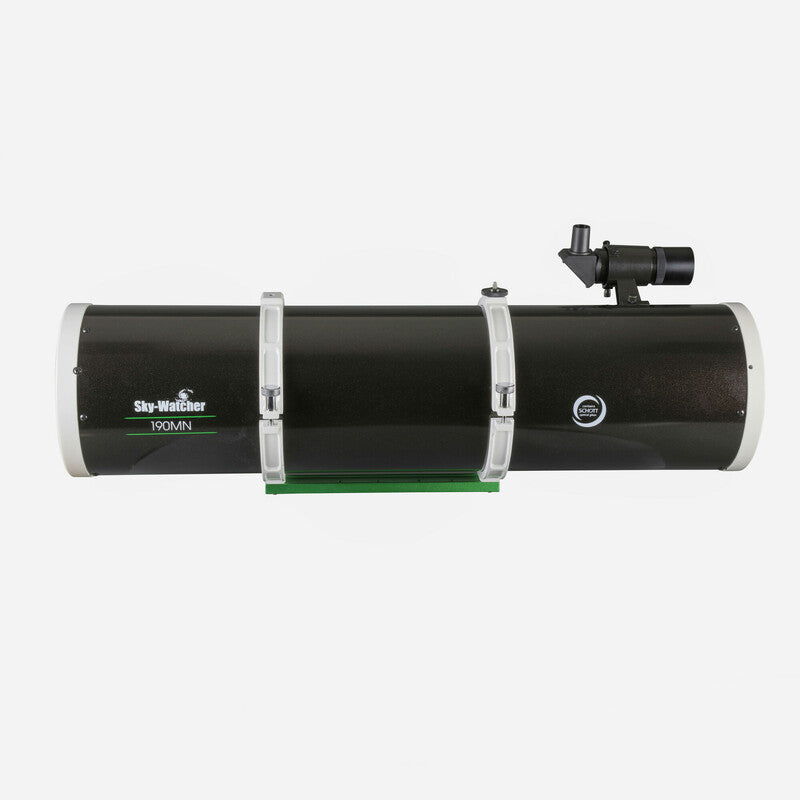


- Description
- Specifications
Product Overview
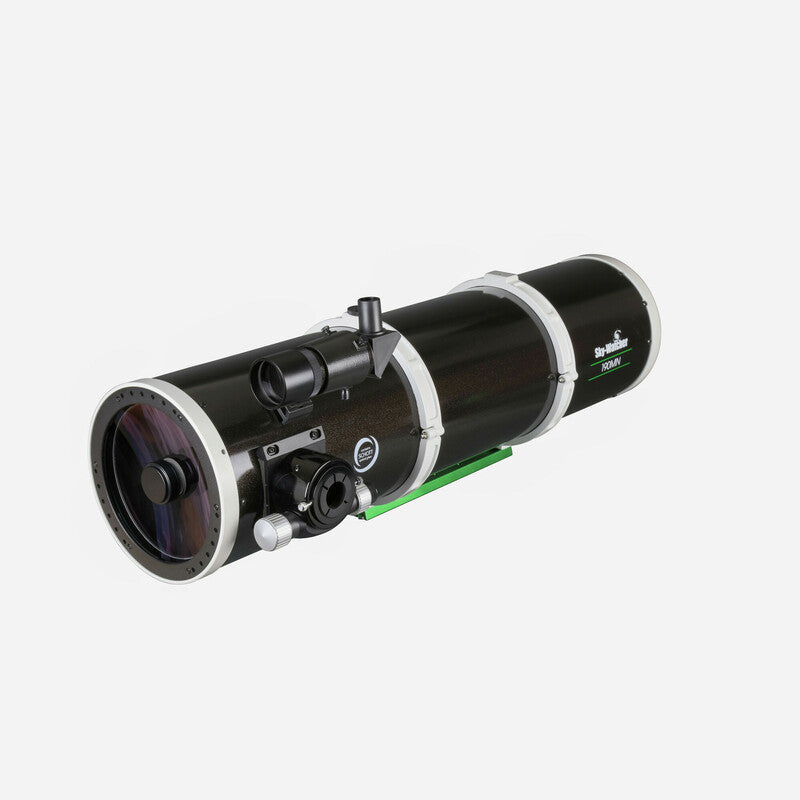
The Starlux 190MN is Sky-Watcher's 190 mm Maksutov-Newtonian optical tube, working at 1000 mm of focal length and f/5.3. It combines a Newtonian reflector's speed with a full-aperture Maksutov meniscus corrector at the front of the tube, and the result is a flat, coma-free field across an APS-C sensor without a separate coma corrector or field flattener. Sky-Watcher describes it as their large-aperture astrograph, and it is equally at home at the eyepiece.
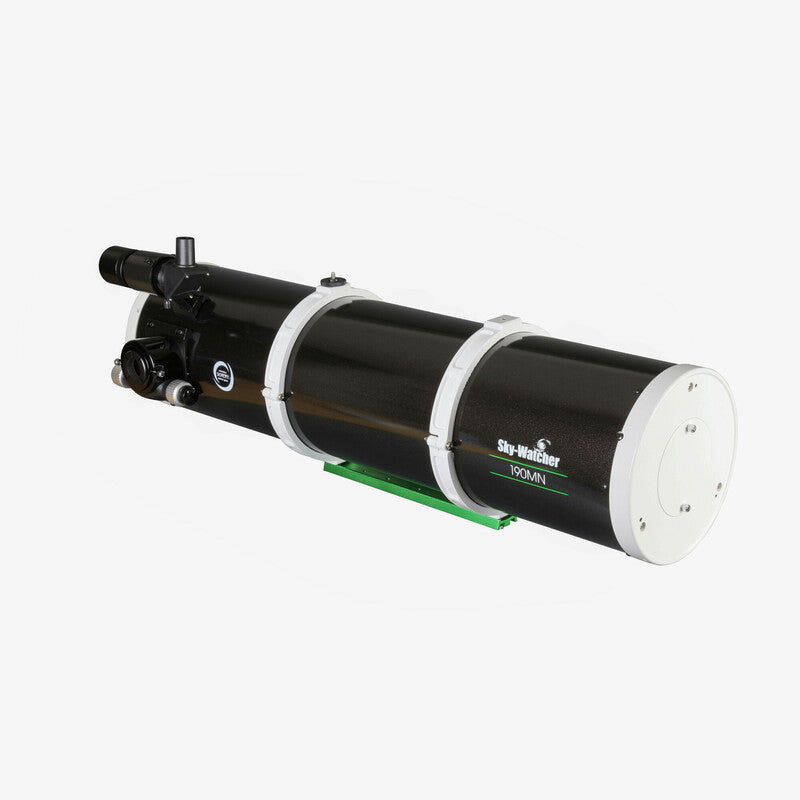
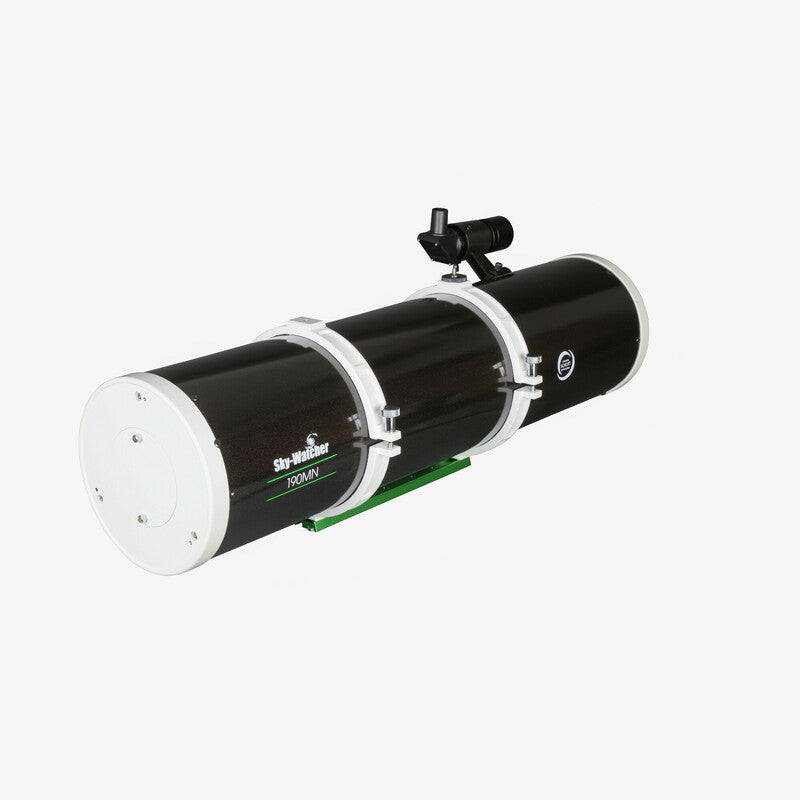
This listing is the optical tube assembly. It ships with mounting rings on a V-style dovetail plate, a 2-inch dual-speed Crayford-style focuser with a 1.25-inch adapter, an 8x50 right-angle finderscope and a 2-inch T-ring adapter. The tube measures 952 mm long and 241 mm across (37.5 by 9.5 inches) and Sky-Watcher publishes its weight as 29 lb (about 13.2 kg). The mount, eyepieces and camera are chosen separately.
Who It's For
This is a good match if you image deep-sky objects with an APS-C camera and want 190 mm of aperture at f/5.3 without building a corrector into your imaging train. At 1000 mm the field frames mid-sized galaxies, globular clusters and planetary nebulae at a useful scale, and the fast focal ratio keeps sub-exposure times practical.
It also suits visual observers who want a sharp, high-contrast 190 mm reflector with a wide, well-corrected field. The flat field that makes it an astrograph also keeps stars tight to the edge of a wide-field 2-inch eyepiece.
If you are stepping up from a small refractor or a first imaging Newtonian, the Starlux is a natural next instrument: no corrector spacing to work out, a closed front end, and a focuser built for a camera. Its size and weight make it a permanent-pier or substantial-equatorial-mount telescope rather than a travel scope.
Key Features & Design
- 190 mm Maksutov-Newtonian at 1000 mm, f/5.3: a fast reflector with a meniscus corrector, giving a flat, coma-free field with no coma corrector or field flattener.
- Corrected for APS-C imaging sensors: Sky-Watcher's stated coverage for pinpoint stars across the frame.
- Borosilicate mirrors with Radiant Aluminum Quartz (RAQ) coatings: Sky-Watcher publishes 94% reflectivity for the primary and secondary coatings, and describes the mirrors as fully multi-coated.
- Meniscus corrector with Metallic High-Transmission Coatings (MHTC): seals the front of the tube and, per Sky-Watcher, virtually eliminates chromatic aberration.
- 2-inch dual-speed Crayford-style focuser: 10:1 fine focus for critical imaging focus, with a 1.25-inch adapter for smaller eyepieces and accessories.
- Knife-edge baffles: internal baffling to reduce glare and stray light.
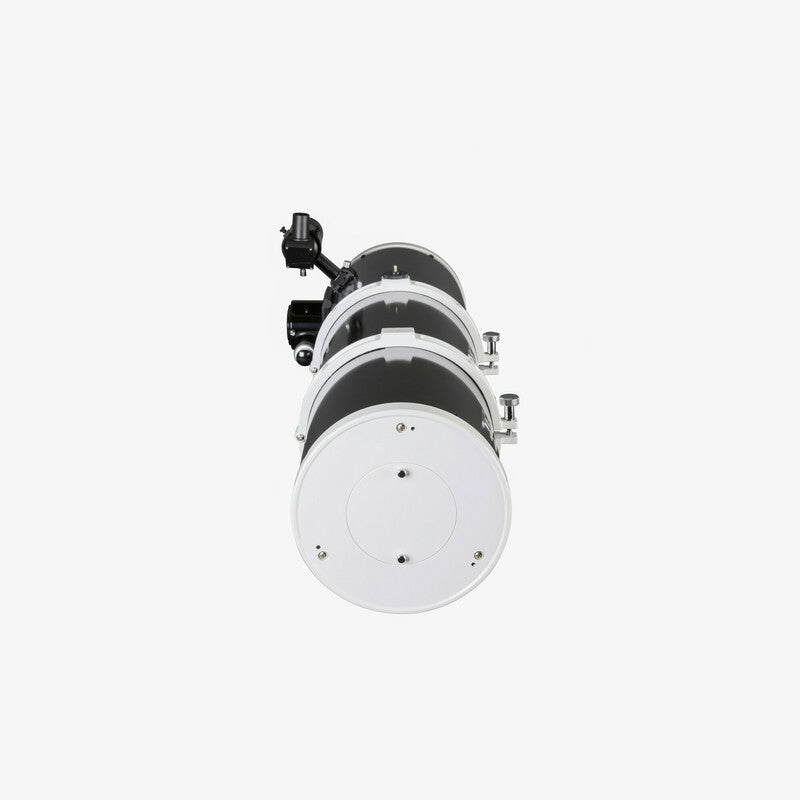
- Front and rear cooling vents: help the optics reach ambient temperature faster after setup.
- Mounting rings on a V-style dovetail plate: fits Vixen-format saddles directly.
- Included accessories: 8x50 right-angle correct-image finderscope and a 2-inch T-ring adapter.
- Aluminium tube in Sky-Watcher's glossy black diamond metal-flake finish.
Optical / Mechanical Design
A Maksutov-Newtonian places a thin, full-aperture meniscus lens at the front of an otherwise Newtonian tube. Light passes through the meniscus to a spherical primary mirror at the back, reflects forward to a flat diagonal secondary, and exits through the side of the tube to the focuser - the familiar Newtonian layout. The difference is the corrector. A spherical mirror on its own at f/5.3 would show spherical aberration, and a parabolic mirror at that speed shows coma off-axis. The meniscus corrects the spherical primary instead, which is how Sky-Watcher eliminates coma and delivers a flat field without a separate corrector lens near the focal plane.
All of the focusing power comes from the two mirrors, which bring every colour to the same focus, and the meniscus itself is a weak correcting element rather than a focusing objective. Sky-Watcher states the MHTC-coated corrector virtually eliminates chromatic aberration, so there is no need for the exotic glass a refractor of similar aperture would require. Sky-Watcher compares the result to a similarly sized Schmidt-Newtonian and states that the Mak-Newtonian yields a sharper image with more contrast.
Mechanically, the meniscus closes the front of the tube, which keeps dust off the mirrors and reduces air currents running up the tube. A closed tube with a glass corrector takes longer to reach ambient temperature than an open truss, which is why Sky-Watcher fits cooling vents at both ends. Knife-edge baffles along the tube control stray light, which matters on long imaging sub-exposures under suburban skies.
Recommended Uses
- Deep-sky imaging with an APS-C camera: galaxies, globular clusters, planetary nebulae and smaller emission nebulae at 1000 mm and f/5.3.
- One-shot-colour and monochrome astrophotography: the corrected field needs no flattener or coma corrector, so there is no corrector-to-sensor spacing to set when you add a filter wheel or off-axis guider.
- Wide-field visual observing: 190 mm of aperture with a flat, coma-free field through 2-inch eyepieces.
- Lunar and planetary observing and imaging: with a Barlow, the high-contrast optics give a useful image scale on the Moon and bright planets.
- Observatory and pier-mounted imaging: a 952 mm tube at 13.2 kg suits a permanent setup on a substantial equatorial mount.
Compatibility and Accessory Notes
The tube rides in mounting rings on a V-style (Vixen-format) dovetail plate. That fits the saddle on Sky-Watcher's EQ6-R and most equatorial mounts in its class. With the tube at 29 lb (13.2 kg) before a camera, filter wheel and guide scope are added, a mount with real payload headroom is the right pairing for imaging; send us your planned setup and we will match a mount to it.
The 2-inch dual-speed Crayford-style focuser accepts 2-inch eyepieces and accessories directly, and the supplied 1.25-inch adapter takes standard 1.25-inch eyepieces, filters and planetary cameras. As a Newtonian-format telescope, no star diagonal is needed - the eyepiece sits at the side of the tube.
For DSLR or mirrorless imaging, the included 2-inch T-ring adapter slides into the focuser and connects to a camera-body T-ring, which is matched to your camera brand and sold separately. Dedicated astronomy cameras connect through their own 2-inch nosepiece or T-thread adapters. Sky-Watcher does not publish a backfocus figure or image-circle diameter for the Starlux 190MN; send us your camera, filter and guider setup and we will work out the connection with you.
Good to Know Before You Order
- This is the optical tube assembly. Rings, dovetail, focuser with 1.25-inch adapter, 8x50 right-angle finderscope and 2-inch T-ring adapter are included. No mount, tripod, eyepieces or camera T-ring are included.
- Correction is specified for APS-C. Sky-Watcher states the field is corrected for APS-C imaging sensors and does not publish coverage for full-frame sensors.
- Sky-Watcher publishes tube weight as 29 lb (13.2 kg) and tube dimensions of 37.5 by 9.5 inches (952 by 241 mm). That puts it in the class of a substantial equatorial mount once an imaging train is attached.
- A closed tube needs cooldown time. The meniscus corrector and closed tube settle to ambient temperature more slowly than an open Newtonian; the front and rear cooling vents shorten that wait.
Frequently Asked Questions
Is it difficult to set up?
Mechanically it is straightforward: the rings and dovetail drop into your mount's saddle, the finder slides into its bracket, and a camera connects through the included 2-inch T-ring adapter with no corrector spacing to set. The parts that take a little care are balancing a 13.2 kg tube with its camera on the mount and, as with any Newtonian-format reflector, checking mirror alignment from time to time - Sky-Watcher's Newtonian collimation guide covers the procedure, and we are happy to walk you through it.
Do I need a coma corrector or field flattener?
No. The Maksutov meniscus corrects the spherical primary mirror, and Sky-Watcher states the field is flat and coma-free across APS-C sensors with no additional corrective optics.
Is it for imaging or visual?
Both. Sky-Watcher positions it primarily as an astrograph, and the same flat, high-contrast field works well at the eyepiece with 2-inch or 1.25-inch eyepieces.
What mount does it need?
A Vixen-format saddle on an equatorial mount with comfortable capacity for a 29 lb (13.2 kg) tube plus camera, filter wheel and guiding gear. Tell us what you plan to attach and we will recommend a mount.
How does it compare with a Schmidt-Newtonian or a refractor of similar size?
Sky-Watcher states the Mak-Newtonian gives a sharper image with more contrast than a similarly sized Schmidt-Newtonian. Compared with an apochromatic refractor, it reaches 190 mm of aperture at f/5.3 with no colour error, without the cost and weight of a large exotic-glass objective.
Will it cover a full-frame sensor?
Sky-Watcher specifies correction for APS-C sensors and does not publish full-frame coverage. If you are planning a larger sensor, get in touch and we will discuss the options with you.
Bottom Line
A 190 mm f/5.3 Maksutov-Newtonian optical tube with a flat, coma-free APS-C field built into the optics, supplied with rings and V-style dovetail, a 2-inch dual-speed Crayford-style focuser, an 8x50 right-angle finder and a 2-inch T-ring adapter. Pair it with a solid equatorial mount and a camera T-ring, and it is ready for deep-sky imaging and wide-field visual work alike.
| SKU | S11550 |
|---|---|
| UPC | 050234115506 |
| Optical design | Maksutov-Newtonian |
| Aperture | 190 mm (working aperture) |
| Focal length | 1000mm |
| F-ratio | 5.3 |
| Field correction | Corrected for APS-C imaging sensors; no coma corrector or field flattener needed |
| Mirror substrate | Borosilicate, fully multi-coated |
| Mirror coatings | Radiant Aluminum Quartz (RAQ) coatings on primary and secondary, 94% reflectivity |
| Corrector plate coatings | Metallic High-Transmission Coatings (MHTC) |
| Baffling | Knife-edge baffles |
| Cooling | Cooling vents on front and rear |
| Focuser | 2-inch dual-speed (10:1) Crayford-style with 1.25-inch adapter |
| Finderscope | 8x50 right-angle correct-image finderscope |
| Mounting hardware | V-style dovetail with mounting rings |
| Tube material and finish | Aluminium, glossy black diamond metal-flake finish |
| Tube length | 37.5 inches (952.5 mm) |
| Tube outer diameter | 9.5 inches (241.3 mm) |
| Tube weight | 29 lbs (13.2 kg) |
| Included accessories | 8x50 right-angle finderscope, 2-inch T-ring adapter, mounting rings and V-style dovetail, 1.25-inch focuser adapter |
| Eyepieces | Not included |
| Mount | Not included - optical tube assembly only |
You may also like
Recently viewed
Recent Blog Posts
View all
Your Guide Graph Is Lying to You
Read More

D-Size vs V-Size: A Complete Guide to Telescope Dovetail Systems
Read More

What Is Back Focus in Astrophotography? Telescope Reducers, Flatteners, and Spacing Explained
Read More