
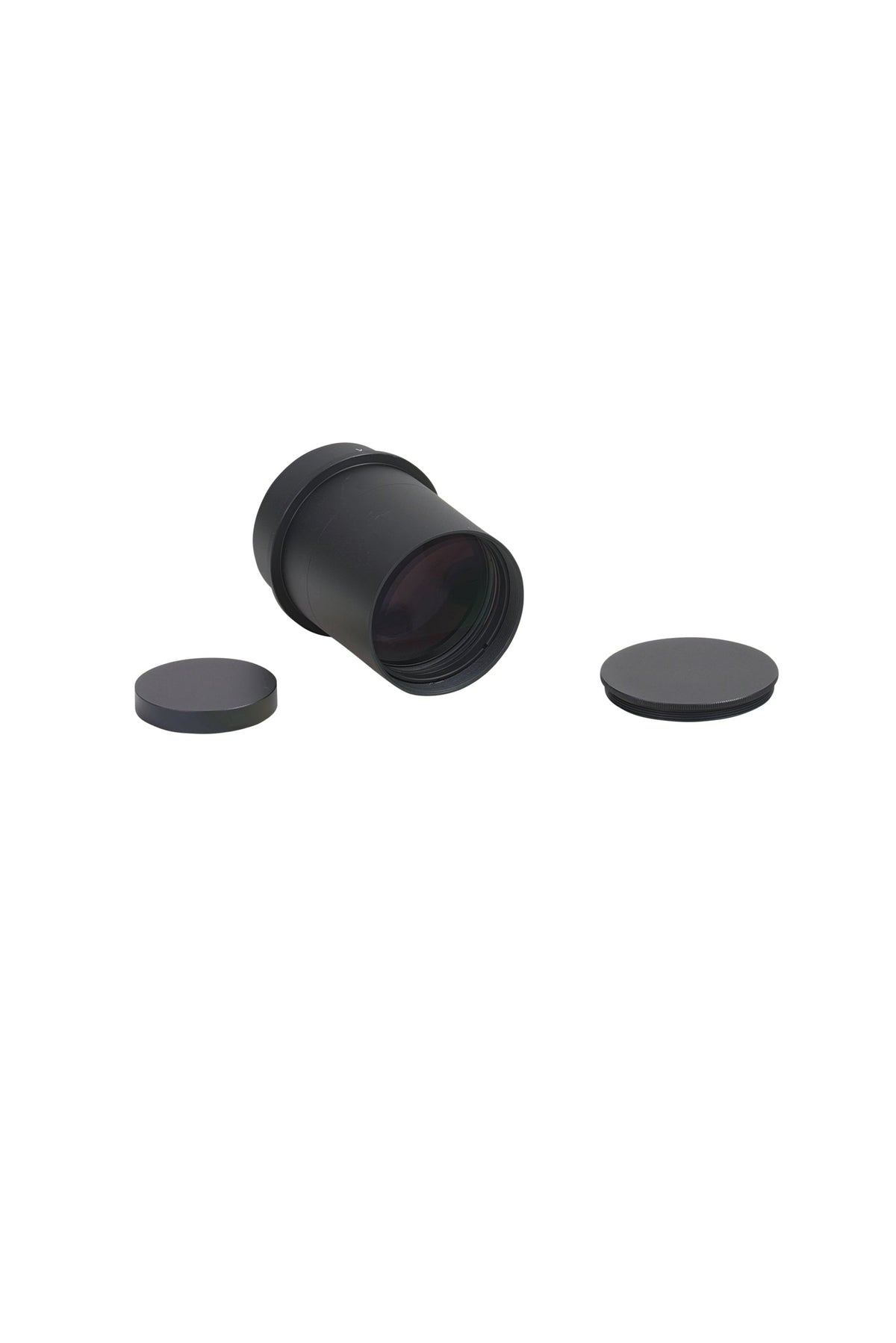
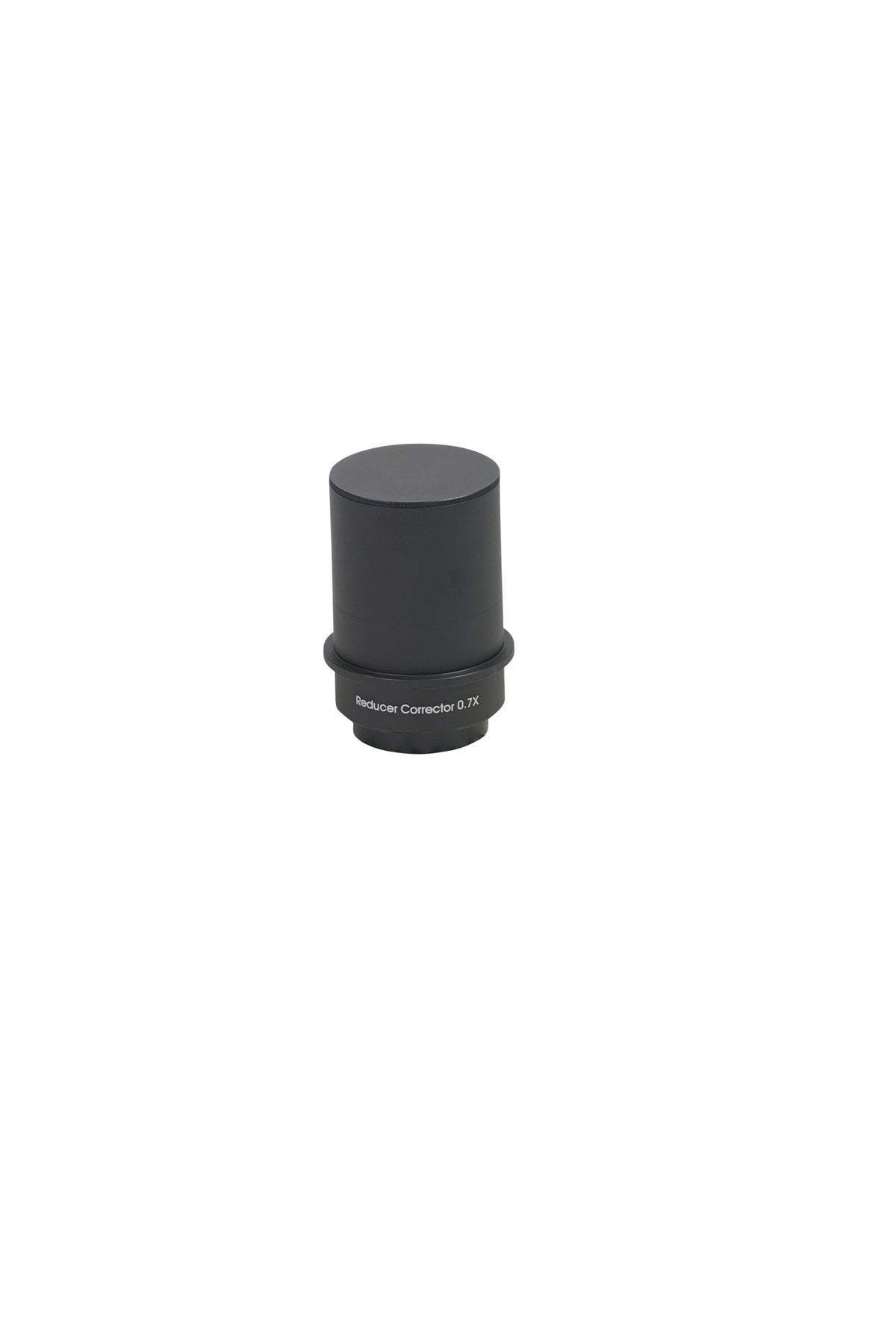


- Description
- Specifications
Product Overview
The Sky-Watcher Skymax 200DX 0.7x Reducer/Corrector is the matched focal reducer for the Skymax 200DX Maksutov-Cassegrain. It takes the telescope from its native 2000 mm at f/10 to 1400 mm at f/7, and Sky-Watcher specifies 55 mm of back focus for it.
It is an accessory for one telescope: if you own or are ordering a Skymax 200DX, this is the reducer Sky-Watcher makes for it.
Who It's For
This is a good match if you use a Skymax 200DX for imaging and want a shorter focal length and faster focal ratio than the native f/10. Going from f/10 to f/7 widens the field and makes each sub-exposure more efficient, which opens up galaxies, planetary nebulae and globular clusters that are too large or too faint to frame comfortably at 2000 mm.
It also suits you if you want one tube that covers both jobs: the 200DX at native focal length for the Moon and planets, and with the reducer fitted for smaller deep-sky targets.
Key Features & Design
- 0.7x reduction: 2000 mm becomes 1400 mm on the Skymax 200DX.
- f/10 to f/7: a faster focal ratio for deep-sky imaging with the same aperture.
- 55 mm back focus: the published distance the camera sensor sits behind the reducer.
- Matched to the Skymax 200DX: designed by Sky-Watcher specifically for this telescope.
Optical / Mechanical Design
A focal reducer shortens the effective focal length of the telescope it is fitted to. On the Skymax 200DX it converts 2000 mm at f/10 into 1400 mm at f/7. The aperture is unchanged at 200 mm, so the same light is spread over a smaller image: the field of view grows and the image on each pixel is brighter, which is what makes the reduced configuration better suited to extended deep-sky objects.
Sky-Watcher describes this unit as a reducer/corrector and specifies 55 mm of back focus. Star shape across the frame depends on placing the camera sensor at that distance, so the spacing between the reducer and the sensor is the one figure worth setting carefully. Most dedicated astronomy cameras and T-ring adapters are built around the same 55 mm convention, and we can work out the spacers for your camera with you.
Recommended Uses
- Deep-sky imaging at 1400 mm: galaxies, planetary nebulae and globular clusters with a dedicated astronomy camera or DSLR/mirrorless body.
- Faster sub-exposures: f/7 instead of f/10 for more efficient imaging of faint targets.
- Wider framing on the Skymax 200DX: fitting objects that overfill the frame at native focal length.
- Dual-purpose imaging rigs: native f/10 for the Moon and planets, reduced to f/7 for the deep sky.
Compatibility and Accessory Notes
Telescope. The reducer is designed for the Sky-Watcher Skymax 200DX. Sky-Watcher has not published compatibility with any other telescope, so this listing is for 200DX owners.
Camera spacing. Back focus is 55 mm from the reducer to the camera sensor. A dedicated astronomy camera with the appropriate adapters, or a DSLR or mirrorless camera with a T-ring, can be spaced to that figure. Send us your camera and any filter wheel or filter drawer in the train and we will work out the spacers with you.
Threads and connection. Sky-Watcher has not yet published the thread sizes on either side of the reducer. We will add them here once they are released, and we can confirm the connection for your setup before you order.
Good to Know Before You Order
- It fits the Skymax 200DX. Sky-Watcher designs it for that telescope and lists no other compatible models.
- Back focus is 55 mm. The sensor needs to sit 55 mm behind the reducer; standard camera adapters and spacers set this, and we can help you work out the stack.
- It is an imaging accessory. Sky-Watcher specifies it by camera back focus and does not describe a visual-observing configuration.
- Thread sizes, image circle and weight have not yet been published by Sky-Watcher. We will update this page when they are; ask us and we will confirm fit for your camera in the meantime.
Frequently Asked Questions
Is it difficult to set up?
No. The reducer goes at the back of the Skymax 200DX and the camera goes behind it at 55 mm of back focus. The only step that takes care is the spacing, and that is set once with standard adapters - send us your camera model and we will help you put the stack together.
What does it do to the Skymax 200DX?
It reduces the focal length from 2000 mm to 1400 mm and the focal ratio from f/10 to f/7, widening the field and speeding up exposures for deep-sky imaging.
Will it work on other Maksutovs or Schmidt-Cassegrains?
Sky-Watcher makes it for the Skymax 200DX and has not published compatibility with other telescopes.
Which cameras can I use with it?
Any camera that can be placed at 55 mm of back focus - dedicated astronomy cameras with their adapters, and DSLR or mirrorless bodies with a T-ring. Tell us what you are using and we will confirm the parts.
Can I use it for visual observing?
Sky-Watcher specifies it for a camera at 55 mm of back focus and does not describe a visual configuration. For visual use, the Skymax 200DX at its native f/10 is the intended setup.
Bottom Line
The matched 0.7x reducer/corrector for the Sky-Watcher Skymax 200DX, taking the telescope to 1400 mm at f/7 for deep-sky imaging. Set your camera at 55 mm of back focus and the 200DX becomes a dual-role instrument - native f/10 for the planets, f/7 for galaxies and nebulae.
| SKU | S20224 |
|---|---|
| UPC | 810098971010 |
| Type | 0.7x focal reducer/corrector |
| Compatible telescope | Sky-Watcher Skymax 200DX |
| Reduction factor | 0.7x |
| Resulting focal ratio | f/7 |
| Resulting focal length | 1400 mm |
| Back focus | 55 mm |
| Use | Deep-sky imaging with the Skymax 200DX |
You may also like
Recently viewed
Recent Blog Posts
View all
Your Guide Graph Is Lying to You
Read More

D-Size vs V-Size: A Complete Guide to Telescope Dovetail Systems
Read More

What Is Back Focus in Astrophotography? Telescope Reducers, Flatteners, and Spacing Explained
Read More