
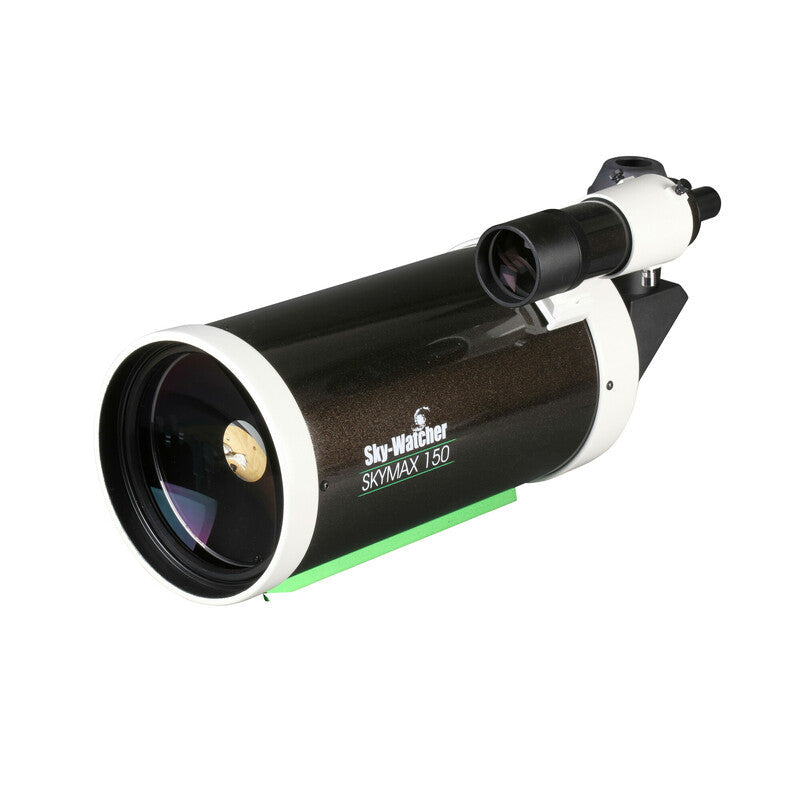
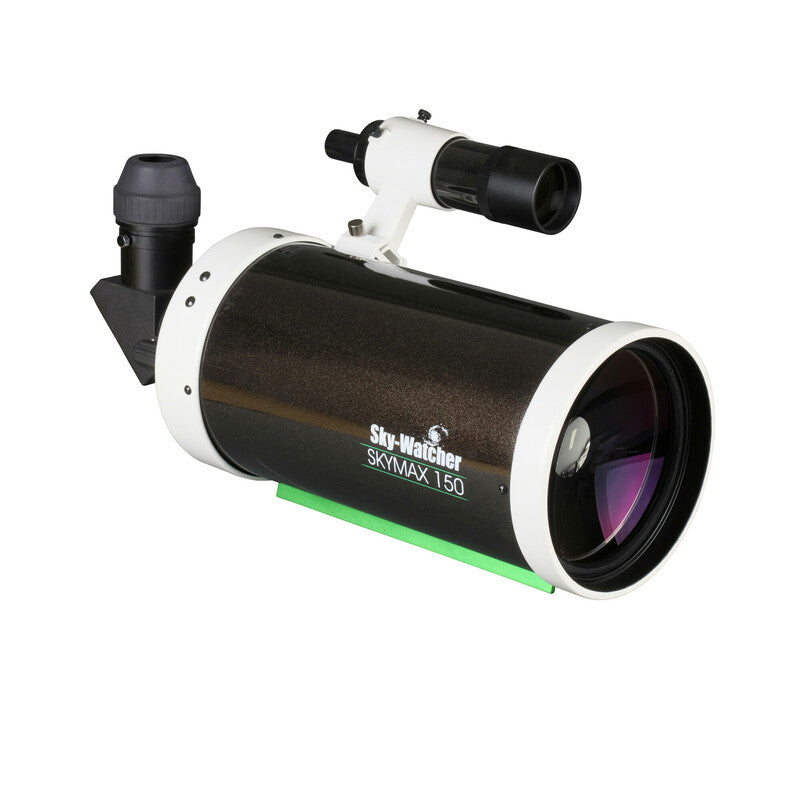
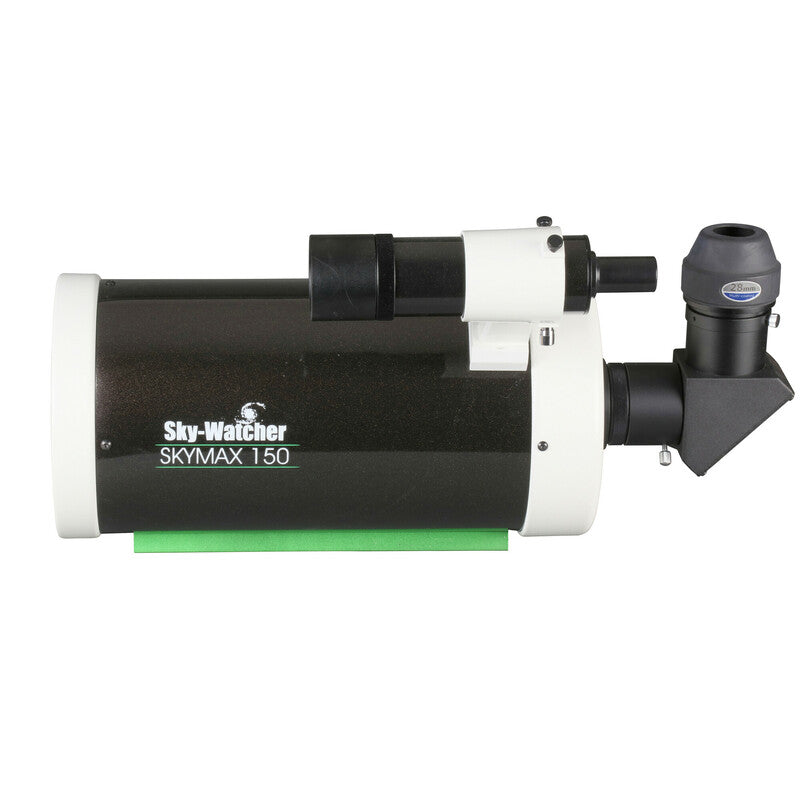
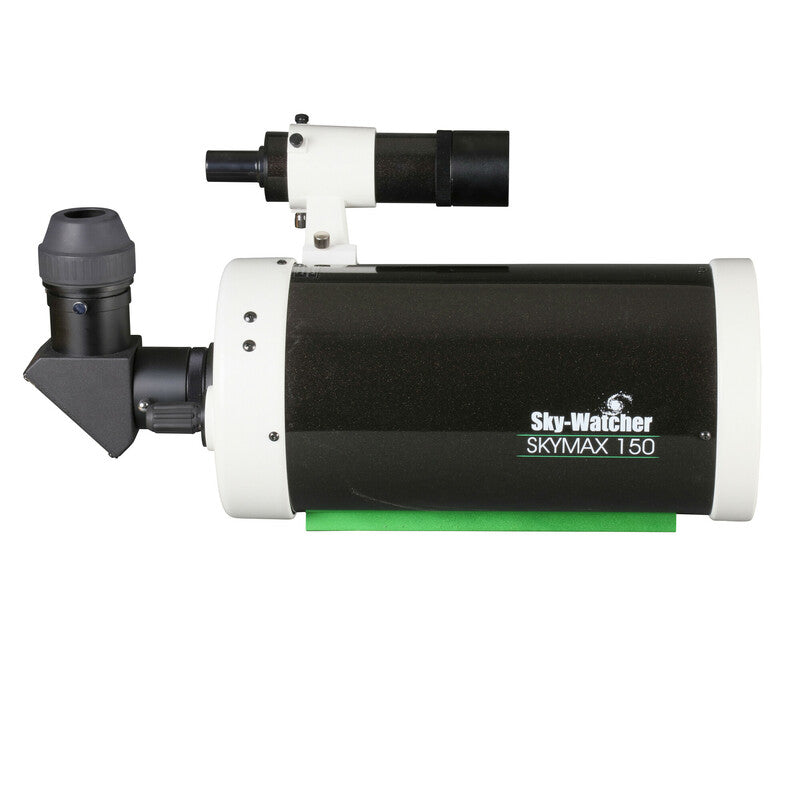


- Description
- Specifications
Product Overview
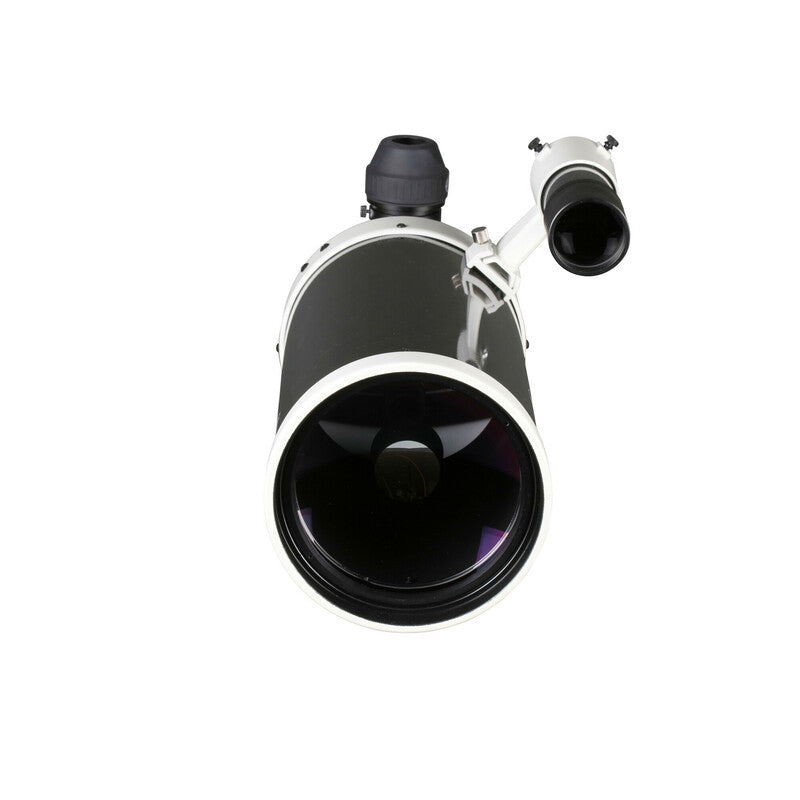
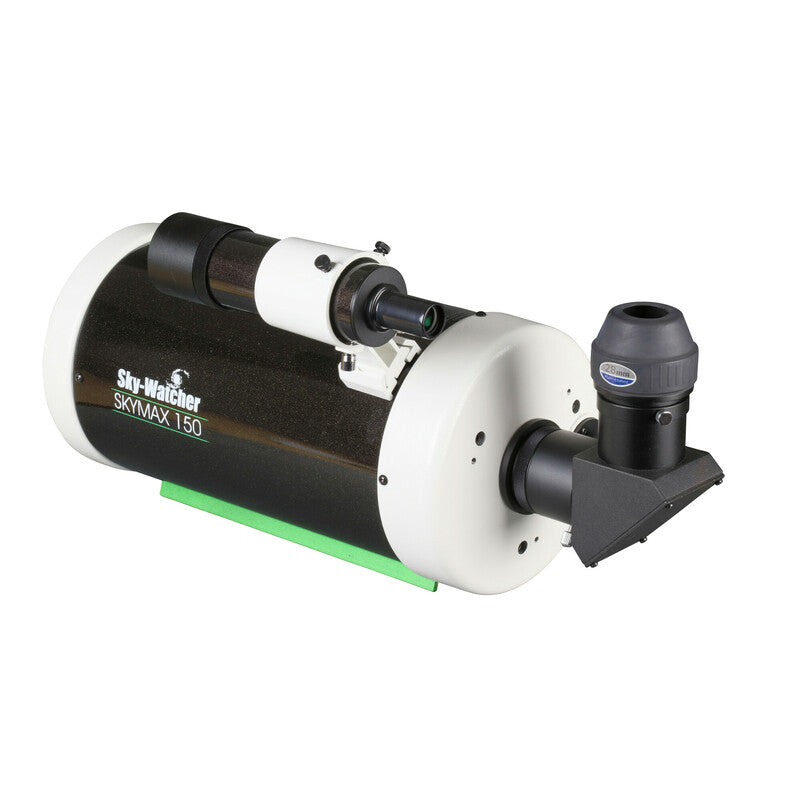
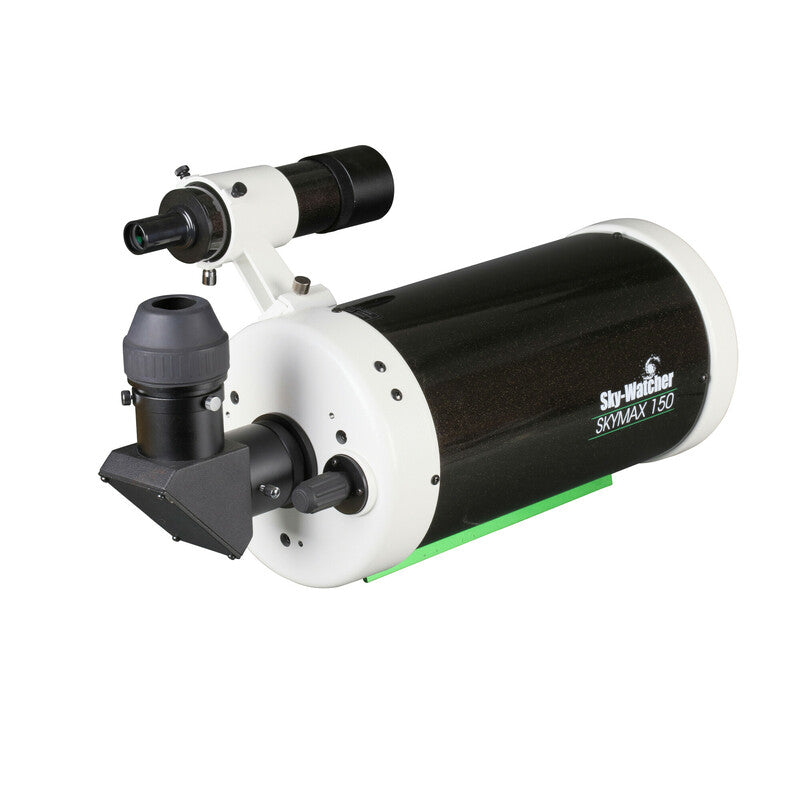
The Skymax 150 is the largest Maksutov-Cassegrain in Sky-Watcher's mainstream Skymax line: 150 mm of aperture at 1800 mm focal length and f/12. The folded optical path puts that focal length into a tube 17.5 inches long and 7.5 inches across, weighing 14 pounds - a six-inch planetary instrument roughly the size of a carry-on.
This listing is the optical tube assembly. Sky-Watcher does not build an AZ-GTi bundle at this aperture, so unlike the Skymax 102 and 127 there is no mounted package version of this scope; the tube is supplied with its 2-inch visual train and V-style dovetail with mounting rings, and the mount is your choice.
Who It's For
This is a good match if planetary and lunar detail is the priority and you want the most resolution a sealed, collimation-free tube can give you. Six inches of aperture and 1800 mm of native focal length put a planetary camera at a large image scale without a Barlow in the train - which is exactly the combination high-resolution planetary imagers look for.
It also suits observers building around one serious visual scope. The 2-inch diagonal and 28 mm eyepiece give a usable low-power view for a scope of this focal length, while the aperture puts globular clusters, planetary nebulae and the brighter galaxies within comfortable reach.
Because it arrives with mounting rings rather than a bare dovetail foot, the tube can be rotated in the rings to index the focuser and finder to a comfortable position - useful on an equatorial mount where the eyepiece angle changes across the sky.
Key Features & Design
- 150 mm Maksutov-Cassegrain at 1800 mm f/12: six inches of aperture and long native focal length in a 17.5 inch tube.
- Borosilicate mirrors with Radiant Aluminum Quartz (RAQ) coatings: Sky-Watcher publishes 94% reflectivity for these coatings.
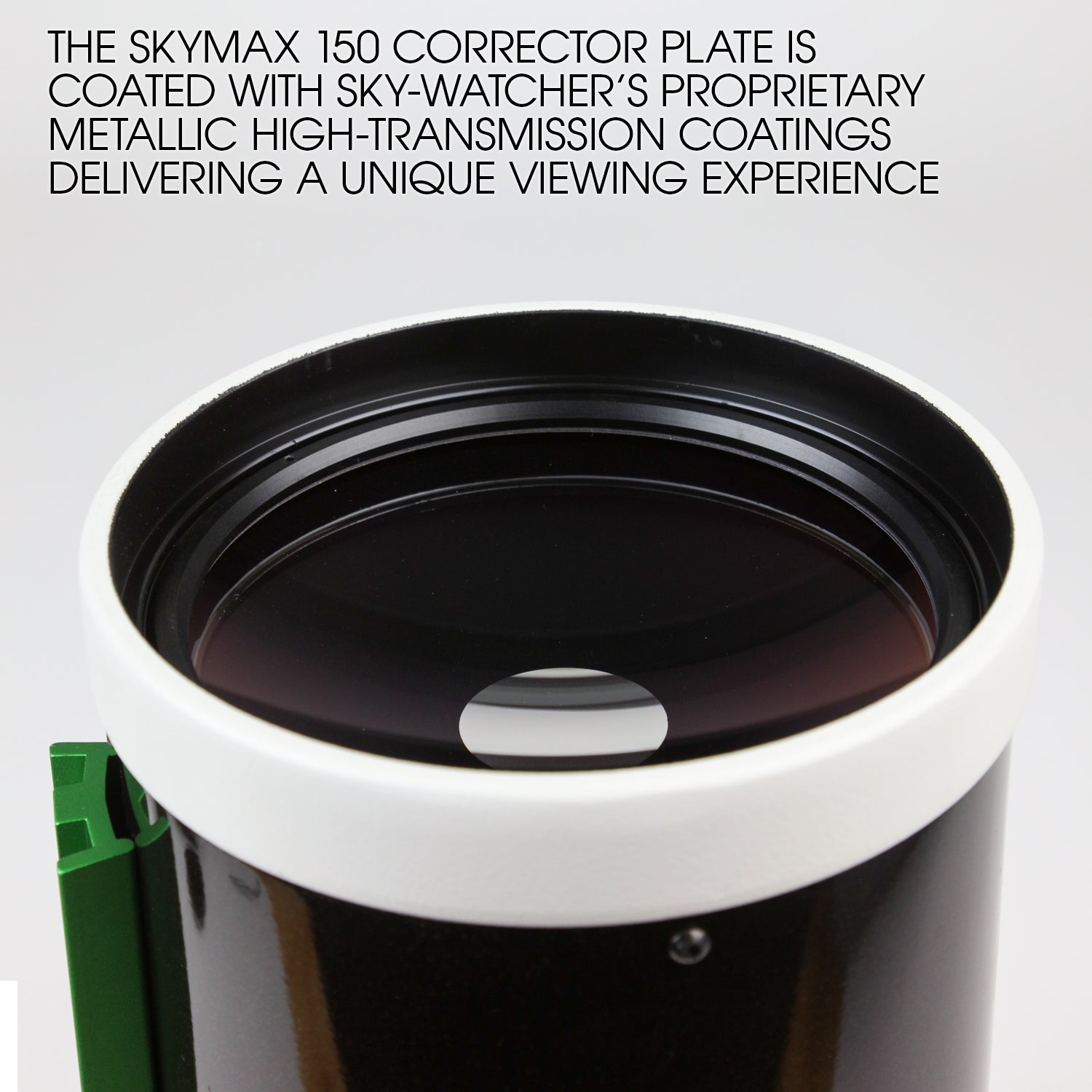
- Full-aperture meniscus corrector with MHTC coating: a 150 mm meniscus seals the tube and carries Sky-Watcher's Metallic High-Transmission Coatings.
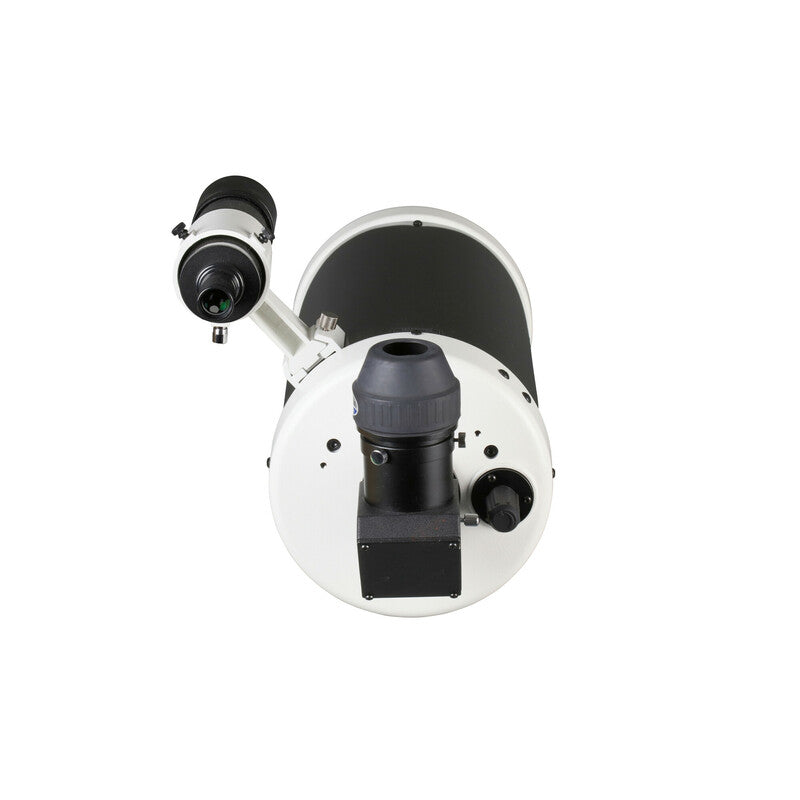
- 2-inch visual train: supplied with a 2-inch star diagonal and a 2-inch 28 mm eyepiece.
- V-style dovetail with mounting rings: the rings let the tube rotate to index the focuser and finder, and spread the load across the tube rather than a single foot.
- Sealed optical tube: the closed design holds collimation and keeps dust off the mirrors, so there is nothing to align before observing.
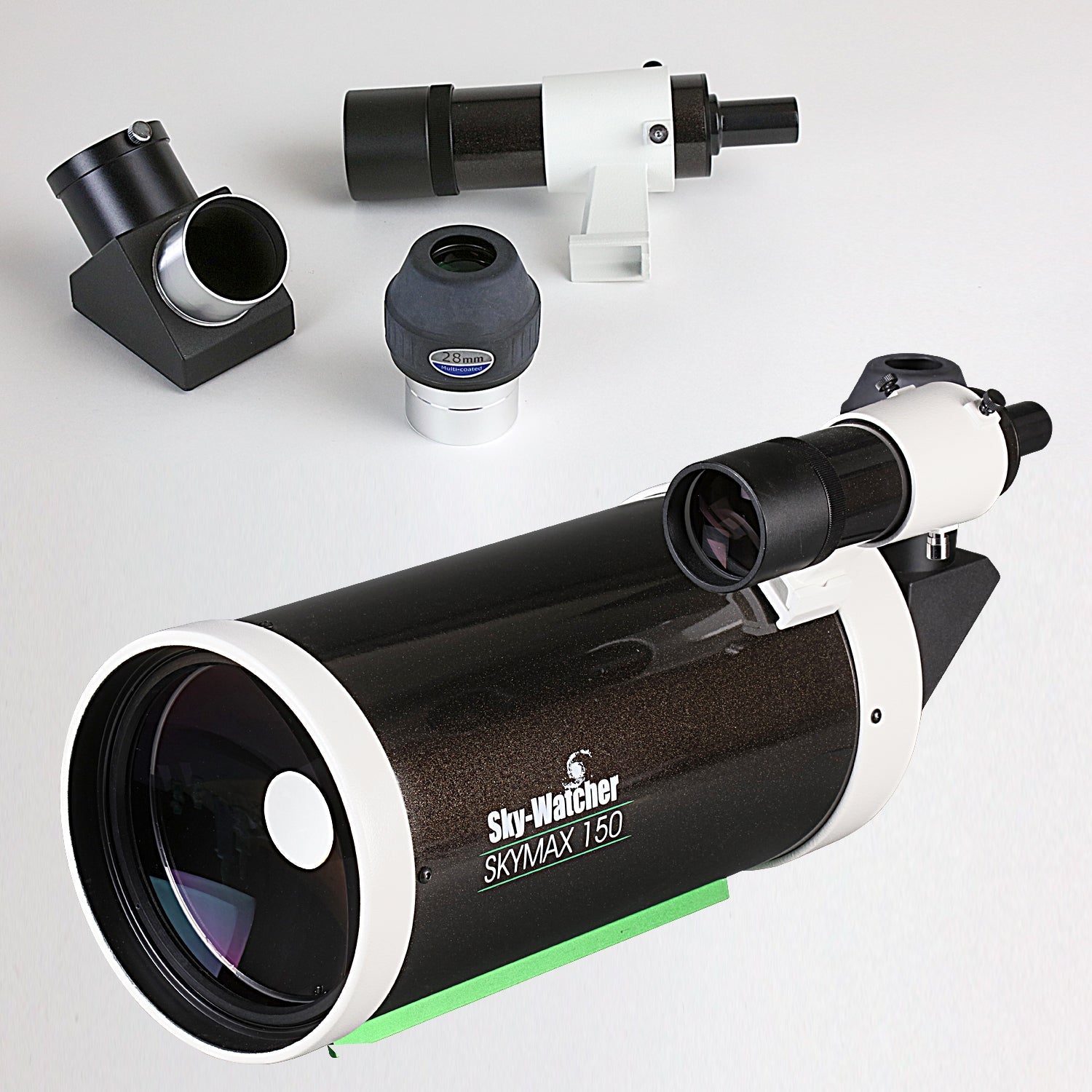
- Included per Sky-Watcher's product page: a 2-inch 28 mm eyepiece, a finderscope, a V-style dovetail and a 2-inch diagonal.
- Glossy black diamond metal-flake finish on the aluminium tube.
Optical / Mechanical Design
A Maksutov-Cassegrain opens with a thick, full-aperture meniscus lens. Light passes through it to a borosilicate primary mirror at the rear, reflects forward to a secondary spot aluminised directly onto the inner face of the meniscus, and comes back through a central hole in the primary to the eyepiece. That fold is what compresses 1800 mm of focal length into a 17.5 inch tube.
The planetary performance follows from the geometry. The secondary is a coating on the corrector, not a mirror on a spider, so there is no support structure in the light path and no diffraction spikes - and the obstruction is small relative to a Schmidt-Cassegrain of comparable aperture. Sky-Watcher describes Maksutovs as generally regarded as producing a sharper image than Schmidt-Cassegrains, and this is the reason. The meniscus is spherical and therefore easier to figure to a high standard than an aspheric corrector, and being full aperture it seals the tube against dust and internal air currents.
The Skymax Series product sheet lists a 2-inch dual-speed Crayford-style focuser with a 1.25 inch adapter for the 150 mm column. Dual-speed control matters here: at 1800 mm and f/12, critical focus on a planetary target is a small window, and a fine ratio makes it findable without nudging the tube.
At f/12, the cone is long and slow - high contrast and a well-corrected central field at high power, with a narrow field of view. This is a resolution instrument, not a wide-field one.
Recommended Uses
- High-resolution planetary observing: 150 mm at 1800 mm on Jupiter's festoons, Saturn's ring divisions and Martian surface markings.
- Lunar observing: six inches of aperture resolving rilles, domes and crater terracing at high image scale.
- Planetary and lunar imaging: native 1800 mm suits a planetary camera directly, with no amplification needed for most sensors.
- Double stars: the aperture and the sealed, thermally stable tube suit close and unequal pairs.
- Globular clusters and planetary nebulae: the aperture resolves cluster cores and shows structure in the brighter planetaries.
- Long-range terrestrial observing with an erecting diagonal.
Compatibility and Accessory Notes
The tube ships with mounting rings on a V-style (Vixen-format) dovetail. That fits the standard saddle on the EQM-35, HEQ5, AZ-EQ5 and larger heads. At 14 pounds before the diagonal and eyepiece, an HEQ5-class equatorial or an AZ-EQ5 is the usual pairing for tracked planetary work; tell us what you are mounting on and we will confirm the headroom.
The visual train is 2-inch, and the supplied diagonal takes 2-inch eyepieces directly. A 1.25 inch adapter is listed with the focuser, so 1.25-inch eyepieces and filters already in your case work without buying anything.
For imaging, a planetary camera goes into the diagonal or straight into the visual back, and the wide range of achievable focus positions means accessories of different optical depths generally come to focus without spacer arithmetic. Send us the camera model and we will confirm the adapter chain.
Unlike the Skymax 102 and 127, there is no Skymax 150 AZ-GTi package - the 14 pound tube is beyond what that mount is intended to carry. If you want this scope on a goto mount, ask us and we will put together a pairing that carries it properly.
Good to Know Before You Order
- This is the optical tube assembly. The eyepiece, diagonal, finder, mounting rings and dovetail are included; no mount and no tripod. There is no AZ-GTi bundle version of the 150.
- Tube weight is 14 pounds. With a 2-inch diagonal and eyepiece the mounted load is higher, which is worth accounting for against your mount's rating and counterweight set.
- Focal ratio is f/12. Long and slow: excellent contrast at high power, a narrow field, and a slow proposition for long-exposure deep-sky imaging.
- The finder specification differs between Sky-Watcher's two publications. Their product page text reads '98x50 finderscope', which is a typographical error for a 9x50; their Skymax Series product sheet lists an 8x50 right-angle finder for the 150mm column. We confirm which finder is in the carton before shipping, and will tell you which one your unit has if you ask.
- Cooldown is a real factor at this aperture. A 150 mm meniscus and a sealed tube equalise with ambient temperature slowly - the sharpest planetary views come after the optics have settled outdoors, and a small rear-cell fan is a common owner addition.
- No carrying case is listed for this model in Sky-Watcher's published accessory list.
- Free shipping applies to this item per Sky-Watcher's listing.
Frequently Asked Questions
Is it difficult to set up?
The optics arrive sealed and collimated, so there is no mirror alignment to perform now or later - which removes the step that makes a six-inch Newtonian or Schmidt-Cassegrain more work. Setup is: dovetail into the saddle, clamp, diagonal and eyepiece into the back, balance, aim. The one thing that takes handling is the 14 pound tube going onto the mount, and the mounting rings give you two places to hold it. Cooldown runs in the background while you set up.
Is there a Skymax 150 AZ-GTi version?
No. Sky-Watcher builds AZ-GTi bundles around the Skymax 102 and 127; the 150 is sold as an optical tube only. We can recommend a mount that carries it - send us a note about how you will use it.
How does it compare to the Skymax 127?
150 mm gathers about 40% more light than 127 mm and resolves finer detail, and the focal length goes from 1540 mm to 1800 mm. It also ships with mounting rings rather than a plain dovetail foot. The trade is weight: 14 pounds against 9.7, which usually means a larger mount.
Can I photograph with it?
It is well suited to lunar and planetary imaging at 1800 mm with a planetary camera. At f/12 long-exposure deep-sky imaging is slow, so this is not the tube people choose for nebulae and galaxies.
Do I need 2-inch eyepieces?
No. A 2-inch 28 mm eyepiece and 2-inch diagonal are supplied, and the focuser is listed with a 1.25 inch adapter, so 1.25-inch eyepieces you already own work directly.
Bottom Line
A sealed 150 mm Maksutov-Cassegrain optical tube delivering 1800 mm of focal length in a 17.5 inch, 14 pound package, supplied with a 2-inch star diagonal, a 2-inch 28 mm eyepiece, a finderscope, and mounting rings on a V-style dovetail. It is the largest Skymax sold as a tube, and it is built for resolution on the Moon and planets. Send us the mount you have in mind and we will confirm the pairing.
| SKU | S11530 |
|---|---|
| UPC | 050234115308 |
| Optical design | Maksutov-Cassegrain |
| Aperture | 150 mm |
| Focal length | 1800mm |
| F-ratio | 12 |
| Mirror substrate | Borosilicate |
| Mirror coatings | Radiant Aluminum Quartz (RAQ) coatings, 94% reflectivity |
| Corrector plate coatings | Metallic High-Transmission Coatings (MHTC) |
| Focuser | 2-inch dual-speed Crayford-style with 1.25 inch adapter |
| Eyepieces | 2-inch 28mm |
| Finderscope | 9x50 finderscope (vendor page prints '98x50') |
| Diagonal | 2-inch Star diagonal |
| Mounting hardware | V-Style with mounting rings |
| Tube material and finish | Aluminium, glossy black diamond metal-flake finish |
| Tube length | 17.5 inches |
| Tube outer diameter | 7.5 inches |
| Tube weight | 14 pounds |
| Included accessories | 2-inch 28mm eyepiece, finderscope, V-style dovetail, 2-inch diagonal |
| Mount | Not included - optical tube assembly only |
You may also like
Recently viewed
Recent Blog Posts
View all
Your Guide Graph Is Lying to You
Read More

D-Size vs V-Size: A Complete Guide to Telescope Dovetail Systems
Read More

What Is Back Focus in Astrophotography? Telescope Reducers, Flatteners, and Spacing Explained
Read More