

- Description
- Specifications
Product Overview
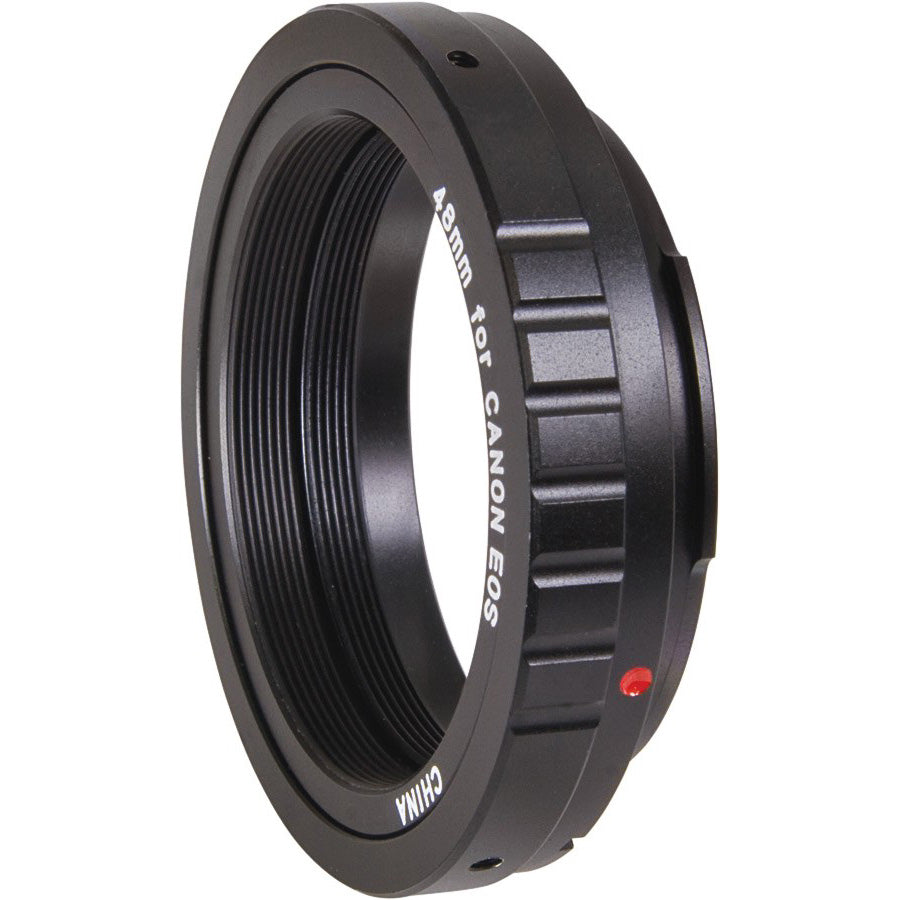
This is the ring that joins a Canon DSLR body to a Sky-Watcher 0.85x Focal Reducer/Corrector. One face carries an M48 thread that screws onto the corrector's camera-side output; the other is a Canon DSLR bayonet that the body twists and locks into. Sky-Watcher publishes it for the Esprit and ProED series when those telescopes are running their dedicated field correctors. The ring weighs 45 g.
Who It's For
This is the adapter for a Canon DSLR going onto a Sky-Watcher 0.85x reducer/corrector on an Esprit or ProED refractor. It replaces the standard T-ring in that position, because the correctors output M48 rather than the T-thread that a T-ring uses. If your imaging camera is a dedicated astronomy camera rather than a DSLR, that camera's own M48 spacing hardware takes this place instead.
Key Features & Design
- M48 telescope-side thread: matches the output thread on Sky-Watcher's 0.85x Focal Reducer/Correctors. Sky-Watcher notes M48 is used for larger-format imaging, where the wider thread keeps the light cone clear of the adapter walls.
- Canon DSLR bayonet on the camera side: the body mounts and locks the same way it would onto a lens, with no adapter stack in between.
- Distinct from the standard T-thread: Sky-Watcher states plainly that M48 rings are different from T-thread rings, so the two are not interchangeable in this position.
- 45 g: light enough that it changes nothing about balance once the camera is on the back.
Optical / Mechanical Design
The adapter sits in the optical train, between the corrector and the sensor, so what it does mechanically has an optical consequence. The M48 thread gives a wider clear bore than a T-thread, which is why Sky-Watcher specifies it for larger-format imaging — the corrected cone from the 0.85x reducer reaches the sensor corners without the adapter throat clipping it. On a T-thread ring the narrower bore becomes the limiting aperture in that same position.
It is a mechanical part only. There are no electrical contacts on either face, so nothing passes between the telescope and the camera body — no autofocus, no aperture control, no EXIF from the optics. The camera runs in manual, and exposures are started from the body or from a remote release.
Sky-Watcher does not publish an optical length or thread pitch figure for this ring. Backfocus in this train is set by the corrector's own published spacing rather than by anything you adjust on the adapter. Send us your telescope and corrector model and we will confirm the spacing you should be hitting.
Recommended Uses
- Deep-sky astrophotography with a Canon DSLR: the prime-focus connection behind a 0.85x reducer/corrector on an Esprit or ProED refractor.
- Wider-field imaging: the reducer shortens focal length and the M48 interface carries the resulting larger illuminated field to the sensor.
- Full-frame and APS-C Canon bodies: the M48 bore is the one Sky-Watcher specifies where a T-thread would be the restriction.
Compatibility and Accessory Notes
- Reducers and correctors: Sky-Watcher designates it for any of their 0.85x Focal Reducer/Correctors.
- Telescopes: the Esprit and ProED series, used with their dedicated field correctors.
- Collapsible Dobsonians: Sky-Watcher states M48 rings are not suitable for that line.
- Nikon bodies: the equivalent ring for Nikon is S20301 — the thread side is the same, the bayonet is not.
- Remote triggering: because the adapter passes no signal, exposures are timed at the camera or through a shutter release cable matched to your body.
Good to Know Before You Order
- A T-ring does not substitute: M48 and T-thread are different standards, and the corrector's output is M48.
- Thread pitch and length are unpublished: Sky-Watcher lists the standard as M48 without stating pitch or the ring's mechanical length. If you are computing a spacing stack, send us the parts list and we will work through it with you.
- Camera bodies are not enumerated: Sky-Watcher specifies the fitment as Canon DSLR rather than naming individual models.
- Weight is 45 g: under a pound, which is worth knowing if you are combining it with other small parts in one shipment.
- Nothing else is in the box: the vendor lists the adapter itself, with no spacers or additional rings published as included.
Frequently Asked Questions
Is it difficult to set up?
No. The M48 face threads onto the corrector by hand and the camera locks onto the bayonet the way a lens does. There is nothing to adjust, align or configure.
Can I use my existing Canon T-ring instead?
Not in this position. The 0.85x correctors output M48, and Sky-Watcher notes M48 rings are a different standard from T-thread.
Does it work on a Sky-Watcher Dobsonian?
Sky-Watcher states M48 rings are not suitable for the Collapsible Dobsonian line.
Does the camera talk to the telescope through it?
No. It is a mechanical ring with no electrical contacts, so the camera operates in manual and exposures are triggered at the body or by a remote release.
Which reducer or corrector does it fit?
Sky-Watcher specifies any of their 0.85x Focal Reducer/Correctors, on Esprit and ProED telescopes running the dedicated field corrector. Tell us your exact scope and corrector and we will confirm the match before you order.
Bottom Line
The M48 ring Sky-Watcher specifies for putting a Canon DSLR behind a 0.85x reducer/corrector on an Esprit or ProED. It is a 45 g mechanical interface with a wider bore than a T-ring, which is exactly what the larger illuminated field behind those correctors needs.
| SKU | S20300 |
|---|---|
| UPC | 050234203005 |
| Type | Camera adapter ring |
| Telescope-side thread | M48 |
| Camera-side mount | Canon DSLR bayonet |
| Designed for | Sky-Watcher 0.85x Focal Reducer/Correctors |
| Telescope compatibility | Esprit and ProED series, when using the dedicated field correctors |
| Not compatible with | Collapsible Dobsonian line |
| Electrical connection | None — mechanical adapter only |
| Weight | 45 g (0.0992 lb) |
You may also like
Recently viewed
Recent Blog Posts
View all
Your Guide Graph Is Lying to You
Read More

D-Size vs V-Size: A Complete Guide to Telescope Dovetail Systems
Read More

What Is Back Focus in Astrophotography? Telescope Reducers, Flatteners, and Spacing Explained
Read More