
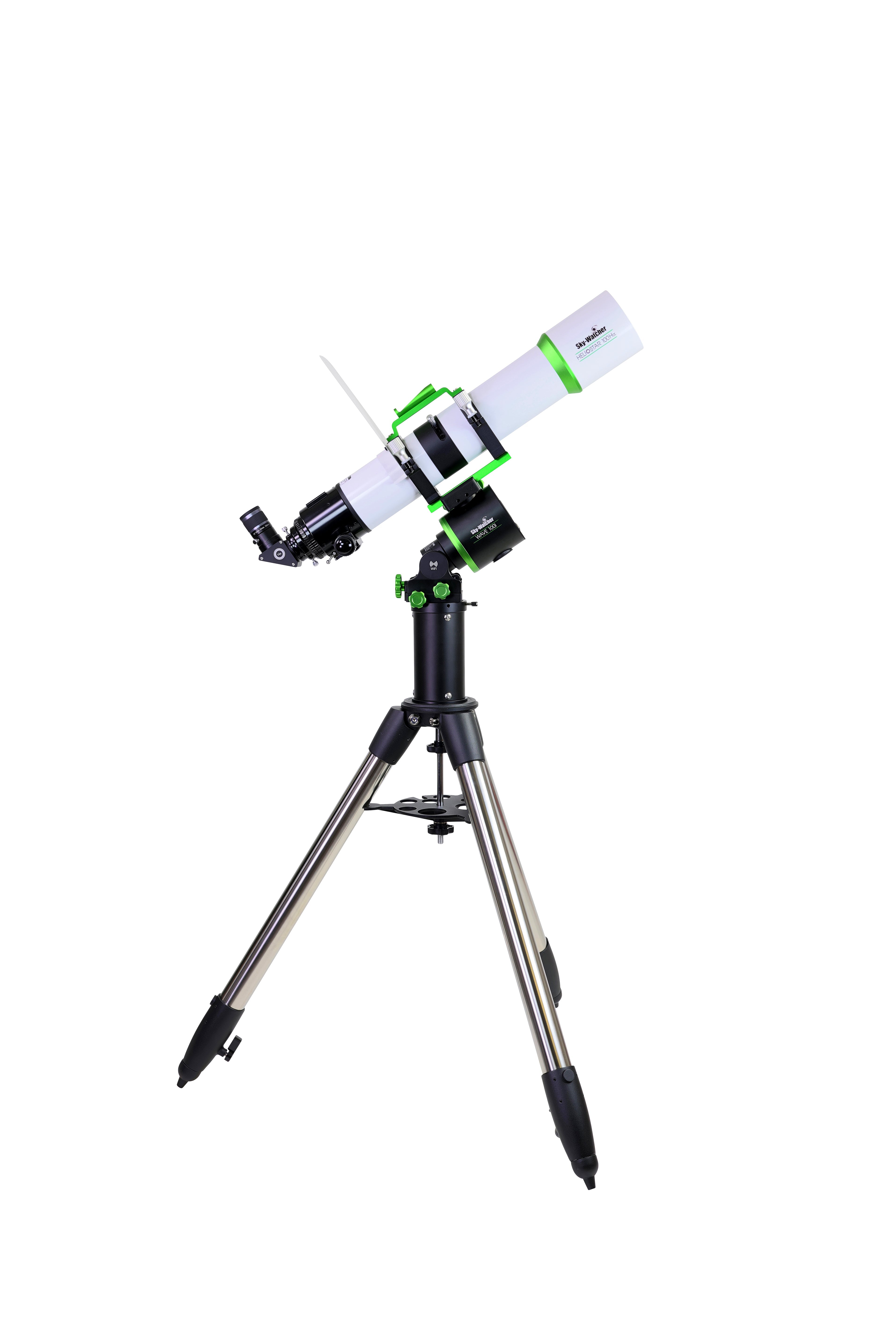
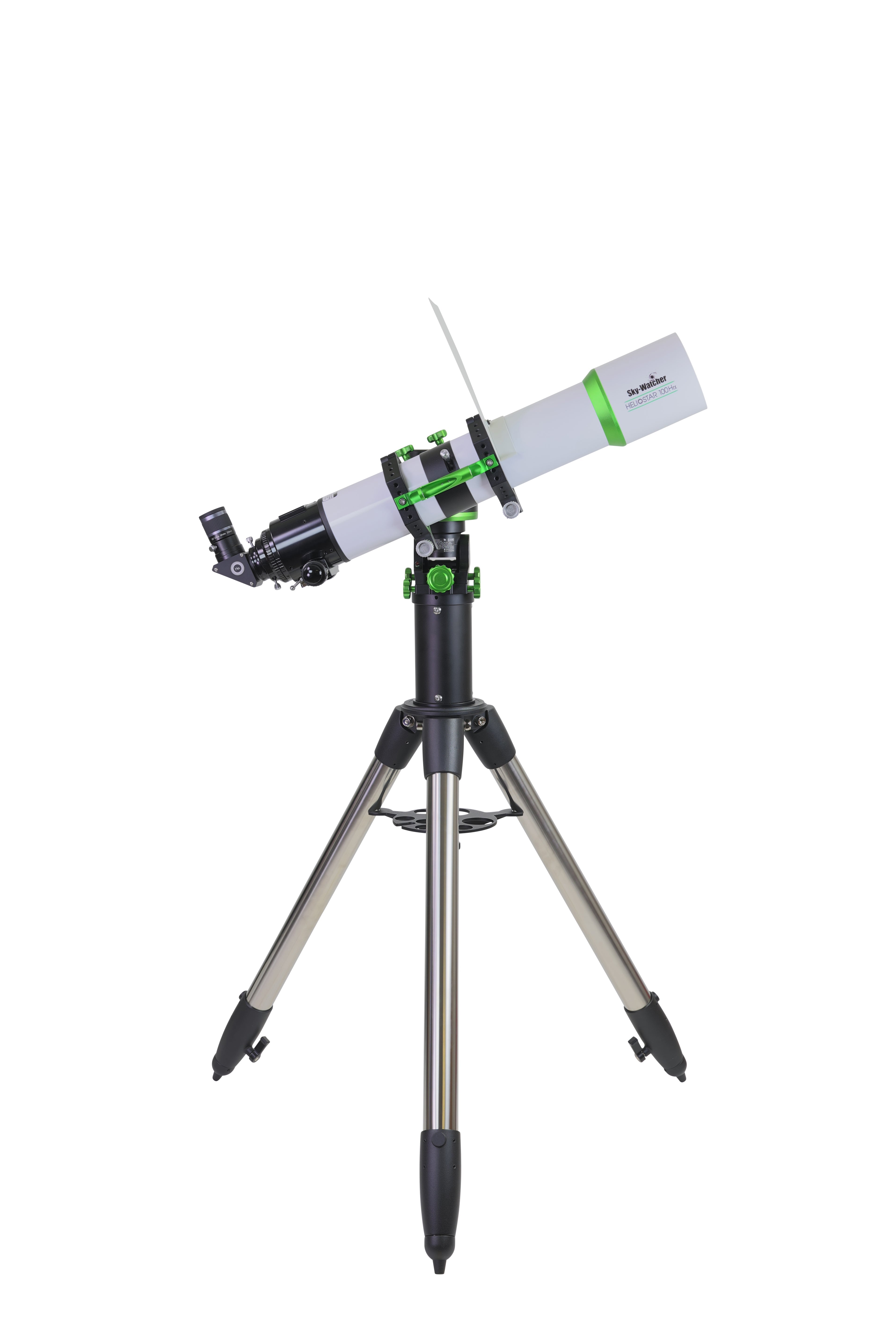
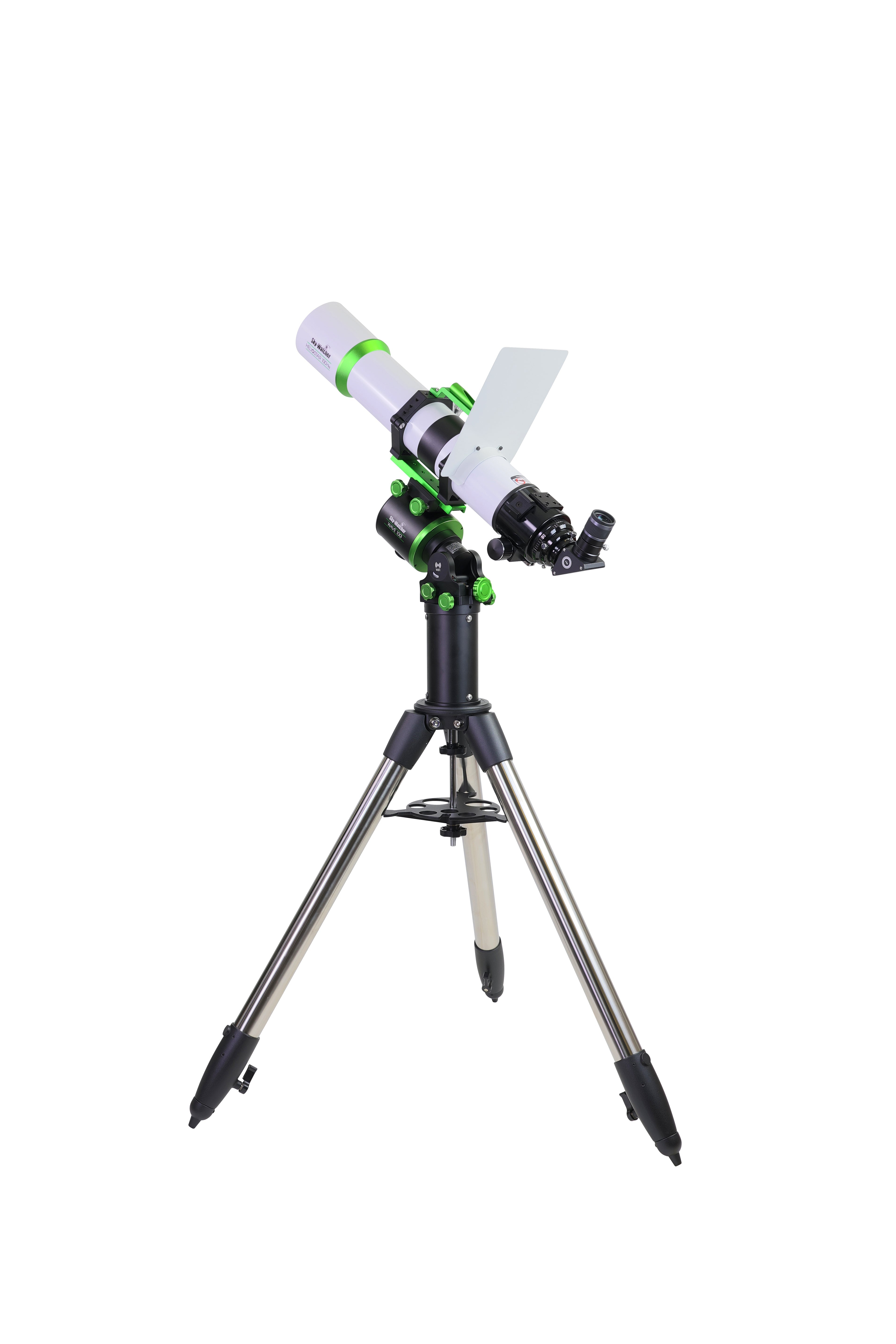
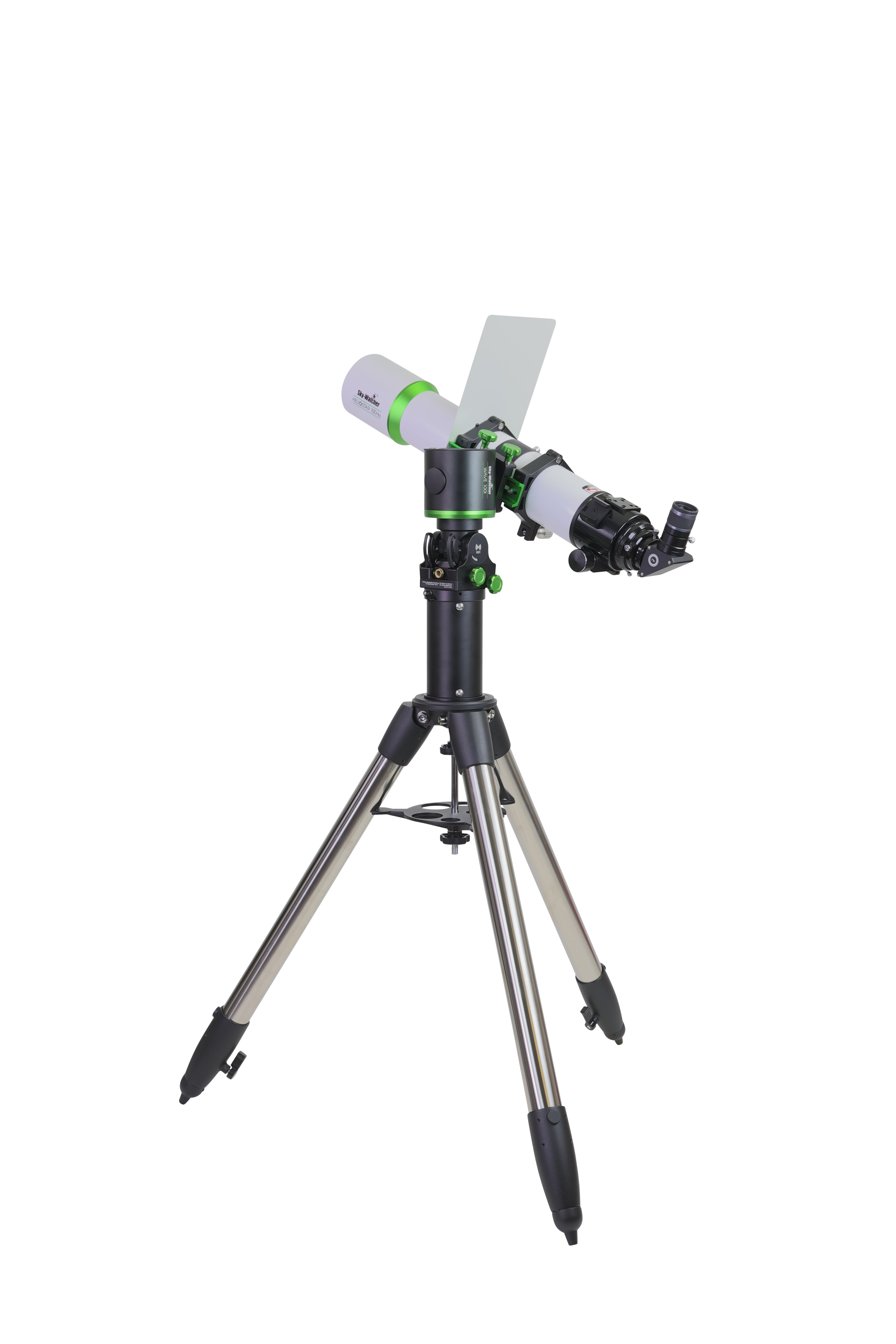


- Description
- Specifications
Product Overview
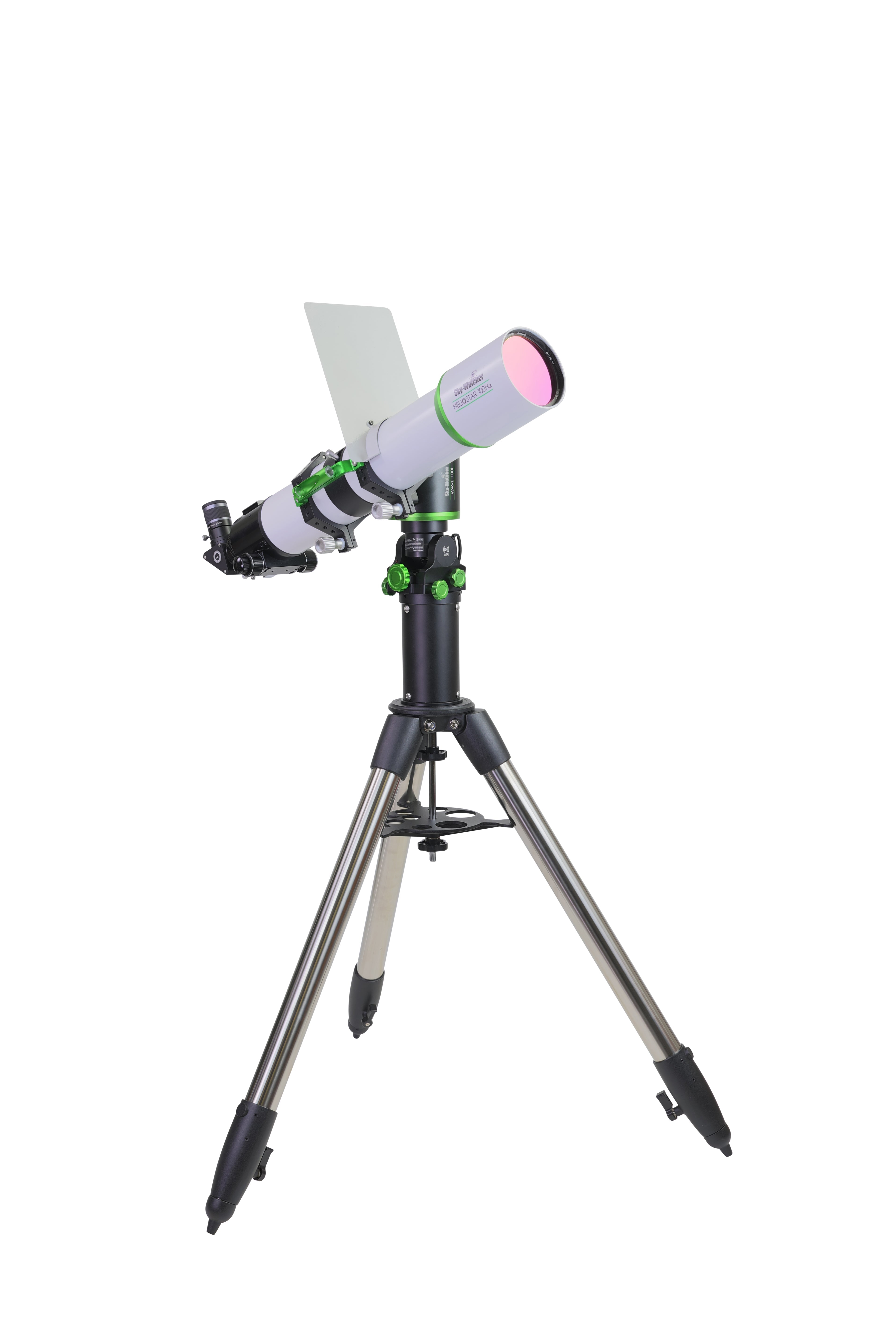
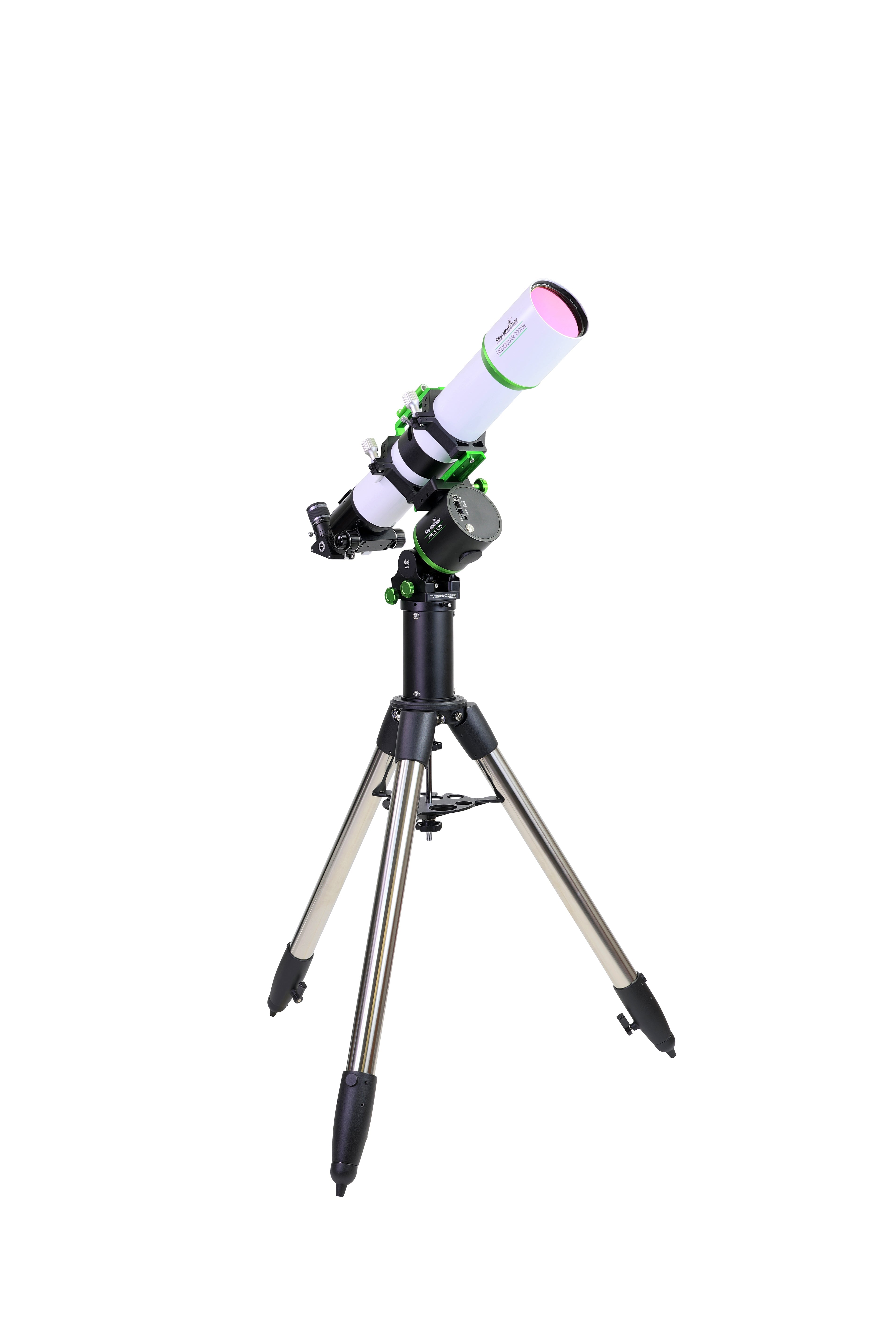
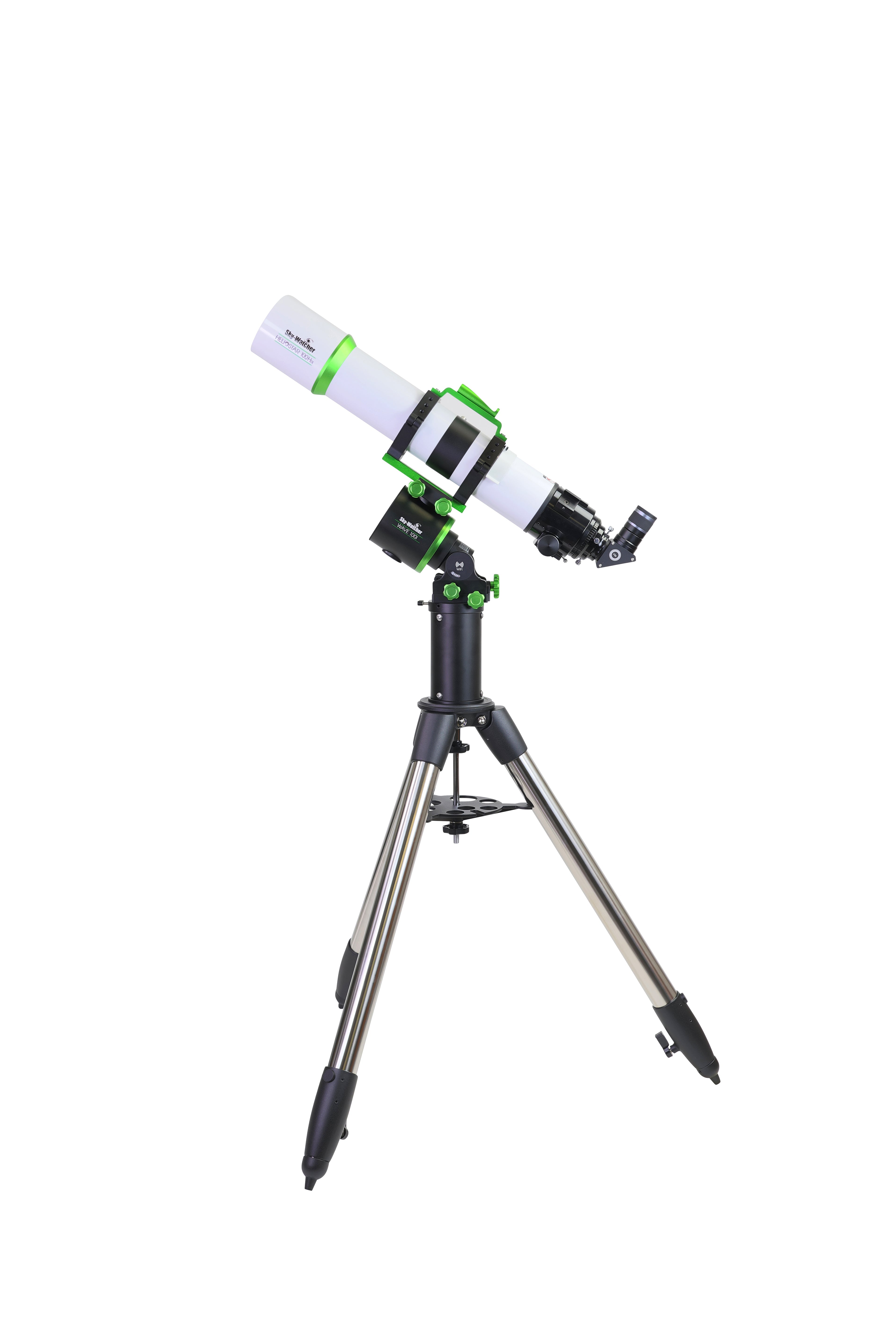
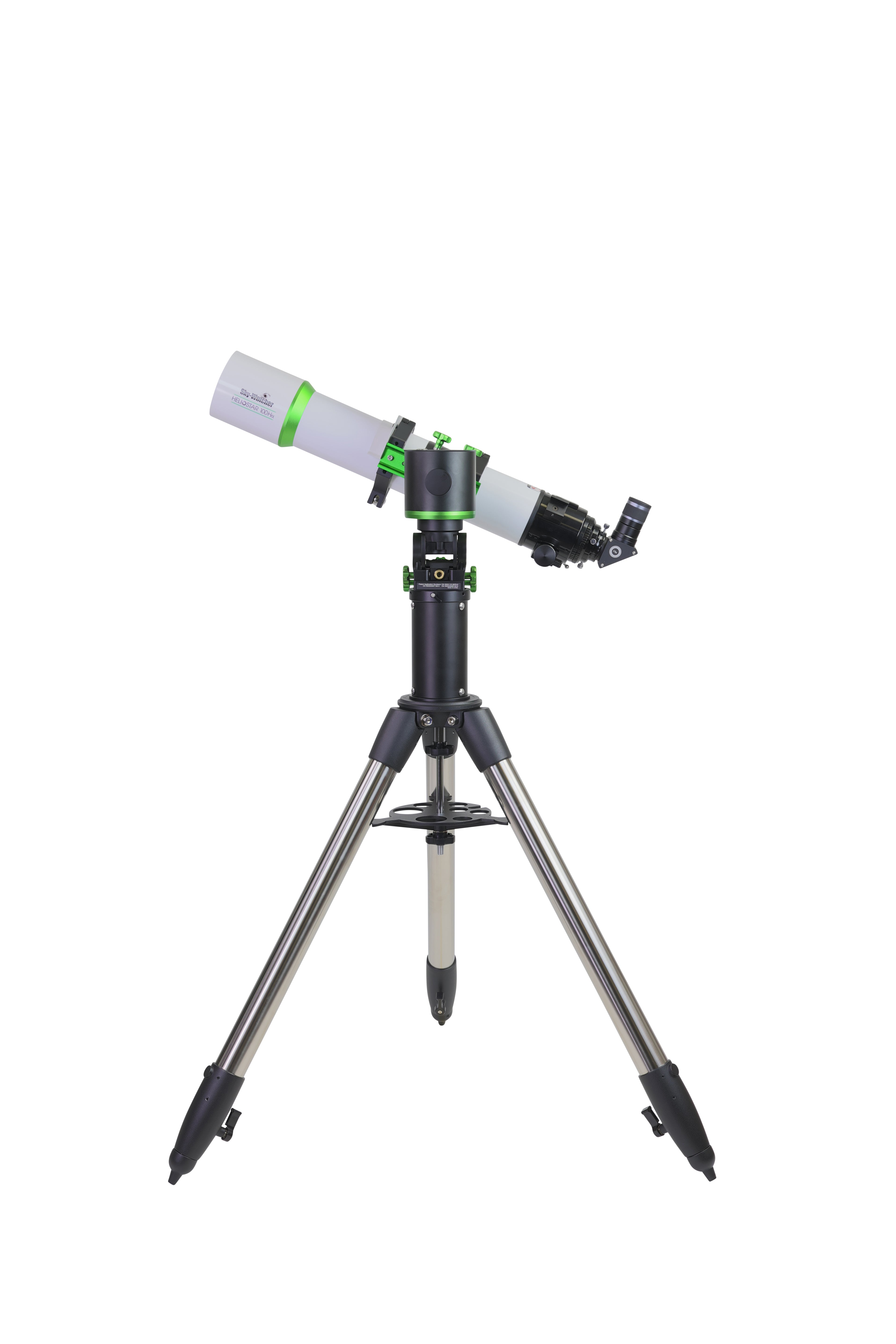
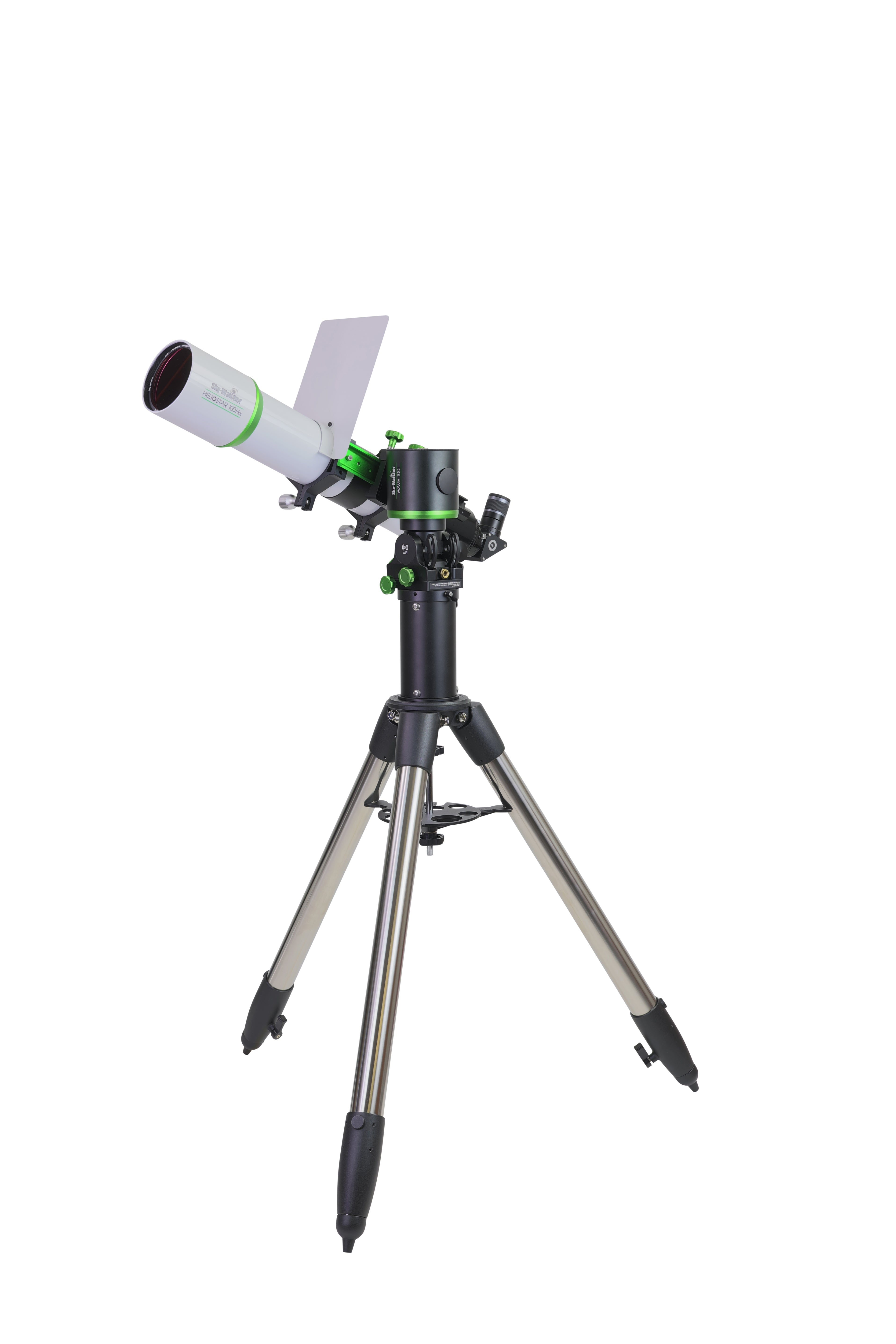
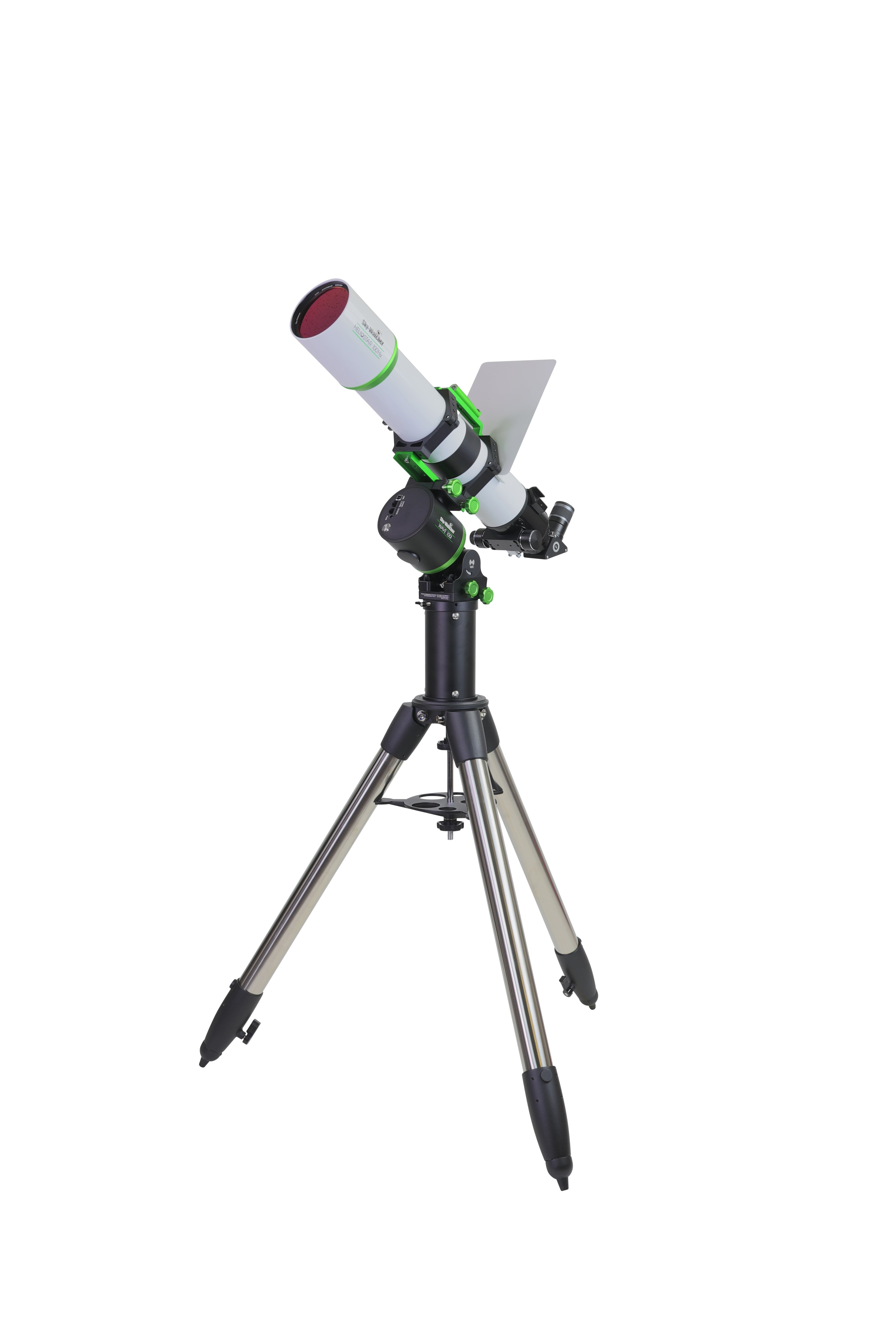
This kit puts the Sky-Watcher Heliostar 100 hydrogen-alpha solar telescope on the Wave 100i strain-wave mount, which is the pairing that makes a 100 mm solar instrument portable. The Heliostar 100 is a dedicated Ha telescope: 100 mm of aperture at 760 mm focal length, f/7.6, tuned natively to a bandpass under 0.5 angstroms. Aperture is the limiting factor on how much chromospheric structure you can resolve, and at 100 mm the spicule texture, filament edges and internal detail of active regions separate in a way a smaller Ha scope cannot deliver.
The Wave 100i is a harmonic-drive head: a stepper motor through a belt drive and harmonic reducer at a 300:1 total ratio, carrying 10 kg (22 lbs) without a counterweight and 15 kg (33 lbs) with one, from a 4.3 kg (9.5 lb) body. It tracks at solar, sidereal and lunar rates, works in both EQ and AZ modes, and runs over Wi-Fi, Bluetooth, a SynScan hand controller or third-party platforms like ASIAir, Eagle and StellarMate.
The telescope weighs 13.2 lbs, the mount head 9.5 lbs, and the kit ships at 42.1 lb.
Who It's For
This is a good match if solar work is a serious part of what you do and you want the resolution that comes with 100 mm of Ha aperture on a mount that packs into a case. It suits solar imagers chasing high-resolution disc mosaics and prominence detail, eclipse travellers who need capability without a pier, and outreach programmes that want a flagship view. The Wave 100i's dual saddles also make it a natural for running two instruments side by side in Alt-Az — a solar scope and a camera rig, or a scope and a white-light companion.
Key Features & Design
- 100 mm f/7.6 dedicated Ha telescope: 760 mm focal length on an achromatic doublet with an H-alpha fully multicoated lens. The aperture is what sets the resolution ceiling on fine chromospheric detail.
- Sub-0.5 angstrom bandpass from a single etalon: Sky-Watcher's Solis Etalon Technology reaches it natively. The traditional alternative is a stacked second etalon, which costs about 40 percent of the system's brightness; one Solis etalon keeps the image bright at the same contrast.
- Trifid Tuner: three support veins press on the etalon plates to move the passband onto the hydrogen line, without loading the surrounding optics.
- 20 mm blocking filter: in the removable 1.25-inch eyepiece diagonal, and part of the telescope's certified safety path.
- 2.8-inch dual-speed rack-and-pinion focuser: a larger focuser than the 76 mm model carries, sized for the imaging trains a 100 mm solar scope attracts.
- Strain-wave drive: a stepper motor through belt drive and harmonic reducer at 300:1, which is what removes the counterweight bar and the bulk from the mount without giving up payload.
- Dual hybrid saddles: the Wave 100i ships with a secondary saddle over the counterweight port, taking up to 22 lbs on each saddle in Alt-Az mode. Both are Vixen/Losmandy hybrid.
- EQ and AZ modes with RA and Dec home positions, 0–90 degree continuously adjustable latitude, RA power-off braking, and a red backlit latitude display and bubble level.
- ISO 12312-2 tested: lab tested in the United States, and each individual unit checked on the actual Sun before shipping.
Optical / Mechanical Design
A hydrogen-alpha telescope isolates one emission line at 656.3 nm from the Sun's full spectrum. The etalon does that isolating: two precisely spaced parallel mirrors that reflect light between them and pass only the wavelengths satisfying the resonance condition. Moving the plate spacing or the angle of incidence moves the passband, which is why the instrument has a tuner — local air pressure changes the refractive index of the air mass you are observing through, and plasma moving at speed in the chromosphere Doppler-shifts the line itself.
Narrowing the band raises contrast on surface features. Stacking a second etalon is the conventional way to narrow it, at the cost of roughly 40 percent of the brightness and a second expensive optical assembly. Solis reaches the same contrast with a single etalon, so the Heliostar 100 gives double-stack surface detail without the light loss. The Trifid Tuner is the mechanism: three veins distribute the tuning pressure across the etalon plates.
The Wave 100i uses a strain-wave (harmonic) reducer rather than a worm-and-wheel. A harmonic gearset delivers very high torque in a small package with effectively no backlash, which is why a 4.3 kg head carries 10 kg with no counterweight at all. The trade is that the whole system's mass moves to the mount body instead of a counterweight bar, so the packed footprint drops sharply. The head slews at 2400x, and both saddles take Vixen or Losmandy bars.
Recommended Uses
- High-resolution hydrogen-alpha solar imaging: 100 mm at 760 mm for disc mosaics, prominence sequences and active-region close-ups.
- Visual solar observing: prominences, filaments, plage, spicules and the fine structure of sunspot groups.
- Time-lapse and event capture: flares, prominence eruptions and the daily evolution of active regions, with solar-rate tracking in either EQ or AZ mode.
- Eclipse travel: a 9.5 lb mount head with case-based transport and no counterweight bar to pack.
- Dual-instrument setups: the second saddle carries a companion scope or camera rig up to 22 lbs in Alt-Az.
- Satellite and ISS transit work: the mount's fast slew and the downloadable Satellite Tracker application for Windows.
Compatibility and Accessory Notes
The Heliostar 100 rides on a V-style dovetail and the Wave 100i's saddles are Vixen/Losmandy hybrid, so the pair connect directly. The telescope's 13.2 lbs against a 22 lb counterweight-free payload leaves 8.8 lbs for cameras, filters and a diagonal, and a counterweight kit raises the mount's capacity to 33 lbs if you want more margin.
The 20 mm blocking filter is built into the removable 1.25-inch eyepiece diagonal and is part of the safety chain that carries the ISO 12312-2 result. The Heliostar is used with that diagonal and no other, since substituting one removes the blocking filter from the light path. Eyepieces are 1.25-inch, with a 2-inch eyepiece adapter supplied; the included 22 mm 70-degree eyepiece gives about 35x on the 760 mm focal length.
The mount runs on DC12V (a 12V 2A supply, not included) and connects through Wi-Fi, Bluetooth, the SynScan hand controller or SynScan app, and third-party control platforms including ASIAir, Eagle and StellarMate, which opens up plate solving and scripted capture runs. Firmware is published at skywatcherusa.com/pages/firmware-and-software. Send us your camera, filter and power setup and we will confirm the payload arithmetic and the cabling before you order.
Good to Know Before You Order
- This is a dedicated solar instrument. Sky-Watcher states it will not provide views or images of anything except the Sun. The etalon passes one 656.3 nm line, which leaves nothing for night-time targets — though the Wave 100i itself tracks at sidereal and lunar rates and will happily carry a night-time scope on the same saddle.
- The supplied diagonal is the safety path. The 20 mm blocking filter is built into it. Solar observing done incorrectly can cause serious and permanent eye damage, and every unit is individually tested on the Sun before shipping precisely because that margin matters.
- Power is not included. The Wave 100i needs a 12V 2A supply. We can pair it with a suitable field battery or supply.
- A tripod is not listed in the kit contents. Sky-Watcher lists the Wave 100i's carbon fibre tripod, pier extension and counterweight kit as optional accessories, and the kit page does not itemise a tripod. Tell us what you are mounting on and we will confirm what you need to complete the setup.
- The bandpass is quoted two ways. The specification list gives <0.5Å; the descriptive text on the same vendor page cites 0.55Å for the Solis etalon. Both come from Sky-Watcher.
- The slew rate is quoted two ways. The Wave product sheet gives a maximum of 2400x (10°/sec); the kit page text cites 7.5°/sec. Both figures are Sky-Watcher's.
- Tuning is part of using it. The Trifid Tuner is adjusted at the start of a session and again as conditions change, because atmospheric pressure and Doppler shifts in the chromosphere move the line. It is a knob, not a calibration procedure.
Frequently Asked Questions
Is it difficult to set up?
The mechanical side is quick, because the strain-wave drive removes the counterweight bar entirely: the head goes on its support, the telescope drops into the hybrid saddle, and one clamp holds it. The bubble level and red backlit latitude display handle levelling and latitude. From there it is a SynScan or app connection over Wi-Fi or Bluetooth, then tuning the etalon and focusing. The 13.2 lb telescope is a comfortable two-hand lift.
What will I see that a white-light filter does not show?
The chromosphere rather than the photosphere: prominences arcing off the limb, dark filaments crossing the disc, bright plage around active regions, spicule texture, and structure inside sunspot groups. At 100 mm that detail is resolved finely enough to follow changes hour to hour.
Can the mount carry more than the solar telescope?
Yes. 22 lbs without a counterweight, 33 lbs with the optional counterweight kit, and the second saddle takes up to 22 lbs of its own in Alt-Az mode. The Heliostar 100 uses 13.2 lbs of that.
Does the mount work at night as well?
The mount does. It tracks sidereal, solar and lunar, runs in EQ or AZ mode with RA and Dec home positions, and integrates with ASIAir, Eagle and StellarMate for plate solving and automated runs. The Heliostar telescope itself is solar-only.
Do I need to double-stack it?
No. The single Solis etalon is tuned to under 0.5Å natively, which is the contrast a stacked pair is normally added to reach, without the 40 percent brightness loss the second etalon costs.
What magnification does the supplied eyepiece give?
The 22 mm eyepiece on a 760 mm focal length works out to roughly 35x, which frames the full disc with the prominences around it.
Bottom Line
A 100 mm sub-0.5Å hydrogen-alpha telescope with single-etalon brightness and double-stack contrast, on a 9.5 lb harmonic-drive mount that carries 22 lbs without a counterweight and tracks in EQ or AZ. It is the largest Heliostar paired with the mount that keeps it portable.
| SKU | S11335 |
|---|---|
| UPC | 810098970983 |
| Kit contents | Heliostar 100mm H-Alpha solar telescope + Wave 100i strain-wave GoTo mount head |
| Heliostar 100mm H-Alpha telescope | |
| Aperture | 100mm |
| Focal length | 760mm |
| Focal ratio | f/7.6 |
| Optical design | Achromatic doublet design, H-alpha fully multicoated lens |
| Bandpass | <0.5Å (vendor descriptive text elsewhere cites 0.55Å for the Solis etalon) |
| Etalon technology | Solis Etalon Technology™ with Trifid Tuner™ (single etalon) |
| Observing wavelength | Hydrogen-alpha, 656.3 nm |
| Blocking filter | 20mm, 1.25-inch diagonal format |
| Focuser | 2.8-inch dual-speed Rack and Pinion |
| Finder | Integrated Heliostar solar finder |
| Safety certification | Lab tested to ISO 12312-2; each unit individually tested on the Sun |
| Telescope weight | 13.2 lbs |
| Telescope included accessories | OTA, mounting rings, V-style dovetail, clip-on Sun shade, 22mm 70° 1.25" eyepiece, 2" eyepiece adapter, hard-shell carrying case |
| Wave 100i mount head | |
| Mount type | Strain wave (harmonic) GoTo, EQ and AZ modes with RA and Dec home positions |
| Transmission mode | Stepper motor + belt drive and harmonic reducer |
| Total transmission ratio | 300:1 |
| Payload capacity (without counterweight) | 10kg (22 lbs) |
| Payload capacity (with counterweight) | 15kg (33 lbs) |
| Tracking rates | Sidereal, solar, lunar |
| Maximum slew rate | 2400x (10°/sec) — vendor kit page text cites 7.5 degrees per second |
| Latitude range | Continuously adjustable from 0° to 90° |
| Saddle type | Dual Hybrid Vixen/Losmandy; secondary saddle mounts over the counterweight port, up to 22 lbs per saddle in Alt-Az mode |
| Control method | SynScan hand controller or SynScan app; Wi-Fi and Bluetooth; third-party platforms (ASIAir, Eagle, StellarMate) |
| Additional features | RA power-off braking; red backlit latitude display and bubble level |
| Power requirement | DC12V (12v 2a, not included) |
| Mount weight | 4.3kg (9.5 lbs) |
| Kit | |
| Shipping weight | 19096 g (42.1 lb) |
You may also like
Recently viewed
Recent Blog Posts
View all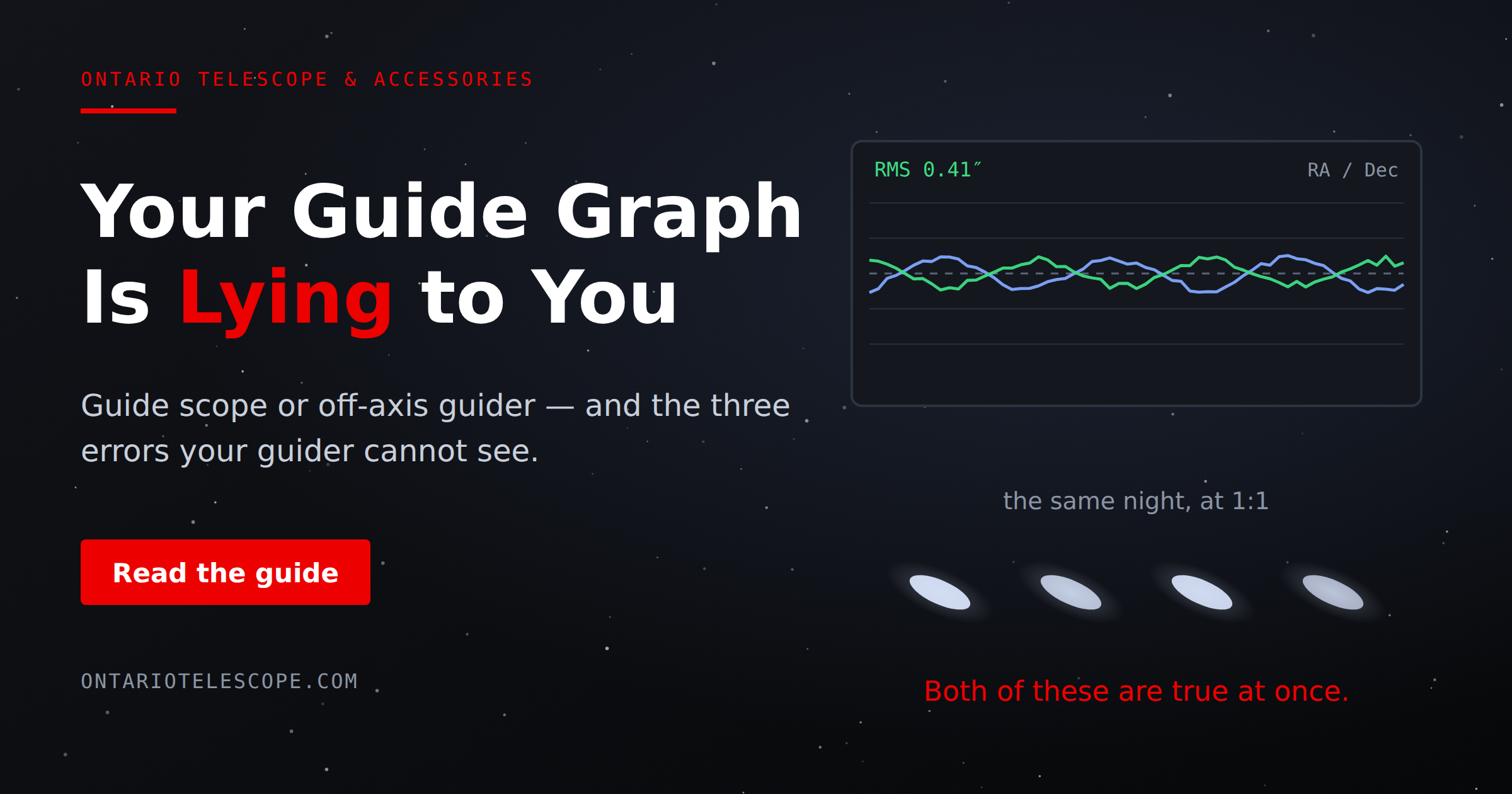
Your Guide Graph Is Lying to You
Read More
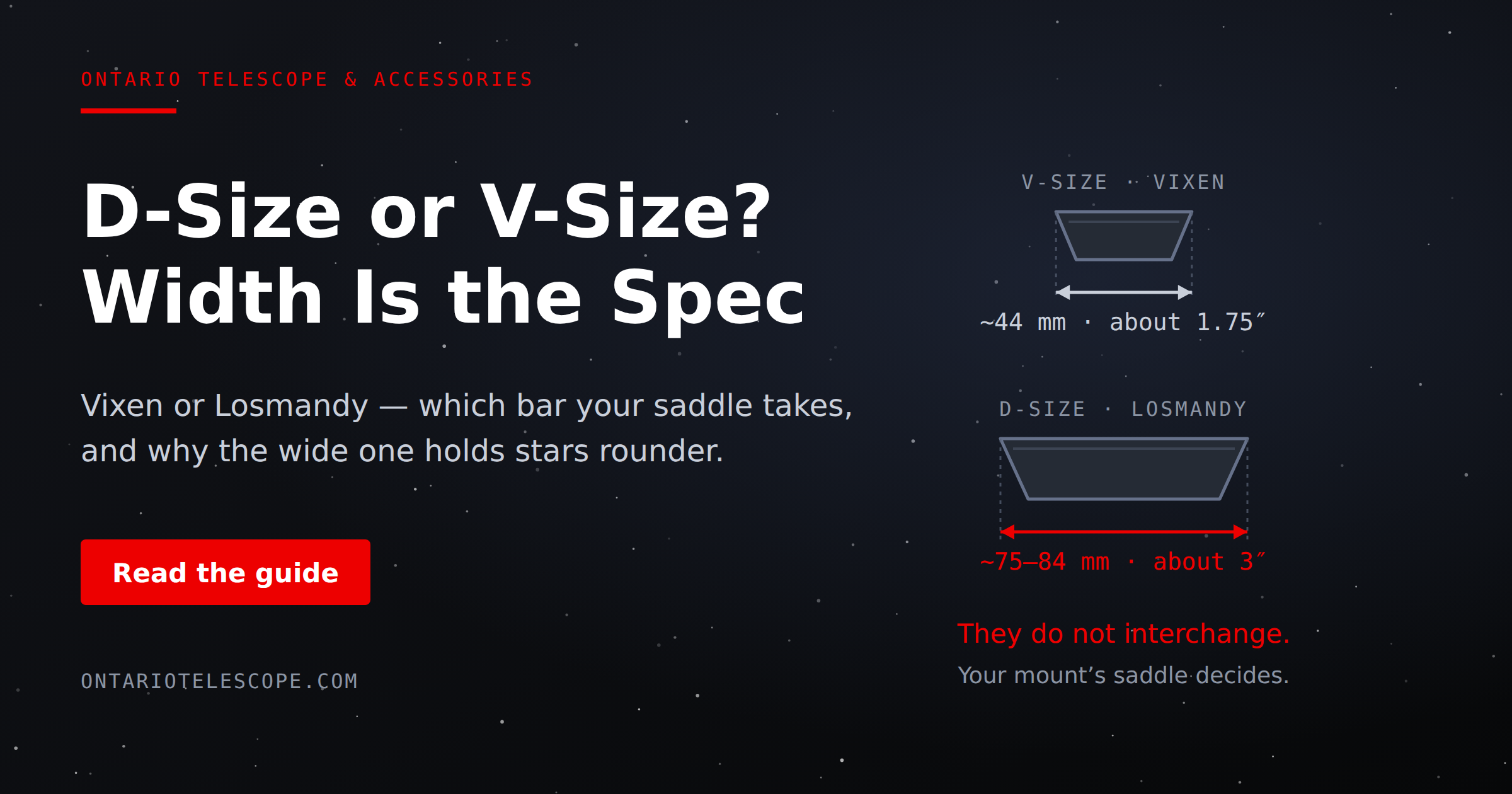
D-Size vs V-Size: A Complete Guide to Telescope Dovetail Systems
Read More
What Is Back Focus in Astrophotography? Telescope Reducers, Flatteners, and Spacing Explained
Read More