


- Description
- Specifications
At a Glance
- Aperture: 406mm (16-inch)
- Focal length: 1800mm
- Focal ratio: f/4.4
- Focuser: 2-inch dual-speed Crayford-style, 1.25-inch adapter supplied
- Finder: 9x50 straight-through
- Mount: Computerised GoTo Dobsonian, dual-axis tracking, 42,900-object database
Product Overview
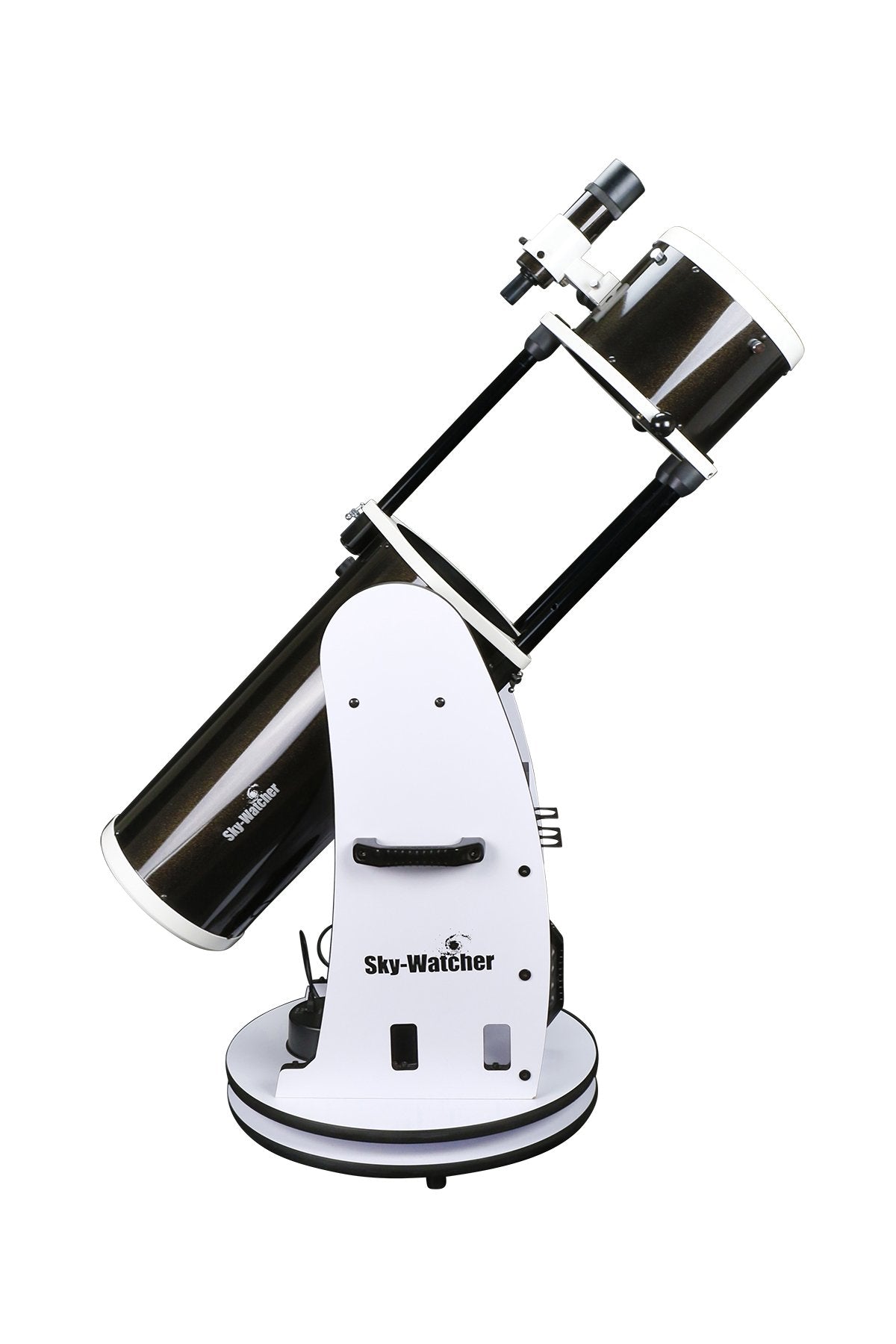
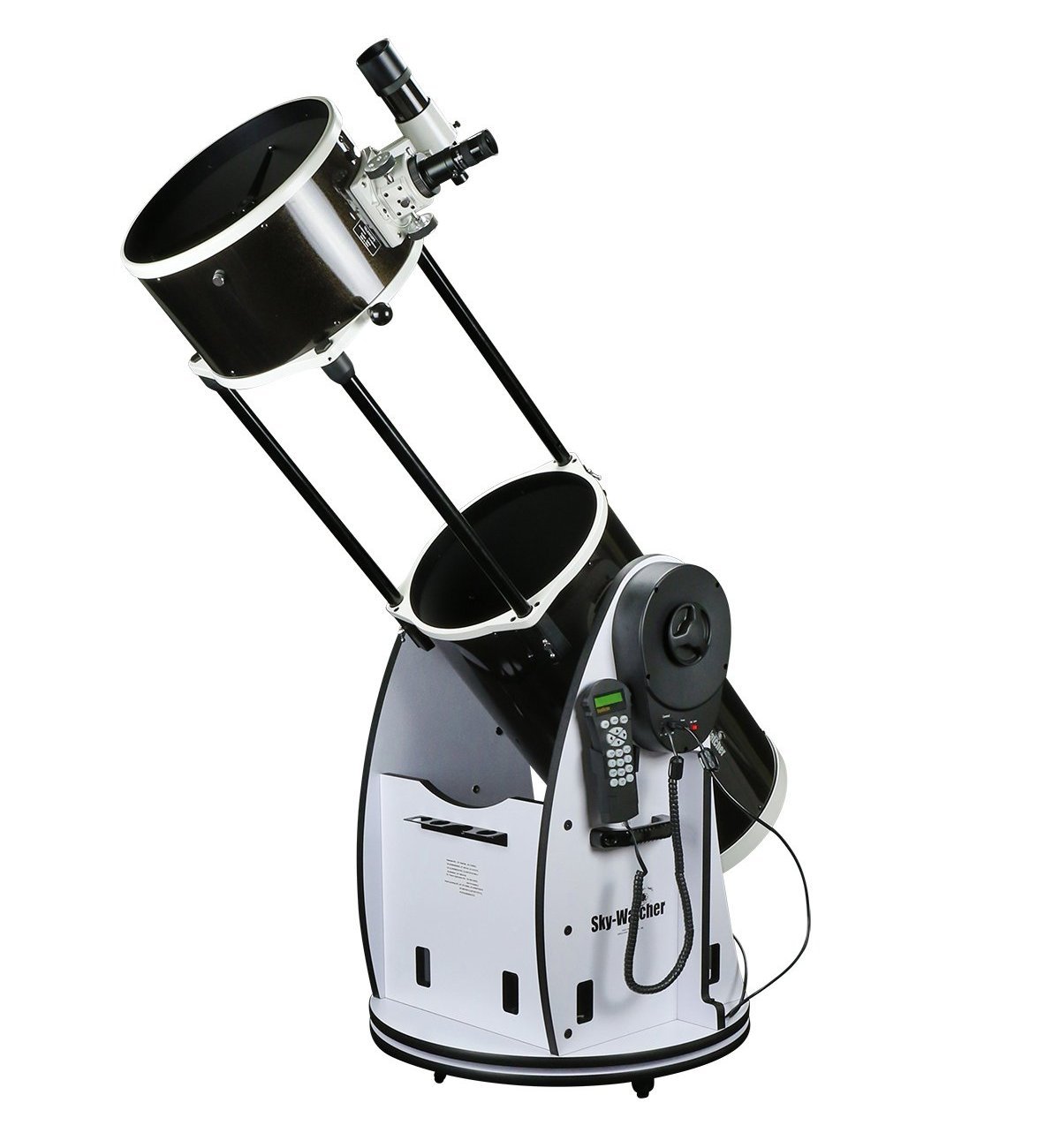
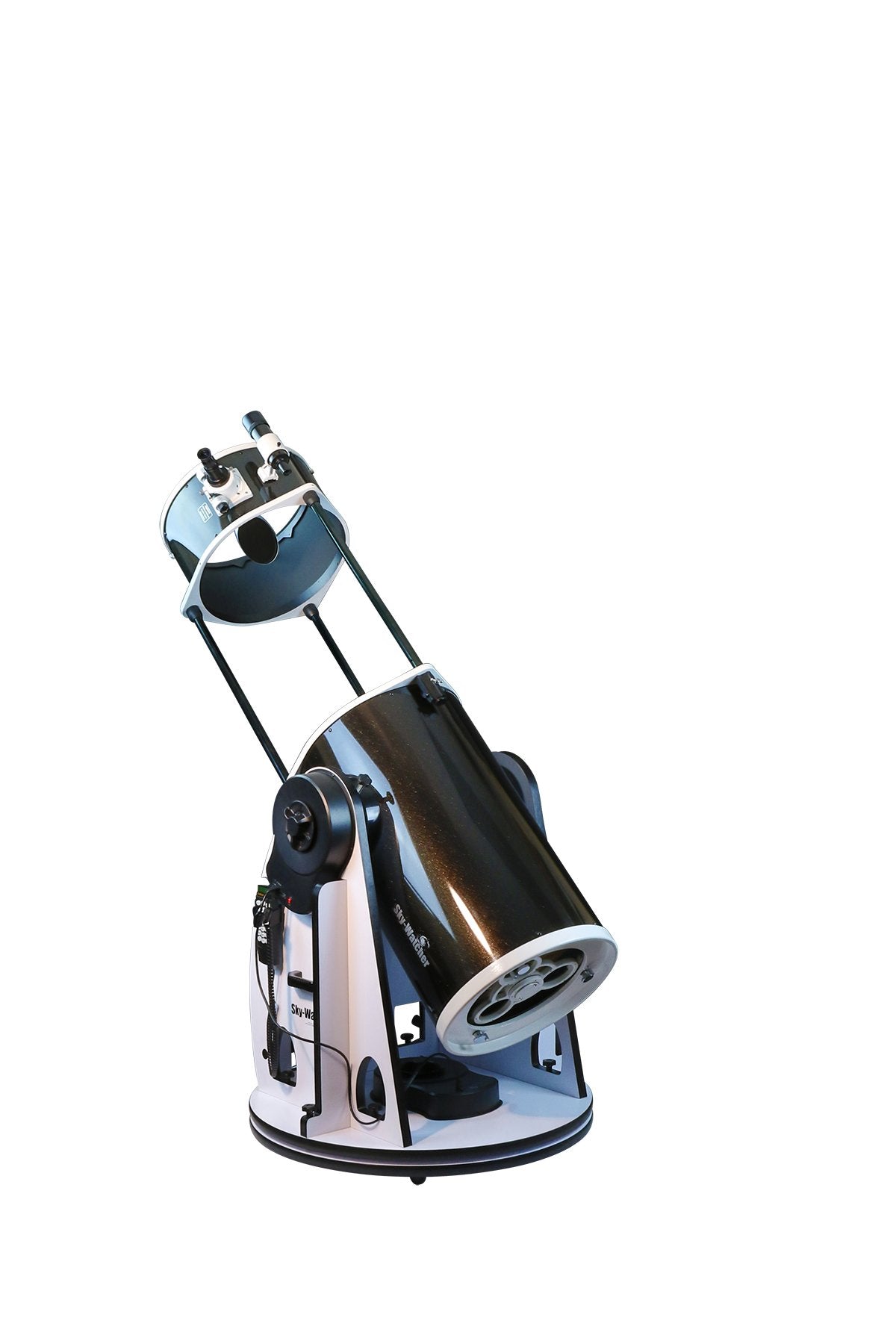
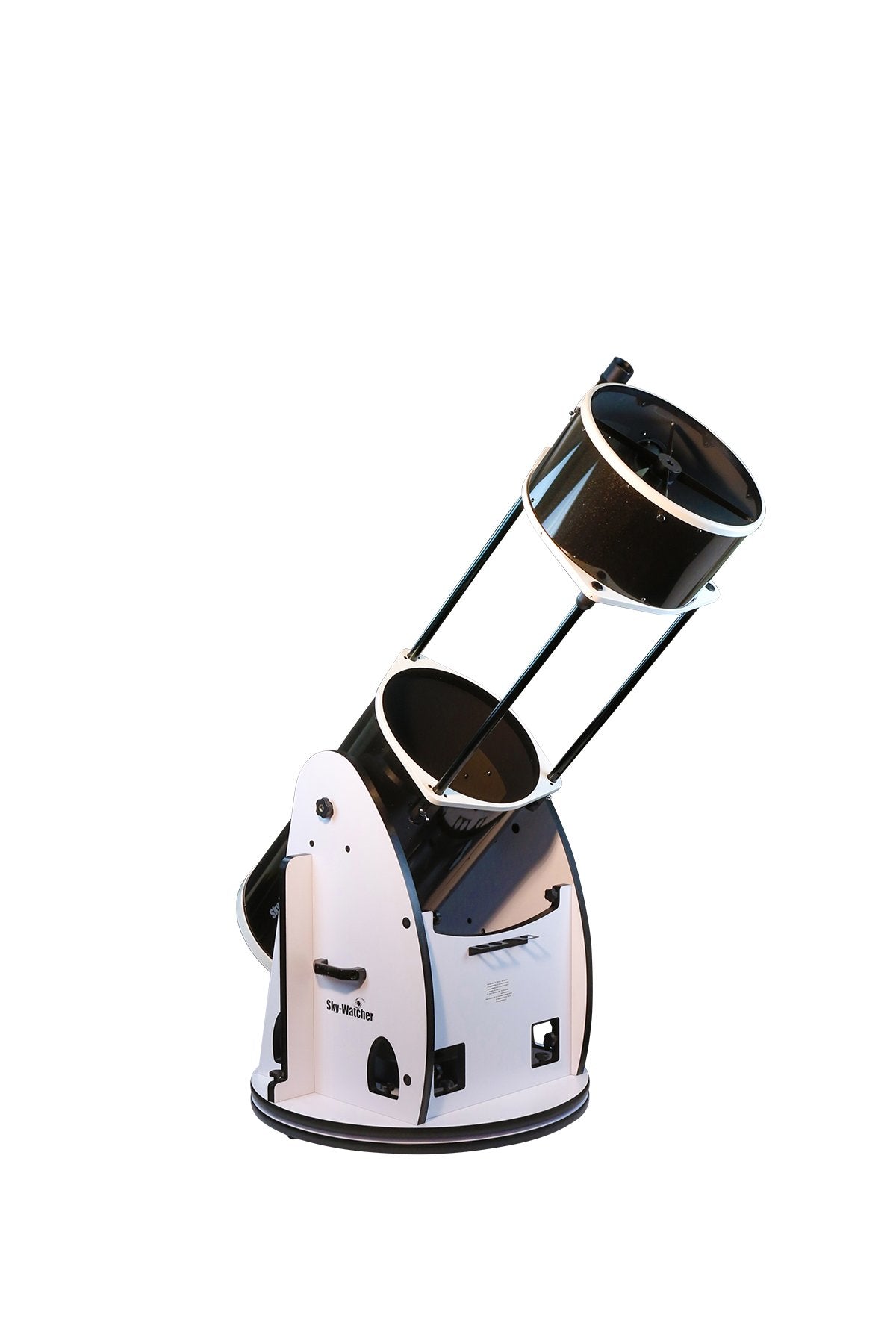
The Sky-Watcher Flextube 400P SynScan is a 406mm (16-inch) computerised GoTo Dobsonian with a collapsible truss tube — the largest telescope in the Flextube range and a serious light bucket. It runs 1800mm of focal length at f/4.4 and gathers 3257 times the light of the unaided eye, with a SynScan hand controller and built-in Wi-Fi driving it across 42,900 catalogued objects.
At this aperture the collapsible truss stops being a convenience and becomes the reason the telescope is ownable at all. It retracts for transport, holds collimation through the cycle, and travels as two pieces rather than a box of struts.
Who It Is For
This is a good match if you:
- Want the faintest targets within reach — 16 inches shows galaxy detail and dim planetary nebulae that smaller apertures only hint at.
- Have a permanent or semi-permanent observing site, or a level path and a dolly.
- Run outreach or club nights where one telescope has to impress a crowd.
- Want computerised finding on a large Dob without giving up the ability to push it by hand.
Key Features and Design
- 3257x the light grasp of the unaided eye: the aperture where faint galaxies stop being smudges and start showing arms and dust lanes.
- f/4.4 over 1800mm: fast for this size, giving a usable true field on an instrument that would otherwise be all magnification and no context.
- Dual-speed Crayford focuser: a fine-focus reduction the smaller SynScan models do not have — at f/4.4 the depth of focus is shallow, and coarse-only focusing would fight you every session.
- Patented collapsible truss tube: retracts for transport and storage while retaining collimation, and provides back focus for camera use.
- Patented Freedom Find dual encoders: push the tube by hand at any time with no re-alignment afterwards.
- SynScan GoTo with built-in Wi-Fi: hand controller and wireless control, with pointing accuracy published to 5 arc minutes.
- Patented tension control handle: essential at this mass for holding aim when a heavy eyepiece goes in.
Optical and Mechanical Design
Optically a fast Newtonian: 1800mm over a 406mm parabolic primary gives f/4.4. Two mirrors and no lenses means no chromatic aberration at any magnification, and the fast ratio keeps the tube shorter than the aperture would otherwise demand.
The dual-speed focuser is the mechanical detail that matters most here and the one that distinguishes this model from the 250P and 300P, which are single-speed. A fast focal ratio produces a shallow depth of focus, so the difference between sharp and nearly sharp is a very small movement of the drawtube. A fine-focus reduction turns that from a fiddle into a routine adjustment. Everything else follows the series: truss geometry that returns to the same position on extension so collimation survives, Freedom Find encoders reading both axes independently of the motors, and a rocker box carrying the mass low on Teflon bearings.
Recommended Uses
- Faint deep-sky observing: distant galaxy groups, dim planetary nebulae, and detail within brighter galaxies.
- Globular clusters: fully resolved across the core under good conditions.
- High-power planetary work: the resolution to exploit genuinely steady seeing.
- Outreach at scale: tracking holds the object while a long queue works through the eyepiece.
Compatibility and Accessory Notes
Supplied with a 9x50 straight-through finderscope, 12.5mm and 20mm four-element 1.25-inch Plössl eyepieces, and the SynScan hand controller. The 2-inch focuser accepts any standard 2-inch eyepiece, with the supplied adapter for 1.25-inch.
At f/4.4 eyepiece choice matters more than on a slower telescope — simpler designs show their limits at the field edge, and a well-corrected wide-field eyepiece is where the money goes first. A coma corrector is worth considering at this focal ratio. Power is 10 to 15 V DC at 1 amp through a 2.1mm centre-positive plug. A light shroud over the open truss is close to essential on an instrument this size. If you would like help specifying eyepieces, a coma corrector, power, or transport for this telescope, get in touch — at this level it is worth getting the supporting kit right the first time.
Good to Know Before You Order
- Plan the logistics before it arrives. This is a 16-inch telescope in two substantial pieces. Storage, the path to your observing spot, and a dolly are worth settling in advance.
- It needs power. The GoTo runs on 10 to 15 V DC, so a capable field battery is part of the kit.
- The eyepiece gets high. Near the zenith a 16-inch Dobsonian puts the eyepiece well above standing height, so an observing ladder or step is normal practice rather than a sign something is wrong.
- Deep-sky imaging is limited by the mount, not the optics. Back focus is available and tracking is dual-axis, but an alt-azimuth mount rotates the field over long exposures. Lunar and planetary capture suits it; long-exposure deep-sky does not.
- Cool-down is longest here. A mirror this large needs real time to reach ambient before it delivers its resolution.
Frequently Asked Questions
Is it difficult to set up?
The assembly is the same quick routine as the smaller Flextubes — extend the truss, seat the tube, connect power, run a two-star alignment. The demanding part is handling, not operating: this is a large telescope and moving it is the step worth planning.
Why does this model have a dual-speed focuser when the others do not?
At f/4.4 the depth of focus is shallow enough that a fine-focus reduction stops being a luxury. The 250P and 300P ship single-speed.
Can I move the telescope by hand?
Yes. Freedom Find dual encoders read position independently, so pushing the tube to a target does not cost you the alignment.
Can I use it for astrophotography?
Lunar and planetary imaging, yes. Long-exposure deep-sky imaging, no — field rotation is inherent to an alt-azimuth mount.
What comes in the box?
A 9x50 straight-through finderscope, 12.5mm and 20mm 1.25-inch Plössl eyepieces, and the SynScan hand controller. You supply a 10 to 15 V DC power source.
How is it different from the 300P SynScan?
406mm against 305mm, 1800mm against 1500mm, and 3257x against 1840x light grasp — plus the dual-speed focuser. The electronics are identical. The 300P is markedly easier to move and store.
Bottom Line
In short: a 406mm f/4.4 collapsible GoTo Dobsonian with dual-speed focusing and encoders that let you drive it or push it as you prefer. Sort out storage, transport, power, and a ladder, and it will show you deep sky that nothing smaller in the range can reach.
| Product Type | Computerised GoTo collapsible truss-tube Dobsonian reflector telescope |
|---|---|
| Item Number | S11840 |
| Aperture | 406mm (16-inch) |
| Focal Length | 1800mm |
| Focal Ratio | f/4.4 |
| Optical Design | Newtonian reflector with parabolic primary mirror |
| Mirror Coatings | Radiant Aluminum Quartz (RAQ), 94% reflectivity |
| Light Grasp | 3257x the unaided eye |
| Tube Design | Patented collapsible truss-tube, retains collimation; provides back focus for camera use |
| Focuser | 2-inch dual-speed Crayford-style with 1.25-inch adapter |
| Mount Type | Dobsonian rocker box with Teflon bearings |
| Altitude Control | Patented tension control handle |
| Encoders | Patented Freedom Find dual encoders, manual movement without re-alignment |
| GoTo Control | SynScan hand controller with built-in Wi-Fi |
| Database | 42,900 objects; complete Messier, NGC and IC, partial SAO, 25 user-defined |
| Motor Type | DC servo motors |
| Encoder Resolution | Motor encoder 1,620,000 counts per revolution; main axis encoder 11,748 counts per revolution |
| Slew Speeds | 1.0x, 2.0x, 8x, 16x, 32x, 200x, 400x, 600x, 800x, 1000x |
| Tracking Rates | Sidereal, lunar, and solar |
| Tracking Mode | Dual-axis tracking |
| Alignment Methods | Brightest-Star alignment, Two-Star alignment |
| GoTo Pointing Accuracy | Up to 5 arc minutes |
| Power Requirement | 10 to 15 V DC, 1 A, 2.1mm plug (centre positive) |
| Finderscope | 9x50 straight-through |
| Included Eyepieces | 12.5mm and 20mm 4-element 1.25-inch Plossl |
| Primary Use | Large-aperture computerised visual deep-sky observing and lunar and planetary imaging |
You may also like
Recently viewed
Recent Blog Posts
View all
Your Guide Graph Is Lying to You
Read More

D-Size vs V-Size: A Complete Guide to Telescope Dovetail Systems
Read More

What Is Back Focus in Astrophotography? Telescope Reducers, Flatteners, and Spacing Explained
Read More