


- Description
- Specifications
At a Glance
- Aperture: 300 mm
- Optical design: Parabolic Newtonian, borosilicate primary
- Tube: Collapsible truss, retains collimation
- Mirror coating: Radiant Aluminum Quartz (RAQ), 94% reflectivity
- Light-gathering power: 1840× the human eye
- Focuser: 2-inch Crayford-style with 1.25-inch adapter
Product Overview
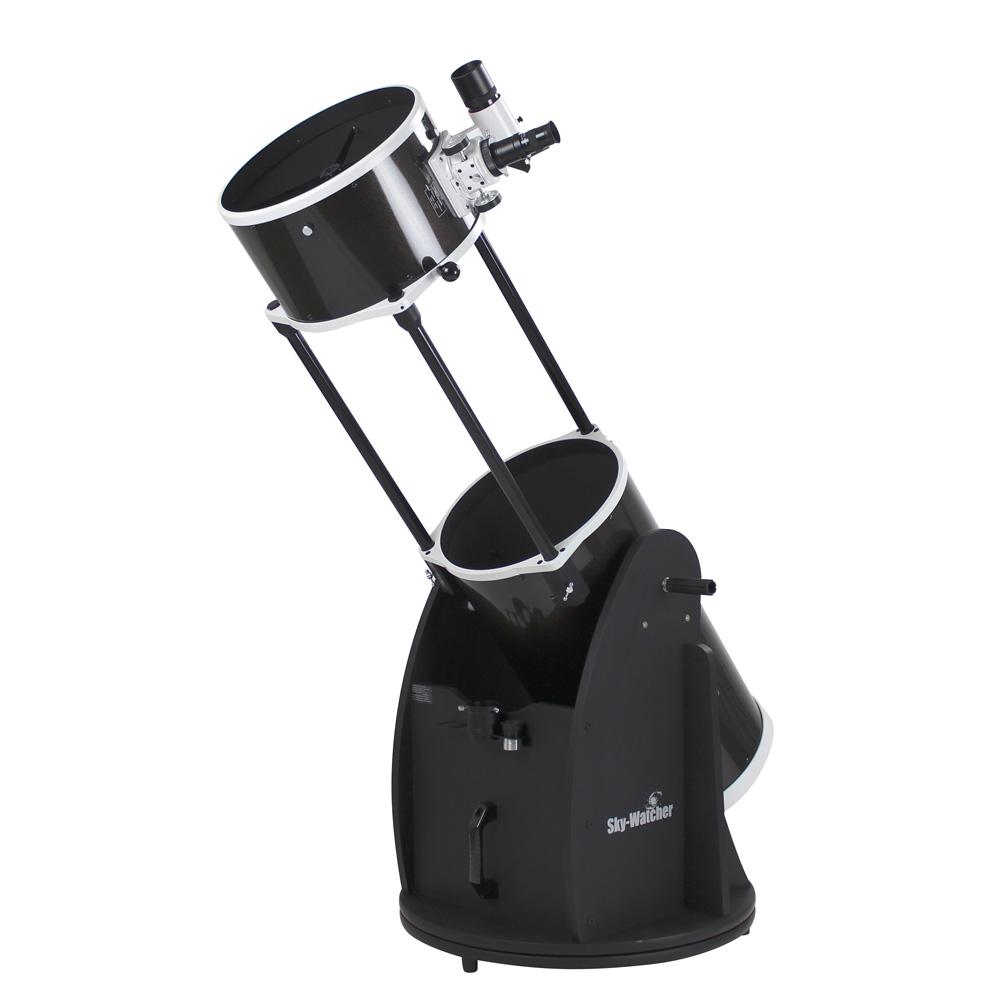
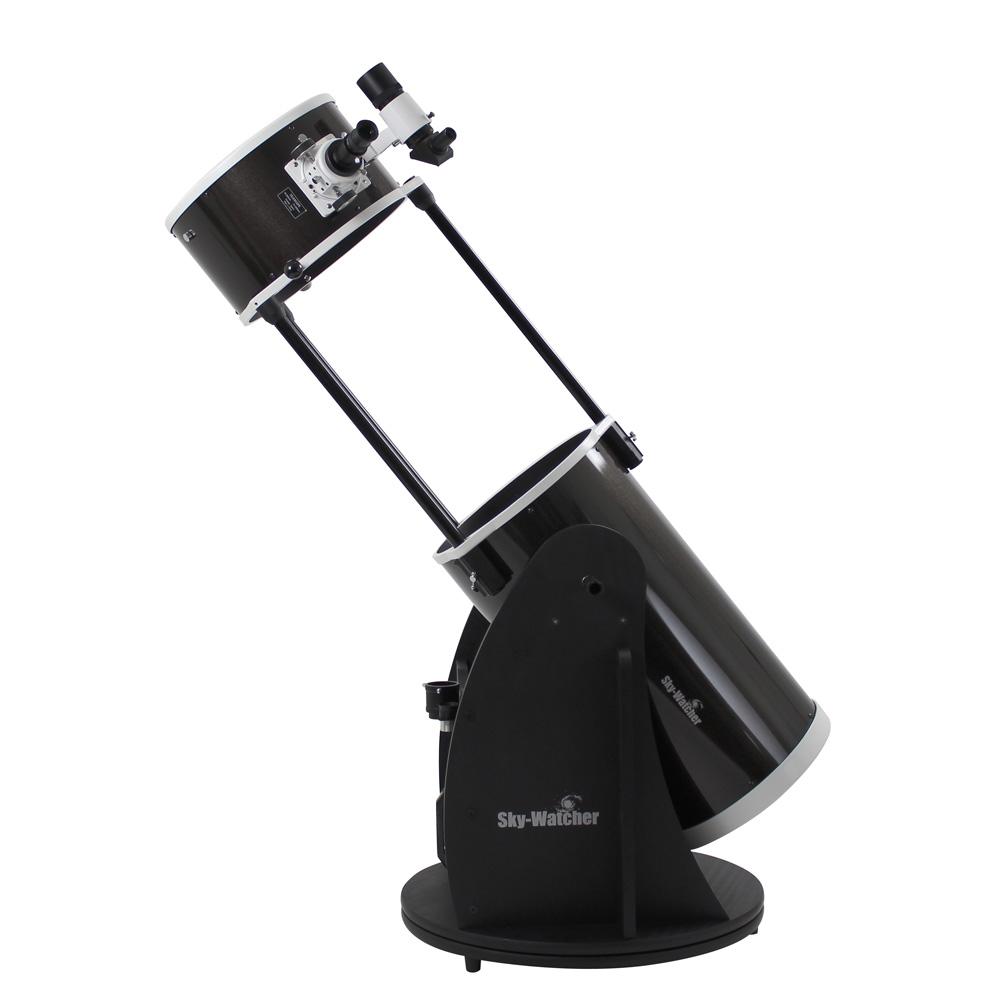
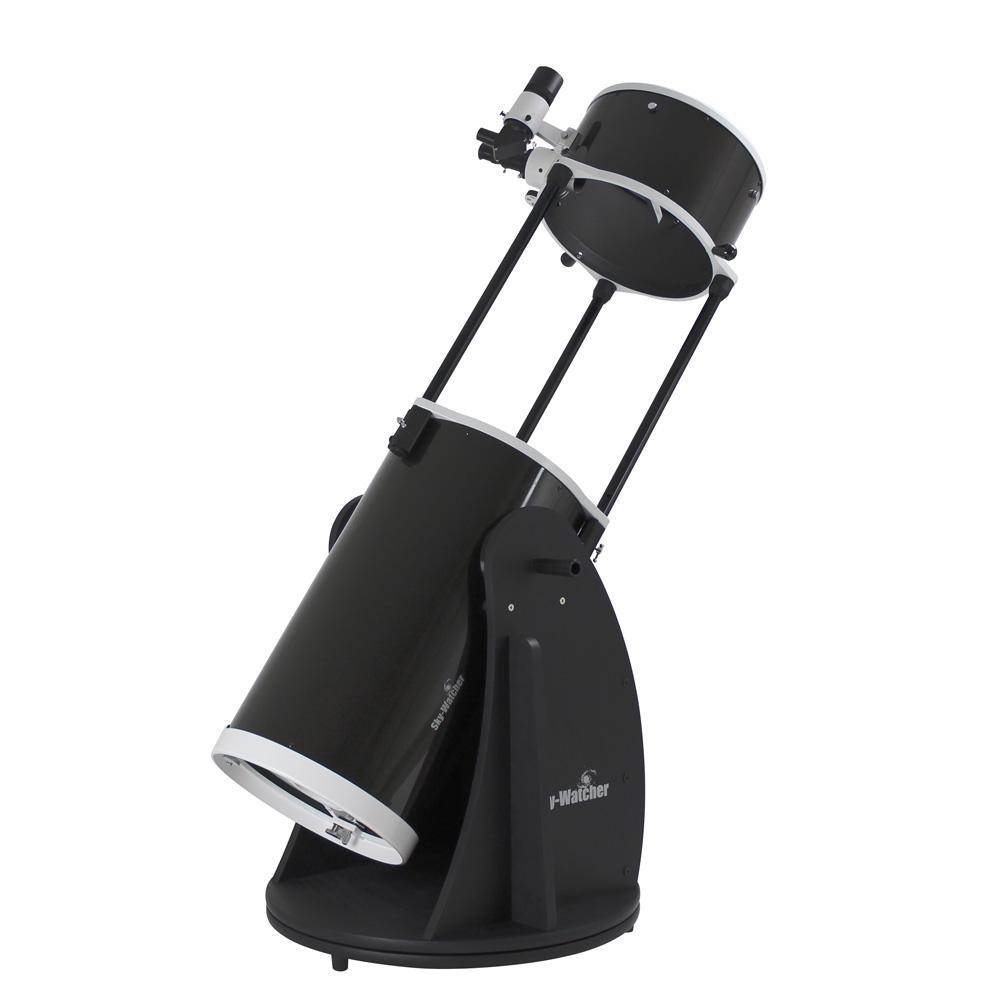
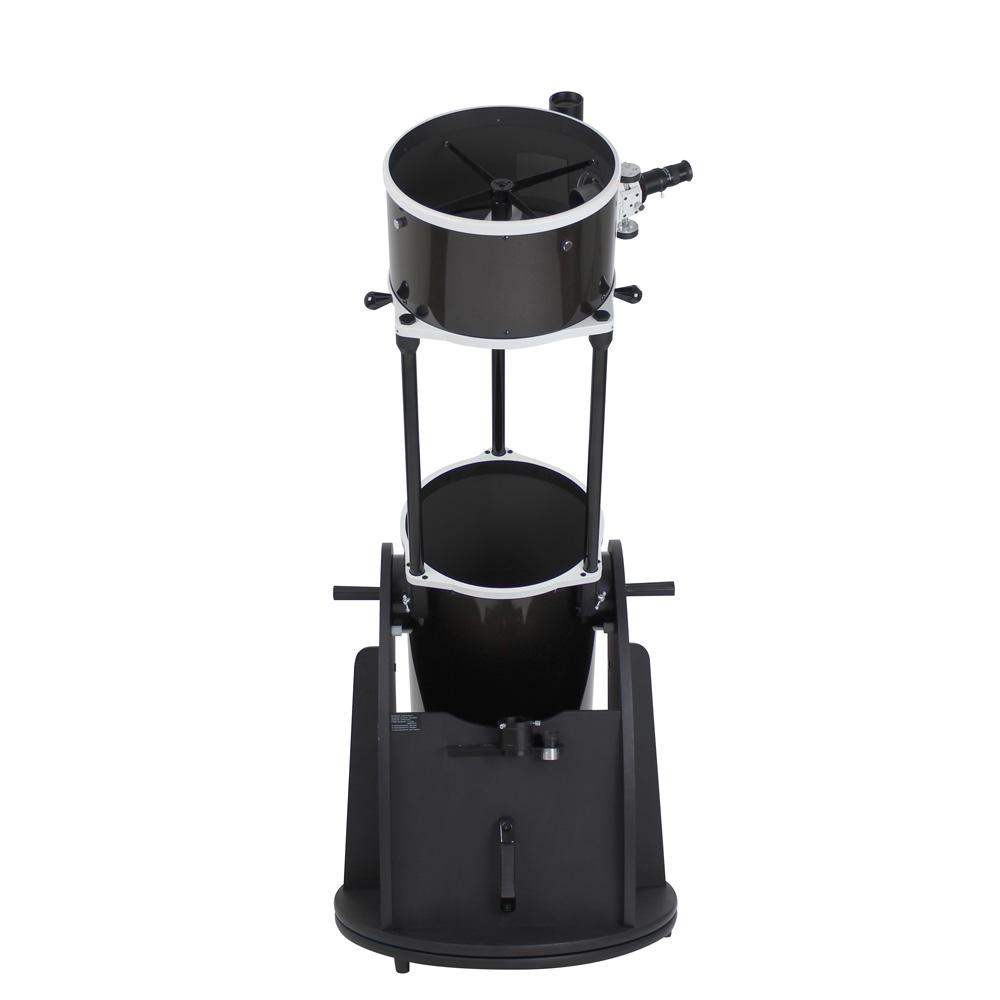
The Sky-Watcher Flextube 300P is a 300 mm Dobsonian reflector on a collapsing truss tube. The front and rear cells draw together along the truss rods and lock, which turns a twelve-inch-class instrument into something that fits in a vehicle rather than something that requires planning a vehicle around it. The design brings the optics back to alignment on re-extension, so the collapse is a transport step rather than a teardown.
The optics are a parabolic borosilicate primary coated with Sky-Watcher's Radiant Aluminum Quartz finish at 94% reflectivity, collecting 1840 times the light of the unaided eye. That figure is the reason to own this scope: at this aperture, objects stop being detections and start being observations. The tube sits in a heavy-duty rocker box on Teflon bearings with the patented tension control handle setting altitude friction.
Who It's For
This is a good match if visual deep-sky observing is your main interest and you have decided that aperture is what you want your money buying. Twelve inches is enough glass to show structure in objects that read as faint patches in an eight-inch, and enough to make a genuinely dark site worth the drive.
It suits you well if you already own a smaller Dobsonian and know what you would do with more light. It also works for a club or an observing group, where the base and tube can be handled between two people and the view is worth showing to a queue of visitors.
Key Features & Design
- Collapsible truss tube: a twelve-inch-class instrument that packs down to transportable length, so the aperture is one you can actually take to dark sky instead of one that stays home.
- Collimation retained through collapse: the truss rods return the cells to the same relative position, so arriving at a site means unfolding and observing rather than aligning first.
- 1840× light grasp: faint extended objects gain surface brightness, which is what turns a smudge into a shape with detail in it.
- Radiant Aluminum Quartz coating: 94% reflectivity, and at this aperture the absolute amount of light that percentage represents is substantial.
- Heavy-duty rocker box with Teflon bearings: the base is built for the mass it carries, so motion stays smooth rather than becoming a wrestling match as the tube gets bigger.
- Patented tension control handle: altitude friction is tunable, which matters more here than on smaller scopes because a heavy 2-inch eyepiece shifts the balance of a tube this size noticeably.
- 2-inch Crayford-style focuser with 1.25-inch adapter: both eyepiece formats are supported, and wide-field 2-inch oculars are where this aperture earns its keep.
Optical / Mechanical Design
The primary is parabolic rather than spherical, which at this aperture is not optional — a spherical mirror this large would show obvious aberration well before it reached useful magnification. Borosilicate is the substrate because a mirror of this diameter carries real thermal mass, and a glass that shifts less as it cools holds its figure while it equalises with the night air.
The coating is aluminium vacuum-deposited onto the polished surface, overcoated with hard quartz and further dielectric layers. The quartz is what makes the finish durable: bare aluminium is soft and degrades with humidity and handling, and a mirror this size is one you want to keep for decades rather than recoat.
In the base, Teflon pads are used instead of ball bearings. With this much mass in the tube, free-rolling bearings would make fine positioning genuinely difficult — momentum carries a heavy tube past the target. Teflon gives a controlled glide that stops where you stop pushing, and the tension handle sets how much resistance that glide has.
Recommended Uses
Deep-sky visual observing is what this aperture is built for: globular clusters resolved well into their cores, planetary nebulae showing internal structure, and galaxies presenting arms and dust lanes rather than just a bright centre. Faint Messier and NGC objects that are borderline in smaller scopes become routine targets.
Lunar and planetary observing benefits from the resolution when the atmosphere allows it, though seeing conditions become the limiting factor rather than the telescope. Public outreach and star parties are another natural fit — a bright, large image and a mount anyone can push by hand make it an effective scope to share.
Compatibility and Accessory Notes
The 2-inch Crayford-style focuser takes 2-inch eyepieces directly and 1.25-inch eyepieces through the supplied adapter, so the eyepieces you already own will fit. At this aperture a good wide-field 2-inch eyepiece makes a visible difference, and eyepieces with strong edge correction are worth the money here more than on a slower instrument.
Sky-Watcher supplies two 1.25-inch eyepieces, a 1.25-inch eyepiece adapter, a 2-inch eyepiece adapter, dust caps, and an 8x50 finderscope. Narrowband nebula filters in UHC and O-III types pair particularly well with this much aperture on emission targets, since there is enough light to spare for the filter to take some. A collimation tool belongs in the accessory list alongside any Newtonian of this size.
If you want help matching eyepieces or filters to this scope, send us what you have and we will work through it with you.
Good to Know Before You Order
The mount is manual and undriven. No motors, no tracking, no object database. You find targets yourself and re-centre them as they drift, which many observers prefer and which is how the sky gets learned. If computerised pointing and tracking are what you want at this aperture, the Flextube 300P SynScan is the equivalent scope with GoTo added.
It is not an astrophotography instrument. A Dobsonian rocker box is alt-azimuth, so the field rotates as an object moves across the sky, and long exposures smear regardless of tracking. Short-exposure lunar and planetary video with a small camera is the practical imaging limit.
It arrives as an optical tube and a separate base, and both are substantial. The two-piece design is what makes a twelve-inch scope manageable at all, and one person can move it in two trips. It is worth thinking about the route from where the scope is stored to where you observe before the first night.
Cool-down time scales with aperture. A mirror this size takes longer to reach ambient temperature than a smaller one, and the view improves as it does. Setting the scope outside while you get the rest of your gear ready covers most of it.
Newtonians need periodic collimation. The truss design holds alignment through the collapse, so this is an occasional check rather than a nightly task, and the supplied collimation cap handles the routine adjustment.
Frequently Asked Questions
Is it difficult to set up?
The mechanics are simple: release the truss clamps, raise the upper cage until it locks, tighten, and the scope is ready. The base assembles once. What takes planning is the carry rather than the assembly, since the tube and base are both meaningful weights — but neither requires tools or alignment work on the night.
How is this different from the Flextube 250P?
Two inches more aperture and a proportionally larger increase in light grasp, since gathering power follows mirror area. The 300P shows more on faint objects, and it costs more in money, mass, storage space and cool-down time. If you are choosing between them, the honest question is not which shows more — it is whether the larger one is the one you will actually take out.
Does it find or follow objects for me?
No. This is the manual version, so you locate targets with the finder and star charts and nudge the tube to keep them centred. The SynScan model in this series adds computerised location and tracking if that is the experience you want.
Can I photograph through it?
Lunar and planetary imaging with a short-exposure camera works. Deep-sky imaging does not, because there is no tracking and because alt-azimuth mounting rotates the field during an exposure. If deep-sky imaging is the aim, the answer is an equatorial mount and a different tube, and we are glad to talk that through.
Will my 2-inch eyepieces work?
Yes, directly. The 1.25-inch adapter is included for the smaller format, so both sizes work out of the box.
Is a twelve-inch scope too much telescope to use regularly?
That depends entirely on your storage and your route to the observing spot, which is exactly what the collapsing tube is designed to ease. Observers with a garage and a short carry use scopes this size constantly. If you are unsure how it would work in your situation, tell us about the space and the trip and we will give you a straight answer.
Bottom Line
In short: 300 mm of parabolic Newtonian aperture on a heavy-duty manual Dobsonian base, in a tube that collapses to a length you can transport. It is a visual instrument built around light grasp, it keeps its collimation through the fold, and it works with the eyepieces you already have.
| SKU | S11740 |
| UPC | 050234117401 |
| Optical Info | |
| Optical Design | Newtonian |
| Mirror Coatings | 94% Aluminum |
| Glass Type | Borosilicate |
| Primary Aperture (mm) | 305 |
| Primary Edge Thickness | 38mm |
| F/Ratio | 4.9 |
| Focal Length (mm) | 1500 |
| Secondary Diameter | 70mm |
| Secondary Obstruction (by diameter) | 23% |
| Secondary Obstruction by Area | 5% |
| Observational Info | |
| Dawes Limit | 0.38 |
| Rayleigh Limit | 0.46 |
| Limiting Mag. | 14.9 |
| Minimum Magnification | 43 |
| Maximum Magnification | 600 |
| Light Gathering (compared to next size down) | 44% |
| General Info | |
| Focuser | 2" Crayford |
| OTA Length (Retract/Ext.) | 36"/55" |
| OTA Outer Diameter | 14.25" |
| OTA Weight (with accessories) | 46.2 |
| Dob Base Weight | 38.3 |
| Dob Base Measurements | 29"x25" |
| Zenith Eyepiece Height | 55.5" |
| Accessories | |
| Included Finder | 8x50 RACI |
| Included Diagonal | No |
| Included Eyepieces | 25/10 Plossl |
| Magnification w/ Included Eyepieces | 60x/150x |
| Included Case | No |
| Corrector | No |
You may also like
Recently viewed
Recent Blog Posts
View all
Your Guide Graph Is Lying to You
Read More

D-Size vs V-Size: A Complete Guide to Telescope Dovetail Systems
Read More

What Is Back Focus in Astrophotography? Telescope Reducers, Flatteners, and Spacing Explained
Read More