


- Description
- Specifications
At a Glance
- Aperture: 250 mm
- Optical design: Parabolic Newtonian, borosilicate primary
- Tube: Collapsible truss, retains collimation
- Mirror coating: Radiant Aluminum Quartz (RAQ), 94% reflectivity
- Light-gathering power: 1235× the human eye
- Focuser: 2-inch Crayford-style with 1.25-inch adapter
Product Overview
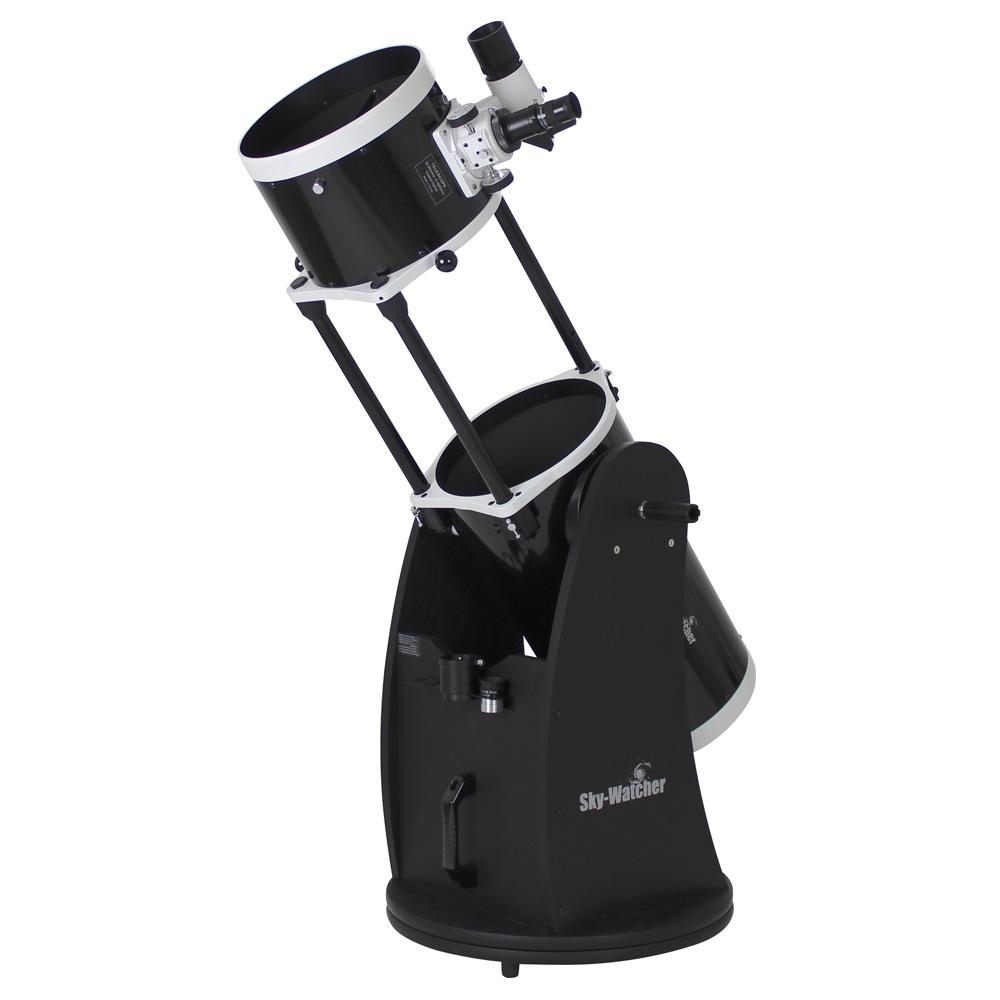
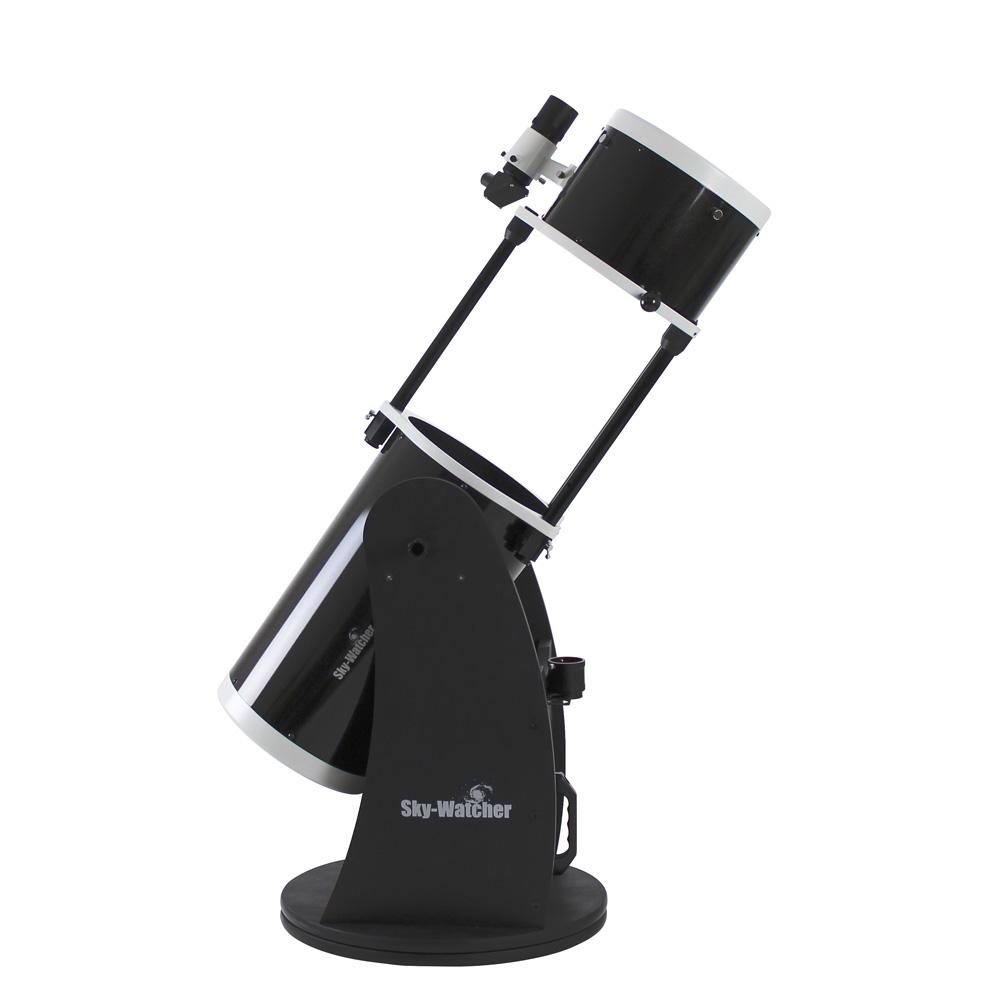
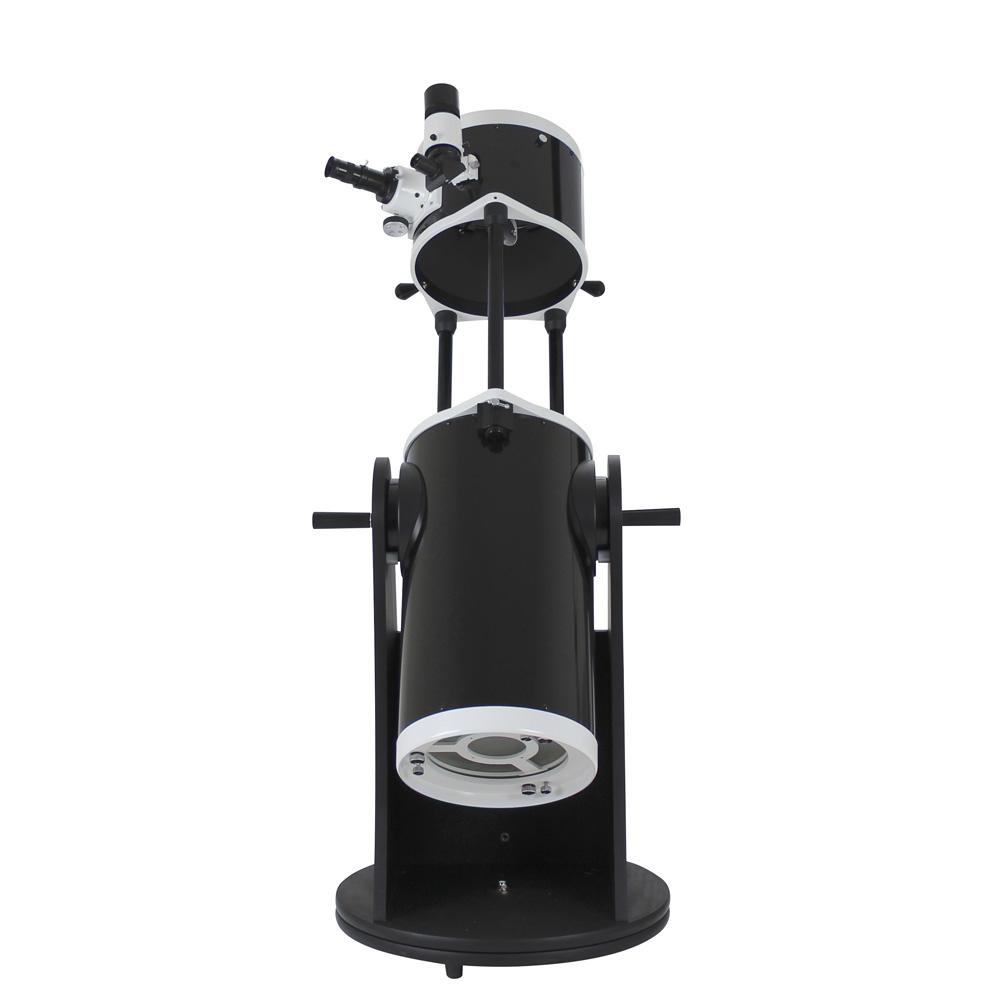
The Sky-Watcher Flextube 250P is a 250 mm Dobsonian reflector built around a tube that collapses on truss rods rather than one that stays rigid at full length. The front and rear cells slide together along the rods and lock down, which shortens the assembly enough to fit across a back seat or into a closet, and the design holds collimation through the collapse and re-extension cycle.
Optically it is a straightforward parabolic Newtonian: a borosilicate primary finished with Sky-Watcher's Radiant Aluminum Quartz coating at 94% reflectivity, gathering 1235 times the light of the unaided eye. The tube rides in a Dobsonian rocker box on Teflon bearings, with a patented tension control handle that sets altitude friction so the tube stays where it is pointed.
Who It's For
This is a good match if you observe visually and want serious aperture that still fits in your vehicle and your storage space. Ten inches of aperture is where a lot of deep-sky observing opens up, and the collapsing tube is what makes that aperture practical for someone without a permanent setup or a large trunk.
It also suits you well if you are stepping up from a smaller reflector and want the extra light grasp without moving to a solid tube you would need help to carry. Anyone whose observing involves a drive to a dark site will get the most out of the collapsing design, since that is precisely the trip it was built for.
Key Features & Design
- Collapsible truss tube: the scope stores and travels at a fraction of its observing length, so the aperture you can own stops being limited by the space you have to put it.
- Collimation held through collapse: the truss rods index the cells back to the same relative position, so setting up at the site is an unfold rather than an alignment session.
- Radiant Aluminum Quartz coating: 94% reflectivity puts more of the collected light through to the eyepiece, which shows up on faint extended objects where every percent counts.
- Teflon bearings on both axes: motion is smooth and continuous rather than sticky, so tracking an object by hand at higher magnification does not fight you.
- Patented tension control handle: altitude friction is adjustable, so the tube holds position as you swap a light eyepiece for a heavy one instead of drifting under the new load.
- 2-inch focuser with 1.25-inch adapter: both eyepiece formats work natively, so wide-field 2-inch oculars and standard 1.25-inch eyepieces are both on the table.
Optical / Mechanical Design
The primary is a parabola rather than a sphere, which is what keeps stars as points across the field at this focal ratio instead of smearing them into the soft blur a spherical mirror of the same aperture would produce. The substrate is borosilicate, chosen because it changes dimension less than ordinary glass as the temperature drops through an evening, so the figure holds while the mirror equalises.
Sky-Watcher's coating stack is aluminium vacuum-deposited onto the polished surface and then overcoated with hard quartz, with further layers applied on top. The quartz overcoat is the durable part: it protects a soft aluminium layer that would otherwise degrade with handling and humidity, and the finished surface reflects 94%.
Mechanically the interesting choice is Teflon rather than ball bearings in the rocker box. Ball races roll freely, which sounds desirable until you are trying to nudge a 250 mm tube a few arc minutes and it coasts past the target. Teflon pads give a consistent low-stiction glide that starts and stops where you put it, and the tension handle tunes how much resistance that glide carries.
Recommended Uses
Deep-sky visual observing is the core application: globular clusters resolving to individual stars, emission nebulae showing structure rather than just presence, and the brighter galaxies beginning to show arm and dust detail from a genuinely dark site.
Lunar and planetary observing works well too, with the aperture supporting high magnification on nights when the atmosphere cooperates. The scope also suits outreach and public observing sessions, where a large bright image and a mount anyone can push around by hand are worth more than computerised pointing.
Compatibility and Accessory Notes
The 2-inch Crayford-style focuser accepts 2-inch eyepieces directly and 1.25-inch eyepieces through the supplied adapter, so essentially any modern eyepiece will fit. At this aperture and focal ratio, wide-field 2-inch eyepieces are where the scope shows its character, and eyepieces with good edge correction will reward the investment more than they would on a slower instrument.
Sky-Watcher supplies the scope with two 1.25-inch eyepieces, a 1.25-inch eyepiece adapter, a 2-inch eyepiece adapter, dust caps, and an 8x50 finderscope. Nebula filters such as UHC and O-III types thread into standard eyepiece barrels and pair well with this much aperture on emission targets. A collimation tool is worth having alongside it, as with any Newtonian.
If you are unsure whether a particular eyepiece or filter suits this scope, send us the details and we will work it out with you.
Good to Know Before You Order
The mount is manual and undriven. There is no motor and no tracking on this model. Objects drift through the field at higher magnifications and you re-centre them by hand, which most visual observers find becomes second nature quickly. If you would rather the scope find and follow targets for you, the Flextube 250P SynScan is the same aperture class with GoTo and tracking added.
It is not an astrophotography instrument. Beyond the absence of tracking, a Dobsonian rocker box is an alt-azimuth mount, so the field of view slowly rotates as an object crosses the sky even when the target is kept centred. That rotation smears long exposures regardless of how well you follow the object. Short-exposure lunar and planetary video work with a small camera is the realistic imaging ceiling here.
It ships as an optical tube and a separate base. Both parts are manageable individually, and this is what makes the scope a one-person load, but it is a two-trip carry from vehicle to observing spot rather than a single lift.
Newtonians need occasional collimation. The truss design holds alignment through collapse, so this is a periodic check rather than a nightly ritual, and the collimation cap supplied with the scope covers the routine adjustment.
Frequently Asked Questions
Is it difficult to set up?
No. Extending the tube is a matter of releasing the truss clamps, drawing the front cell up to its stop, and locking it again, and the design brings the optics back to the same alignment each time. The base assembles once and stays assembled. Most of the first night goes to learning the sky rather than the hardware.
How is this different from the Classic 250P?
Same aperture, different tube. The Classic 250P is a solid tube, which is simpler and costs less; the Flextube collapses for transport and storage. If the scope will live in one place and you have room for it, the Classic is the value choice. If it has to travel or fit somewhere it does not obviously fit, the collapsing tube is what you are paying for.
Does collapsing it ruin the collimation?
The truss rods index the cells back to a repeatable position, which is the whole point of the design, so alignment survives the collapse and re-extension. Like any Newtonian it still benefits from an occasional check, but collapsing it is not what knocks it out.
Can I photograph through it?
Lunar and planetary work with a short-exposure camera is realistic. Deep-sky imaging is not, because the mount neither tracks nor compensates for the field rotation inherent to an alt-azimuth design. If deep-sky imaging is the goal, an equatorial mount and a shorter, faster tube is the direction to look, and we are happy to talk that through.
Will my 2-inch eyepieces work?
Yes, directly in the focuser. The 1.25-inch adapter is supplied for the smaller format, so both sizes are covered without buying anything.
What makes it worth stepping up from an 8-inch?
Light grasp scales with mirror area, not diameter, so the jump is larger than the numbers suggest. Objects that read as faint smudges in a smaller scope start showing structure, and targets that were borderline become routine. The collapsing tube is what keeps that step up from also being a step up in storage and transport problems.
Bottom Line
In short: 250 mm of parabolic Newtonian aperture on a smooth manual Dobsonian base, in a tube that folds down to fit where a solid 10-inch will not. It is built for visual observing, it holds its collimation through the fold, and it works with the eyepieces you already own.
| SKU | S11720 |
| UPC | 050234117203 |
| Optical Info | |
|---|---|
| Optical Design | Newtonian |
| Mirror Coatings | 94% Aluminum |
| Glass Type | Borosilicate |
| True Aperture (mm) | 257 |
| Primary Aperture (mm) | 254 |
| F/Ratio | 4.7 |
| Focal Length (mm) | 1200 |
| Secondary Diameter | 64mm |
| Secondary Obstruction (by diameter) | 25% |
| Secondary Obstruction by Area | 6% |
| Observational Info | |
| Dawes Limit | 0.46 |
| Rayleigh Limit | 0.55 |
| Limiting Mag. | 14.5 |
| Minimum Magnification | 36 |
| Maximum Magnification | 500 |
| Light Gathering (compared to next size down) | 57% |
| General Info | |
| Focuser | 2" Crayford |
| OTA Length (Retract/Ext.) | 31.5"/44" |
| OTA Outer Diameter | 11.375" |
| OTA Weight (with accessories) | 33 |
| Dob Base Weight | 26.5 |
| Dob Base Measurements | 29.5"x20" |
| Zenith Eyepiece Height | 48" |
| Accessories | |
| Included Finder | 8x50 RACI |
| Included Diagonal | No |
| Included Eyepieces | 25/10 Plossl |
| Magnification w/ Included Eyepieces | 48x/120x |
| Included Case | No |
| Corrector | No |
You may also like
Recently viewed
Recent Blog Posts
View all
Your Guide Graph Is Lying to You
Read More

D-Size vs V-Size: A Complete Guide to Telescope Dovetail Systems
Read More

What Is Back Focus in Astrophotography? Telescope Reducers, Flatteners, and Spacing Explained
Read More