


- Description
- Specifications
At a Glance
- Aperture: 200mm (8-inch)
- Optical design: Newtonian reflector, parabolic primary
- Tube: Collapsible truss, retains collimation
- Mirror coating: Radiant Aluminum Quartz, 94% reflectivity
- Focuser: 2-inch Crayford-style, 1.25-inch adapter supplied
- Mount: Manual Dobsonian rocker box, Teflon bearings
Product Overview
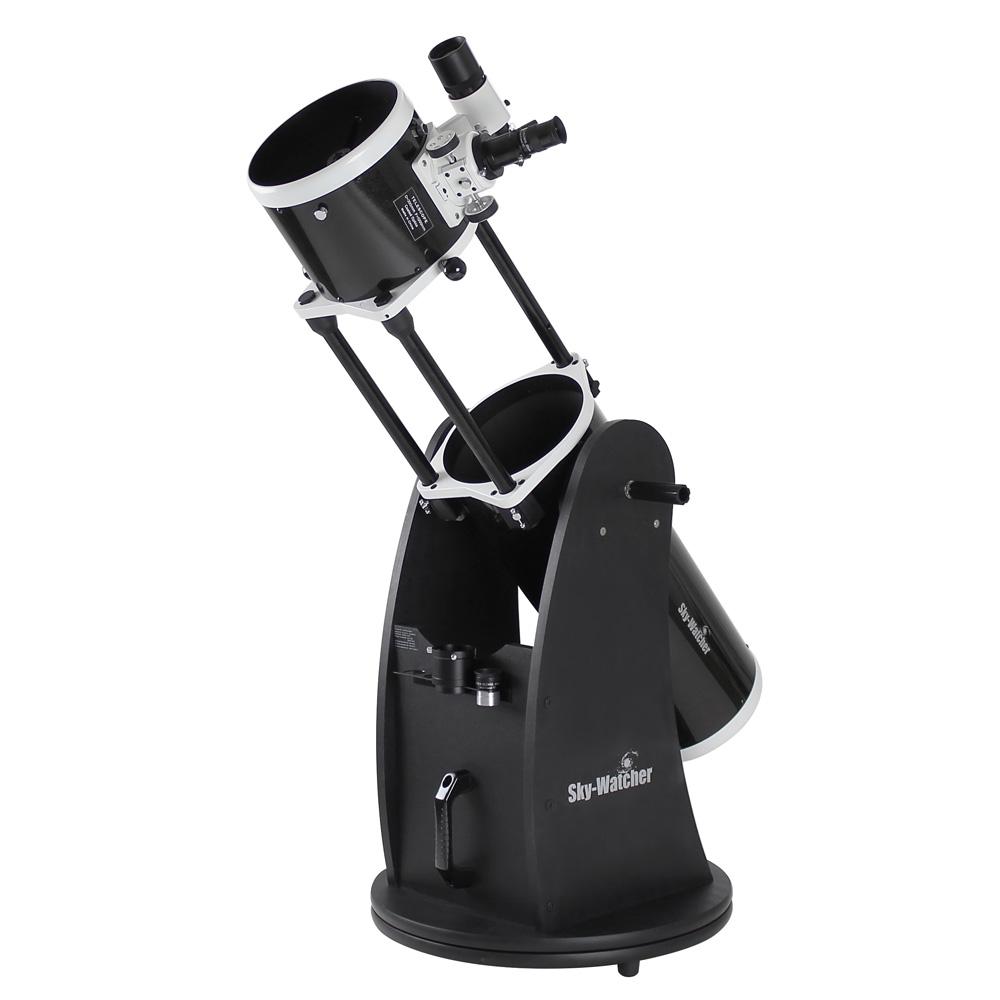
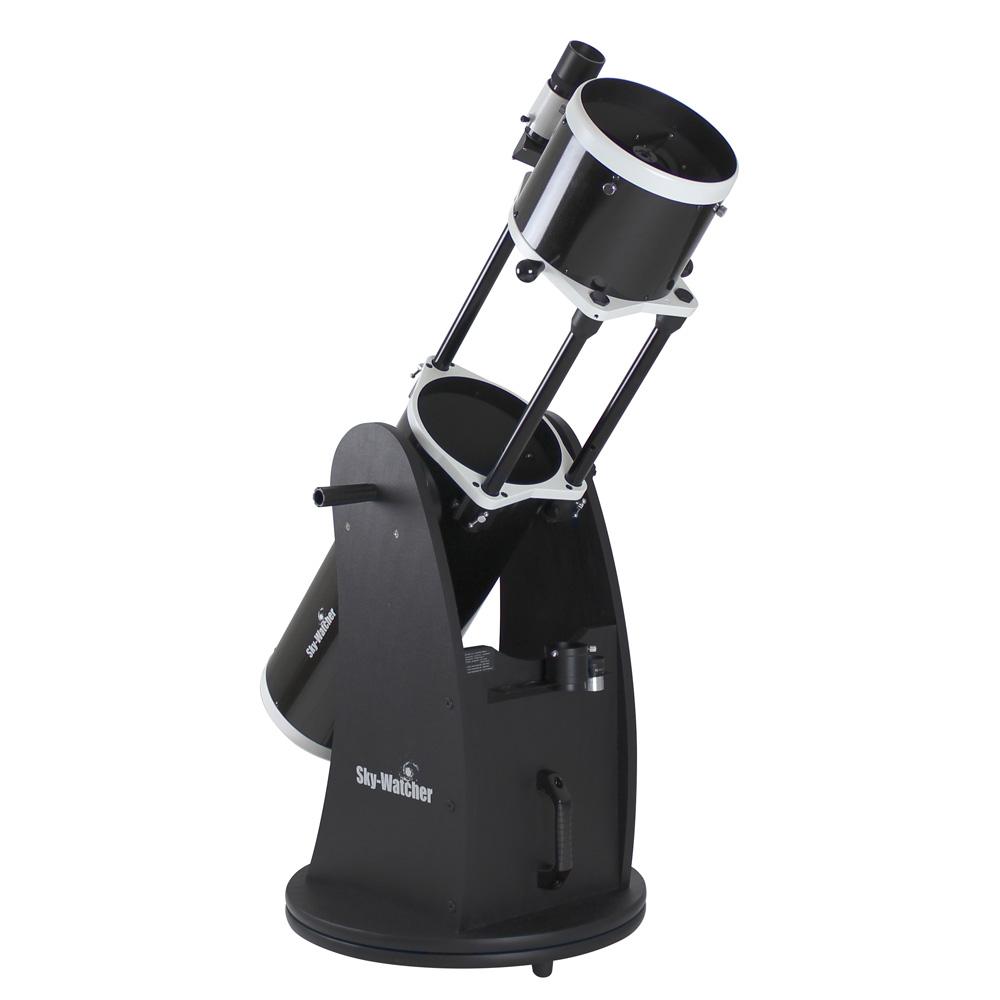
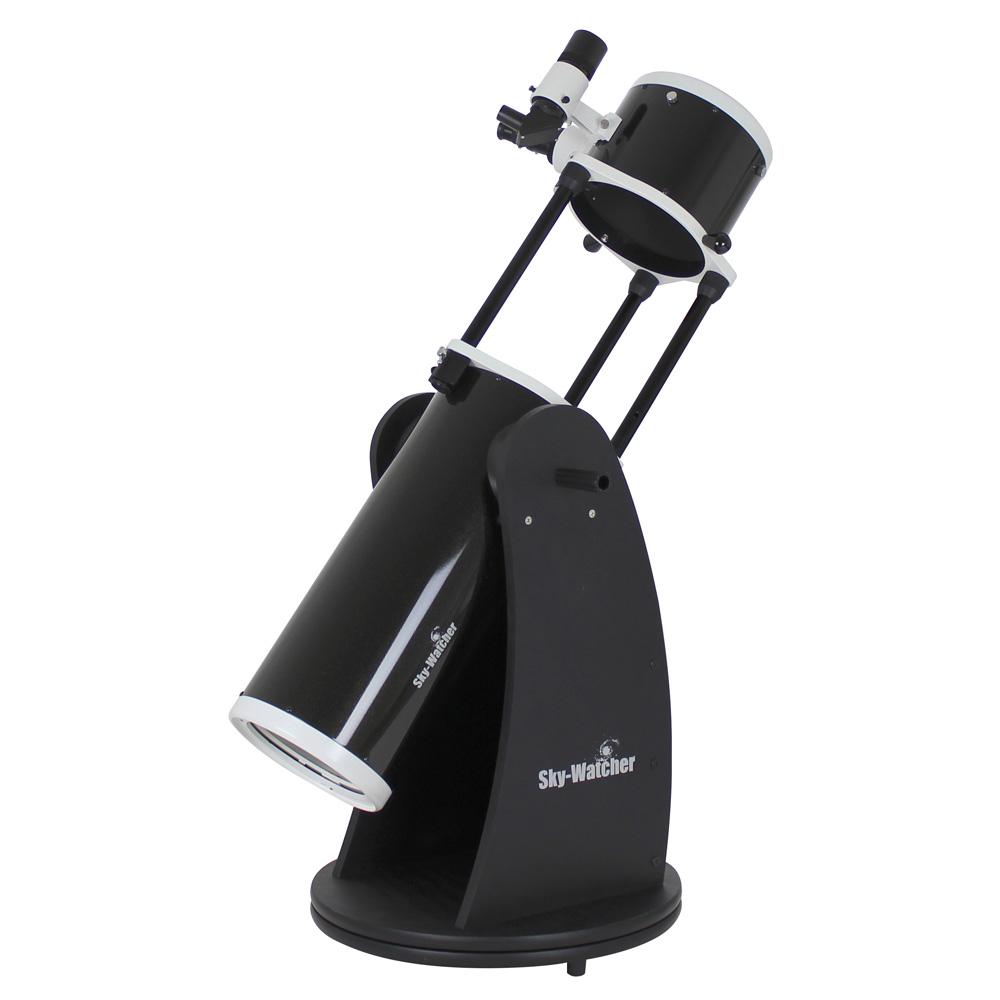
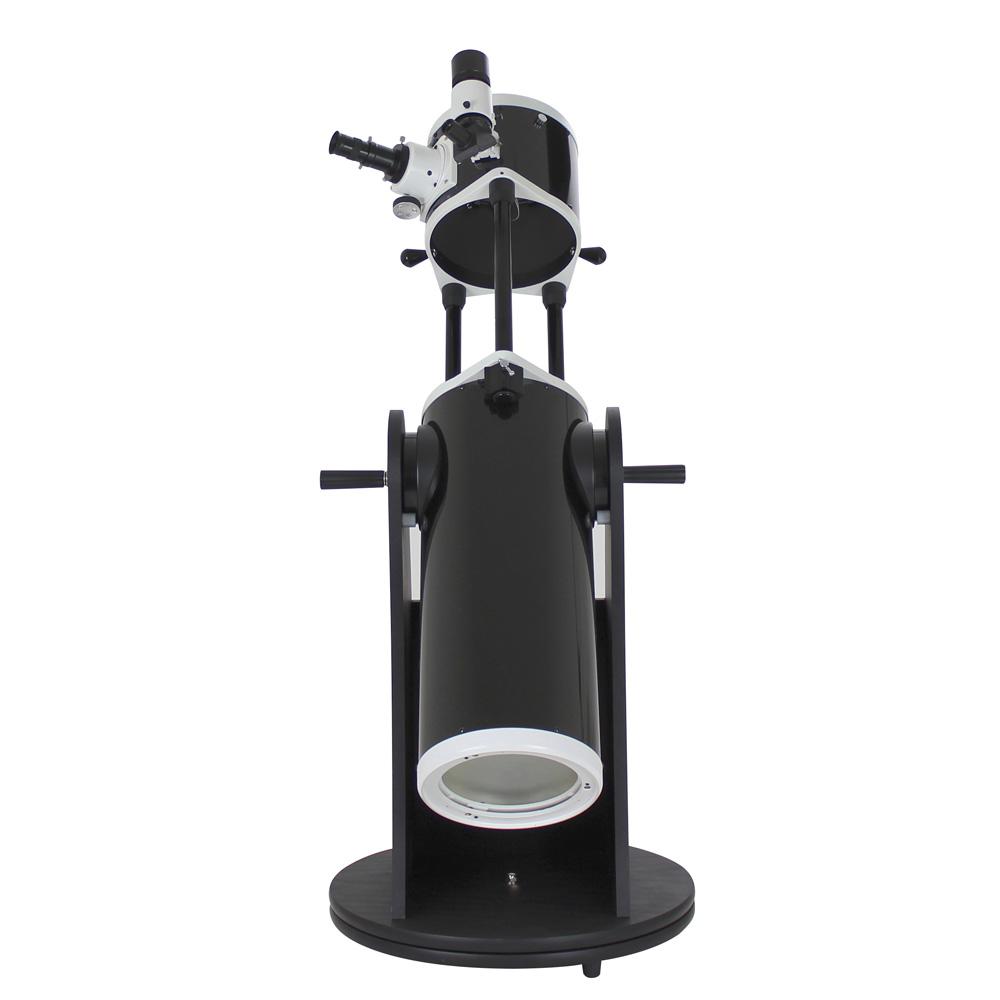
The Sky-Watcher Flextube 200P is a 200mm (8-inch) collapsible Dobsonian reflector for visual astronomy. It takes the optics of a conventional 8-inch Dobsonian and puts them in a patented truss-tube assembly that retracts for transport and storage, then extends for observing — and it holds collimation through the cycle, so collapsing it is not a decision you pay for later in setup time.
Sky-Watcher publishes its light grasp as 816 times that of the unaided eye.
Who It Is For
This is a good match if you:
- Want 8-inch aperture but cannot store a full-length tube — the collapsed length is the entire point of this design.
- Drive to darker skies and need the telescope to fit a car boot alongside everything else.
- Observe visually across deep-sky and planetary targets and want aperture rather than electronics.
- Live somewhere with stairs or a tight hallway between storage and the observing spot.
Key Features and Design
- Collimation survives the collapse: the truss locates positively on extension, so the telescope is ready to observe rather than ready to re-align — the difference between a design that saves space and one that costs time.
- 816x the light grasp of the unaided eye: full 8-inch performance, not a compromise made for portability.
- True parabolic figure: stars stay tight to the field edge instead of softening under a wide-field eyepiece.
- 94% reflectivity from the RAQ coating: paid twice over on a two-mirror system, with a quartz overcoat protecting the aluminium.
- Crayford-style focuser action: low backlash, so high-power focus lands where you put it.
- Patented tension control handle: balances heavier eyepieces so the tube holds its aim rather than drifting down.
Optical and Mechanical Design
Optically this is a Newtonian reflector: light travels to the parabolic primary, back to a flat secondary, and out to the focuser on the side of the tube. Working entirely with mirrors means no chromatic aberration at all — no false colour on Jupiter, Venus, or the lunar limb at any magnification.
The difference from a solid-tube Dobsonian is structural. Rather than one rigid tube, the upper cage rides on truss struts that slide down over the mirror box. Sky-Watcher designed the extended position to locate positively, which is why collimation survives the collapse — the mirrors return to the same relative geometry each time. In practice you extend the tube, tighten the clamps, and observe. The rocker box underneath is the same proven arrangement as the Classic range, carrying the load low and wide with no tripod, counterweights, or polar alignment involved.
Recommended Uses
- Travel and dark-sky observing: the design exists for observers who move the telescope regularly.
- Deep-sky observing: globular clusters resolving to stars, brighter galaxies, and nebulae with a filter.
- Planetary and lunar observing: 200mm has the resolution to take high magnification on steady nights.
- Outreach nights: transports assembled in two pieces and sets up quickly on site.
Compatibility and Accessory Notes
The 2-inch Crayford focuser accepts any standard 2-inch eyepiece, and the supplied adapter steps it down to 1.25-inch, so effectively any eyepiece will fit. A wide-field 2-inch eyepiece is the upgrade that most changes what this telescope shows on large clusters and extended nebulae.
Filters thread onto eyepiece barrels in both sizes; a UHC or O-III lifts nebula contrast noticeably from suburban skies. A Cheshire or laser collimator is worth owning — collimation survives collapsing, but every Newtonian benefits from a periodic check. A light shroud over the open truss section is a common addition for observing near streetlights or in dewy conditions. If you would like help choosing eyepieces, filters, or a shroud for this scope, get in touch and we will sort it out with you.
Good to Know Before You Order
- This is a visual instrument. The alt-azimuth base does not track, so long-exposure deep-sky imaging is outside what it does. Lunar and planetary capture works well.
- The truss section is open. Unlike a solid tube, stray light and dew can reach the light path from the side. A shroud addresses both and is inexpensive.
- Collapsed does not mean small. It is a genuinely more portable 8-inch, but the mirror box and rocker box are still two separate carries.
- Targets drift at high power and get nudged back by hand — that is how a Dobsonian works, and it becomes automatic within a session.
- Give the mirror time to cool. Setting it outside while you organise the rest of your gear pays off directly in planetary detail.
Frequently Asked Questions
Is it difficult to set up?
No. Extend the truss until it locates, tighten the clamps, drop the tube into the rocker box, and fit an eyepiece. There is no alignment routine, no levelling, and no power required.
Does collapsing the tube ruin the collimation?
No — the truss system is designed to retain collimation through the collapse and extension cycle. A periodic check with a collimation tool is still sensible, as with any Newtonian.
What is it best used for?
Visual deep-sky and planetary observing, particularly if you transport the telescope. At 200mm globulars resolve and brighter galaxies show structure.
Can I use it for astrophotography?
Not for deep-sky imaging, since the mount does not track. Lunar and planetary imaging with a planetary camera is achievable.
How is it different from the Classic 200P?
Identical aperture and the same Crayford-style focuser. The Flextube collapses for transport and storage; the Classic is a solid tube, mechanically simpler and with no open truss section to shroud.
How is it different from the Flextube 200P SynScan?
The SynScan version adds computerised GoTo — motors, a hand controller, and an object database that drives the telescope to targets and tracks them. This version is manual throughout.
Bottom Line
In short: a 200mm parabolic Dobsonian whose truss tube collapses for transport without losing collimation. It gives you full 8-inch light grasp and a Crayford focuser in a package that actually fits in a car and a cupboard, which for most owners means it gets used far more often than a solid tube of the same aperture.
| Product Type | Manual collapsible truss-tube Dobsonian reflector telescope |
|---|---|
| Item Number | S11700 |
| Aperture | 200mm (8-inch) |
| Optical Design | Newtonian reflector with parabolic primary mirror |
| Tube Design | Patented collapsible truss-tube system, retains collimation when collapsed and extended |
| Mirror Substrate | Borosilicate glass |
| Mirror Coatings | Radiant Aluminum Quartz (RAQ), 94% reflectivity |
| Focuser | 2-inch Crayford-style with 1.25-inch adapter |
| Mount Type | Dobsonian rocker box with Teflon bearings |
| Altitude Control | Patented tension control handle |
| Eyepiece Compatibility | Accepts both 1.25-inch and 2-inch eyepieces |
| Light Grasp | 816x the unaided eye |
| Primary Use | Portable visual observing of star clusters, nebulae, galaxies, the Moon, and planets |
You may also like
Recently viewed
Recent Blog Posts
View all
Your Guide Graph Is Lying to You
Read More

D-Size vs V-Size: A Complete Guide to Telescope Dovetail Systems
Read More

What Is Back Focus in Astrophotography? Telescope Reducers, Flatteners, and Spacing Explained
Read More