
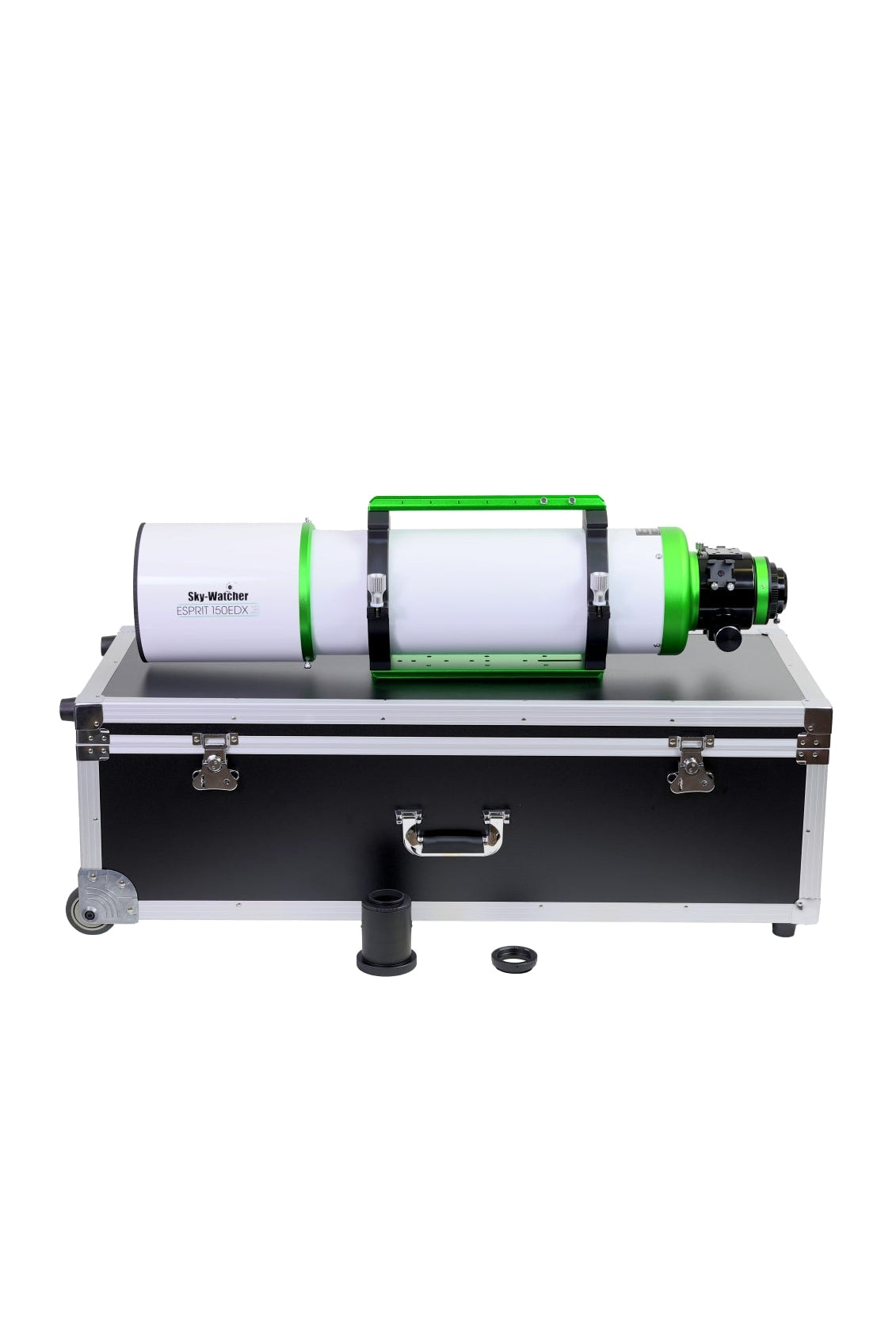


- Description
- Specifications
Product Overview
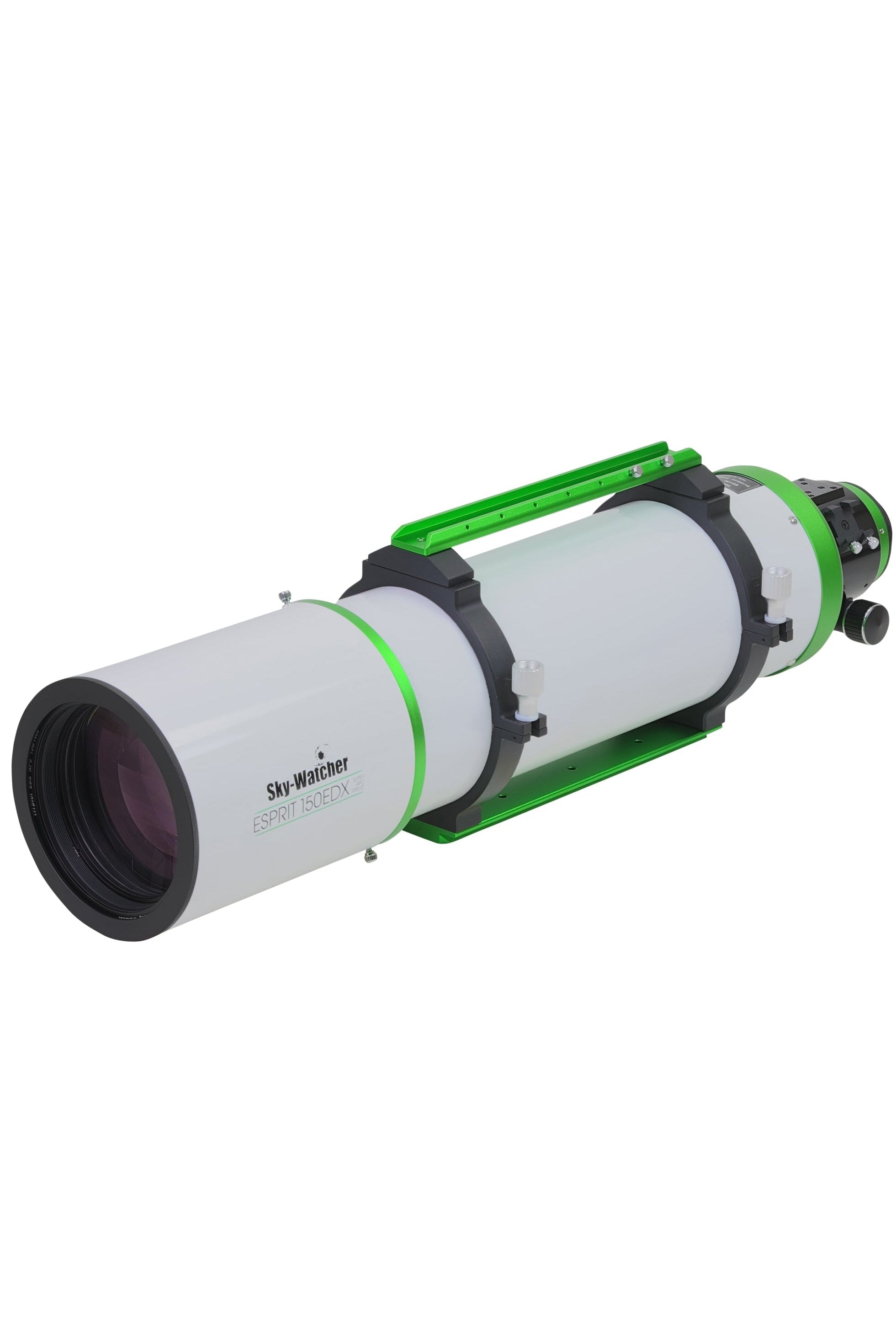
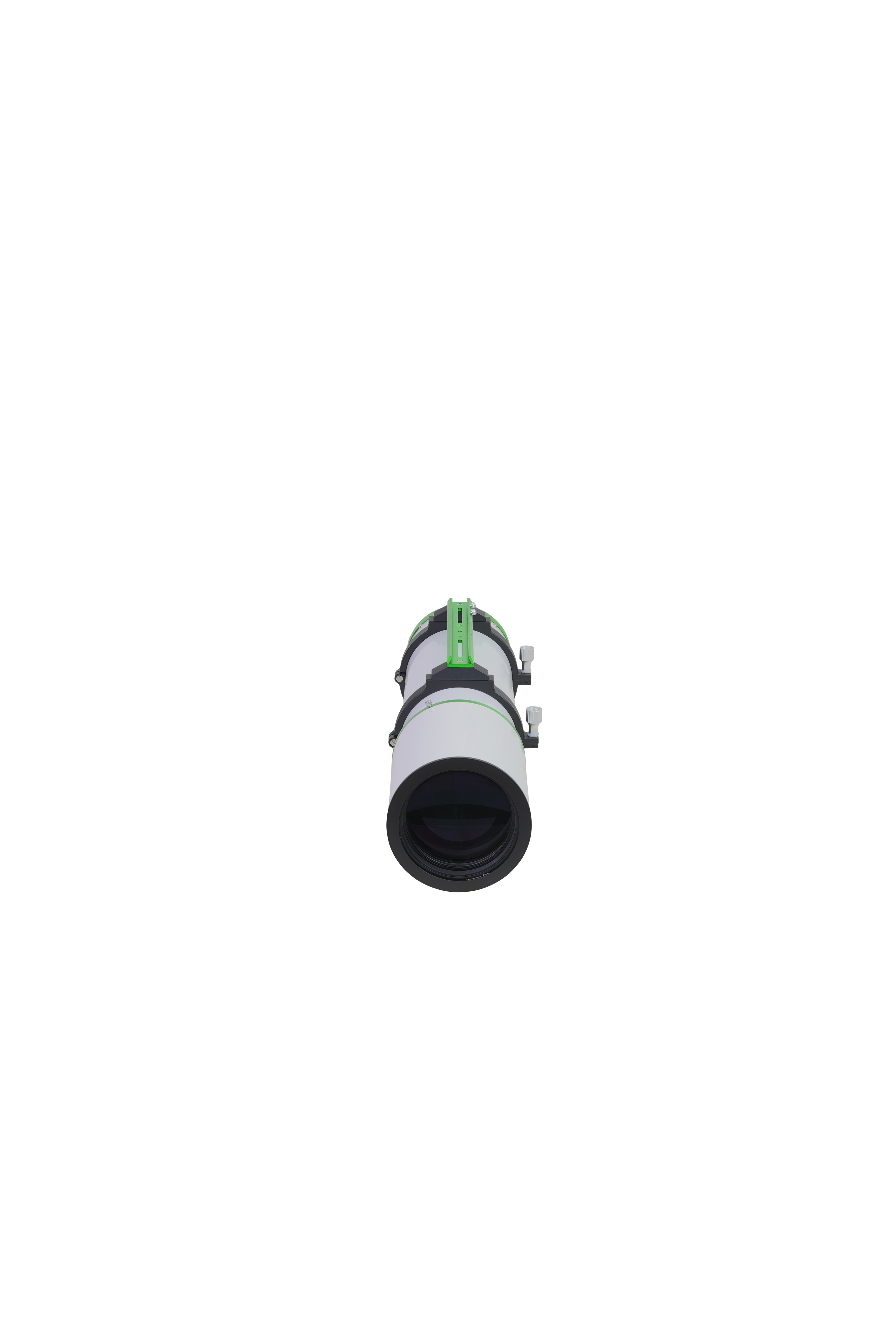
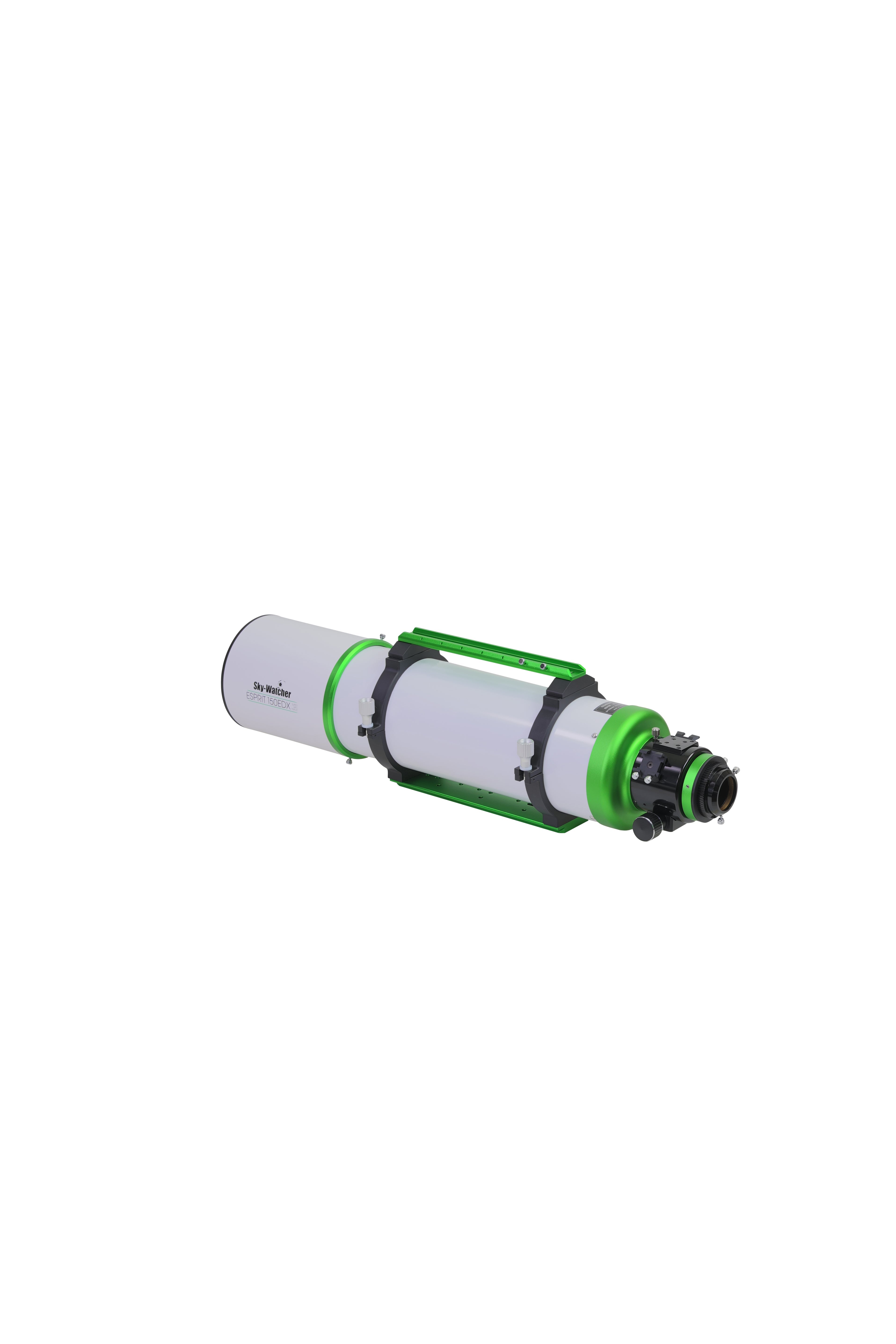
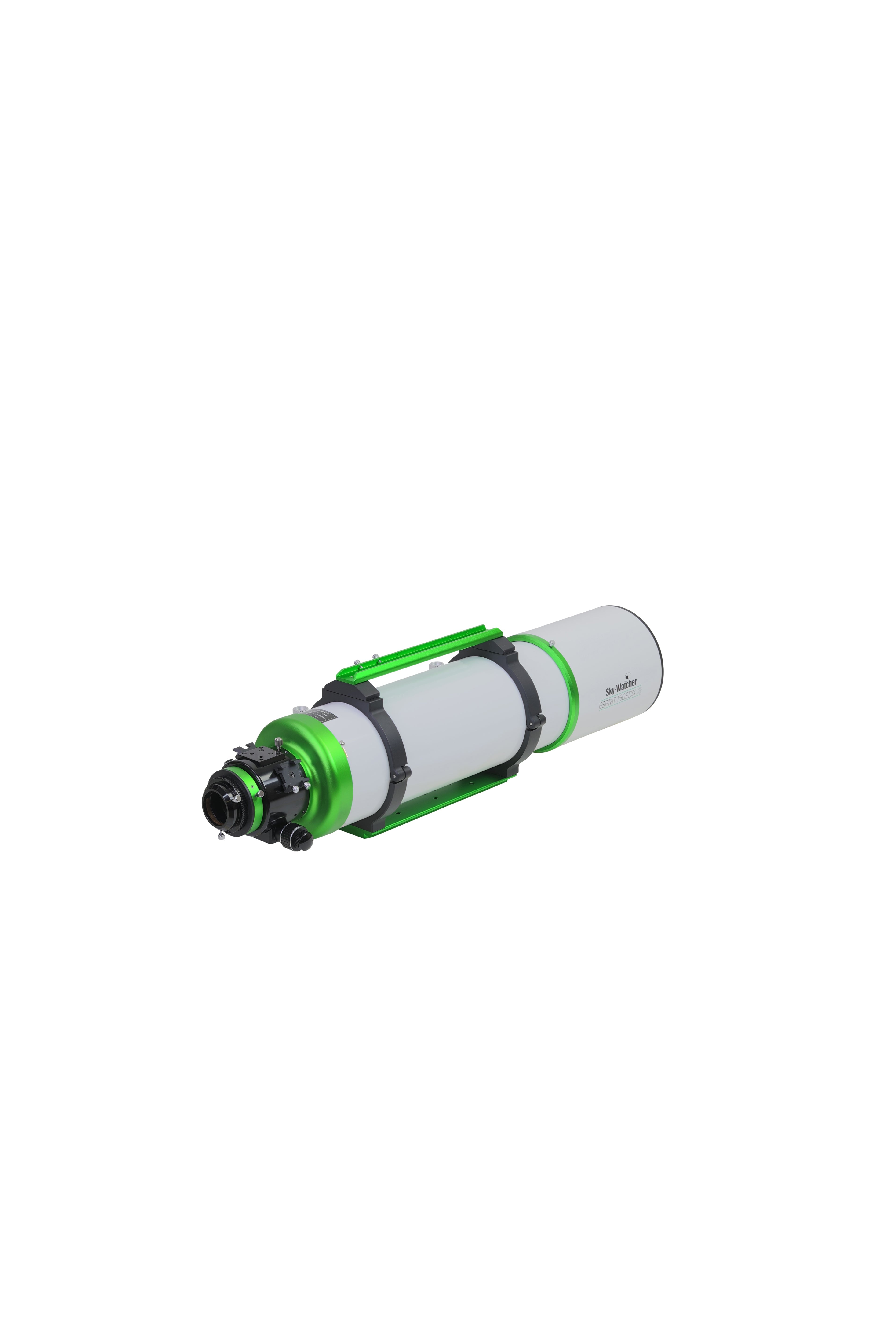
The Esprit 150EDX is the largest optical tube in Sky-Watcher's Esprit EDX astrograph line: a 150 mm air-spaced triplet apochromat working at 1050 mm of focal length and f/7. The three-element, laboratory-matched objective uses extra-low dispersion glass, and every surface carries Sky-Watcher's Metallic High-Transmission Coatings (MHTC). For this aperture Sky-Watcher publishes 0.77 arc seconds Dawes resolution, 0.93 arc seconds Rayleigh, a limiting stellar magnitude of 13.4, and light grasp 459x that of the human eye.
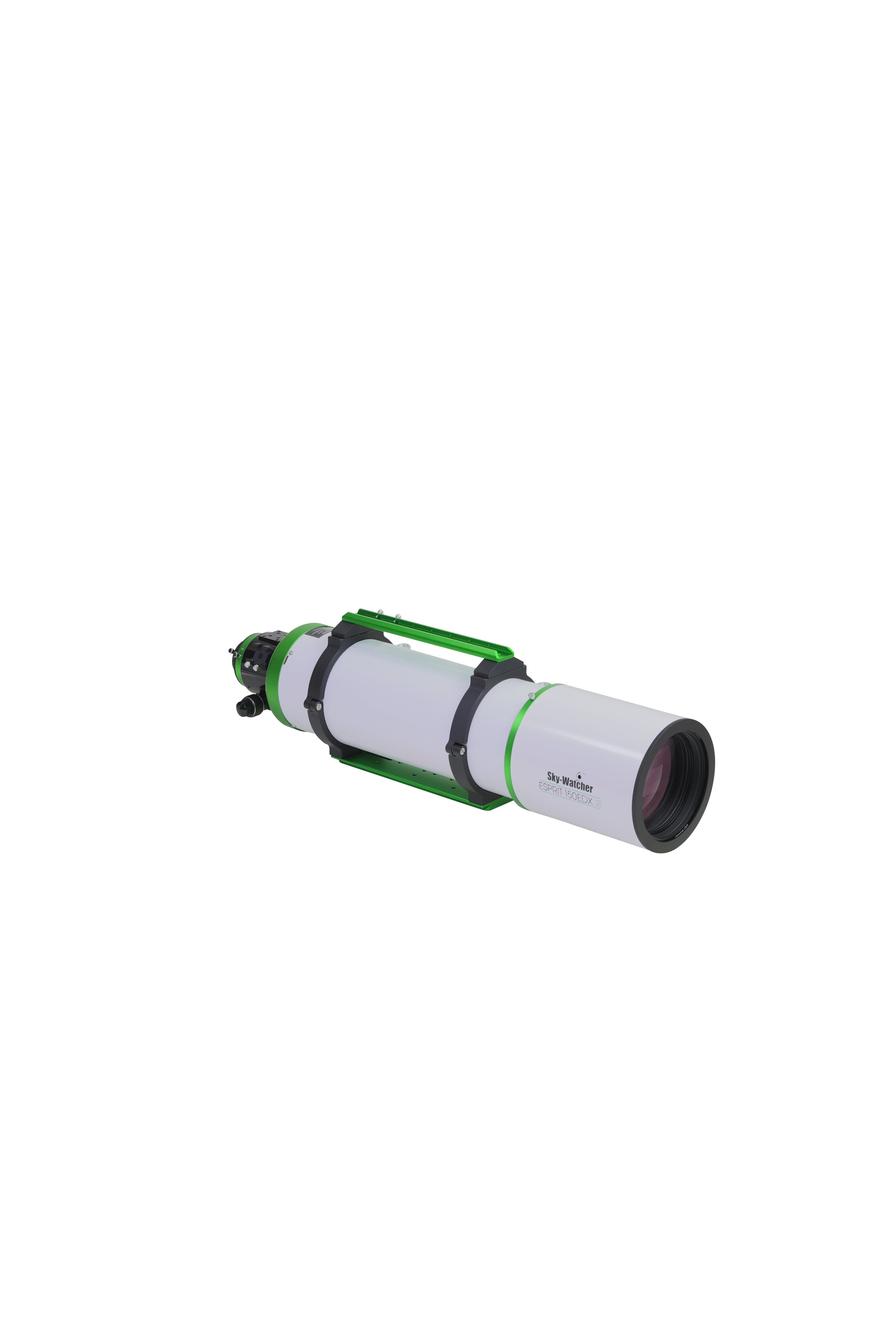
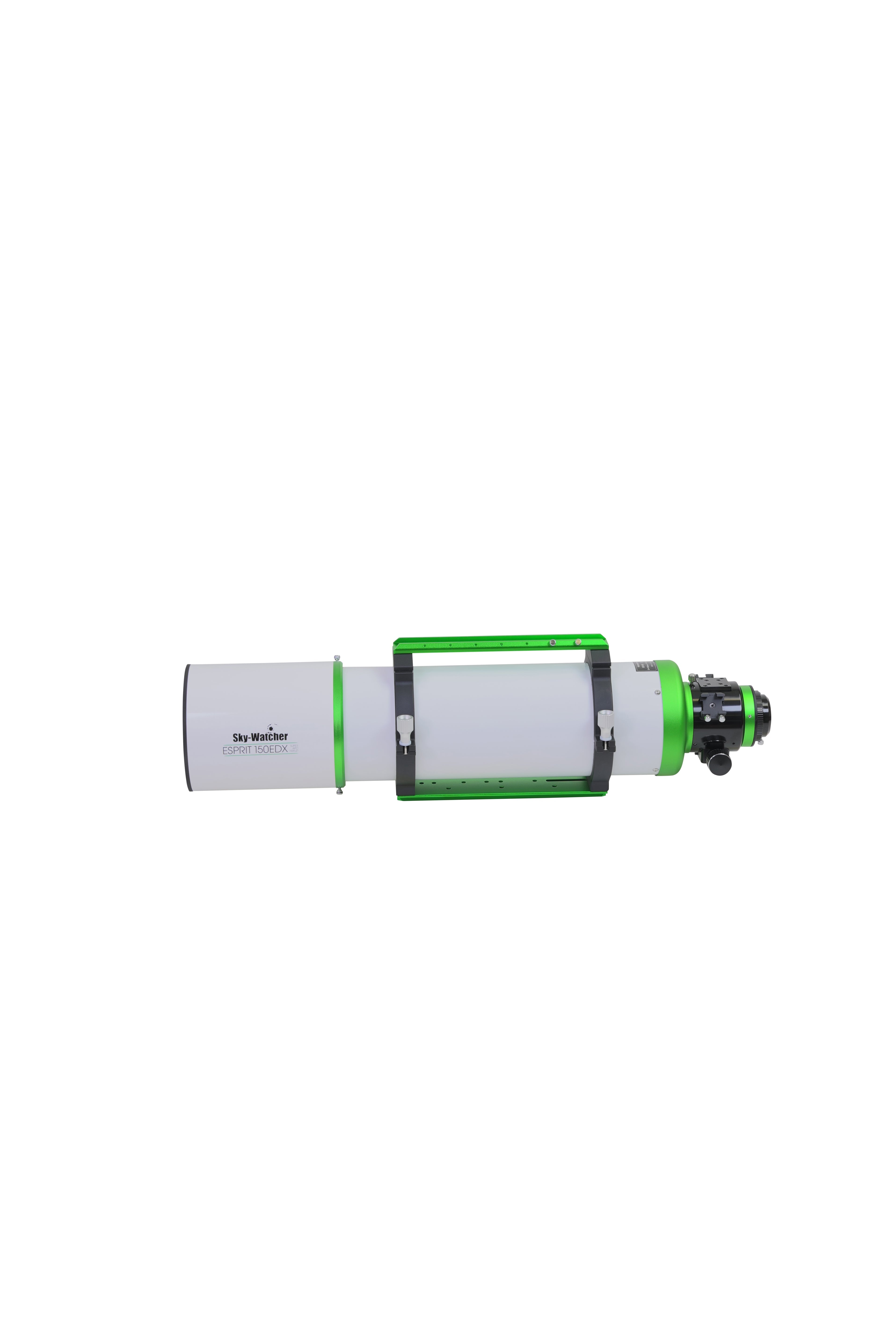
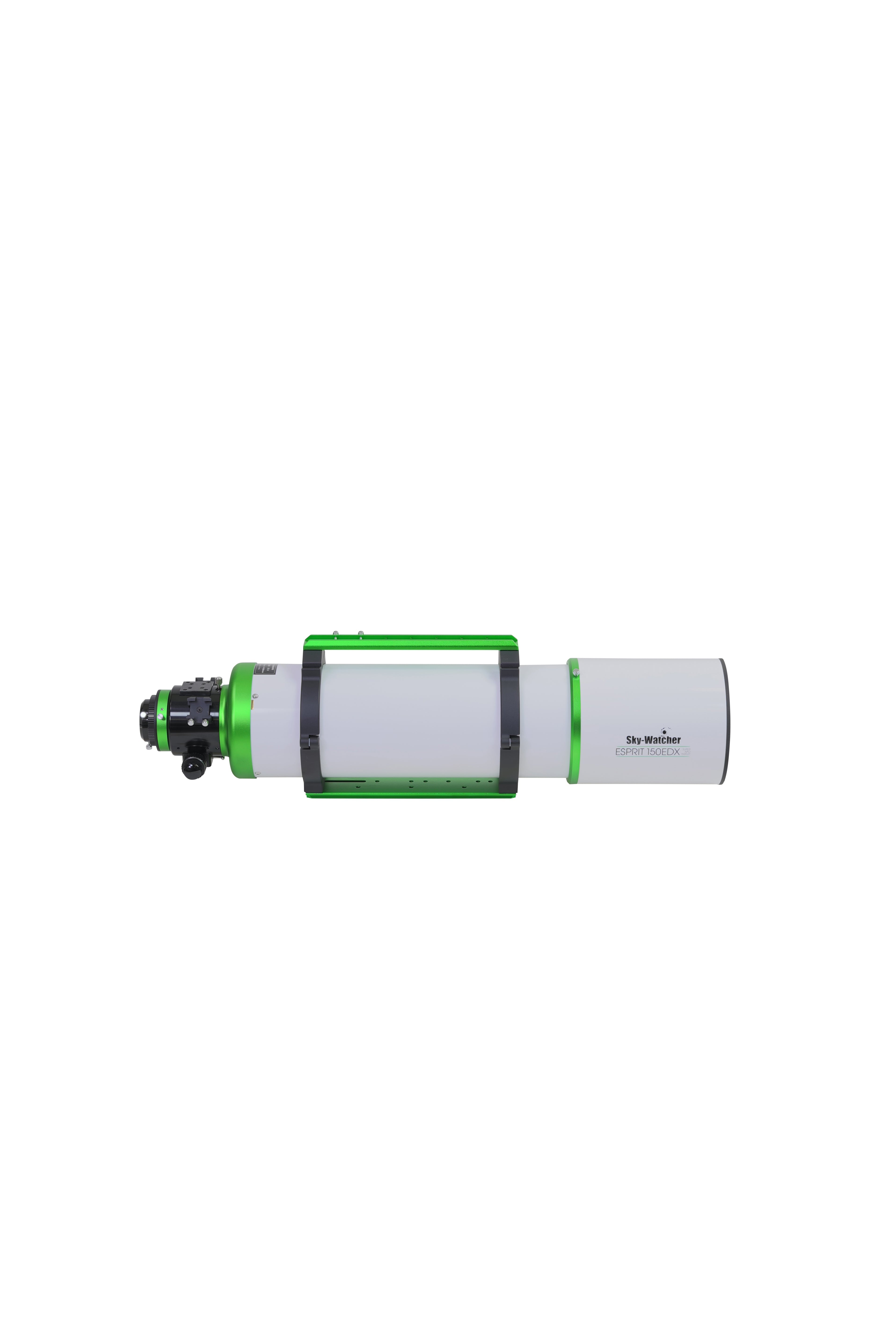
What ships is the optical tube assembly with mounting rings, dovetail plate, camera adapter and a foam-lined hard case. The mount is chosen separately, and at 15 kg (32 lbs) of tube weight the mount choice is the main planning decision on this scope.
Who It's For
This is a good match if you image at longer focal lengths and want refractor star shape rather than a mirror system's diffraction pattern. At 1050 mm, galaxy cores, globular clusters and small planetary nebulae come up at a scale most 400-600 mm astrographs cannot reach, while f/7 keeps exposures workable.
It is equally at home visually. Sky-Watcher publishes more than 170 mm (6.7 in) of visual back focus, which accommodates a 2-inch diagonal and binoviewers without adapters that eat into travel, and a useful magnification range of 21x to 354x covers everything from full-frame nebulae to high-power planetary work.
Astrophotographers pairing it with a large German equatorial - and observers who want one refractor that does deep-sky imaging and planetary viewing without compromise - are the natural buyers here.
Key Features & Design
- 150 mm f/7 air-spaced triplet apochromat: three matched elements including extra-low dispersion glass, so bright stars and lunar limbs come through without the violet fringe a doublet leaves behind.
- Metallic High-Transmission Coatings (MHTC): full multi-coating on every air-to-glass surface, which is where the published 459x light-gathering figure comes from.
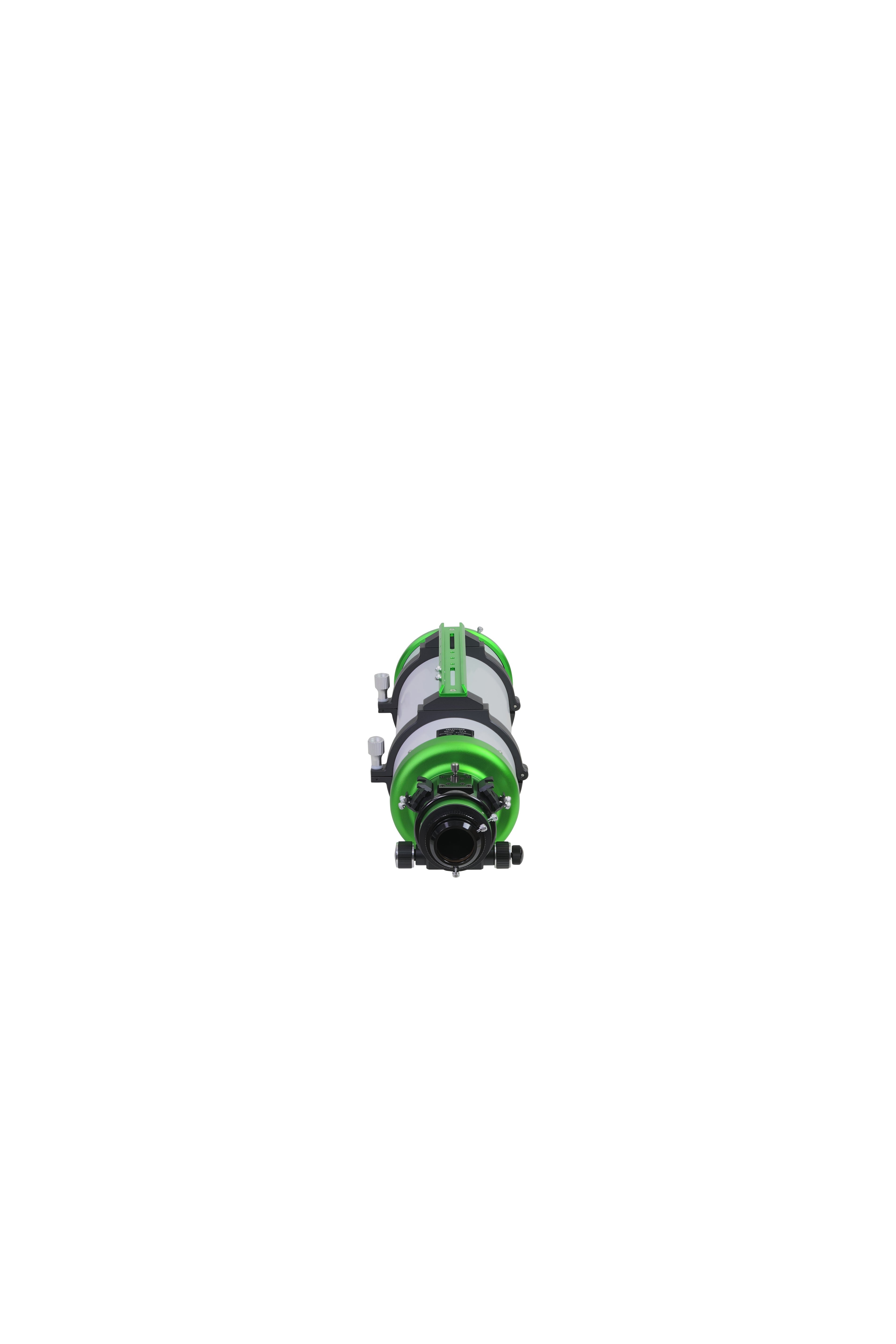
- 3-inch CNC-machined rotatable dual-speed focuser: a linear power focuser with 1:11 fine reduction. The drawtube is a linear track rather than a rack riding on a shaft, so a 15 kg imaging train does not introduce image shift at the moment of focus.
- Camera Angle Adjuster: sits at the end of the drawtube and rotates the camera or eyepiece to frame a target, leaving the focuser body and its balance untouched.
- Rotatable focuser body: standard on the 100, 120 and 150 EDX, so the focus knobs can be indexed to wherever your hand falls at the mount.
- 44 mm fully illuminated field with the field flattener: that covers a full-frame 35 mm sensor's 43.3 mm diagonal.
- More than 170 mm visual back focus: room for a 2-inch diagonal, a binoviewer, or a filter wheel and off-axis guider stack.
- Included in the box: mounting rings, dovetail plate, camera adapter and a foam-lined hard case.
Optical / Mechanical Design
The objective is a three-element, air-spaced super-apochromatic assembly. Air spacing lets Sky-Watcher tune the gaps between elements during assembly rather than accepting whatever an oiled or cemented stack gives, and the matched-assembly process means the three elements in your tube were figured and tested together. The practical result is the 0.77 arc second Dawes figure holding across the field instead of only at centre, and colour that stays neutral on Vega or a first-quarter Moon.
Mechanically the interesting part is the focuser. A 3-inch drawtube is wide enough that the light cone from a 150 mm f/7 objective clears it without vignetting at the corners of a full-frame sensor, and the linear-track design carries the load on rails rather than on a pinion contact patch. The 1:11 fine ratio gives roughly a tenth of a turn of drawtube travel per full turn of the fine knob, which matters when critical focus at f/7 on a 150 mm aperture is a few tens of microns deep.
The tube measures 92 cm (36 in) with the dew cap retracted, and weighs 15 kg (32 lbs). Sky-Watcher's own carton for the complete package, including the hard case, is listed at 77 lb.
Recommended Uses
- Long-focal-length deep-sky imaging: 1050 mm at f/7 across a flattened 44 mm circle, for galaxies, globulars and compact nebulae.
- Narrowband work: the apochromatic correction means Ha, OIII and SII sub-frames land on the same focus point, so filter-offset chasing largely disappears.
- High-resolution lunar and planetary viewing: 354x highest useful magnification with an unobstructed aperture.
- Double-star observing: 0.77 arc seconds Dawes.
- Wide-field visual sweeping: 21x lowest useful magnification through a 2-inch diagonal.
Compatibility and Accessory Notes
The Esprit 150EDX Flattener is the matched corrector for this tube and is sold separately. Sky-Watcher specifies the sensor sitting at exactly 100 mm from the back of the flattener, or 95 mm from the edge of the lens mount - corner star shape across the 44 mm circle depends on hitting that number, and it is set with spacers between the flattener and the camera. These figures are published for the Esprit 150EDX; other Esprit apertures pair with their own flatteners, so send us your model and we will confirm the right one.
The camera adapter supplied with the tube handles a straightforward DSLR or mirrorless attachment. For a filter wheel, off-axis guider and cooled camera stack, the spacing arithmetic changes - send us the parts list and we will work out the spacer chain with you before you order.
Visually, the published back focus of more than 170 mm accepts a 2-inch star diagonal and standard eyepieces, and leaves enough travel for a binoviewer's optical path.
The tube ships with mounting rings and a dovetail plate. At 15 kg before a camera, imaging mounts in the EQ6-R / EQ8 class are the usual pairing; tell us what you are mounting on and we will confirm the headroom.
Good to Know Before You Order
- This is an optical tube assembly. Mounting rings, dovetail plate, camera adapter and hard case are included; a mount, tripod and eyepieces are not.
- Tube weight is 15 kg (32 lbs). With a camera, filter wheel and guider attached the imaging payload lands meaningfully higher, which is worth accounting for against your mount's rating.
- The field flattener is a separate purchase. The 44 mm fully illuminated field is the figure published with the flattener in place.
- Sky-Watcher's spec sheet does not name the specific ED glass type for this model. Their published description states laboratory-matched lens assemblies including extra-low dispersion elements; we have not carried a glass code across from another Esprit aperture.
- Shipping weight is 77 lb for the complete package. The hard case and packaging account for the difference from the 15 kg tube figure.
- Free shipping applies to this item per Sky-Watcher's listing.
Frequently Asked Questions
Is it difficult to set up?
The optical assembly arrives finished - there is no collimation to perform and no mirror to align. Setup is mounting rings onto the dovetail, dovetail into the saddle, and balancing. The one part that takes real handling is the tube itself: 15 kg over 92 cm is a two-hand lift onto a saddle, and most owners settle into a routine of mounting the tube before the counterweights go on.
What is the difference between the Esprit EDX and the older Esprit ED?
The EDX generation adds the Camera Angle Adjuster at the drawtube and, on the 100, 120 and 150, a rotatable focuser body. The objective carries Sky-Watcher's MHTC multi-coating.
Do I need the flattener for visual observing?
No. The flattener corrects field curvature across a camera sensor. For eyepiece use the tube goes straight to a 2-inch diagonal, with more than 170 mm of back focus available.
Will it cover a full-frame sensor?
With the matched flattener, the fully illuminated field is 44 mm - larger than the 43.3 mm diagonal of a 35 mm full-frame sensor.
Can it be used for planetary imaging?
Yes. 1050 mm native focal length with an unobstructed 150 mm aperture, and a published highest useful magnification of 354x, suits lunar and planetary capture directly or with a Barlow.
Bottom Line
A 150 mm f/7 triplet apochromat with a 3-inch rotatable dual-speed focuser, a 44 mm flattened image circle and better than 170 mm of visual back focus - shipped as an optical tube with rings, dovetail, camera adapter and hard case. It is the top of the Esprit EDX range, and it does long-focal-length imaging and high-power visual work with the same optics. If you would like us to confirm the mount pairing or the imaging-train spacing for your camera, send us the details and we will map it out.
| SKU | S11455 |
|---|---|
| UPC | 810098970730 |
| Optical design | Refractor (air-spaced triplet APO) |
| Aperture | 150 mm (5.9 in) |
| Focal length | 1050 mm (41 in) |
| Focal ratio | f/7 |
| Lens elements | Three-element, air-spaced; laboratory-matched assembly including extra-low dispersion elements |
| Optical coatings | Fully multi-coated; Metallic High-Transmission Coatings (MHTC) |
| Highest useful magnification | 354 x |
| Lowest useful magnification | 21 x |
| Limiting stellar magnitude | 13.4 |
| Resolution (Rayleigh) | 0.93 arc seconds |
| Resolution (Dawes) | 0.77 arc seconds |
| Light gathering power | 459 x (compared to human eye) |
| Fully illuminated field with field flattener | 44 mm (1.7 in) |
| Focuser | 3 in CNC machined 1:11 rotatable dual speed linear power focuser |
| Camera angle adjuster | Yes |
| Telescope visual backfocus | >170 mm (6.7 in) |
| Optical tube length | 92 cm (36 in) (retracted dew cap) |
| Optical tube weight | 15 kg (32 lbs) |
| Included accessories | Mounting rings, dovetail plate, camera adapter, foam-lined hard case |
| Field flattener spacing | Sensor at exactly 100 mm from back of flattener (95 mm from lens mount edge); flattener sold separately |
You may also like
Recently viewed
Recent Blog Posts
View all
Your Guide Graph Is Lying to You
Read More

D-Size vs V-Size: A Complete Guide to Telescope Dovetail Systems
Read More

What Is Back Focus in Astrophotography? Telescope Reducers, Flatteners, and Spacing Explained
Read More