

- Description
- Specifications
Product Overview
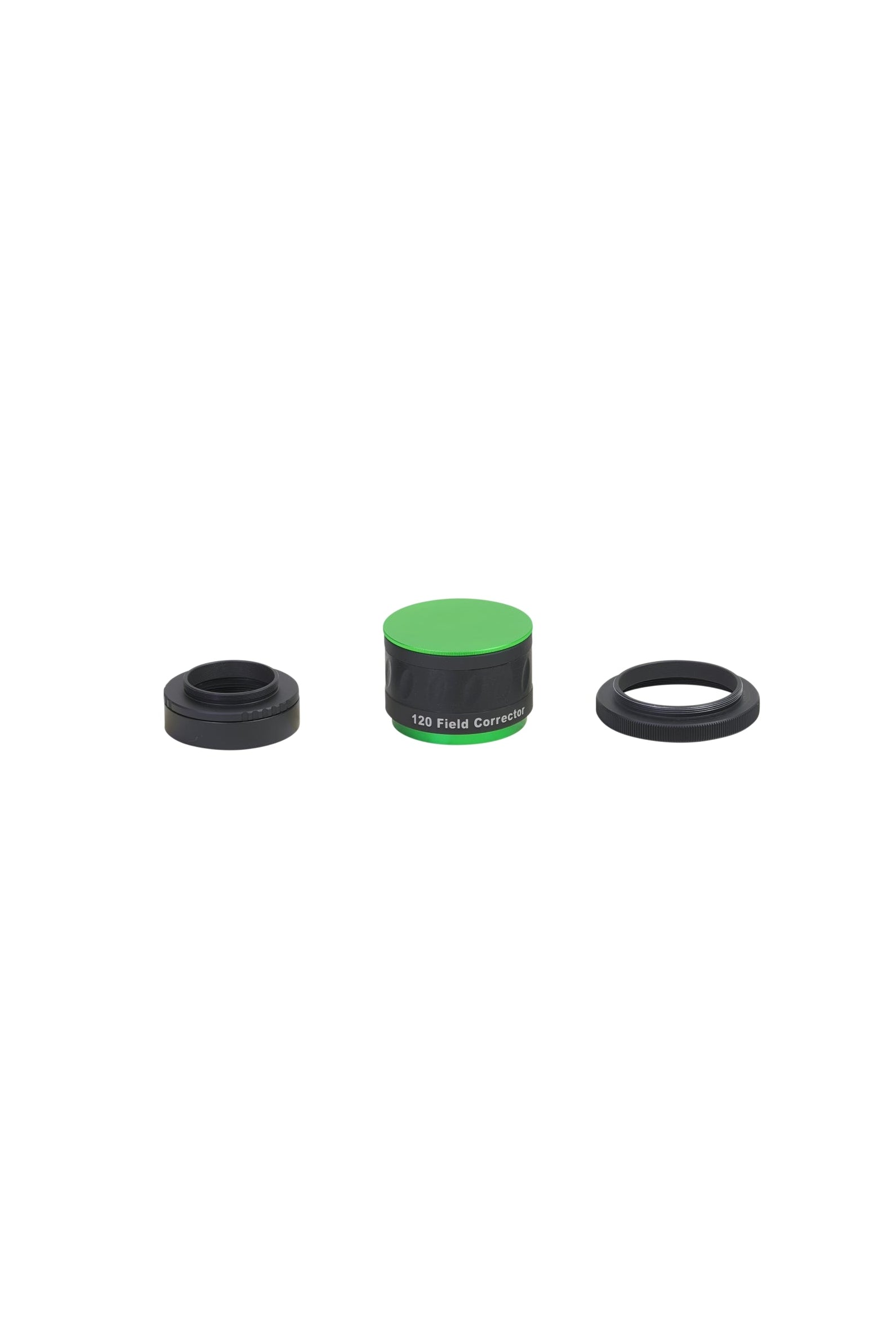
The Esprit 120EDX Flattener is Sky-Watcher's dedicated field corrector for the Esprit 120EDX super apochromatic refractor. A fast triplet objective focuses onto a gently curved surface; a camera sensor is flat. The flattener resolves that mismatch so stars hold their shape out to the frame edges instead of drawing short radial streaks in the corners while the centre stays sharp.
Sky-Watcher publishes a 44 mm corrected image circle for this corrector. That encloses the 43.3 mm diagonal of a full-frame sensor and covers APS-C with margin to spare, so framing choices are driven by focal length rather than by how much of the sensor the corrector reaches.
This is a flattener, not a reducer. Sky-Watcher publishes no reduction factor and no altered focal length or focal ratio for it, so the Esprit 120EDX images at its native figures with this part in the train. The 0.77x Reducer/Flattener for the Esprit 120 (S20209) is a separate optic with a different prescription.
Who It's For
This is the corrector Sky-Watcher pairs with the Esprit 120EDX, and it is the right part if you own that telescope and want flat, round stars across a large sensor at the scope's native focal length & ratio.
It suits deep-sky imagers who want the full native image scale — galaxies, globular clusters, planetary nebulae, small to mid-size emission targets — rather than the wider, faster field a reducing corrector produces. If your priority is shorter exposures and a wider frame, the 0.77x reducer/flattener for the Esprit line is the part built for that job.
Key Features & Design
- Matched to the Esprit 120EDX: Sky-Watcher publishes compatibility with the Esprit 120EDX specifically. The correction is computed for that objective rather than sold as a universal flattener.
- 44 mm corrected image circle: the published figure covers a full-frame sensor's 43.3 mm diagonal and leaves APS-C well inside the corrected zone.
- Flattening only: no published reduction factor, so the telescope's native focal length and focal ratio carry through the corrector.
- Single-piece corrector: one optic in the imaging train between focuser and camera, with no separate elements to align.
Optical / Mechanical Design
What it corrects: field curvature across the imaging field of the Esprit 120EDX. The visible symptom it removes is corner stars that elongate radially, pointing away from the frame centre, while the middle of the frame focuses cleanly.
Corrected image circle: 44 mm, as published by Sky-Watcher. Sensor coverage follows directly from that number — a full-frame sensor measures 43.3 mm corner to corner and an APS-C sensor roughly 28 mm, so both sit inside the corrected field.
Resulting focal length and focal ratio: Sky-Watcher publishes none, consistent with a flattener that works at native focal length. We publish only what they publish, so no altered figures appear here.
Required backfocus and thread interface: Sky-Watcher does not publish a backfocus distance in millimetres or a thread size for this corrector on its product page, and no manual or datasheet is linked there. Those two numbers determine how the corrector spaces to your camera, so send us your camera, filter drawer and any adapters and we will work the train out with you before you order.
Recommended Uses
- Deep-sky astrophotography at native focal length: galaxies, globular clusters, planetary nebulae and compact emission regions where image scale matters more than field width.
- Large-sensor imaging: the 44 mm circle supports full-frame and APS-C cameras, including cooled astronomical CMOS bodies in those formats.
- Mosaic panels: flat corners let adjacent panels blend without a ring of distorted stars at every seam.
- Narrowband and broadband alike: field curvature is a geometric error, so the correction applies regardless of the filter in front of the sensor.
Compatibility and Accessory Notes
Sky-Watcher lists one compatible telescope: the Esprit 120EDX. Other Esprit models — including the earlier Esprit 120ED — have their own correctors in Sky-Watcher's range, and refractors from other makers pair with their own. Tell us the exact model on your tube and we will confirm which corrector belongs on it.
The vendor does not publish the thread interface or the spacing distance to the sensor, so the adapters between this corrector and your camera cannot be specified from published data. Send us your camera model, filter wheel or drawer, and any off-axis guider in the train, and we will map the imaging train and tell you exactly what sits between the two.
Nothing about this part changes the mount side of the setup: it adds a short optic and roughly a pound behind the focuser rather than changing how the telescope mounts.
Good to Know Before You Order
- Backfocus is not published. Sky-Watcher gives no spacing figure in millimetres for this corrector. Corner star shape depends on hitting the correct sensor distance, and we can work that out with you from your specific camera and adapters.
- Thread interface is not published. No thread size appears on the vendor page, so the camera-side connection is confirmed case by case rather than assumed.
- Published for the Esprit 120EDX. The 44 mm figure is stated for that telescope and is not carried across to other models.
- It is a flattener, not a reducer. Focal length and focal ratio stay at the telescope's native values; the separate 0.77x reducer/flattener is the part that changes them.
- Weight figure is the vendor's shipping weight. Sky-Watcher lists 1.0 lb for this item and publishes no separate optic-only mass in a specification table.
- Vendor image note. Sky-Watcher states "Images subject to change" on this listing, which is normal for a recently released part.
Frequently Asked Questions
Is it difficult to set up?
Physically it is one optic that goes into the imaging train between the focuser and the camera, and it stays there. The part that takes attention is the spacing to the sensor, which Sky-Watcher does not publish for this corrector. Send us the camera and adapters you plan to use and we will lay out the train for you.
Does it change the focal length or focal ratio?
Sky-Watcher publishes no reduction factor, resulting focal length, or resulting focal ratio for this corrector. It flattens the field at the telescope's native figures. The 0.77x Reducer/Flattener is the part that shortens focal length and speeds the ratio.
Will it cover my full-frame camera?
The published corrected image circle is 44 mm and a full-frame sensor measures 43.3 mm across the diagonal, so the sensor sits inside the corrected field. APS-C sits well inside it.
Does it fit the Esprit 120ED rather than the 120EDX?
Sky-Watcher publishes compatibility only with the Esprit 120EDX for this part. The Esprit 120ED has its own correctors in the range, including a 0.77x reducer/flattener. Send us the model printed on your tube and we will match it.
What weight does it add to the imaging train?
Sky-Watcher lists 1.0 lb for this item. It is a small addition behind the focuser next to the camera, filters and any guider.
Bottom Line
A dedicated flattener for the Esprit 120EDX with a published 44 mm corrected circle — enough to keep stars round across a full-frame sensor at the telescope's native focal length. Sky-Watcher leaves the backfocus and thread figures unpublished, so we confirm the spacing with you against your own camera and adapters and send it out ready to drop into the train.
| SKU | S20218 |
|---|---|
| UPC | 810098970778 |
| Type | Field flattener (optical corrector) |
| What it corrects | Field curvature |
| Corrected image circle | 44mm image circle |
| Compatibility | Compatible with Esprit 120EDX |
| Resulting focal length / focal ratio | Not published by vendor (flattener, no reduction factor published) |
| Required backfocus | Not published by vendor |
| Thread interface | Not published by vendor |
| Weight | 1.0 lb (vendor shipping weight) |
You may also like
Recently viewed
Recent Blog Posts
View all
Your Guide Graph Is Lying to You
Read More

D-Size vs V-Size: A Complete Guide to Telescope Dovetail Systems
Read More

What Is Back Focus in Astrophotography? Telescope Reducers, Flatteners, and Spacing Explained
Read More