


- Description
- Specifications
At a Glance
- Aperture: 150mm (6-inch)
- Optical design: Newtonian reflector, parabolic primary
- Mirror coating: Radiant Aluminum Quartz, 94% reflectivity
- Focuser: 2-inch rack-and-pinion, 1.25-inch adapter supplied
- Finder: 6x30
- Mount: Manual Dobsonian rocker box, Teflon bearings
Product Overview
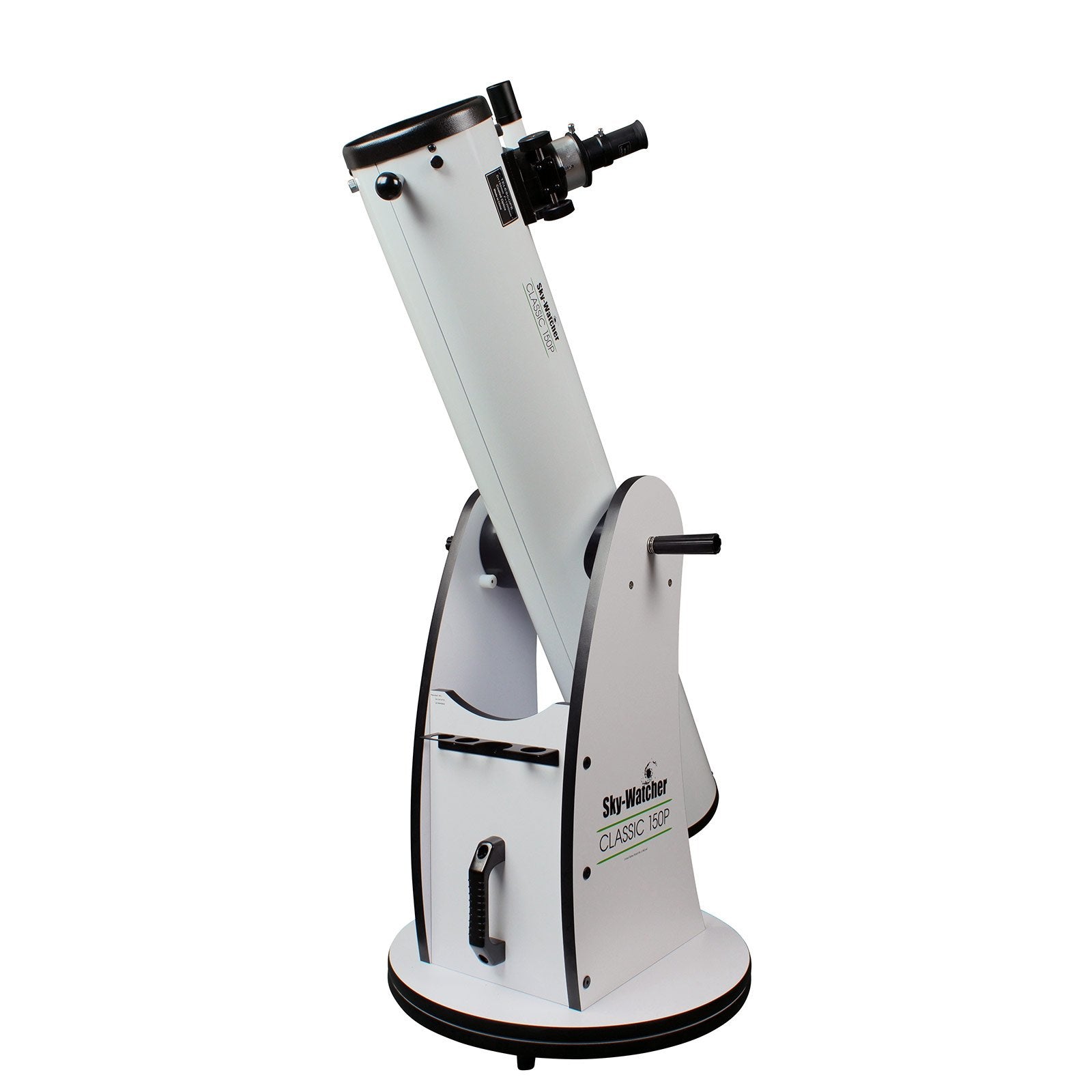
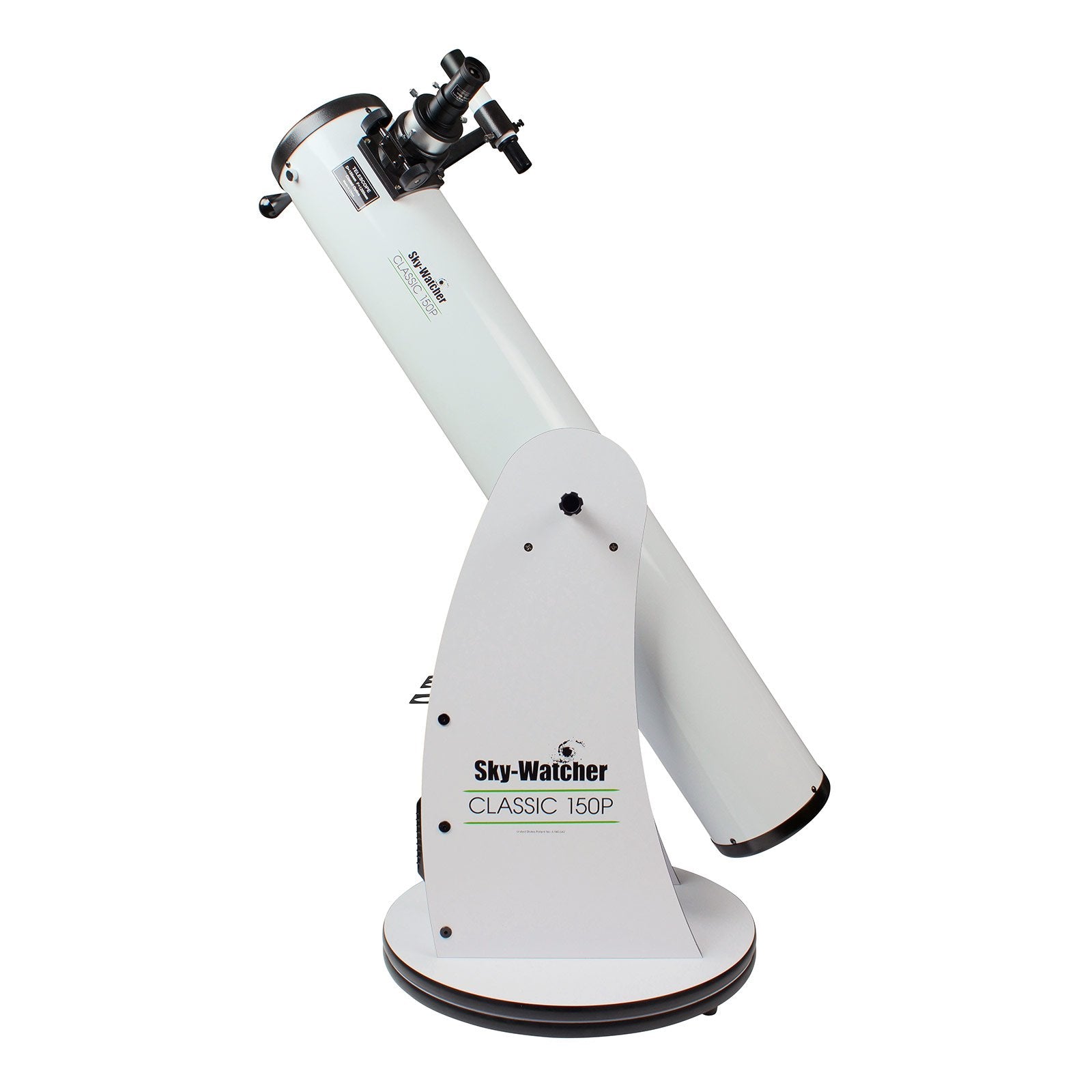
The Sky-Watcher Classic 150P is a 150mm (6-inch) Dobsonian reflector built for visual astronomy. A parabolic primary mirror sits in a simple alt-azimuth rocker box, which is the arrangement that puts more aperture on the sky per dollar than any other telescope type. Sky-Watcher publishes its light grasp as 460 times that of the unaided eye.
Everything needed for the first night out is in the box: two 1.25-inch eyepieces, a 1.25-inch adapter, a 2-inch eyepiece adapter, dust caps, and a 6x30 finderscope.
Who It Is For
This is a good match if you:
- Observe visually and want the most aperture your budget will carry.
- Are choosing a first serious telescope — there is no software, no alignment routine, and no power supply between you and the eyepiece.
- Like finding targets by star chart rather than by database, and want to learn the sky as you go.
- Have limited storage or car space — at 150mm this is the most manageable scope in the Classic range, and the one most likely to get carried outside on a weeknight.
Key Features and Design
- True parabolic figure: a parabola rather than a sphere is what keeps stars pinpoint to the edge of the field instead of flaring outward.
- 94% reflectivity from the RAQ coating: on a two-mirror system every percent counts twice, and a quartz overcoat protects the aluminium underneath from handling and humidity.
- Borosilicate mirror substrate: low thermal expansion, so the figure holds while the mirror cools to ambient rather than drifting as the temperature drops.
- 2-inch focuser travel: takes wide-field 2-inch eyepieces the moment you outgrow the supplied pair, so the telescope has somewhere to go.
- Patented tension control handle: sets altitude friction by hand, so the tube holds position when you swap to a heavier eyepiece instead of sinking toward the horizon.
- Teflon azimuth bearings: no stiction to break at high power, which is what makes small nudges land where you intend.
Optical and Mechanical Design
The Classic 150P is a Newtonian reflector: light travels down the tube to the parabolic primary, back up to a flat secondary, and out through the side of the tube to the focuser. Two mirrors, no lenses, which means no chromatic aberration at all — colour around bright objects like Jupiter, Venus, or the lunar limb simply is not part of this design.
The mount is the other half of the idea. A Dobsonian rocker box carries the tube on two axes with the load sitting low and wide, so a 150mm tube feels stable without a tripod, counterweights, or a polar alignment. You push the tube where you want it and it stays there. The tension control handle is what makes that work in practice across a range of eyepiece weights.
Recommended Uses
- Lunar observing: craters, rilles, and terminator detail at high power.
- Planetary observing: Jupiter belts and moons, Saturn rings, Mars at opposition.
- Deep-sky observing: globular and open clusters, brighter nebulae, and the larger galaxies from a reasonably dark site.
- Outreach and sidewalk astronomy: fast to set up, and nothing to go wrong in front of a queue of people.
Compatibility and Accessory Notes
The 2-inch focuser takes any standard 2-inch eyepiece, and the supplied adapter steps it down to 1.25-inch, so effectively any eyepiece on the market will fit. Standard 2-inch and 1.25-inch filters thread onto eyepiece barrels in the usual way — a UHC or O-III filter is the single most useful addition for nebula work from a light-polluted site.
A collimation tool is worth having. Every Newtonian needs its mirrors aligned periodically, and a simple Cheshire or laser collimator makes it a two-minute job. If you are unsure which eyepieces or filters would suit this scope and your skies, send us a note and we will work through it with you.
Good to Know Before You Order
- This is a visual instrument. An alt-azimuth Dobsonian does not track the sky, so it is not a platform for long-exposure deep-sky imaging. Afocal snapshots of the Moon through the eyepiece work well.
- Objects drift and you nudge them back. At high power a target crosses the field in under a minute. Most observers stop noticing within a session or two.
- Collimation is part of owning a Newtonian. It is a straightforward adjustment with the right tool, and it holds well between sessions.
- Give it time to cool. Mirrors need to reach ambient temperature before they show their best detail — set the scope outside while you get the rest of your gear together.
- Finding is manual. There is no GoTo and no encoders, so a star chart or a phone planetarium app does the pointing.
Frequently Asked Questions
Is it difficult to set up?
No. The tube drops into the rocker box, the finder clips on, and an eyepiece goes in the focuser. There is nothing to align, level, or power, and once assembled it is a single carry from the house to the yard.
What is it best used for?
Visual observing across the board — Moon and planets at high power, clusters and nebulae at low power. It rewards dark skies but still shows plenty from a suburban backyard.
Can I use it for astrophotography?
Not for deep-sky imaging, because the mount does not track. Lunar and planetary snapshots with a phone adapter or a planetary camera are achievable.
What eyepieces does it take?
Both 2-inch and 1.25-inch, using the supplied adapter for the smaller size. Two 1.25-inch eyepieces come in the box.
How does it compare with the Classic 200P?
The 200P gathers 78% more light and steps up to a Crayford-style focuser and a 9x50 finder. The 150P is lighter and easier to store and move, which for many observers means more nights actually spent looking.
Does it need anything else to work?
No. It observes as supplied. A collimation tool and a nebula filter are the two additions most owners make first.
Bottom Line
In short: a 150mm parabolic Dobsonian that trades tracking and electronics for aperture and simplicity. It sets up in under a minute, shows the Moon, planets, clusters, and brighter deep-sky objects well, and asks nothing of you but a star chart and a little patience while the mirror cools.
| Product Type | Manual Dobsonian reflector telescope |
|---|---|
| Item Number | S11600 |
| Aperture | 150mm (6-inch) |
| Optical Design | Newtonian reflector with parabolic primary mirror |
| Mirror Substrate | Borosilicate glass |
| Mirror Coatings | Radiant Aluminum Quartz (RAQ), 94% reflectivity |
| Focuser | 2-inch rack-and-pinion with 1.25-inch adapter |
| Mount Type | Dobsonian rocker box with Teflon bearings |
| Altitude Control | Patented tension control handle |
| Finderscope | 6x30 |
| Light Grasp | 460x the unaided eye |
| Included Accessories | Two 1.25-inch eyepieces, 1.25-inch adapter, 2-inch eyepiece adapter, dust caps, 6x30 finderscope |
| Primary Use | Visual observing of the Moon, planets, star clusters, nebulae, and galaxies |
You may also like
Recently viewed
Recent Blog Posts
View all
Your Guide Graph Is Lying to You
Read More

D-Size vs V-Size: A Complete Guide to Telescope Dovetail Systems
Read More

What Is Back Focus in Astrophotography? Telescope Reducers, Flatteners, and Spacing Explained
Read More