

- Description
- Specifications
Product Overview
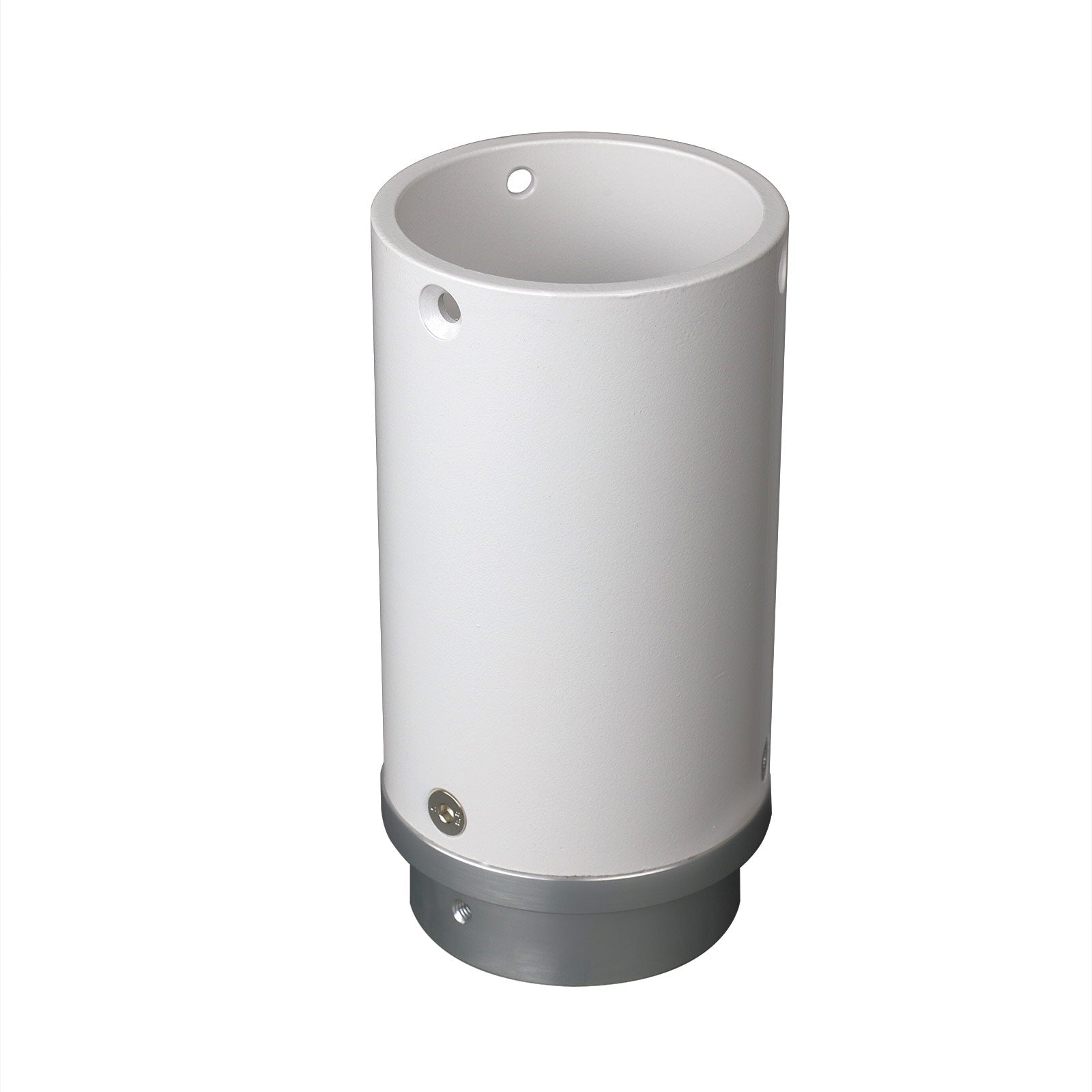
The AZ-EQ5 Pier Extension is a column that sits between the tripod and the AZ-EQ5 head and raises the mount head 6.3". That single figure is the whole point of the part: everything the mount carries moves up by 6.3" without the tripod legs being extended any further.
Who It's For
This is for AZ-EQ5 owners who keep running out of room at the bottom of the swing — a long refractor or a Newtonian whose tube end reaches the tripod legs as the mount tracks past the meridian, a dovetail-mounted camera that fouls a leg, or an eyepiece that ends up uncomfortably low near the zenith. It is also the usual answer for anyone using the AZ-EQ5 in alt-azimuth mode with a long tube, where the rear of the tube swings low as the scope points high.
Key Features & Design
- Raises the mount head 6.3": the published figure, added between the tripod head and the mount base. The tripod stays at whatever leg extension you already trust, so the extra height does not come at the cost of a wider, wobblier leg setting.
- Clearance where it is actually lost: tube-to-leg interference on a German equatorial happens near the meridian and near the horizon. Lifting the whole head is what buys back that arc, rather than lifting the tube in its rings.
- Rides between tripod and head: it becomes a permanent part of the column, so once it is fitted there is nothing to set up or adjust each session.
- Single-purpose part: no controls, no adjustment, nothing to align — the geometry of the mount above it is unchanged.
Recommended Uses
- Long tubes on the AZ-EQ5: refractors and Newtonians whose tube end or camera reaches the tripod legs during a meridian pass.
- Alt-azimuth observing: the AZ-EQ5 in AZ mode with a long tube pointed high, where the back of the scope drops toward the legs.
- Standing visual observing: 6.3" of extra height puts the eyepiece nearer standing eye level at high altitudes.
- Imaging trains with a deep back end: filter wheels, off-axis guiders and long camera stacks that add length behind the focuser.
Compatibility and Accessory Notes
Sky-Watcher publishes one fitment statement for this extension: it works on the AZ-EQ5. No other mount is named, and we do not extend that to the AZ-EQ6, EQ6-R or the HEQ5 — each of those has its own extension where one exists.
The extension does not change how the mount is polar aligned or balanced; it moves the whole head up as a unit. Counterweights, shaft and dovetail saddle all stay as they are.
If you are working out whether the extension solves the specific clash you are seeing, send us your tube length, the rings or dovetail you are using and what is hanging off the back, and we will work out whether 6.3" is enough for your setup.
Good to Know Before You Order
- AZ-EQ5 only: Sky-Watcher publishes fitment for the AZ-EQ5 and names no other mount for this part.
- The gain is exactly 6.3": that is the published figure, and it is fixed — the extension has no adjustment range of its own.
- Raising the head raises the centre of mass: the same load now sits 6.3" higher above the tripod apex, which is a real consideration in wind or on a soft surface. Setting the tripod legs shorter recovers most of the difference.
- No spec table is published: Sky-Watcher lists the fitment and the height gain for this part and nothing else — no material, thread or bolt-pattern detail — so we quote nothing beyond what they state.
- Shipping weight: the only mass Sky-Watcher publishes for this item is 6804 g (15.0003 lb) in their own product data, which reads as a packed shipping figure rather than a bare part weight.
Frequently Asked Questions
Is it difficult to set up?
No. It is a one-time fitting: the AZ-EQ5 head comes off the tripod, the extension goes on in its place, and the head goes back on top of the extension. After that it stays there and each session is set up exactly as before.
How much height does it add?
6.3", measured at the mount head. The telescope and eyepiece rise by the same amount.
Which mounts does it fit?
The AZ-EQ5. That is the only mount Sky-Watcher publishes for it.
Does it affect polar alignment?
It lifts the whole head without altering its geometry, so the alignment routine is unchanged. Polar alignment is redone after the extension is fitted, as it is after any change to the tripod.
Can it be left on permanently?
Yes. It becomes part of the column between tripod and head, and most owners fit it once and leave it.
Bottom Line
A fixed 6.3" of extra head height for the AZ-EQ5, fitted once between tripod and mount. If a long tube is catching the tripod legs during a meridian pass, or the eyepiece sits too low near the zenith, this is the part Sky-Watcher publishes to solve it.
| SKU | S30202 |
|---|---|
| UPC | 050234302029 |
| Type | Pier extension |
| Compatibility | Works on AZ-EQ5 |
| Height added | Raises the mount head 6.3" |
| Mounting position | Between tripod and mount head |
| Weight | 6804 g (15.0003 lb, vendor product data) |
You may also like
Recently viewed
Recent Blog Posts
View all
Your Guide Graph Is Lying to You
Read More
D-Size vs V-Size: A Complete Guide to Telescope Dovetail Systems
Read More
What Is Back Focus in Astrophotography? Telescope Reducers, Flatteners, and Spacing Explained
Read More