

- Description
- Specifications
Product Overview
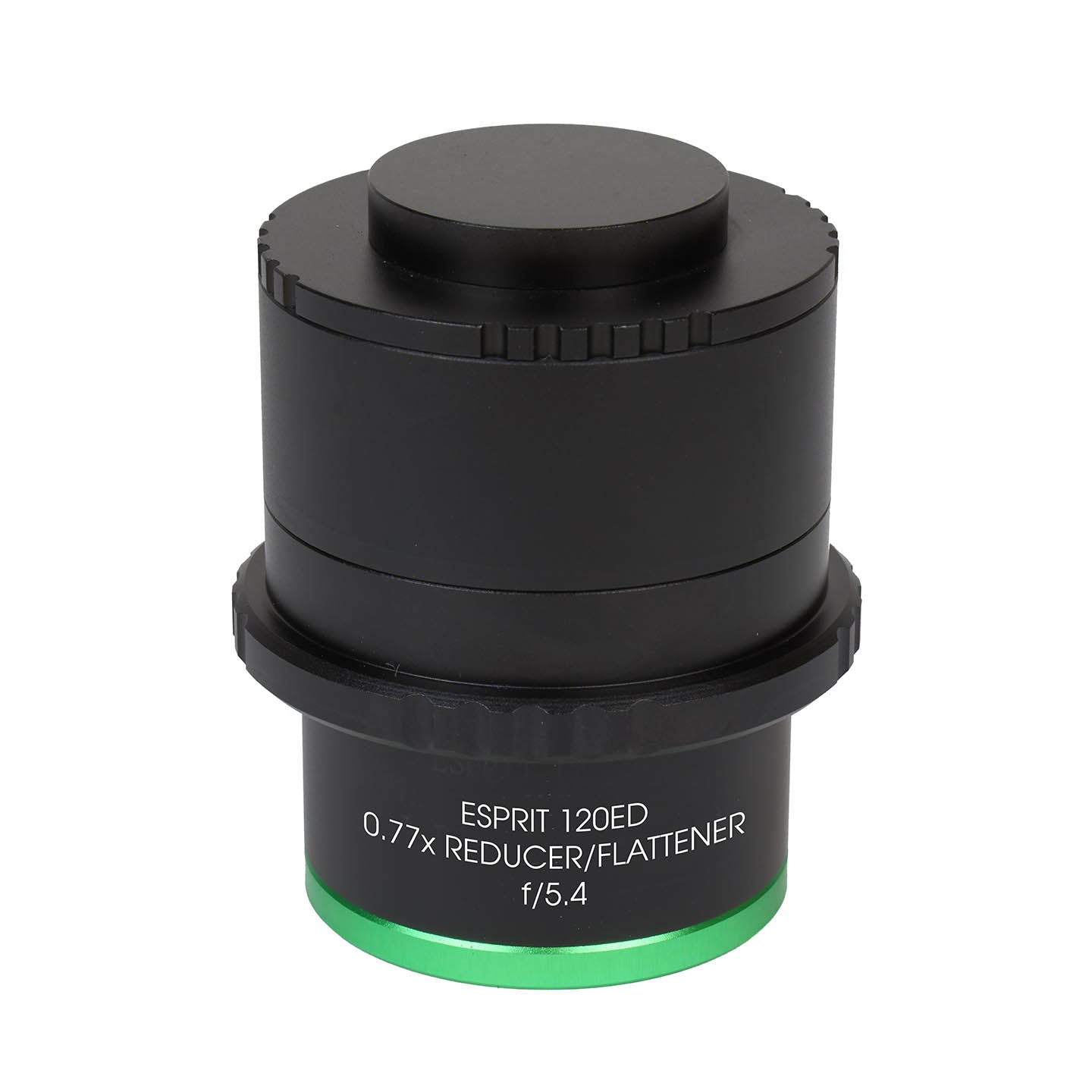
The Esprit 120ED Reducer/Flattener is Sky-Watcher's 0.77x corrector for the Esprit 120ED. It does two jobs in one optic: it flattens the curved focal surface the triplet objective produces so corner stars stay round, and it shortens the system. Sky-Watcher publishes the change as a drop from native f/7 (840mm) to f/5.4 (647mm).
That faster ratio is the reason most people fit one. Sky-Watcher publishes a 68% reduction in exposure time compared with native f/7 — the same signal arrives in a fraction of the integration, which shows up as more usable subs per night rather than as a change in what the telescope can resolve.
The field grows with it. Sky-Watcher publishes a 3.18 x 2.12-degree field of view on a full-frame camera and 2.08 x 1.39 degrees on an APS-C crop sensor, with a 34 mm fully illuminated field that the vendor states can handle full frame as well.
This is the reducing corrector for the Esprit 120ED. The Esprit 120EDX Flattener (S20218) is a different part — it flattens at native focal length and publishes no reduction.
Who It's For
This is for Esprit 120ED owners imaging wide targets: large emission nebulae, open clusters with surrounding nebulosity, star fields, and anything that runs off the edge of the frame at 840 mm. At 647 mm and f/5.4 the same telescope frames a noticeably wider field and gathers it faster.
It also suits anyone working from a site with limited clear time or heavy light pollution, where the 68% shorter exposure Sky-Watcher publishes translates directly into finishing a target in fewer nights.
If the goal is maximum image scale on small targets instead — galaxies, globulars, planetary nebulae — a plain flattener at native focal length is the part that serves that.
Key Features & Design
- 0.77x reduction, published end to end: Sky-Watcher states the result as f/7 (840mm) dropping to f/5.4 (647mm) on the Esprit 120ED, so the working figures are the vendor's own rather than an estimate.
- Reducer and flattener in one optic: field curvature correction and focal reduction happen in the same unit, so only one element joins the imaging train.
- 34 mm fully illuminated field: the vendor's published figure, with the note that it can handle full frame as well.
- Two backfocus configurations: 95 mm back-focus as supplied, or 55 mm with the back focus spacer and M48 ring installed — the 55 mm figure is the standard astro-camera spacing.
- Built-in 2" filter cell: a 2-inch filter threads into the corrector itself, putting the filter in the light path without a separate drawer or spacer stack.
- Published fields of view: 3.18 x 2.12 degrees on full frame, 2.08 x 1.39 degrees on APS-C.
Optical / Mechanical Design
What it corrects: field curvature across the Esprit 120ED imaging field, combined with a 0.77x focal reduction. Without a corrector, stars in the corners stretch radially while the frame centre focuses cleanly; this optic flattens that surface onto the sensor plane and shortens the system at the same time.
Resulting focal length and focal ratio: Sky-Watcher publishes the change as native f/7 (840mm) to f/5.4 (647mm). Both figures are the vendor's, stated for the Esprit 120ED specifically.
Corrected image circle: 34 mm fully illuminated, with Sky-Watcher noting it can handle full frame as well. A full-frame sensor's 43.3 mm diagonal sits outside the 34 mm fully illuminated circle, so the far corners of a full-frame chip fall in the region the vendor describes as usable rather than fully illuminated; an APS-C sensor at roughly 28 mm diagonal sits entirely inside it. The published fields of view follow from that — 3.18 x 2.12 degrees full frame, 2.08 x 1.39 degrees APS-C.
Required backfocus: 95 mm as supplied, or 55 mm when the back focus spacer and M48 ring are installed. 55 mm is the distance most cooled astronomical cameras and filter wheels are built around, so the reconfigured setting is the one most imaging trains land on.
Thread interface: M48, by way of the M48 ring that pairs with the 55 mm back focus configuration.
Filter mounting: the 2" filter cell is built into the corrector, so a 2-inch filter sits inside the reduced light path rather than adding length to the train.
Recommended Uses
- Wide-field deep-sky astrophotography: large emission and reflection nebulae, cluster-plus-nebulosity fields and Milky Way regions that overflow the native 840 mm frame.
- Short-session and light-polluted imaging: the published 68% exposure reduction against native f/7 puts more finished data into each clear night.
- Narrowband work: the faster ratio offsets the transmission cost of narrow filters, and the built-in 2" cell holds the filter in the light path.
- APS-C and full-frame imaging: APS-C sits inside the 34 mm fully illuminated field; full frame is covered by the vendor's stated capability with the published 3.18 x 2.12-degree frame.
Compatibility and Accessory Notes
Sky-Watcher publishes this corrector for the Esprit 120ED, and the reduction figures — f/7 (840mm) to f/5.4 (647mm) — are stated for that telescope. Other Esprit models pair with their own correctors, including the separate Esprit 120EDX Flattener, and refractors from other makers have their own. Send us the exact model printed on your tube and we will confirm which corrector belongs on it.
The two published backfocus settings shape the rest of the train. At 55 mm, with the back focus spacer and M48 ring installed, the corrector meets the standard most cooled astro cameras and filter wheels are dimensioned for. At 95 mm as supplied, the extra distance has to be filled by whatever sits between corrector and sensor. Send us your camera, filter wheel or drawer, off-axis guider and any adapters, and we will add the train up with you and confirm which configuration your setup wants.
Filters thread into the built-in 2" cell, so a 2-inch filter needs no separate drawer. Cameras with their own internal filter wheel simply leave that cell empty.
Good to Know Before You Order
- The published figures are for the Esprit 120ED. 840mm to 647mm and f/7 to f/5.4 are stated for that telescope. Other refractors reduce by their own numbers with their own correctors.
- Backfocus decides corner star shape. The corrector delivers 95 mm as supplied and 55 mm with the back focus spacer and M48 ring installed; the imaging train is built to whichever of those two figures you use.
- 34 mm is the fully illuminated field. Sky-Watcher states it can handle full frame as well, so a full-frame sensor's outer corners lie beyond the fully illuminated circle in the region the vendor describes as usable.
- Filter cell takes 2-inch filters. The built-in cell is sized for 2" filters; other filter sizes go elsewhere in the train.
- This is the reducing corrector, not the flattener. The Esprit 120EDX Flattener is a separate part that works at native focal length.
- Vendor publishes no barcode for this SKU. The UPC we carry is 050234202091.
- Vendor lists 2.0 lb for this item. That is the published weight; no separate optic-only mass appears in a specification table.
Frequently Asked Questions
Is it difficult to set up?
The optic threads into the imaging train once and stays there. The decision that matters is which backfocus you build to — 95 mm as supplied, or 55 mm with the back focus spacer and M48 ring installed — and then adding the camera, filter wheel and adapters up to that number. Send us your components and we will do that arithmetic with you.
What focal length and focal ratio do I end up with?
Sky-Watcher publishes the Esprit 120ED as dropping from native f/7 (840mm) to f/5.4 (647mm) with this reducer/flattener fitted.
How much faster is it in practice?
Sky-Watcher publishes a 68% reduction in exposure time compared with native f/7 for the same result.
Will it cover a full-frame sensor?
Sky-Watcher publishes a 34 mm fully illuminated field and states it can handle full frame as well, quoting a 3.18 x 2.12-degree field of view on a full-frame camera and 2.08 x 1.39 degrees on APS-C.
What thread does it use?
M48, via the M48 ring that goes with the 55 mm back focus configuration.
Can I use filters with it?
Yes — there is a built-in 2" filter cell for mounting filters, so a 2-inch filter sits in the light path without a separate drawer.
Bottom Line
Sky-Watcher's own 0.77x corrector for the Esprit 120ED: f/7 (840mm) becomes f/5.4 (647mm), exposure time drops by a published 68%, the field opens to 3.18 x 2.12 degrees on full frame, and a 2" filter threads straight into the corrector. Tell us what camera and filters you are running and we will confirm the 55 mm or 95 mm spacing with you before it ships.
| SKU | S20209 |
|---|---|
| UPC | 050234202091 |
| Type | 0.77x reducer/flattener (optical corrector) |
| What it corrects | Field curvature, with 0.77x focal reduction |
| Resulting focal length and focal ratio | Drops f/ratio from native f/7 (840mm) to f/5.4 (647mm) |
| Corrected image circle | 34mm fully illuminated field but can handle full frame as well |
| Required backfocus | 95mm back-focus (55mm when back focus spacer and M48 ring installed) |
| Thread interface | M48 ring |
| Field of view (full frame) | 3.18 x 2.12-degree field of view when used with a full frame camera |
| Field of view (APS-C) | 2.08 x 1.39-degree field of view when used with APS-C crop sensor |
| Exposure time | Reduces exposure time by 68% compared to native f/7 |
| Filter mounting | Built-in 2" filter cell for mounting filters |
| Compatibility | Esprit 120ED |
| Weight | 2.0 lb |
You may also like
Recently viewed
Recent Blog Posts
View all
Your Guide Graph Is Lying to You
Read More

D-Size vs V-Size: A Complete Guide to Telescope Dovetail Systems
Read More

What Is Back Focus in Astrophotography? Telescope Reducers, Flatteners, and Spacing Explained
Read More