


- Description
- Specifications
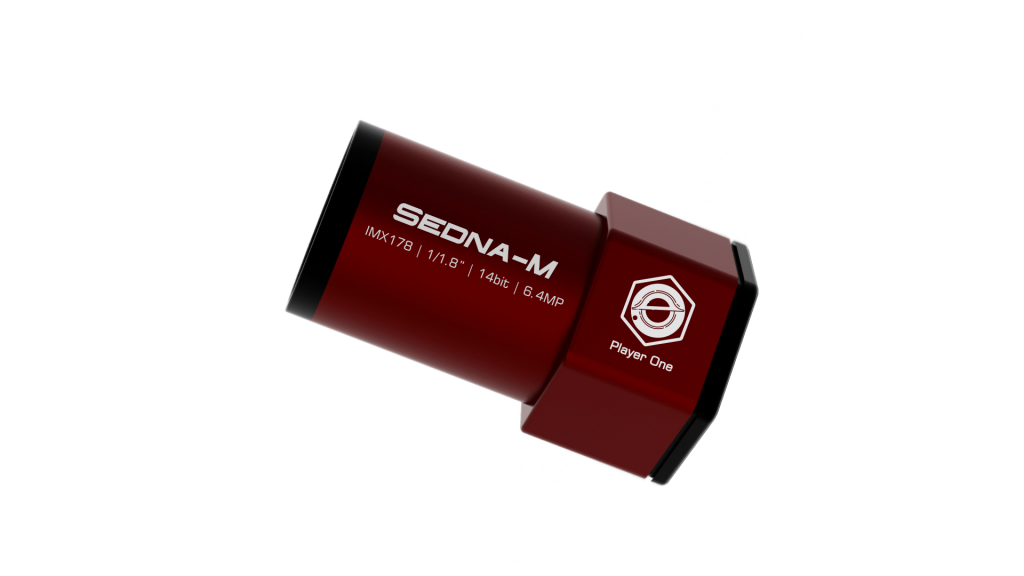
The Player One Sedna-M is a compact monochrome astronomy camera built around the 1/1.8" Sony IMX178 CMOS sensor. It is designed first as an autoguider, and its low read noise, small pixels, and high-frame-rate readout also make it capable at planetary, lunar, and electronically-assisted (EAA) imaging. The camera connects over USB 3.0, carries an ST4 guide port for direct pulse-guiding to your mount, and drops into any 1.25" focuser or guide scope.
Product Overview
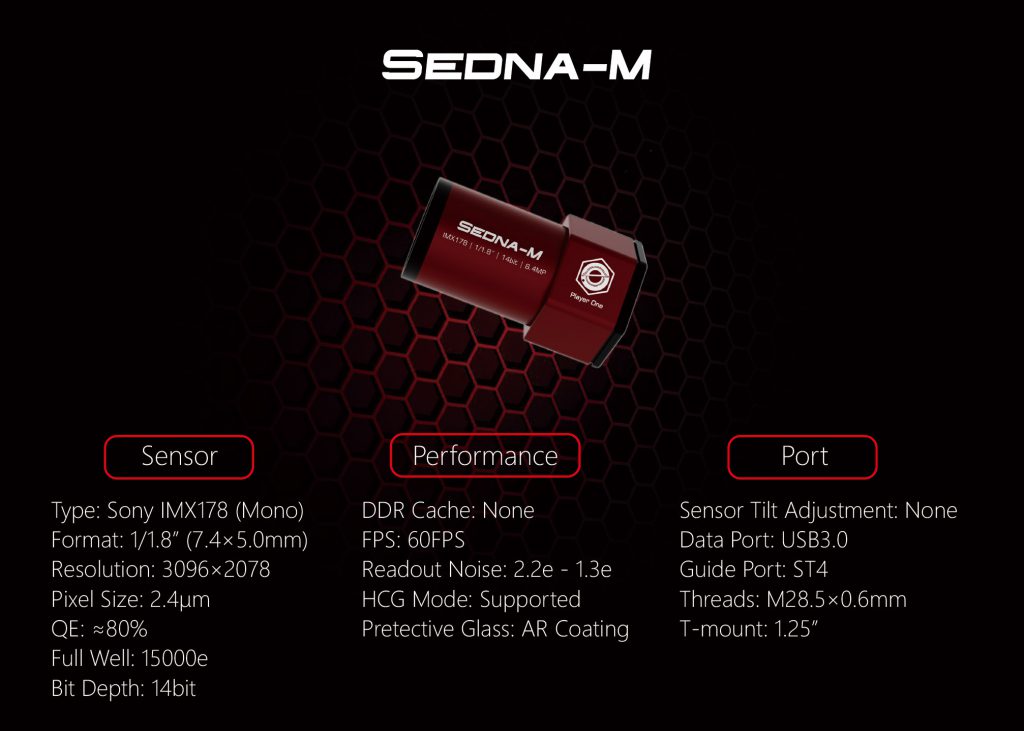
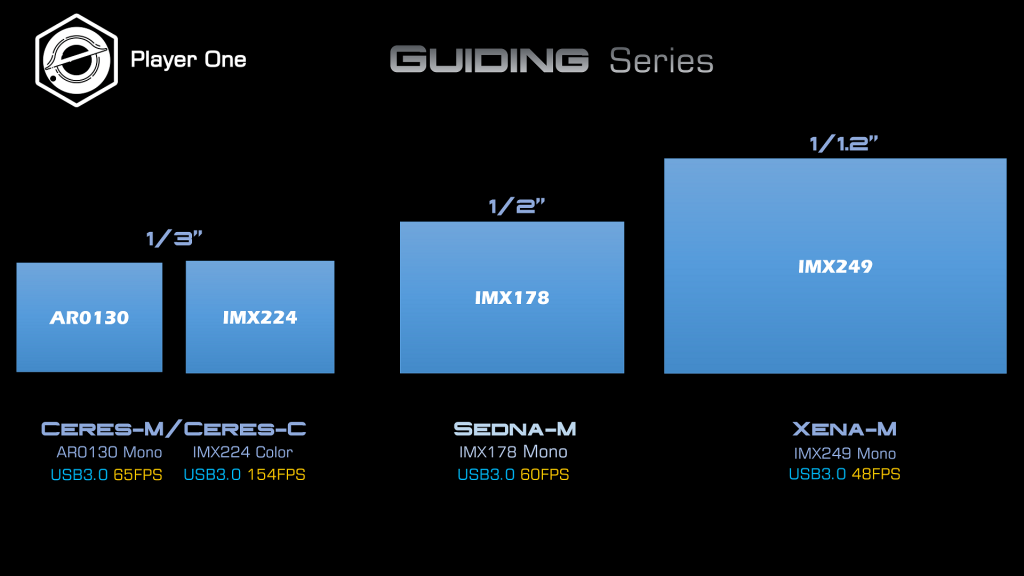
The Sedna-M pairs the 6.4-megapixel Sony IMX178 sensor (3096 × 2078 pixels) with 2.4µm pixels across a 9 mm diagonal. Because it is monochrome, every pixel records luminance directly with no Bayer matrix in the way, which gives it more sensitivity and finer effective resolution than a colour sensor of the same size — exactly what matters when you are locking onto a faint guide star. Peak quantum efficiency of roughly 80% and read noise as low as 1.3e (1.34e measured at a gain of 350) let it pull usable signal from dim stars quickly, so it can guide on fields where a less sensitive camera would come up empty.
Who It's For
This is a good match if you are running an imaging rig and need a dedicated guide camera to keep your main scope tracking accurately over long exposures. It is equally at home on a small guide scope or in an off-axis guider. Beyond guiding, it suits you if you also want to capture the Moon, planets, or bright deep-sky targets for EAA, where its 60 fps readout and small pixels are an advantage. It is not intended for visual use — there is no eyepiece function — and its small, uncooled sensor is not built for long-exposure deep-sky astrophotography of faint nebulae.
Key Features & Design
- Sony IMX178 mono CMOS sensor: 6.4 MP at 3096 × 2078, 1/1.8" format with a 9 mm diagonal — a monochrome chip that records luminance directly for maximum sensitivity per pixel.
- 2.4µm pixels: a fine pixel pitch that samples guide stars precisely and resolves detail on the Moon and planets at high magnification.
- Read noise down to 1.3e: a range of 2.2e to 1.3e, with a measured minimum of 1.34e at a gain of 350, so faint guide stars register cleanly.
- 15k e full-well capacity and 14-bit ADC: enough dynamic range and bit depth to hold detail across bright and dim areas of a frame.
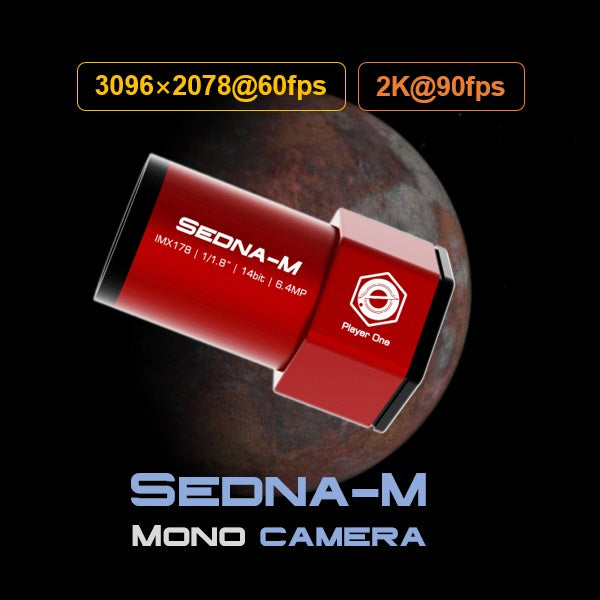
- Up to 60 fps at 10-bit: full-resolution readout over USB 3.0 for high-frame-rate planetary capture and responsive guiding.
- ST4 guide port: connects directly to your mount's autoguider input for pulse guiding, in addition to guiding through the USB connection.
- 1.25" / M28.5×0.6 nosepiece: drops into any 1.25" focuser or guide scope and threads to standard 1.25" filters.
- 65 g body, 40 mm diameter: light and small enough to hang off a finder-style guide scope without loading the mount.
Optical / Mechanical Design
The Sedna-M is an uncooled CMOS camera in a 40 mm-diameter body weighing just 65 g. The sensor sits behind a 21 mm AR (anti-reflection) multi-layer coated protective window, which passes light efficiently while keeping dust and moisture off the chip. Back focal length from the sensor to the front of the 1.25" nosepiece is 7.5 mm, which is what you use to work out spacing if you place the camera behind a filter or in an off-axis guider. The rolling-shutter sensor supports exposures from 32µs all the way to 2000 s, covering fast planetary frames at one end and long guide or EAA sub-exposures at the other.
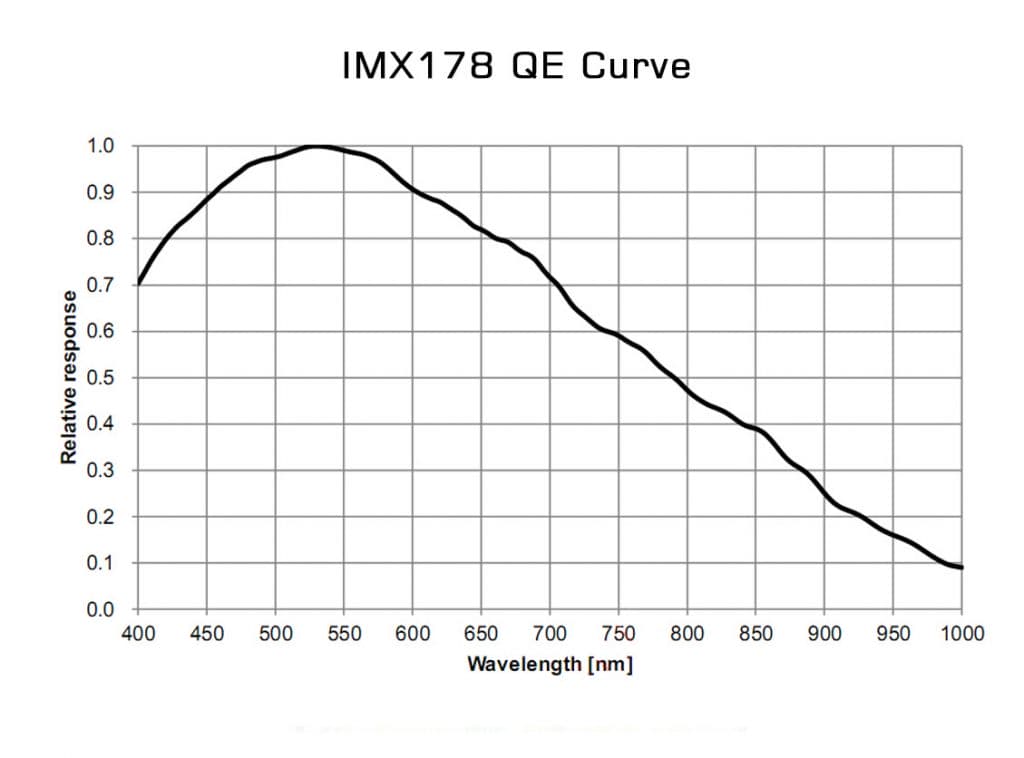
The quantum-efficiency curve below shows where the IMX178 is most responsive across the visible spectrum, peaking near 80%. High QE is what lets the Sedna-M reach faint guide stars and short-expose bright targets without pushing gain to noisy extremes.

Recommended Uses
- Autoguiding: the primary role — keeping your main imaging scope tracking accurately during long exposures, on a guide scope or through an off-axis guider.
- Planetary and lunar imaging: the 60 fps readout and 2.4µm pixels capture thousands of frames for lucky-imaging stacks of the Moon and planets.
- Electronically-assisted astronomy (EAA): live viewing of brighter deep-sky targets on a monitor with short, stacked sub-exposures.
Compatibility and Accessory Notes
The camera terminates in a 1.25" barrel with an M28.5×0.6 thread, so it fits any 1.25" focuser, guide scope, or off-axis guider, and accepts standard 1.25" filters directly. It connects to your computer over USB 3.0 (backward compatible with USB 2.0) and supports popular capture and guiding software. The ST4 port lets it send guide corrections straight to a compatible mount's autoguider input. The dimensional drawing below gives the body diameter, thread, and 7.5 mm back focal length for planning your imaging train.

Good to Know Before You Order
- Monochrome sensor: the Sedna-M records luminance only. For guiding, planetary luminance, and narrowband work this is an advantage; for one-shot colour imaging you would want a colour camera or a filter set.
- Uncooled, small-format sensor: it is built for guiding and high-frame-rate capture, not long-exposure deep-sky imaging of faint nebulae, where a larger cooled camera is the right tool.
- No visual function: it produces an image on a computer or device rather than through an eyepiece.
- Back focal length is 7.5 mm: if you are placing the camera behind a filter or in an off-axis guider, this is the figure to work spacing from. If you are unsure how it fits your setup, send us your guide scope or OAG details and we will confirm it with you.
Frequently Asked Questions
Is it difficult to set up?
No. The camera drops into any 1.25" focuser or guide scope, connects with a single USB 3.0 cable, and is recognized by common guiding and capture software. If you are pulse-guiding through the ST4 port, one additional cable runs from the camera to your mount's autoguider input.
What is it best used for?
Autoguiding an imaging rig is its main job. Its sensitivity and small pixels also make it a strong performer for planetary, lunar, and EAA imaging.
Can it do deep-sky astrophotography on its own?
It is not designed for it. The IMX178 is a small, uncooled sensor optimized for guiding and high-frame-rate capture. For long-exposure deep-sky imaging, a larger cooled camera is the better match, with the Sedna-M guiding alongside it.
Does it come with an ST4 guide port?
Yes. The Sedna-M has an ST4 port for direct pulse guiding to a compatible mount, and it can also guide over its USB connection.
What threads and adapters does it use?
It has a 1.25" nosepiece with an M28.5×0.6 thread, so it fits 1.25" focusers and guide scopes and takes standard 1.25" filters.
Why choose a mono camera for guiding?
A monochrome sensor has no colour filter array, so every pixel collects all incoming light. That gives it more sensitivity and finer resolution than a colour sensor of the same size — which is exactly what you want when locking onto faint guide stars.
Bottom Line
In short: a compact, sensitive 6.4 MP mono guide camera built on the Sony IMX178, with read noise down to 1.3e, an ST4 port, and a 1.25" nosepiece — a dedicated autoguider that doubles as a capable planetary, lunar, and EAA camera when you want one.
| Sensor | Sony IMX178 1/1.8" CMOS (mono) |
|---|---|
| Resolution | 6.4 MP (3096 × 2078) |
| Pixel size | 2.4 µm |
| Sensor diagonal | 9 mm |
| Sensor size | 7.4 mm × 5.0 mm |
| Full-well capacity | 15k e |
| Read noise | 2.2e~1.3e (1.34e min at gain 350) |
| Peak QE | ≈80% |
| ADC | 14-bit |
| Frame rate | 60 fps at 10-bit (3096 × 2078, USB3.0) |
| Exposure range | 32 µs – 2000 s |
| Shutter | Rolling shutter |
| Data port | USB3.0 / USB2.0 |
| Guide port | ST4 |
| Adapter | 1.25" / M28.5×0.6 |
| Back focal length | 7.5 mm |
| Protective window | D21 × 1.1 mm AR (anti-reflection) multi-layer coating |
| Body diameter | 40 mm |
| Weight | 65 g |
You may also like
Recently viewed
Recent Blog Posts
View all
Your Guide Graph Is Lying to You
Read More
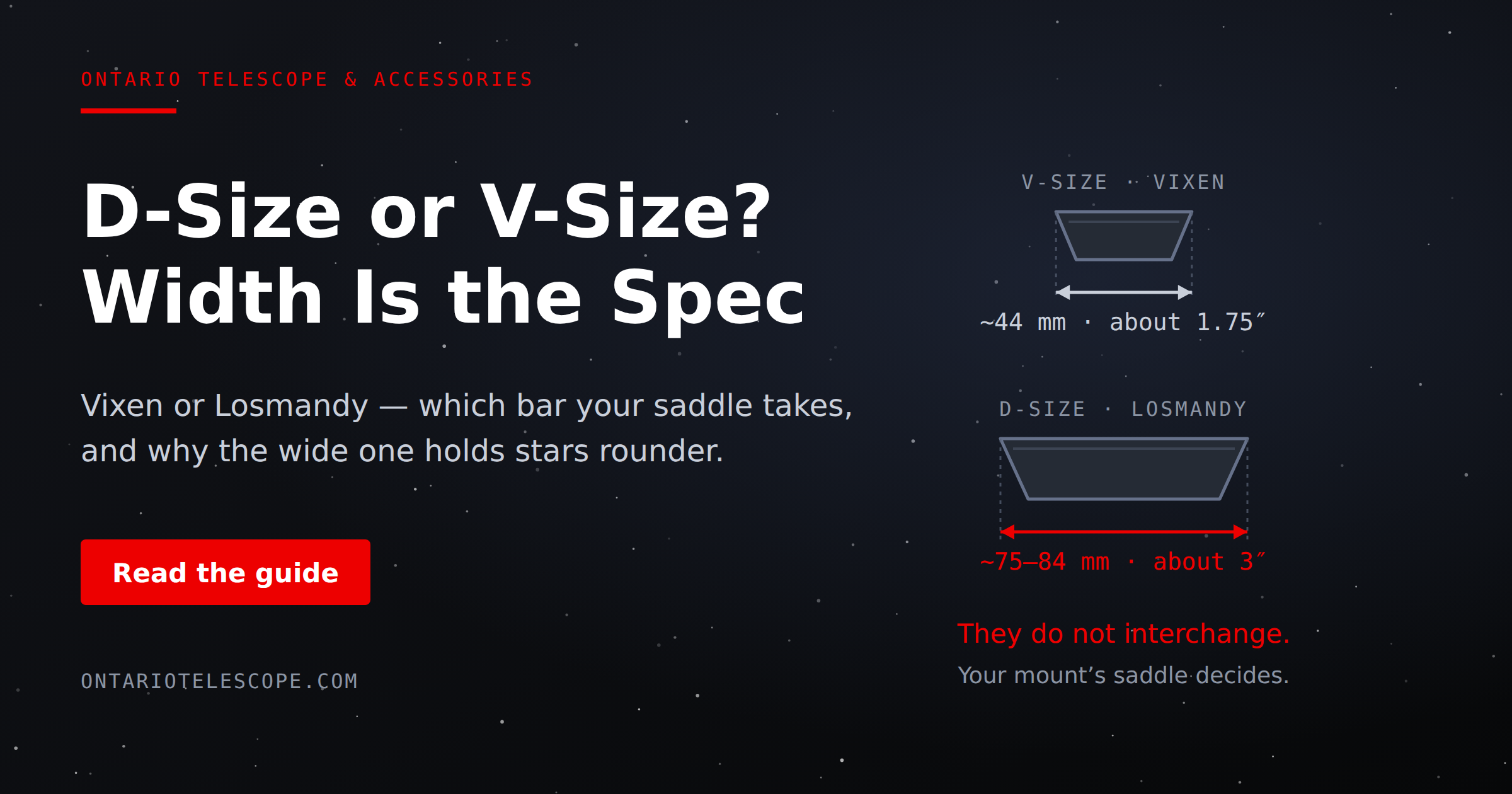
D-Size vs V-Size: A Complete Guide to Telescope Dovetail Systems
Read More
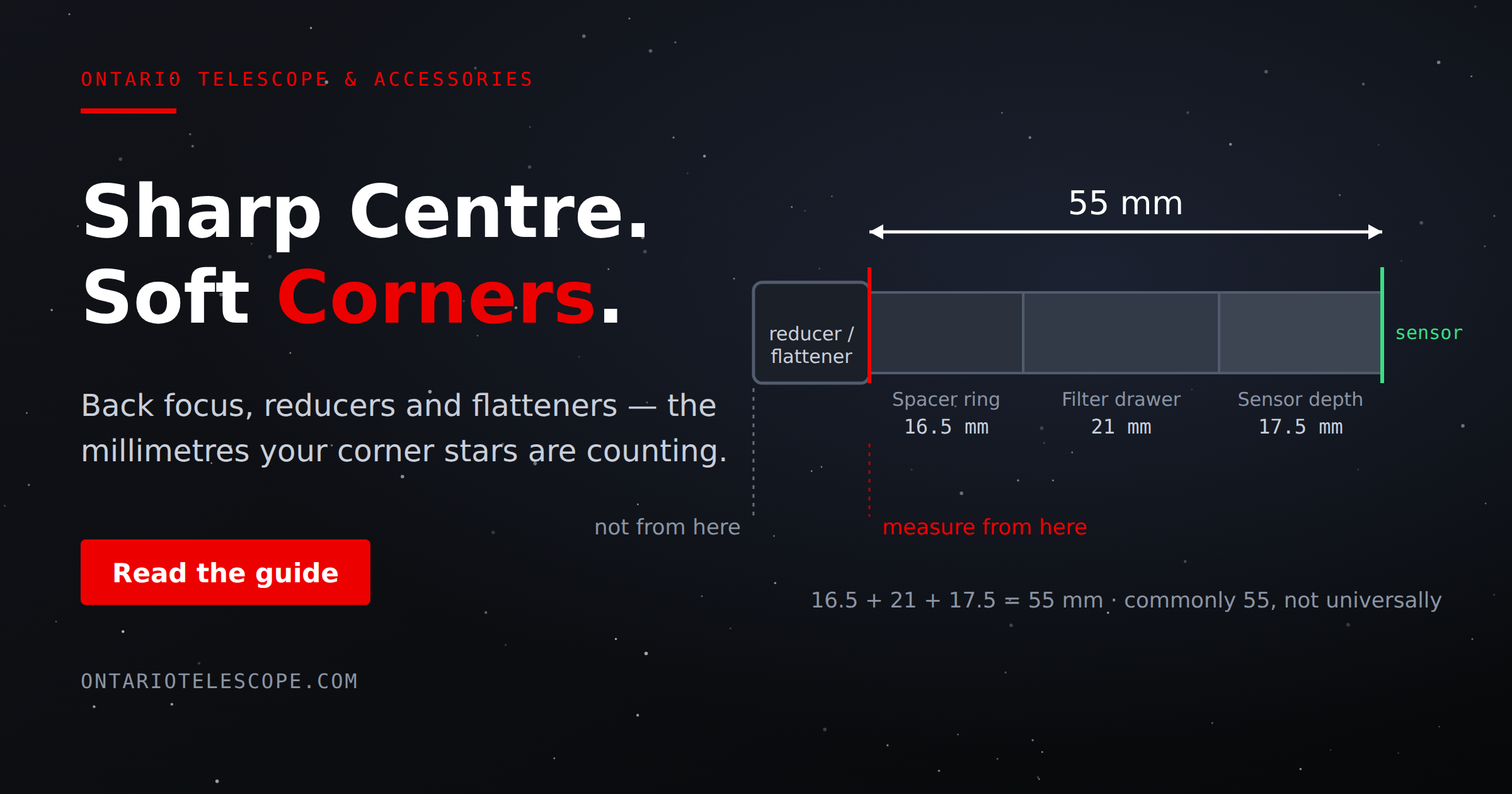
What Is Back Focus in Astrophotography? Telescope Reducers, Flatteners, and Spacing Explained
Read More