


- Description
- Specifications
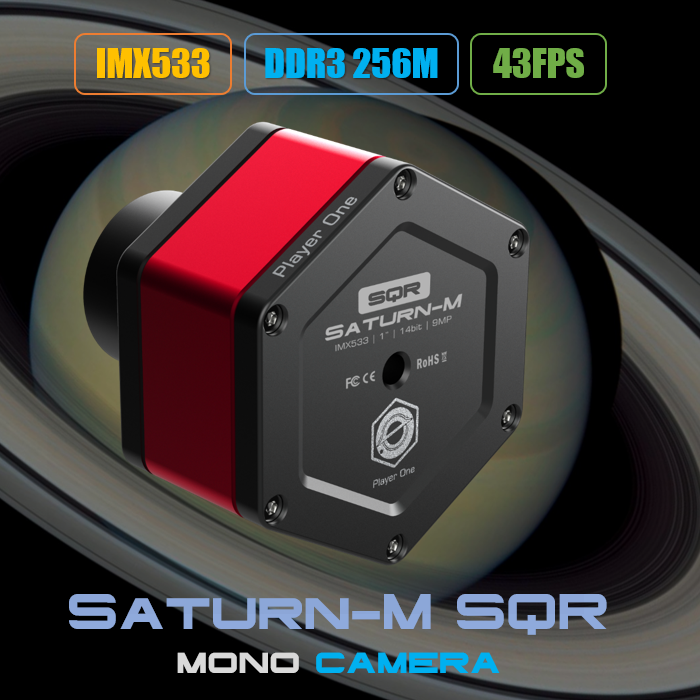
The Player One Saturn-M SQR is a USB3.0 monochrome camera built around the 1" square Sony IMX533 back-illuminated STARVIS CMOS sensor. It combines a 1:1 square field — no rotation needed to frame a target — with a full-resolution monochrome readout, making it a detailed high-resolution imager for the Moon, planets and Sun when working through filters.
Product Overview
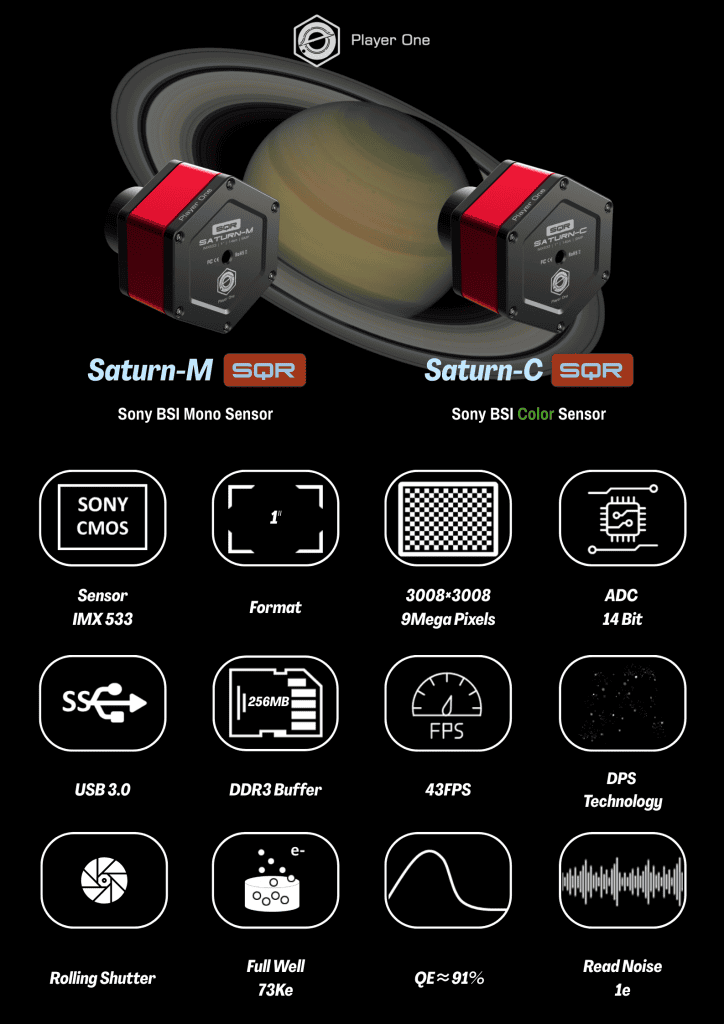
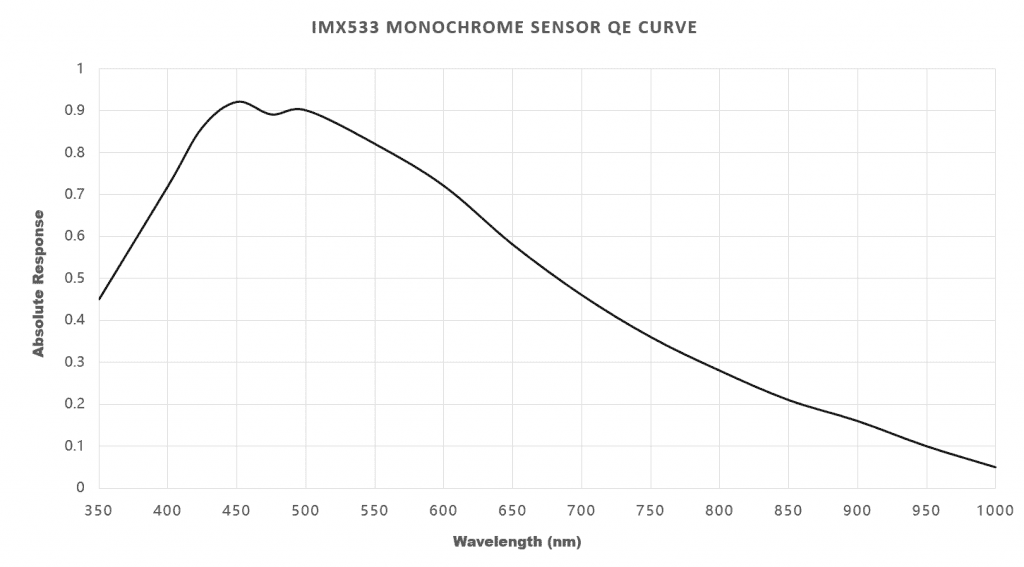
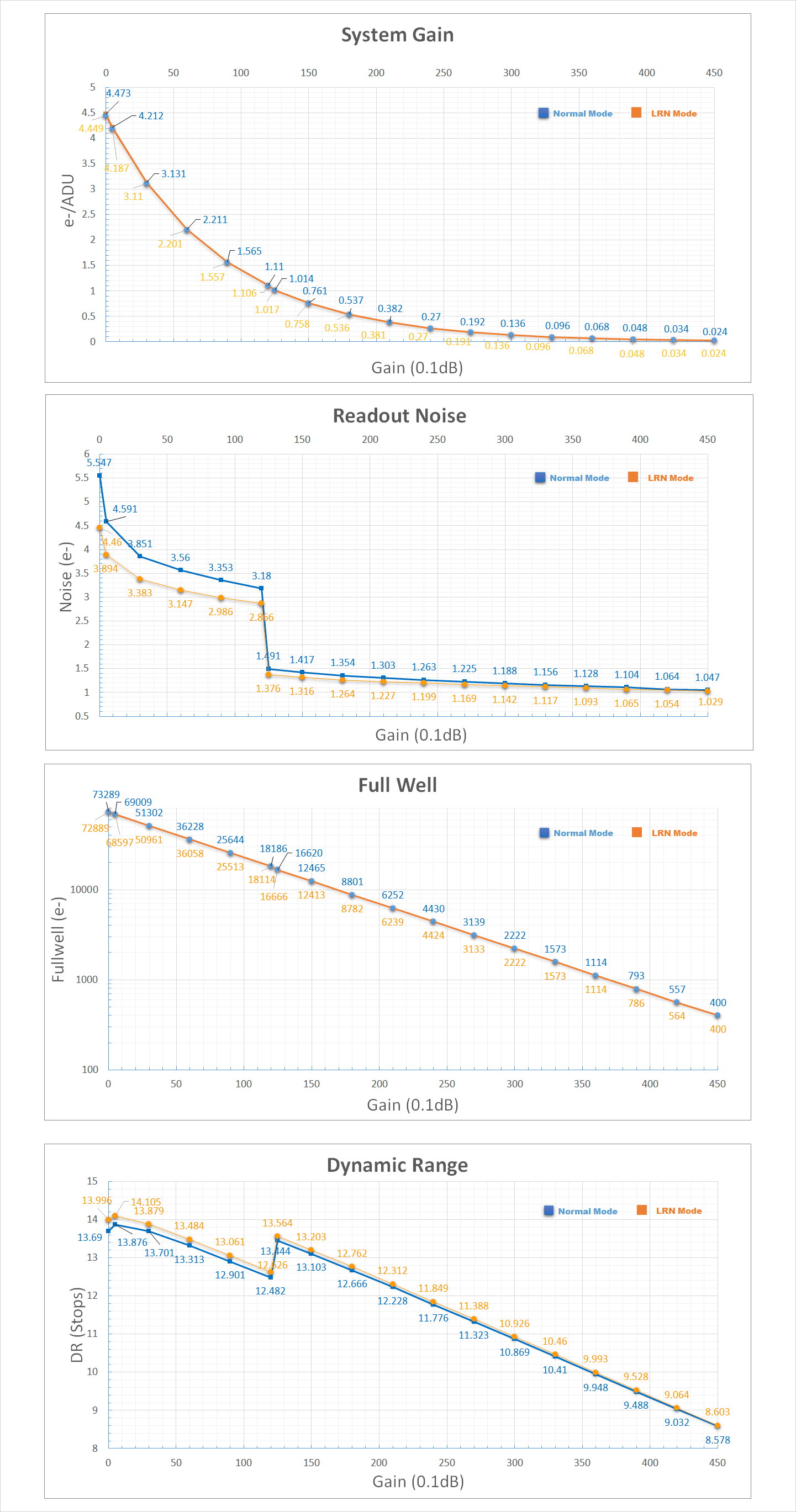
The IMX533 provides a 3008×3008 array of 3.76µm pixels, an 11.31 mm square imaging area with a 16 mm diagonal. A deep 73k e⁻ full-well gives wide dynamic range, read noise falls to about 1 e⁻, the 14-bit ADC delivers smooth tonal gradation, and peak QE reaches roughly 91%. The back-illuminated STARVIS design produces very low amp glow and clean dark frames. Over USB3.0 it captures up to 43 FPS in Raw8 at full resolution.
Who It's For
This is a good match if you image the Moon, planets and Sun at high resolution, want the extra sensitivity and detail of a monochrome sensor, and are set up to shoot through filters. The square format frames round targets symmetrically, and the camera autoguides through its ST4 port.
Key Features & Design
- Sony IMX533 square monochrome sensor: 1" back-illuminated STARVIS CMOS, 9 MP, 1:1 format.
- Full-resolution mono readout: resolves finer detail than a colour sensor of the same size.
- Deep 73k e⁻ full-well: wide dynamic range for bright lunar and planetary highlights.
- Very low amp glow: the STARVIS design yields clean dark frames.
- 14-bit ADC and high peak QE (≈ 91%): smooth, sensitive capture.
- Protective window: D32×2 mm with AR Plus multi-layer coating; 256MB DDR3 buffer and ST4 port.
Optical / Mechanical Design
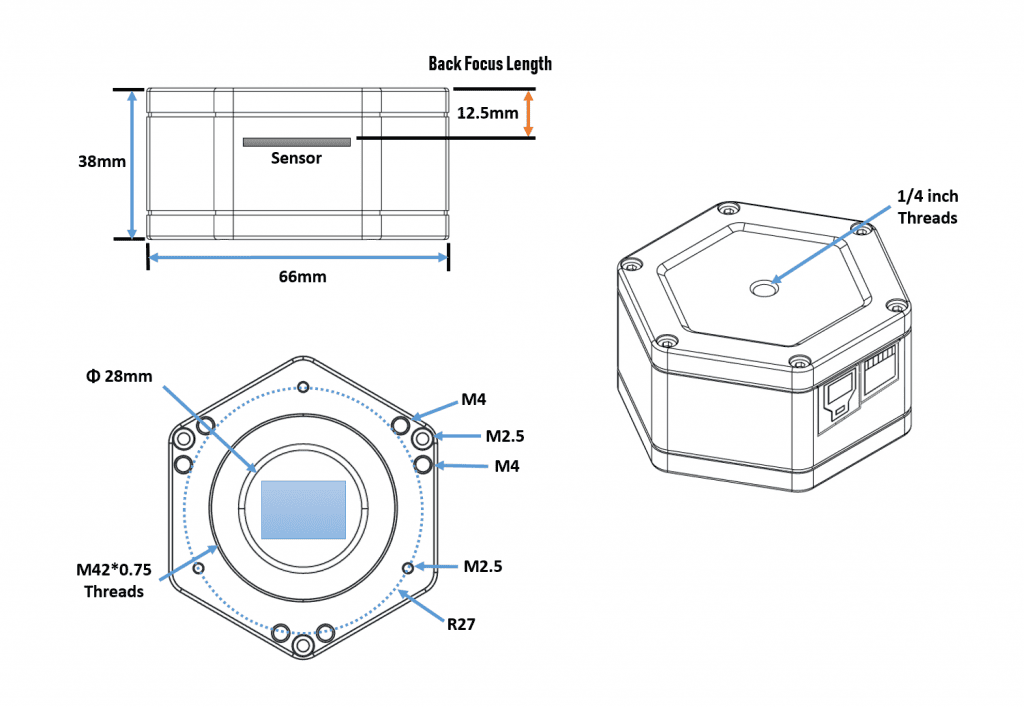
The Saturn-M SQR uses a rolling-shutter monochrome CMOS with 3.76µm pixels. With no colour filter array, each pixel records the full light passed by whatever filter is in the train, which is why mono sensors resolve finer planetary detail. The larger square sensor and deep full-well suit bright, high-cadence solar-system targets. The sensor sits at a 12.5 mm back focal distance, and the 66 mm body threads accept 1.25" and M42×0.75 (T-thread) adapters. Exposures run 32µs to 2000 s. The published weight is 160 g.
Recommended Uses
- High-resolution LRGB planetary imaging through a filter wheel.
- Monochrome lunar imaging behind a Barlow or long-focal-length scope.
- Solar imaging with suitable solar filtration or a dedicated solar scope.
- Autoguiding through the ST4 port.
Compatibility & Accessory Notes
The camera connects through 1.25" nosepiece or M42×0.75 threads and fits any telescope with those interfaces. For colour planetary results you add R, G, B (and often IR-pass) filters, usually via a filter wheel. Note the larger D32×2 mm window and 16 mm diagonal — use Barlows and filters that clear the larger sensor without vignetting. Capture is over USB3.0, and the ST4 port accepts a standard autoguide cable.
Good to Know Before You Order
- Monochrome output: colour planetary results come from imaging through separate filters and combining them.
- Uncooled camera: optimized for bright solar-system targets rather than cooled long-exposure deep-sky imaging.
- Larger sensor: the 16 mm diagonal benefits from Barlows and filters rated for a wider field to avoid vignetting.
Frequently Asked Questions
Is it difficult to set up?
No. It threads onto a 1.25" or M42 connection, installs its driver, and appears in your capture software. Working in mono adds filters to the train, a straightforward step.
What is it best used for?
High-resolution monochrome and filtered lunar, planetary and solar imaging, plus autoguiding.
Why choose mono over the colour Saturn-C SQR?
A monochrome sensor resolves finer detail and is more sensitive because it has no Bayer filter; colour work is done through separate filters.
Can I use it for deep-sky astrophotography?
As an uncooled camera it is built for bright solar-system targets; long-exposure deep-sky work is better served by a cooled camera.
Does it autoguide?
Yes, through its ST4 port with a suitable guide scope.
Bottom Line
In short: a 9 MP, 1" square monochrome camera with a deep 73k e⁻ full-well, high QE and very low amp glow, well suited to detailed lunar, planetary and solar imaging through filters on standard 1.25" and M42 threads.
| Sensor | Sony IMX533 (1" back-illuminated STARVIS CMOS, monochrome, square) |
|---|---|
| Resolution | 9 MP (3008 × 3008) |
| Pixel size | 3.76 µm |
| Sensor diagonal | 16 mm |
| Image size | 11.31 mm × 11.31 mm |
| Full-well capacity | 73k e⁻ |
| Read noise | 4.46 e⁻ ~ 1 e⁻ |
| ADC | 14-bit |
| Peak QE | ≈ 91% |
| Frame rate (full res) | 43 FPS (Raw8) |
| Exposure range | 32 µs – 2000 s |
| Back focal length | 12.5 mm |
| Data interface | USB3.0 / USB2.0 |
| Guide port | ST4 |
| Adapters | 1.25" / M42 × 0.75 |
| Protective window | D32 × 2 mm AR Plus multi-layer coating |
| DDR buffer | 256MB DDR3 |
| Diameter | 66 mm |
| Weight | 160 g |
You may also like
Recently viewed
Recent Blog Posts
View all
Your Guide Graph Is Lying to You
Read More

D-Size vs V-Size: A Complete Guide to Telescope Dovetail Systems
Read More

What Is Back Focus in Astrophotography? Telescope Reducers, Flatteners, and Spacing Explained
Read More