


- Description
- Specifications
Product Overview
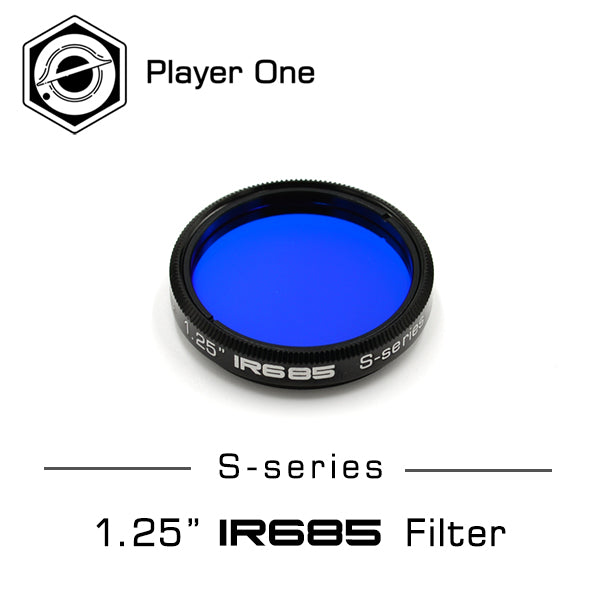
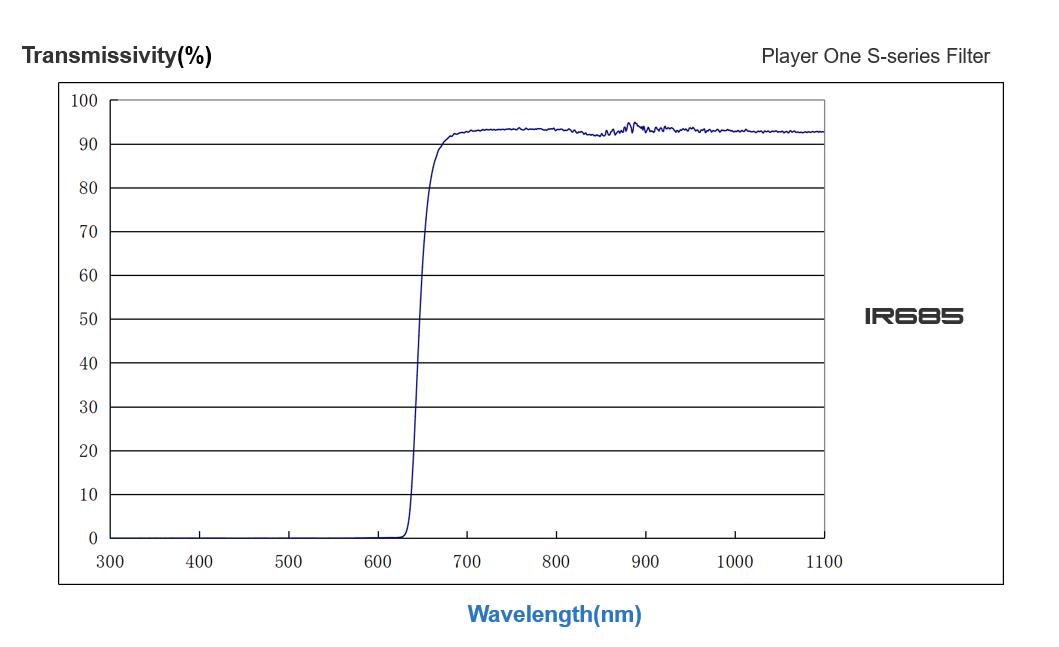
The Player One Astronomy S-series IR685nm 1.25″ is an infrared long-pass filter that admits light beyond 685 nm and blocks the visible band to OD3. Imaging in the near-infrared cuts through atmospheric turbulence more effectively than visible light, so on nights of mediocre seeing this filter helps your planetary and lunar frames hold detail that would otherwise smear. It transmits about 90% in-band on a double-sided multi-layer coated optical-glass substrate.
Who It's For
This filter is for high-resolution planetary and lunar imagers, usually working with an infrared-sensitive monochrome camera, who want to salvage sharpness when the atmosphere is unsteady. If you chase fine detail on the Moon, Mars, Jupiter, or Saturn and want a tool for turbulent skies, the IR685 earns its place.
Key Features & Design
- 685 nm long-pass: transmits near-infrared beyond 685 nm, where atmospheric seeing has a smaller effect on resolution.
- Visible blocking to OD3: suppresses shorter wavelengths so only the near-IR reaches the sensor.
- ≈90% in-band transmission: keeps enough signal for practical frame rates on bright planetary targets.
- Double-sided multi-layer coating: applied to both faces of the optical-glass substrate.
- 1.25″ thread (M28.5×0.6): fits standard 1.25-inch filter cells, drawers, and wheels.
Optical/Mechanical Design
The IR685 is a long-pass interference filter with a cut-on near 685 nm: it transmits about 90% of light above that point and blocks the visible band to optical density 3 (OD3). Because longer wavelengths are refracted less by atmospheric turbulence, near-IR imaging can resolve planetary and lunar detail on nights when visible-light frames would be soft — the physical reason many high-resolution imagers keep an IR-pass filter on hand. The 2 mm-thick optical-glass substrate carries a double-sided multi-layer composite coating. Mechanically it uses the 1.25-inch M28.5×0.6 thread with a 5 mm body plus 2 mm thread section (7 mm total).

Recommended Uses
- High-resolution planetary imaging in poor or average seeing with an IR-sensitive camera.
- Lunar detail work where near-IR steadies the view.
- Infrared-band imaging of bright solar-system targets with monochrome cameras.
Compatibility & Accessory Notes
- Fit: 1.25″ M28.5×0.6 filter thread — works in 1.25-inch cells, drawers, and filter wheels.
- Cameras: best paired with a camera that retains sensitivity in the near-infrared, typically a monochrome model.
- Backfocus: the 7 mm cell and 2 mm glass add to your optical path; include them in your spacing calculation.
Good to Know Before You Order
- This is an imaging filter for infrared capture; it passes light your eye cannot see and is not intended for visual observing.
- A camera with strong near-IR response gets the most from it; sensors with heavy internal IR-cut will show reduced signal.
- Player One does not publish a net weight for this filter, so the shipping weight shown at checkout is an estimate. Contact us if you need an exact figure.
FAQ
Is it difficult to set up? No. It threads into a standard 1.25-inch filter cell, drawer, or wheel and needs no power or configuration; refocus once after fitting, since IR focus can differ slightly from visible.
Why image in the infrared? Longer wavelengths are less disturbed by atmospheric turbulence, so an IR-pass filter can sharpen planetary and lunar detail when seeing is poor.
Do I need a special camera? A camera with good near-infrared sensitivity, usually monochrome, gets the best results because the filter only passes wavelengths beyond 685 nm.
Can I use it for visual observing? No. It transmits near-infrared that the eye cannot use; it is an imaging filter.
Bottom Line
The S-series IR685nm 1.25″ filter opens up near-infrared imaging beyond 685 nm with ~90% transmission and OD3 visible blocking, giving high-resolution planetary and lunar imagers a practical way to beat unsteady skies.
| Brand | Player One Astronomy |
| Model | S-series IR685nm 1.25″ IR-Pass |
| Filter Type | Infrared long-pass (IR-pass) |
| Cut-on Wavelength | 685 nm |
| Peak Transmittance | ≈90% |
| Blocking | OD3 |
| Coating | Double-sided multi-layer composite coating |
| Substrate | High-quality optical glass |
| Thread | M28.5 × 0.6 (1.25″) |
| Cell Thickness | 7 mm (5 mm body + 2 mm thread) |
| Glass Thickness | 2 mm |
You may also like
Recently viewed
Recent Blog Posts
View all
Your Guide Graph Is Lying to You
Read More

D-Size vs V-Size: A Complete Guide to Telescope Dovetail Systems
Read More

What Is Back Focus in Astrophotography? Telescope Reducers, Flatteners, and Spacing Explained
Read More