


- Description
- Specifications
Product Overview
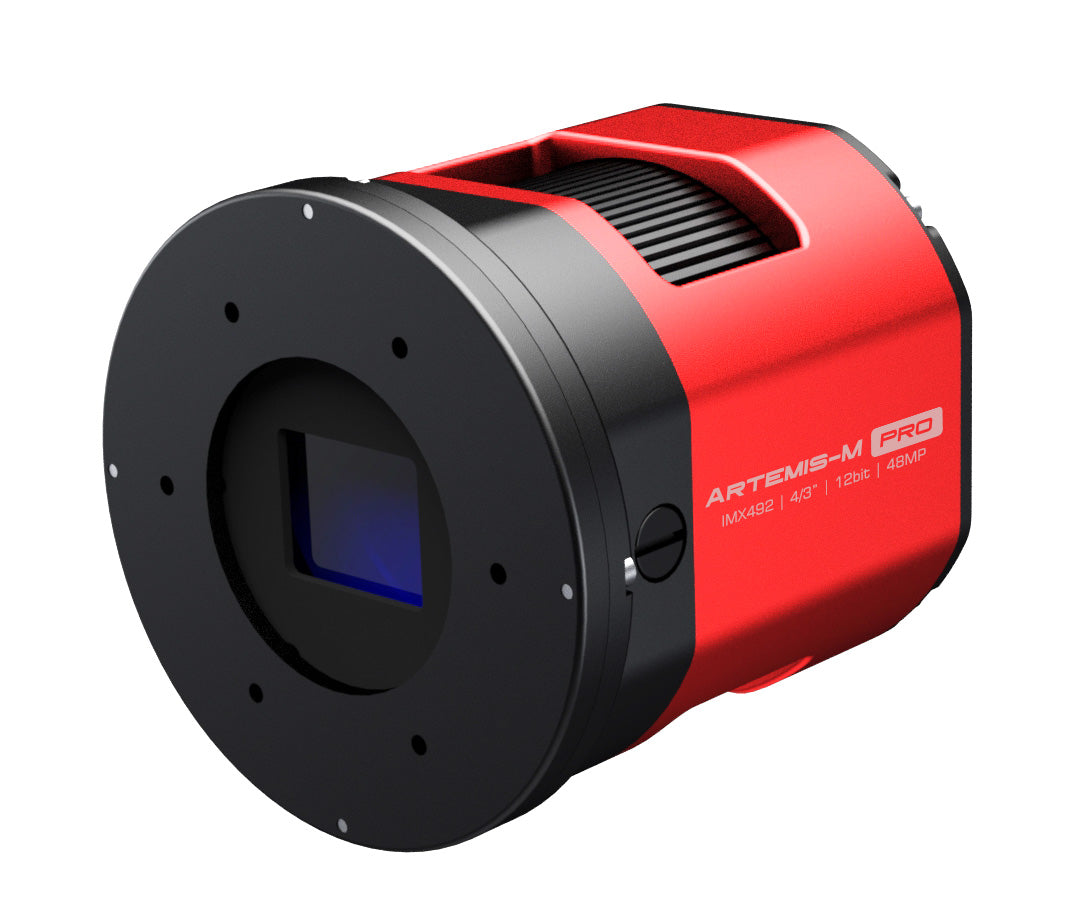
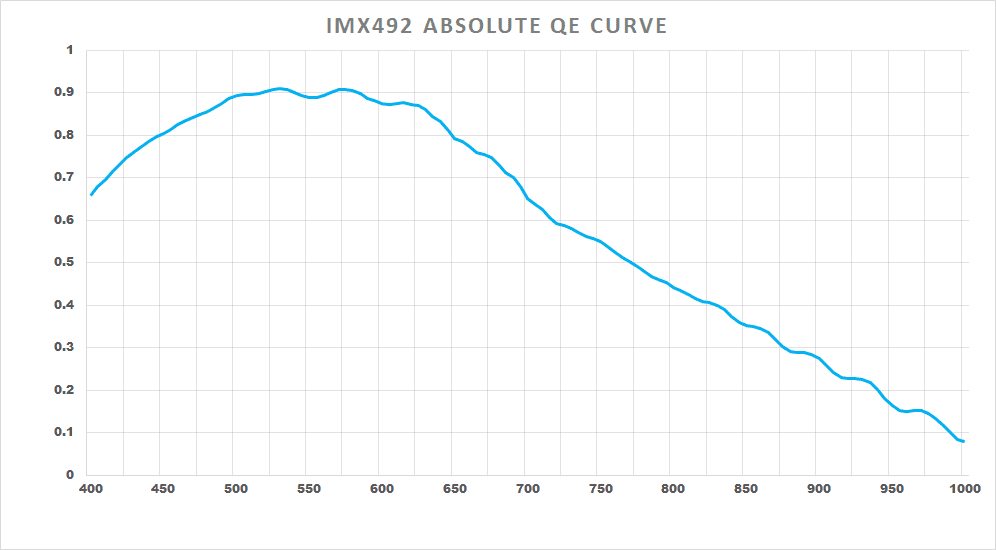
The Player One Astronomy Artemis-M Pro is a cooled monochrome USB3.0 camera built on the 47-megapixel Sony IMX492 CMOS sensor. The IMX492 is a 4/3″ sensor (19.2 mm × 13 mm, 23.2 mm diagonal) with very fine 2.315 µm pixels — 8288 × 5648 in full BIN1 resolution — making it a high-resolution mono imager. Binned 2×2 it becomes an 11.7 MP sensor with a larger 65.8 ke- full well. A two-stage TEC cools it 40°C ± 2°C below ambient, and peak quantum efficiency is about 90%.
Who It's For
This is a good match if you want high-resolution monochrome detail for narrowband and LRGB imaging, particularly on longer focal lengths where the fine 2.315 µm pixels resolve tight structure. BIN2 mode gives you a lower-resolution, higher-full-well option when conditions or targets favor deeper wells over pixel count.
Key Features & Design
- Sony IMX492 4/3″ mono sensor: 47 MP at 8288 × 5648 with 2.315 µm pixels for fine detail.
- Selectable binning: BIN1 for resolution (18.6 ke- well, 12-bit) or BIN2 for depth (65.8 ke- well, 14-bit).
- Read noise to 1.46e- (BIN1): a low floor for faint narrowband signal.
- Peak QE about 90%: high mono sensitivity across the spectrum.
- Two-stage TEC, 40°C ± 2°C below ambient: controls dark current on long exposures.
- M48, 2″, and 1.25″ interfaces: flexible connection to imaging trains.
Optical / Mechanical Design
The IMX492's 2.315 µm pixels are unusually fine, which is what gives the sensor its 47 MP resolution on a 4/3″ frame — ideal for oversampling at longer focal lengths. In BIN1 the ADC runs 12-bit with an 18.6 ke- full well; BIN2 combines pixels for a 65.8 ke- well and 14-bit output, trading resolution for dynamic range. Peak QE of about 90% and cooling to 40°C ± 2°C below ambient support long, low-noise integrations.

Recommended Uses
- High-resolution narrowband: fine detail in nebulae through H-alpha, OIII, and SII filters.
- LRGB galaxy and cluster work: oversampled luminance at longer focal lengths.
- Flexible binning: BIN2 for deeper wells when seeing or target brightness calls for it.
Compatibility & Accessory Notes
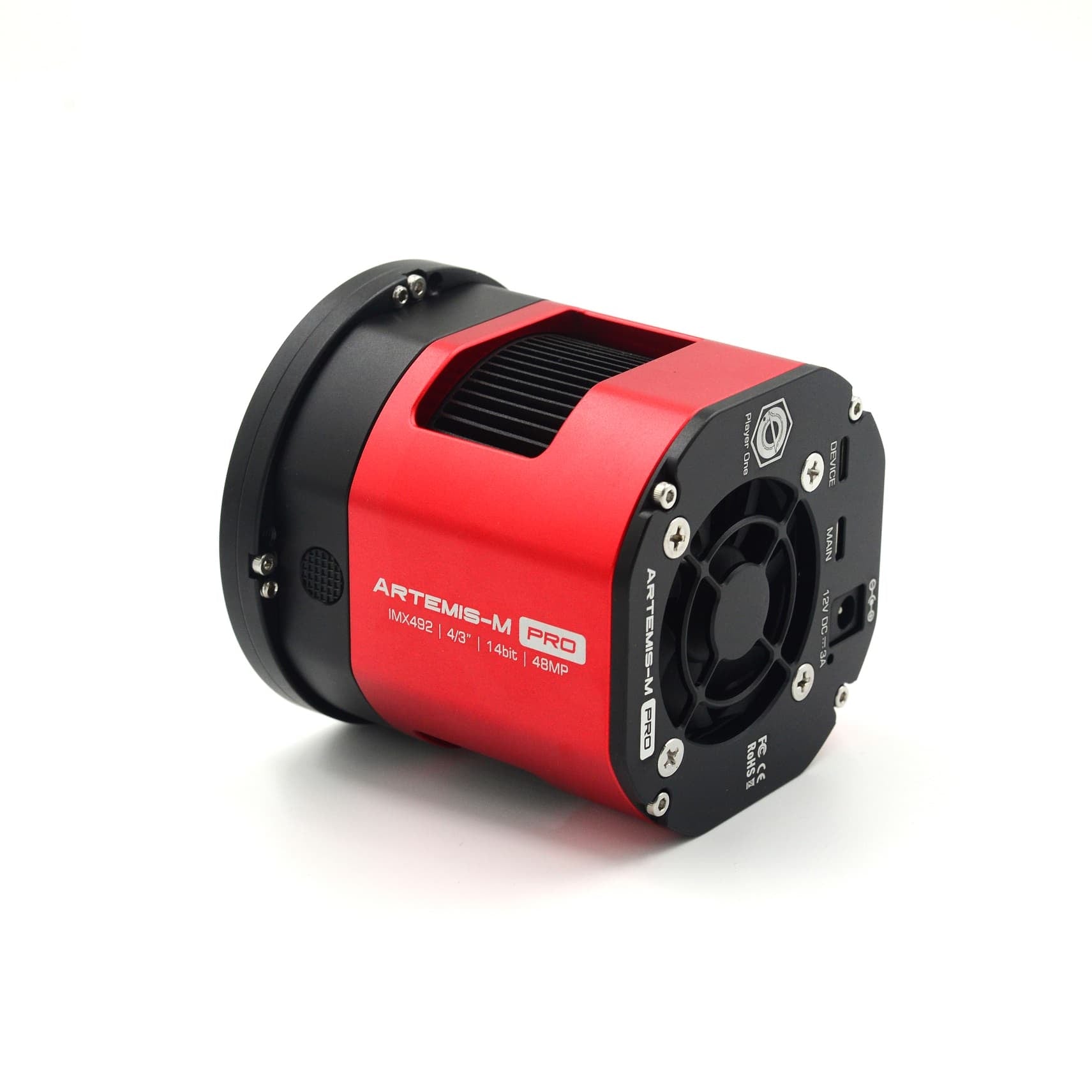
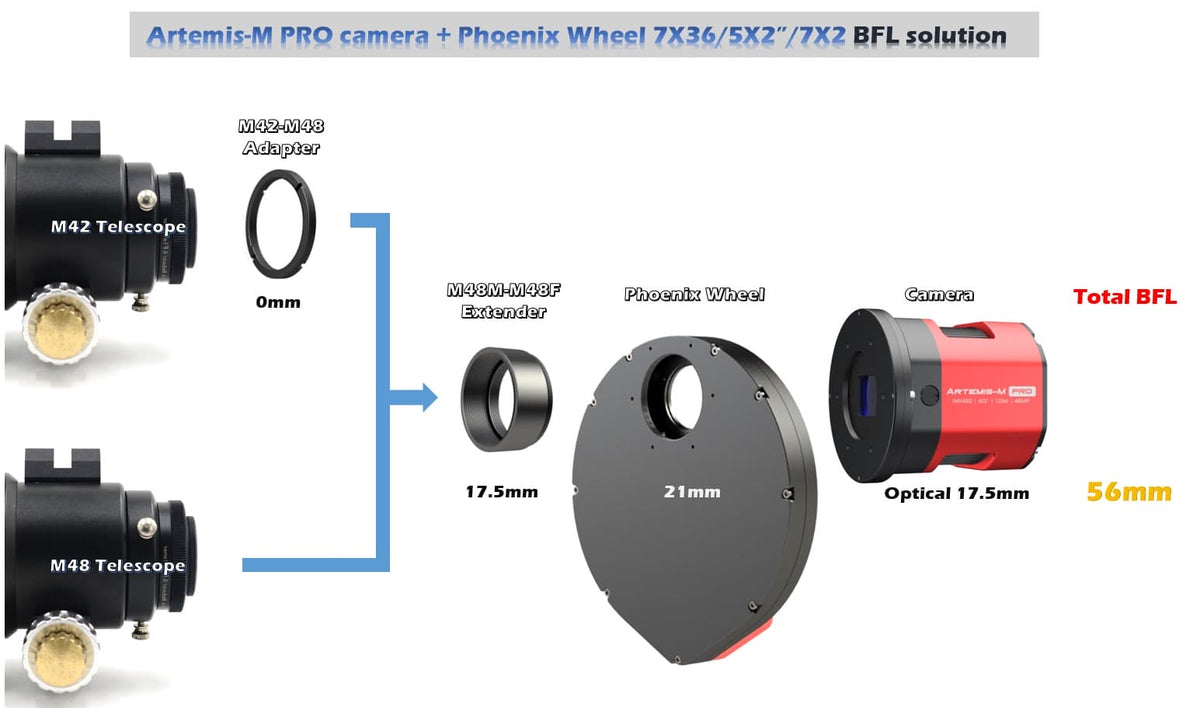
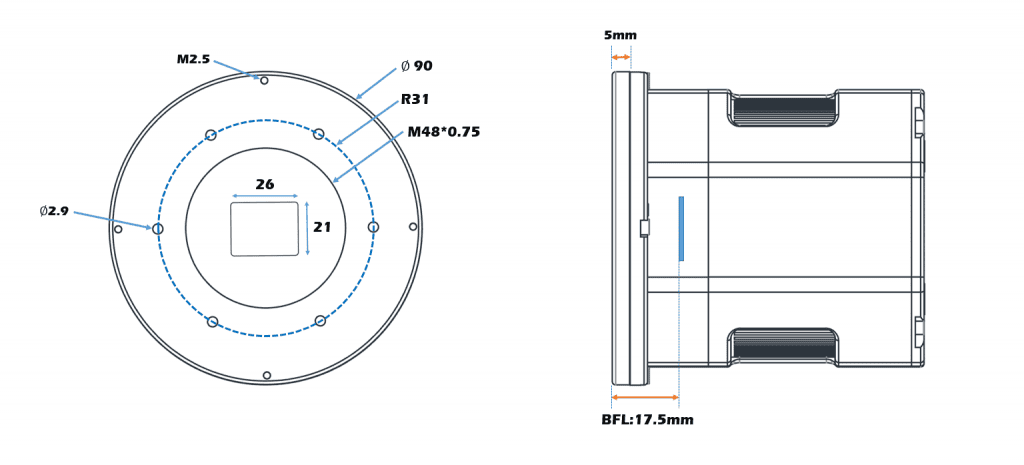
The Artemis-M Pro connects over USB3.0/USB2.0 (Type-C) and powers its cooler from a 12 V DC 5.5 × 2.1 mm input. It offers M48 × 0.75, 2″, and 1.25″ interfaces. Back focal distance is 17.5 mm with the sensor tilt plate fitted, or 12.5 mm without — note your configuration when spacing a filter wheel and flattener. As a mono camera it is designed to run with filters.

Good to Know Before You Order
- Fine pixels favor longer focal lengths: the 2.315 µm pixels oversample at short focal lengths; BIN2 helps match your image scale.
- Color needs filters: a monochrome camera builds color from separate filtered exposures, typically with a filter wheel.
- Back focus depends on the tilt plate: 17.5 mm with the plate, 12.5 mm without.
- Spacing help: send us your filter wheel and flattener setup and we will confirm the spacing and adapters with you.
Frequently Asked Questions
Is it difficult to set up?
No. It threads onto M48, 2″, or 1.25″, connects with one USB3.0 Type-C cable, and takes 12 V DC for cooling. Choosing BIN1 or BIN2 and the back-focus configuration are the main decisions; the rest is set in software.
What is it best used for?
High-resolution monochrome deep-sky imaging — narrowband nebulae and oversampled LRGB galaxies at longer focal lengths.
What is the difference between BIN1 and BIN2?
BIN1 gives full 47 MP resolution with a smaller full well; BIN2 combines pixels for 11.7 MP with a deeper 65.8 ke- well and higher bit depth.
Do I need a filter wheel?
For color, yes — mono cameras record one filter at a time and combine the channels in processing.
Bottom Line
In short: a cooled monochrome camera on the 47 MP 4/3″ Sony IMX492, with fine 2.315 µm pixels, selectable BIN1/BIN2, about 90% peak QE, and 40°C of cooling below ambient. Run it with filters at a longer focal length and it resolves fine narrowband and LRGB detail, set 17.5 mm (or 12.5 mm) behind its front face.
| Sensor | Sony IMX492 CMOS, monochrome |
|---|---|
| Sensor format | 4/3″ (19.2 mm × 13 mm, 23.2 mm diagonal) |
| Resolution | 47 MP; 8288 × 5648 (BIN1), 4144 × 2824 (BIN2) |
| Pixel size | 2.315 µm |
| Full-well capacity | 18.6 ke- (BIN1); 65.8 ke- (BIN2) |
| Read noise | 1.46e- – 7.7e- (BIN1); 1.2e- – 7.8e- (BIN2) |
| ADC | 12-bit (BIN1); 14-bit (BIN2) |
| Max frame rate | 8 fps @BIN1 (10-bit); 33 fps @BIN2 (10-bit) |
| Peak QE | ≈90% |
| Cooling | Two-stage TEC, 40°C ± 2°C below ambient |
| Back focal length | 17.5 mm (with sensor tilt plate); 12.5 mm (without) |
| Buffer | 512 MB DDR3 |
| Data interface | USB3.0 / USB2.0 (Type-C) |
| Adapters | M48 × 0.75, 2″, 1.25″ |
| Diameter | 90 mm |
| Weight | 650 g |
| Working temperature | -10°C to 60°C |
You may also like
Recently viewed
Recent Blog Posts
View all
Your Guide Graph Is Lying to You
Read More
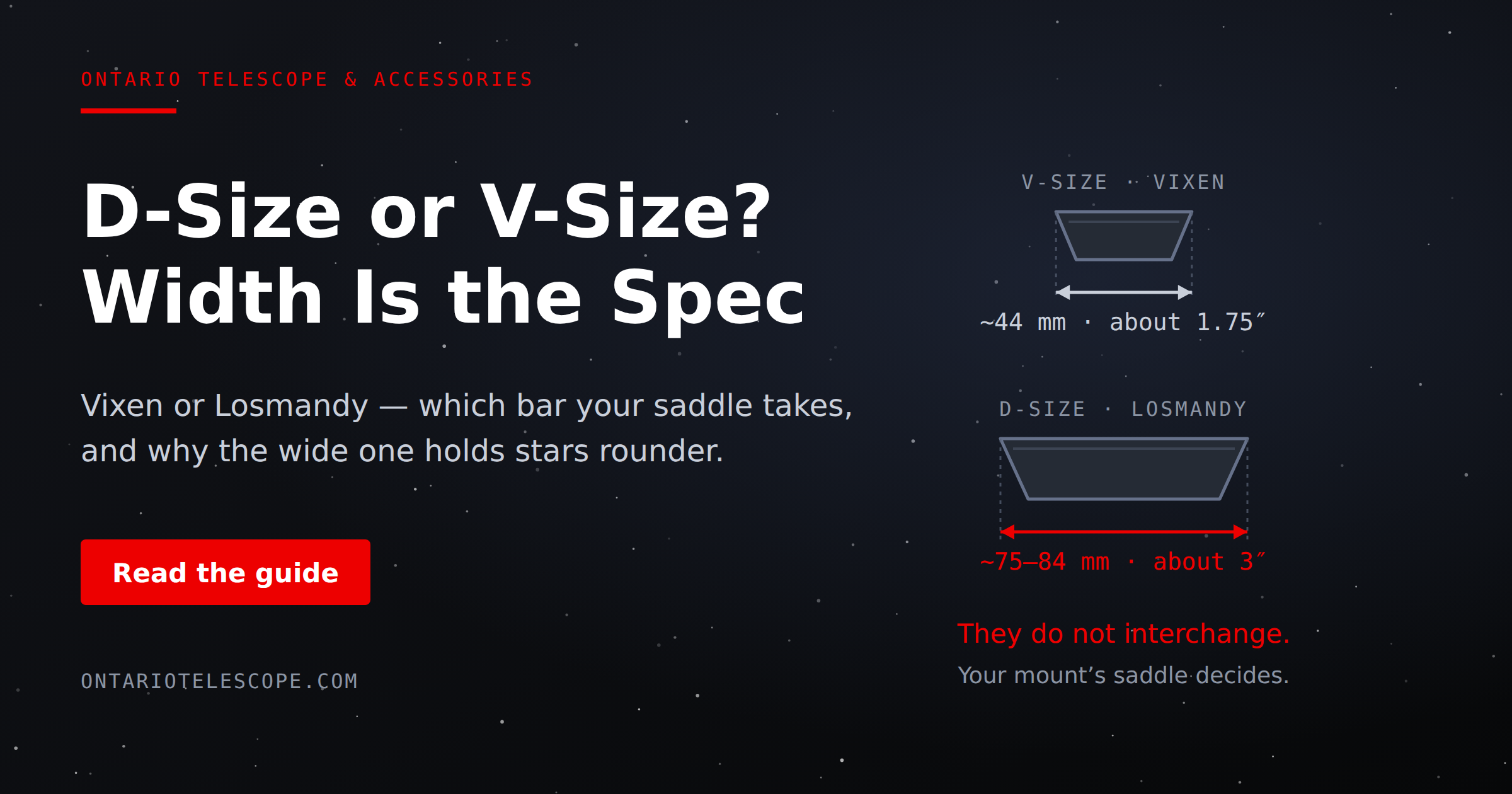
D-Size vs V-Size: A Complete Guide to Telescope Dovetail Systems
Read More
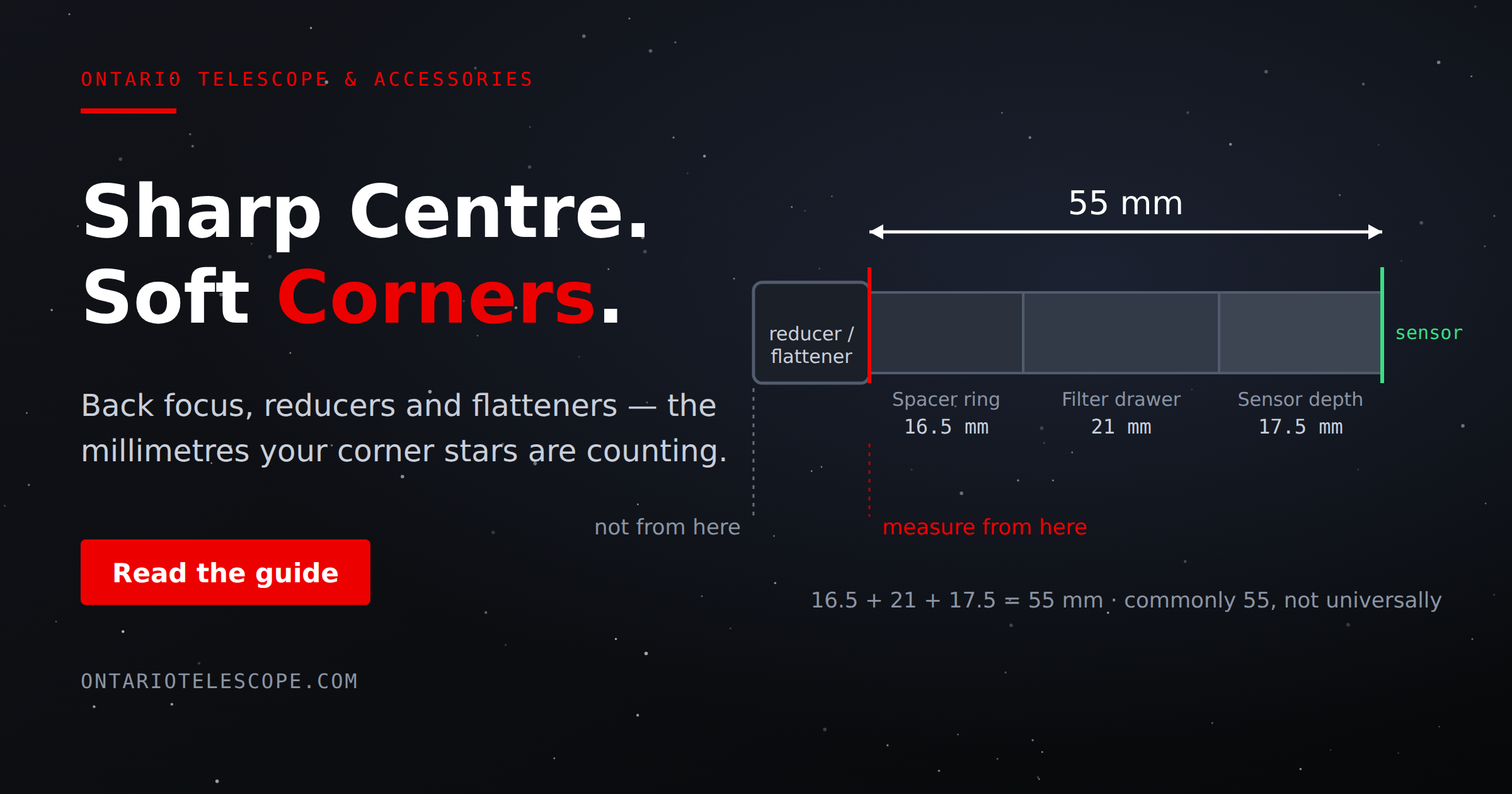
What Is Back Focus in Astrophotography? Telescope Reducers, Flatteners, and Spacing Explained
Read More