


- Description
- Specifications
Product Overview
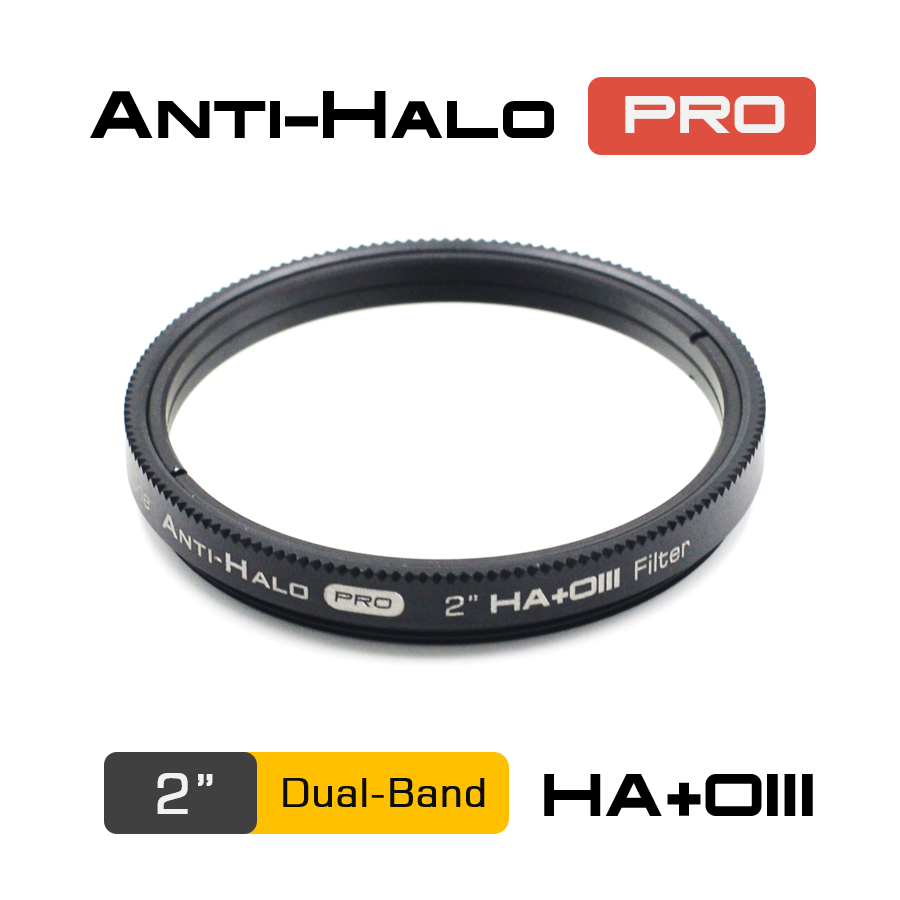
The Player One Astronomy Anti-Halo PRO Dual-Band 2″ filter isolates the two brightest emission lines in the night sky — hydrogen-alpha (Ha) at 656.3 nm and doubly ionised oxygen (OIII) at 500.7 nm — in a single 2-inch imaging filter. Its anti-halo construction suppresses the bright reflection rings that dual-band filters can throw around brilliant stars, so your emission-nebula data stays clean around the field's brightest points.
Who It's For
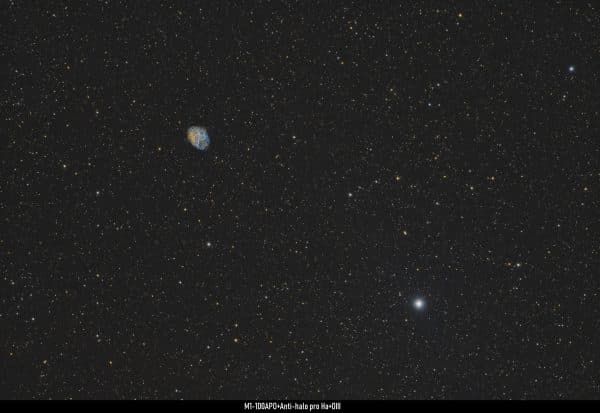
This filter is made for astrophotographers imaging emission nebulae from light-polluted skies, whether you shoot with a cooled colour (OSC) camera or a monochrome camera. If you want the Ha and OIII structure of targets like the Rosette, Veil, or North America Nebula in one exposure set while keeping stars tight and halo-free, it belongs in your imaging train.
Key Features & Design
- True dual-band pass: transmits Ha (656.3 nm) and OIII (500.7 nm) simultaneously, capturing the dominant red and teal nebula emissions in a single frame.
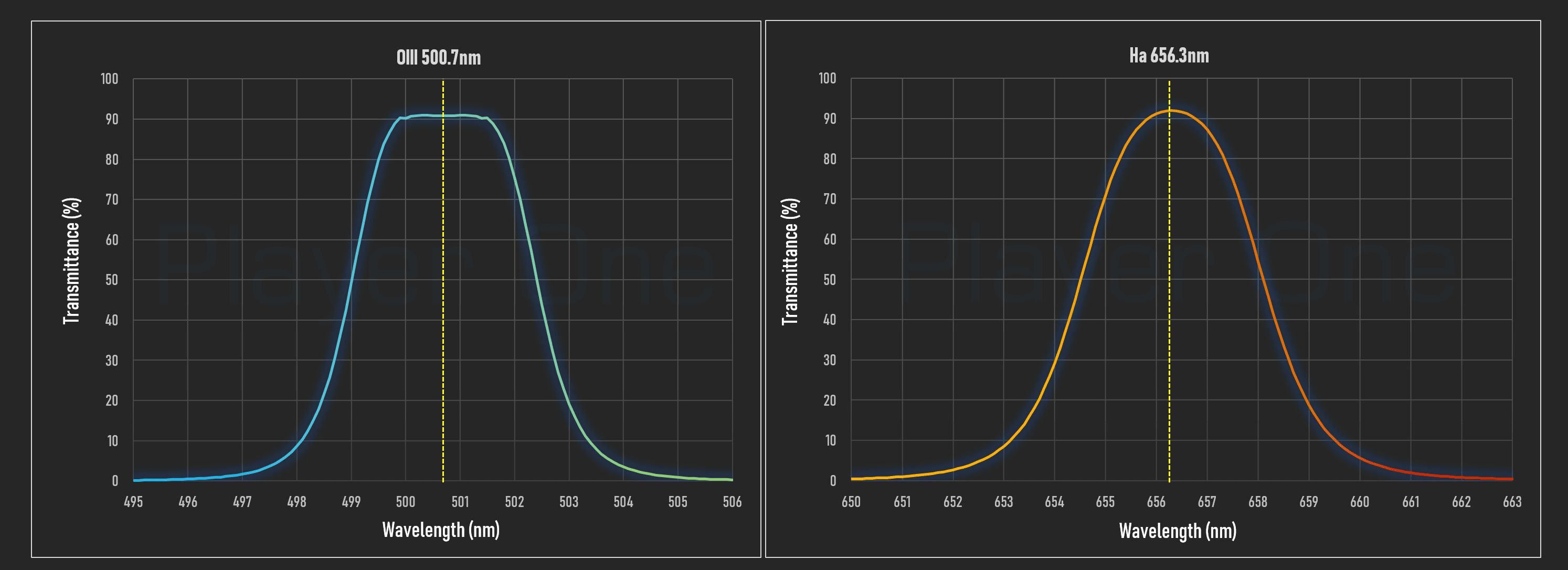
- Tight 3–4 nm bandwidths: a 3.7 ± 0.5 nm Ha window and a 3.2 ± 0.5 nm OIII window reject most artificial skyglow, raising contrast under heavy light pollution.
- Anti-halo construction: the coating stack is engineered to eliminate the reflection halos that can surround bright stars in dual-band data.
- Deep OD5 blocking: out-of-band light is blocked to optical density 5 across 200–1100 nm, keeping the passbands clean.
- High in-band transmission: ≥85% peak transmittance preserves signal at both target lines.
- Standard 2″ format: threads into any standard 2-inch filter cell, drawer, or filter wheel.
Optical/Mechanical Design
The filter combines two narrow passbands on one substrate: a 3.7 ± 0.5 nm FWHM window centred on the Ha line (656.3 nm) and a 3.2 ± 0.5 nm FWHM window centred on the OIII line (500.7 nm). Peak in-band transmittance is ≥85%, while everything outside the passbands is suppressed to OD5 (optical density 5) over the full 200–1100 nm range — deep enough to hold contrast against artificial light and to keep the camera's near-infrared response from leaking through. Mechanically it is a 2-inch threaded filter; the cell measures 5 mm at the body plus a 2.5 mm thread section for a 7.5 mm total stack, and the optical glass itself is 1.85 mm thick, which matters when you budget backfocus and account for the small focus shift a filter introduces.

Recommended Uses
- Dual-band emission-nebula imaging with OSC/colour cameras from urban and suburban skies.
- Ha and OIII data collection with monochrome cameras where a combined pass speeds acquisition.
- High-contrast wide-field nebula work where star halos would otherwise spoil the frame.
Compatibility & Accessory Notes
- Fit: standard 2″ (M48) filter threads — works in 2-inch filter drawers, filter wheels, and threaded nosepieces.
- Cameras: suits both one-shot-colour and monochrome astronomy cameras.
- Backfocus: the 7.5 mm cell and 1.85 mm glass add to your optical path; keep them in your spacing calculation.
Good to Know Before You Order
- This is an imaging filter for emission nebulae; it is not intended for visual observing or for broadband targets such as galaxies and reflection nebulae.
- Player One does not publish a net weight for this filter, so the shipping weight shown at checkout is an estimate. Contact us if you need an exact figure.
- As with any interference filter, introducing it shifts focus slightly, so refocus after inserting it.
FAQ
Is it difficult to set up? No. It threads into a standard 2-inch filter holder, drawer, or wheel and needs no power or configuration; refocus once after it is in place.
Will it work with my one-shot-colour camera? Yes. The dual-band design lets an OSC camera record Ha and OIII together in one exposure, which is one of the main reasons to choose this filter.
Does it help under light pollution? Yes. The narrow 3.2–3.7 nm passbands and OD5 blocking reject most artificial skyglow, so it is well suited to city and suburban skies.
What is the “anti-halo” part? The coating stack is engineered to suppress the bright reflection rings that can appear around brilliant stars in dual-band images.
Bottom Line
The Anti-Halo PRO Dual-Band 2″ Ha+OIII filter gives you clean, halo-suppressed narrowband data on emission nebulae in a single pass, with tight 3–4 nm windows and OD5 blocking that hold contrast even under heavy light pollution.
| Brand | Player One Astronomy |
| Model | Anti-Halo PRO Dual-Band 2″ Ha+OIII |
| Filter Type | Dual-band narrowband (Ha + OIII) |
| Ha Center Wavelength | 656.3 nm |
| Ha Bandwidth (FWHM) | 3.7 ± 0.5 nm |
| OIII Center Wavelength | 500.7 nm |
| OIII Bandwidth (FWHM) | 3.2 ± 0.5 nm |
| Peak Transmittance | ≥85% |
| Blocking | OD5 (200–1100 nm) |
| Thread / Format | 2″ (M48) |
| Cell Thickness | 7.5 mm (5 mm body + 2.5 mm thread) |
| Glass Thickness | 1.85 mm |
You may also like
Recently viewed
Recent Blog Posts
View all
Your Guide Graph Is Lying to You
Read More

D-Size vs V-Size: A Complete Guide to Telescope Dovetail Systems
Read More

What Is Back Focus in Astrophotography? Telescope Reducers, Flatteners, and Spacing Explained
Read More