


- Description
- Specifications
Product Overview
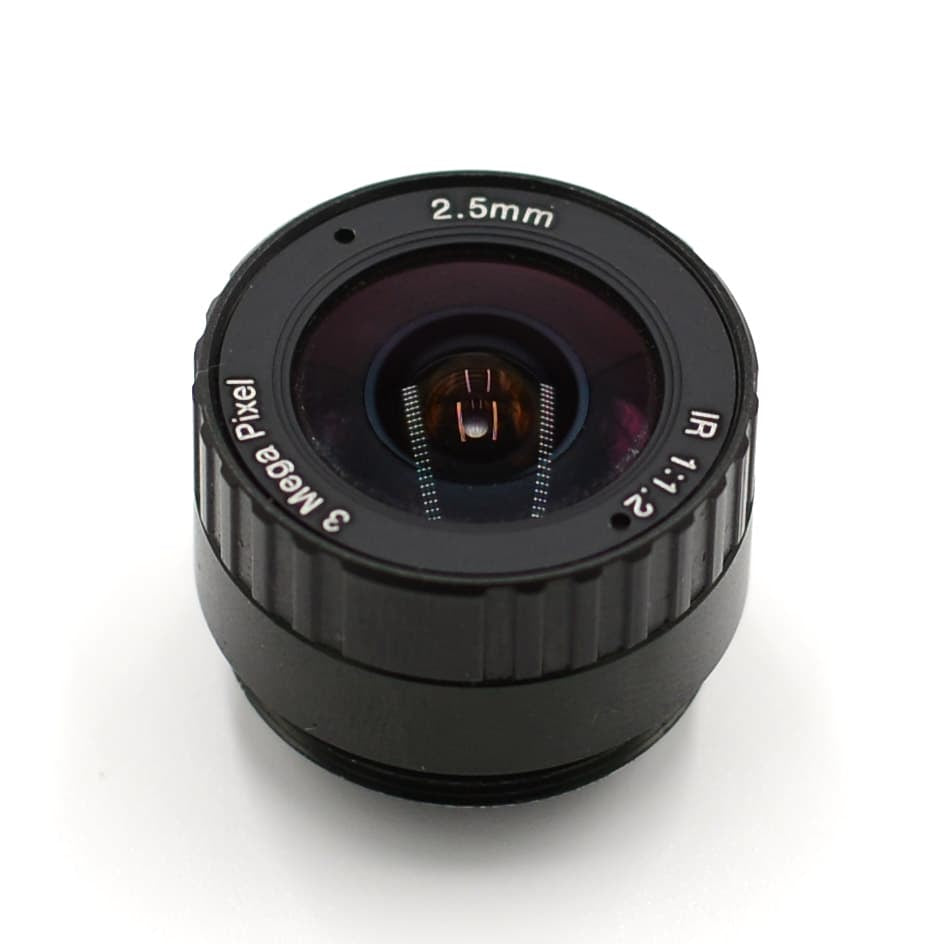
The Player One 2.5mm CS-Mount All-Sky Lens is a very short focal-length lens that turns a small-format planetary or guide camera into an all-sky monitor. At 2.5 mm it delivers a 170° field of view on a 1/2″ sensor — wide enough to take in nearly the entire sky in a single frame. It threads on via the standard CS mount and is metal-bodied. Player One optimizes it for their 1/2″-format cameras, the Neptune series in particular.
Who It's For
This is a good match if you run a 1/2″-format planetary or guide camera (such as a Neptune-M, Neptune-C, or Neptune-C II) and want to point it at the whole sky for cloud, meteor, or aurora monitoring. It also works as a very wide finder-style lens on a guide camera.
Key Features & Design
- 2.5 mm focal length: an ultra-short focal length that yields a 170° field on a 1/2″ sensor.
- CS mount: threads onto any CS-mount camera, including Player One planetary and guide cameras.
- Matched to 1/2″ sensors: the 170° coverage is stated for the 1/2″ format — the Neptune series in particular.
- Metal construction: a compact, durable barrel.
Optical Design
The all-sky field comes directly from the focal length and sensor size: a 2.5 mm focal length projected onto a 1/2″ sensor spans roughly 170°, which is why such a short lens captures the whole dome of the sky rather than a narrow patch. The CS mount is the standard machine-vision lens interface (a C mount shortened by 5 mm of flange distance) used by compact astronomy cameras, so the lens seats at the correct back-focus without an adapter on a CS-mount body.
Recommended Uses
All-sky monitoring — clouds, meteors, satellites, aurora — with a 1/2″ planetary camera, and use as a wide-field lens on a guide camera.
Compatibility and Accessory Notes
The lens uses a CS mount and is matched to 1/2″-format sensors such as the Neptune series. On a larger sensor the 170° figure no longer applies and the image circle may not fill the frame. If you are pairing it with a different camera and are unsure of the fit, send us your camera model and we will confirm it with you.
Good to Know Before You Order
- 1/2″ format: the 170° field is specified for a 1/2″ sensor (Neptune series); a larger sensor changes the coverage.
- CS mount: it needs a CS-mount camera; a C-mount body requires a 5 mm CS-to-C spacer, sold separately.
- Lens only: the camera and any mounting are not included.
Frequently Asked Questions
Is it difficult to set up?
No — thread it onto a CS-mount camera and adjust focus at the lens. Nothing else is required.
What camera is it for?
A 1/2″-format planetary or guide camera, such as the Player One Neptune-M, Neptune-C, or Neptune-C II.
What field of view does it give?
170° on a 1/2″ sensor — an all-sky view.
How is it different from the 2.1mm lens?
The 2.1mm lens is matched to the smaller 1/3″ format (Mars series) and gives a 150° field; this 2.5mm lens is matched to the 1/2″ format and gives 170°.
Bottom Line
In short: a 2.5 mm CS-mount lens that gives a 170° all-sky field on a 1/2″ sensor, matched to the Player One Neptune series for whole-sky monitoring.
| Focal length | 2.5 mm |
|---|---|
| Mount | CS |
| Field of view | 170° (1/2″ format) |
| Matched cameras | 1/2″ sensor — Neptune series |
| Material | Metal |
You may also like
Recently viewed
Recent Blog Posts
View all
Your Guide Graph Is Lying to You
Read More
D-Size vs V-Size: A Complete Guide to Telescope Dovetail Systems
Read More
What Is Back Focus in Astrophotography? Telescope Reducers, Flatteners, and Spacing Explained
Read More