

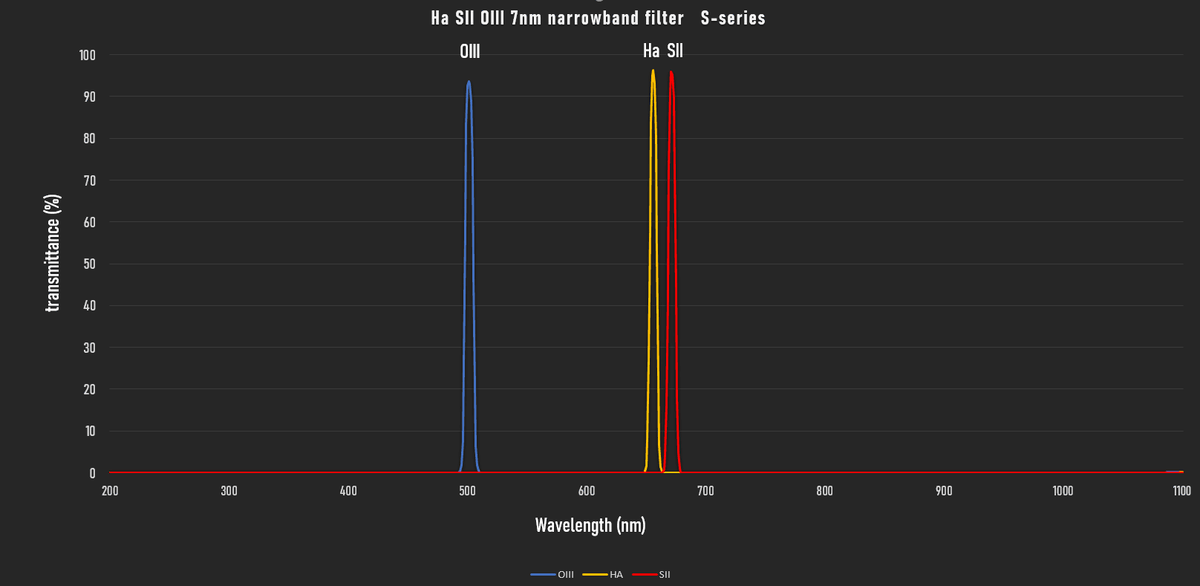


- Description
- Specifications
Overview. The Player One 1.25" Ha 7nm Narrowband Filter is an S-series hydrogen-alpha (Hα) emission-line filter for monochrome deep-sky astrophotography. It transmits a narrow 7nm ±0.5nm band centered on the hydrogen-alpha emission of nebulae while blocking the rest of the spectrum, so faint emission structure is recorded with high contrast even under moderate light pollution. The filter is built on a high-quality optical glass substrate with a multi-layer composite coating and threads into standard 1.25" filter mounts.
Who It's For. This filter suits imagers using cooled or uncooled monochrome cameras who want to capture emission nebulae, isolate the Hα channel of an SHO (Hubble-palette) dataset, or extend imaging into moonlit and light-polluted nights.
Key Features & Design.
- Narrow 7nm passband: a 7nm ±0.5nm FWHM isolates the hydrogen-alpha line and rejects most skyglow and broadband light pollution.
- Deep blocking: OD3 blocking (less than 0.1% transmission off-band) with NIR cutoff across 700–1100nm suppresses stray and out-of-band light.
- High in-band throughput: approximately 90% peak transmittance preserves signal on faint targets.
- Multi-layer composite coating: applied to a high-quality optical glass substrate for durability and consistent response.
- Standard 1.25" format: M28.5×0.6 cell threads fit common 1.25" filter wheels, drawers, and threaded accessories.
Optical/Mechanical Design. The filter passes a 7nm ±0.5nm FWHM band on the hydrogen-alpha emission line and holds OD3 off-band blocking (<0.1% transmission) with the near-infrared blocked from 700–1100nm. Peak in-band transmittance is about 90%. Both surfaces are polished to 1/4 lambda surface accuracy on a 2.0 ±0.03 mm optical glass substrate carrying a multi-layer composite coating. The anodized cell uses M28.5×0.6 (1.25") threads and measures 7.5mm overall (5mm body plus 2.5mm thread).
Recommended Uses. Narrowband imaging of emission nebulae, supernova remnants, and HII regions; the Hα channel in bicolor (HOO) and tricolor (SHO) narrowband processing; and continued deep-sky capture during bright-moon or light-polluted conditions.
Compatibility & Accessory Notes. The M28.5×0.6 cell fits standard 1.25" filter wheels, filter drawers, and 1.25" nosepieces and eyepiece-thread accessories. It pairs naturally with matching Player One 1.25" OIII 7nm and SII 7nm filters for a complete SHO set. Narrowband filters are intended for monochrome imaging cameras; on one-shot-color sensors the effective throughput is reduced.
Good to Know Before You Order.
- Individual center wavelength: Player One does not publish a numeric center wavelength for this line on the product page, so it is not stated here.
- Shipping weight: a packaged weight is not published by the manufacturer; contact us if you need it before ordering.
- Camera type: narrowband results are strongest with monochrome cameras.
FAQ.
Is it difficult to set up? No. The filter threads into any standard 1.25" filter wheel, drawer, or nosepiece and requires no adjustment once installed.
Will it help under light pollution? Yes. The 7nm passband rejects most broadband skyglow, so Hα emission is recorded with strong contrast even from suburban skies.
Can I use it with a color camera? It is designed for monochrome cameras; a one-shot-color sensor will still pass the band but with reduced efficiency.
Bottom Line. A well-coated 7nm hydrogen-alpha filter in the convenient 1.25" format, the Player One 1.25" Ha 7nm delivers high-contrast emission-line imaging and forms the Hα channel of a full narrowband set.
| Specification | Value |
|---|---|
| Type | Hydrogen-Alpha (Hα) narrowband, S-series |
| Bandwidth (FWHM) | 7nm ±0.5nm |
| Blocking depth | OD3 (<0.1% off-band transmission) |
| NIR cutoff | 700nm–1100nm |
| Peak transmittance | About 90% |
| Surface accuracy | 1/4 lambda (both surfaces) |
| Substrate thickness | 2.0 ±0.03 mm optical glass |
| Coating | Multi-layer composite coating |
| Mount thread | M28.5×0.6 (1.25") |
| Frame thickness | 7.5mm total (5mm body + 2.5mm thread) |
You may also like
Recently viewed
Recent Blog Posts
View all
Your Guide Graph Is Lying to You
Read More
D-Size vs V-Size: A Complete Guide to Telescope Dovetail Systems
Read More
What Is Back Focus in Astrophotography? Telescope Reducers, Flatteners, and Spacing Explained
Read More