
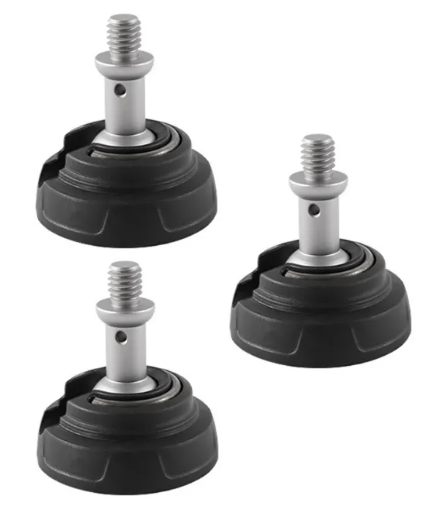

- Description
- Specifications
Product Overview
This is a set of three rubber footpads for tripod legs, designed for hard surfaces — concrete, tiles and the like — where the metal spikes a tripod normally uses have nothing to bite into. Pegasus Astro publishes them as fully compatible with the NYX-101 and NYX-88 carbon tripods, as well as other carbon tripod models.
A spike on a patio slab is a point contact that can skate. A rubber pad is a friction contact that does not.
Who It's For
This is a good match if you:
- Set up on concrete, paving or tiles — a driveway, a patio, an observatory floor, a balcony.
- Image from the same hard-surface spot each session and want the tripod to stay exactly where you put it.
- Would rather not put spike marks into a finished floor or a deck.
- Own a NYX carbon tripod and want the matched footpads for it.
Key Features & Design
- Set of three: one per leg, so a tripod is covered by a single purchase.
- Rubber construction: friction contact rather than a point, which is what stops a leg walking on a smooth surface.
- Made for hard surfaces: Pegasus Astro specifies concrete, tiles and similar.
- Broad tripod compatibility: published as compatible with the NYX-101 and NYX-88 carbon tripods and other carbon tripod models.
- Adds stability where spikes would otherwise be resting on a surface they cannot penetrate.
Recommended Uses
- Imaging or observing from a concrete pad, driveway, patio or balcony.
- Observatory floors where the tripod stands on a finished surface.
- Any hard surface where a spiked leg can slide under load or during a slew.
- Protecting decking and indoor floors from spike marks.
Compatibility and Accessory Notes
- Published fitment: the NYX-101 and NYX-88 carbon tripods, and other carbon tripod models.
- Set of three — enough for one tripod.
- Not for soft ground. On grass or soil, spikes are the better contact; the pads are for the surfaces spikes cannot grip.
- Different tripod? Send us the model and we will check the fit with you before you order.
Good to Know Before You Order
- These replace the spikes, they do not supplement them. Which contact you want depends on what you are standing on.
- Pegasus Astro publishes no dimensions, thread size or weight for these pads. Those rows are left out rather than filled with figures we cannot source, and it is why the listing is not yet available to order.
- Want it sooner? Ask and we will weigh a set off the shelf and get the listing live for you.
- A set covers one tripod. If you have two tripods to fit, order two sets.
Frequently Asked Questions
Is it difficult to set up?
No. The pads fit onto the tripod feet, one per leg, and stay there until you swap back to spikes.
How many do I get?
Three — one per tripod leg.
Do I still need the spikes?
Keep them for soft ground. The pads are for concrete, tiles and other hard surfaces where a spike cannot dig in.
Will they fit a tripod that is not a Pegasus one?
Pegasus publishes them as compatible with other carbon tripod models as well as their own. Tell us what you have and we will check it with you.
Do they actually make a difference to vibration?
On a hard surface, yes — a spike resting on concrete is a small, hard contact that can slip and ring, and rubber both grips and damps.
Bottom Line
In short: three rubber tripod footpads for concrete, tiles and other hard surfaces — the contact that grips where a spike only skates.
| Product type | Tripod footpads |
|---|---|
| Quantity | 3 pieces (one per tripod leg) |
| Material | Rubber |
| Designed for | Hard surfaces - concrete, tiles and similar |
| Compatibility | NYX-101 and NYX-88 carbon tripods, and other carbon tripod models |
| Dimensions | Not published by vendor |
| Thread / fitting size | Not published by vendor |
| Weight | Not published by vendor |
You may also like
Recently viewed
Recent Blog Posts
View all
Your Guide Graph Is Lying to You
Read More

D-Size vs V-Size: A Complete Guide to Telescope Dovetail Systems
Read More
What Is Back Focus in Astrophotography? Telescope Reducers, Flatteners, and Spacing Explained
Read More