

- Description
- Specifications
Product Overview
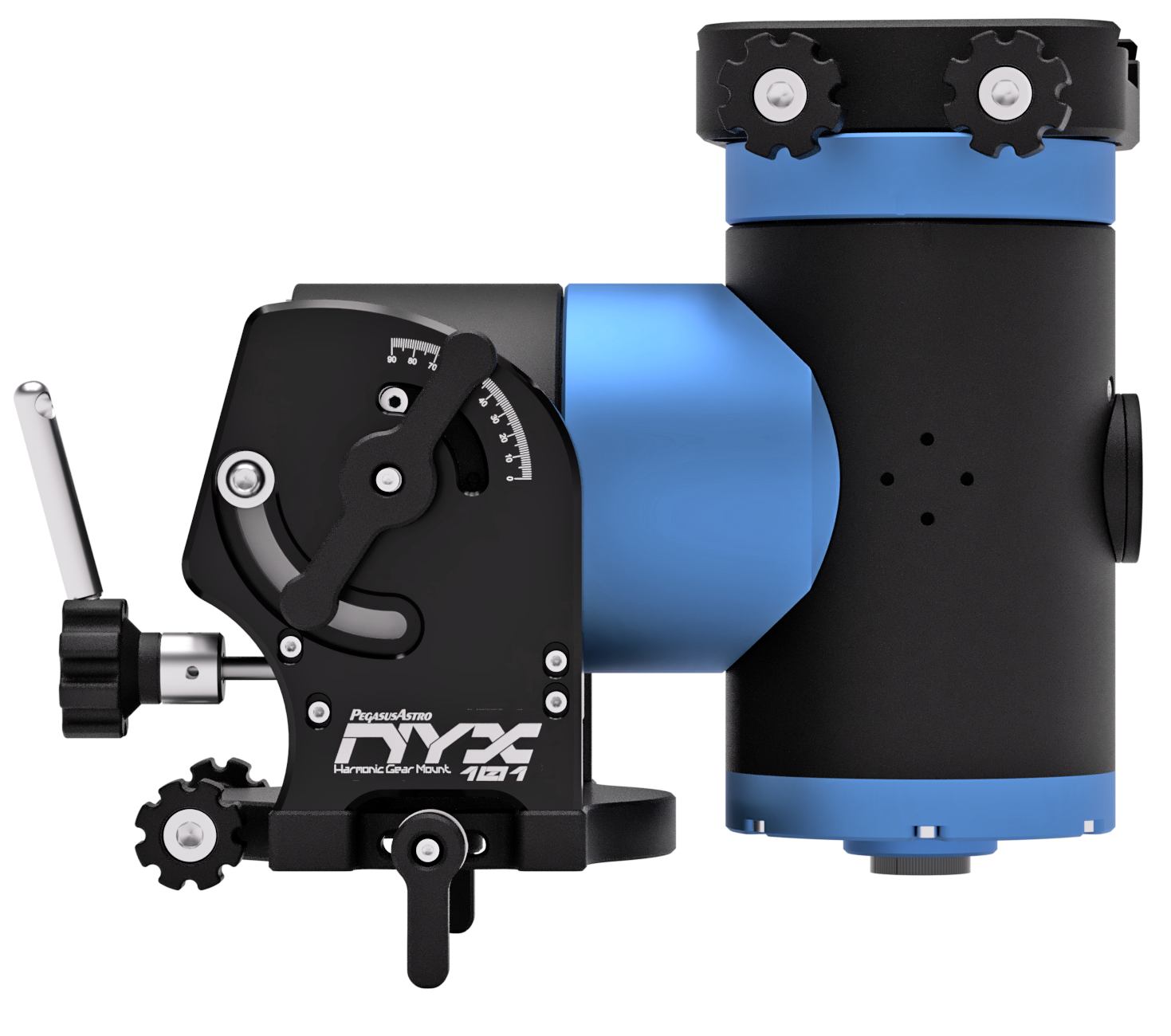
This is the Pegasus Astro NYX-101 strain wave mount supplied with a Saddle Powerbox already fitted. The NYX-101 carries 20 kg with no counterweight at all and 30 kg with one, from a 6.5 kg head machined out of 6061 aircraft aluminium — the payload-to-weight ratio that makes harmonic drive mounts worth the money. The Saddle Powerbox sits between the mount and your telescope and turns the saddle into the rig's power and data hub.
Bought together, the two remove most of the cabling from a portable setup: one 12 V feed reaches the mount, and everything above it draws from the saddle.
Who It's For
This is a good match if you:
- Carry your rig to dark sites and want a mount that handles a serious imaging train without a counterweight bar and a stack of weights to go with it.
- Are moving up from a belt-driven German equatorial and want the setup time and the transport weight to come down together.
- Run a cabled imaging train — cooled camera, filter wheel, dew heaters, guide camera, focuser — and want them all fed from the saddle rather than from the ground.
- Image remotely or unattended and want WiFi and USB control with environmental sensing built in.
- Want one purchase rather than two. The powerbox arrives fitted, so there is no puck to source and no installation step.
Key Features & Design
- 20 kg payload with no counterweights, 30 kg with: the defining property of a strain wave mount — the gearing holds the load rather than balancing against it.
- 6.5 kg mount head: CNC-machined 6061 aircraft aluminium alloy.
- 500:1 RA and 300:1 DEC reduction: strain wave (harmonic) gear and belt.
- 0.10″ RA resolution and 6°/sec maximum slew: fine positioning with fast target changes.
- 12 V DC unregulated, 0.7 A tracking and 2 A slewing: modest draw for a field battery.
- Wireless 802.11g and USB2, plus an ST4 guide port.
- Vixen and Losmandy 3-inch saddle, with an M12 counterweight shaft at 1.75 mm pitch.
- Saddle Powerbox fitted: four 12 V outputs (10 A total), two PWM dew channels, two USB 3.1 and two USB 2 ports, and onboard temperature, humidity and dew-point sensing, in a 110 x 110 x 32 mm body rated to a 40 kg payload.
- Rated −20 °C to +50 °C, with a three-year warranty.
Optical / Mechanical Design
A strain wave gear works by flexing a thin-walled cup inside a rigid ring, so the reduction happens through elastic deformation rather than through meshing gear teeth. Two consequences follow, and both are why this mount can do what it does. The first is that the reduction ratio is enormous for the volume — 500:1 on RA here — which is what lets a 6.5 kg head hold 20 kg with nothing on the other side of the axis. The second is that the drive is effectively self-locking: the load does not back-drive the gear, so balance stops being the thing that keeps your telescope pointing where you left it.
That changes the practical setup. A conventional German equatorial needs the payload balanced against counterweights on both axes, and getting it wrong loads the drive train unevenly. The NYX-101 does not need the counterweight at all up to 20 kg, so a session starts with mounting the telescope and ending there. The counterweight shaft is present for the 30 kg case, where the extra mass buys margin rather than being a requirement.
The trade-off worth knowing about harmonic drives is periodic error: the flexing action produces a repeating error signature that is generally larger in amplitude than a well-made worm drive's, though it is smooth and highly repeatable. In practice this is why almost everyone guides these mounts, and the ST4 port and the 0.10″ RA resolution are there for exactly that. Guided, the mount tracks to the standard a modern imaging train needs; unguided sub-exposures are shorter than the payload figure alone might suggest.
Fitting the Saddle Powerbox at the saddle rather than on the tripod matters for a different mechanical reason. Every cable that runs from the ground to the telescope crosses both moving axes, and a mount that slews at 6°/sec will find the shortest cable in the bundle eventually. Powering and connecting from above the axes means only one lead crosses them.
Recommended Uses
- Portable deep-sky imaging where the whole rig has to be carried and set up each night.
- Travel astrophotography, where losing the counterweight set is a real weight and volume saving.
- Permanent or semi-permanent observatory use with a cabled imaging train fed from the saddle.
- Remote and unattended operation over WiFi or USB.
- Visual observing in either equatorial or alt-azimuth working, with goto and tracking.
Compatibility and Accessory Notes
- Saddle: accepts Vixen and Losmandy 3-inch dovetail bars.
- Tripod: the mount needs a support. Pegasus Astro's carbon fibre tripod and the EQ6 / Universal tripod adapter both fit, and we stock them alongside the half-pier extensions for extra height.
- Power: 12 V DC unregulated. The mount ships with a 12 V / 5 A supply on a GX12 jack; the Saddle Powerbox takes 12–14 V DC and feeds everything above it.
- Control: wireless 802.11g and USB2, with ASCOM and INDI support. The NYX Hand Controller is available separately if you want to work without a computer.
- No puck needed. The Saddle Powerbox mounts to the NYX-101 directly, which is part of why this bundle exists — on any other mount you would be buying a mount-specific puck as well.
- Guiding: ST4 port on the mount, and the Saddle Powerbox's USB hub will carry a guide camera.
- Planning a specific imaging train? Send us the telescope, camera and accessories and we will work through the payload and the cabling with you before you order.
Good to Know Before You Order
- Currently out of stock at Pegasus Astro. Orders are accepted and fulfilled when supply returns — get in touch and we will tell you what we are hearing about timing.
- No tripod or pier is included. The box holds the mount, a 12 V / 5 A power supply with GX12 jack, a soft carry case, a USB2 Type-A to Type-B cable and the azimuth dowel. The support is a separate purchase and we can pair it for you.
- Counterweights are not included and are not needed below 20 kg. The M12 shaft is there for the 30 kg case.
- Harmonic mounts are normally guided. The periodic error of a strain wave drive is smooth and repeatable but larger than a premium worm drive's, so plan on a guide camera for long sub-exposures. The ST4 port and the USB hub on the saddle are both there for it.
- Shipping weight is not yet set on this listing. Pegasus Astro publishes 6.5 kg for the mount head but no figure for the Saddle Powerbox, so the bundle's packed weight cannot be established from the manufacturer's own data — and we will not estimate one on a mount of this value. Contact us for a shipping quote and we will weigh the actual carton.
Frequently Asked Questions
Is it difficult to set up?
Less so than the German equatorial it replaces, because there is no balancing step below 20 kg. Mount the telescope, level and roughly polar align, then run the mount's star or polar alignment routine. The azimuth dowel in the box is the part that makes the azimuth adjustment repeatable.
Do I really not need counterweights?
Not up to 20 kg. Above that, up to the 30 kg figure, the counterweight shaft is used.
What does the pre-installed Saddle Powerbox add?
Four switchable 12 V outputs totalling 10 A, two PWM dew heater channels, four USB ports, and temperature, humidity and dew-point sensing — all at the saddle, so your camera, focuser and dew straps are powered above the moving axes instead of from the ground.
Can I use it in alt-azimuth for visual observing?
Yes. The NYX platform supports both equatorial and alt-azimuth working.
Does it need a computer?
No. It runs over its own WiFi from a phone or tablet, and the NYX Hand Controller is available separately for computer-free operation. USB2 and ASCOM or INDI are there when you do want a PC.
How does it compare to the NYX-88?
The 88 is the smaller mount — 5.0 kg head, 14 kg without counterweights and 20 kg with, 400:1 RA reduction. The 101 is the one to choose when the imaging train is heavier or you want the margin.
Bottom Line
In short: a 6.5 kg harmonic mount that carries 20 kg without a counterweight, with the Saddle Powerbox already fitted so power, dew and USB all start at the saddle. Add a tripod and a guide camera and it is a complete portable imaging platform.
| Product type | Strain wave (harmonic) telescope mount with pre-installed Saddle Powerbox |
|---|---|
| Payload without counterweights | 20 Kg |
| Payload with counterweights | 30 Kg |
| Mount weight | 6.5 Kg |
| Material | CNC machined 6061 aircraft aluminum alloy |
| Drive | Strain Wave (Harmonic) Gear and Belt, 500:1 (RA) and 300:1 (DEC) |
| RA resolution | 0.10" |
| Maximum slew rate | 6 degs/sec |
| Power | 12V DC unregulated - 0.7A tracking, 2A slewing |
| Communication | Wireless 802.11g and USB2 |
| Guide port | ST4 |
| Saddle | Vixen and Losmandy 3-inch |
| Counterweight shaft | M12 shaft (1.75 mm pitch) |
| Mount modes | Equatorial and Alt-Azimuth |
| Operating temperature | -20 C to +50 C |
| Warranty | 3 years |
| Saddle Powerbox - outputs | 4 x 12V (10 A total), 2 x PWM dew channels |
| Saddle Powerbox - USB | 2 x USB 3.1 SuperSpeed, 2 x USB 2 High-Speed |
| Saddle Powerbox - sensors | Temperature, humidity and dew point |
| Saddle Powerbox - dimensions | 110 mm x 110 mm x 32 mm |
| Saddle Powerbox - weight | Not published by vendor |
| Bundle packed weight | Not established - mount head is 6.5 Kg, Saddle Powerbox weight unpublished |
| In the box | NYX-101 mount, 12V/5A power supply with GX12 jack, soft case carry bag, USB2 Type-A to Type-B cable, azimuth dowel |
You may also like
Recently viewed
Recent Blog Posts
View all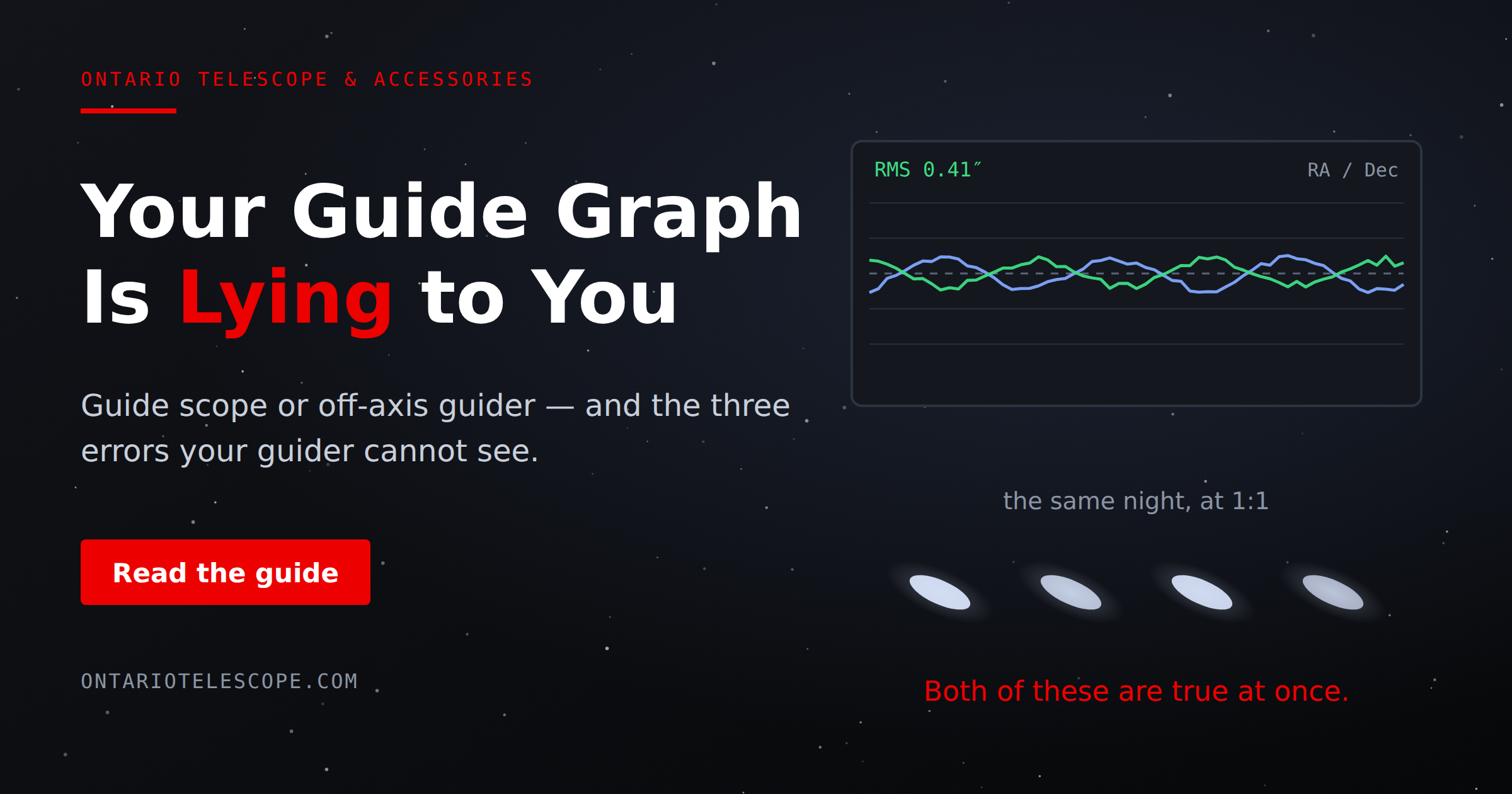
Your Guide Graph Is Lying to You
Read More
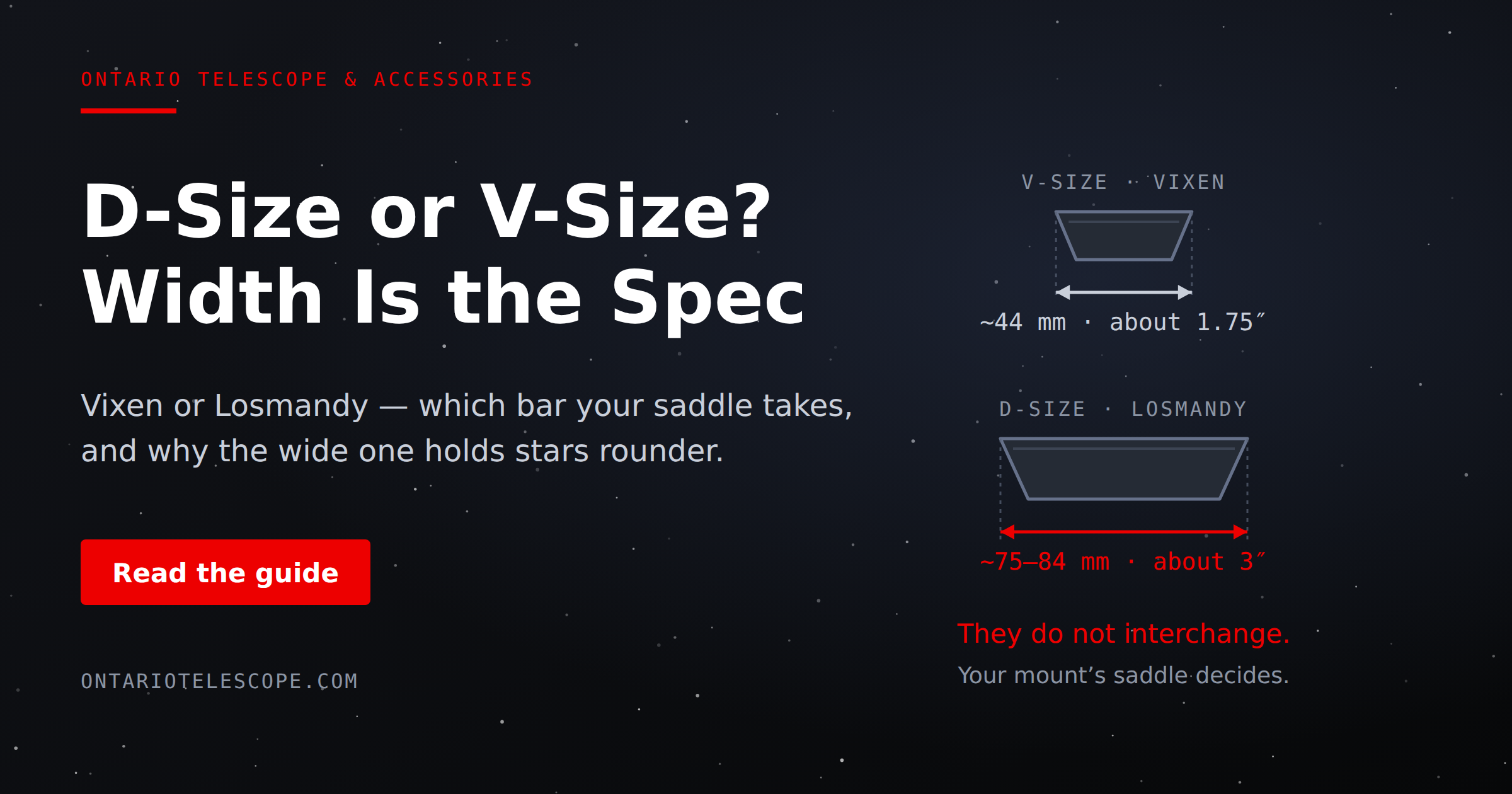
D-Size vs V-Size: A Complete Guide to Telescope Dovetail Systems
Read More
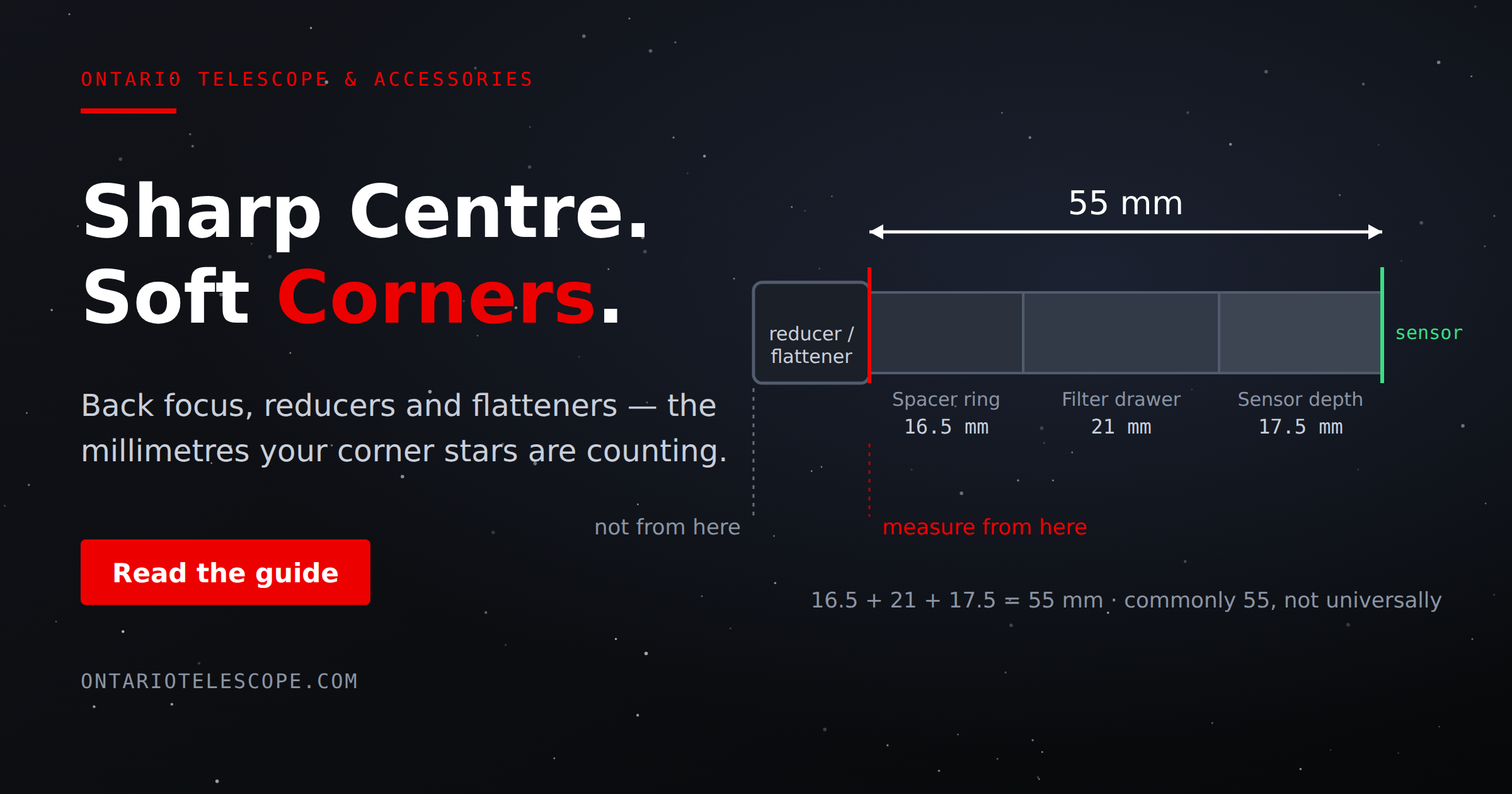
What Is Back Focus in Astrophotography? Telescope Reducers, Flatteners, and Spacing Explained
Read More