


- Description
- Specifications
Product Overview
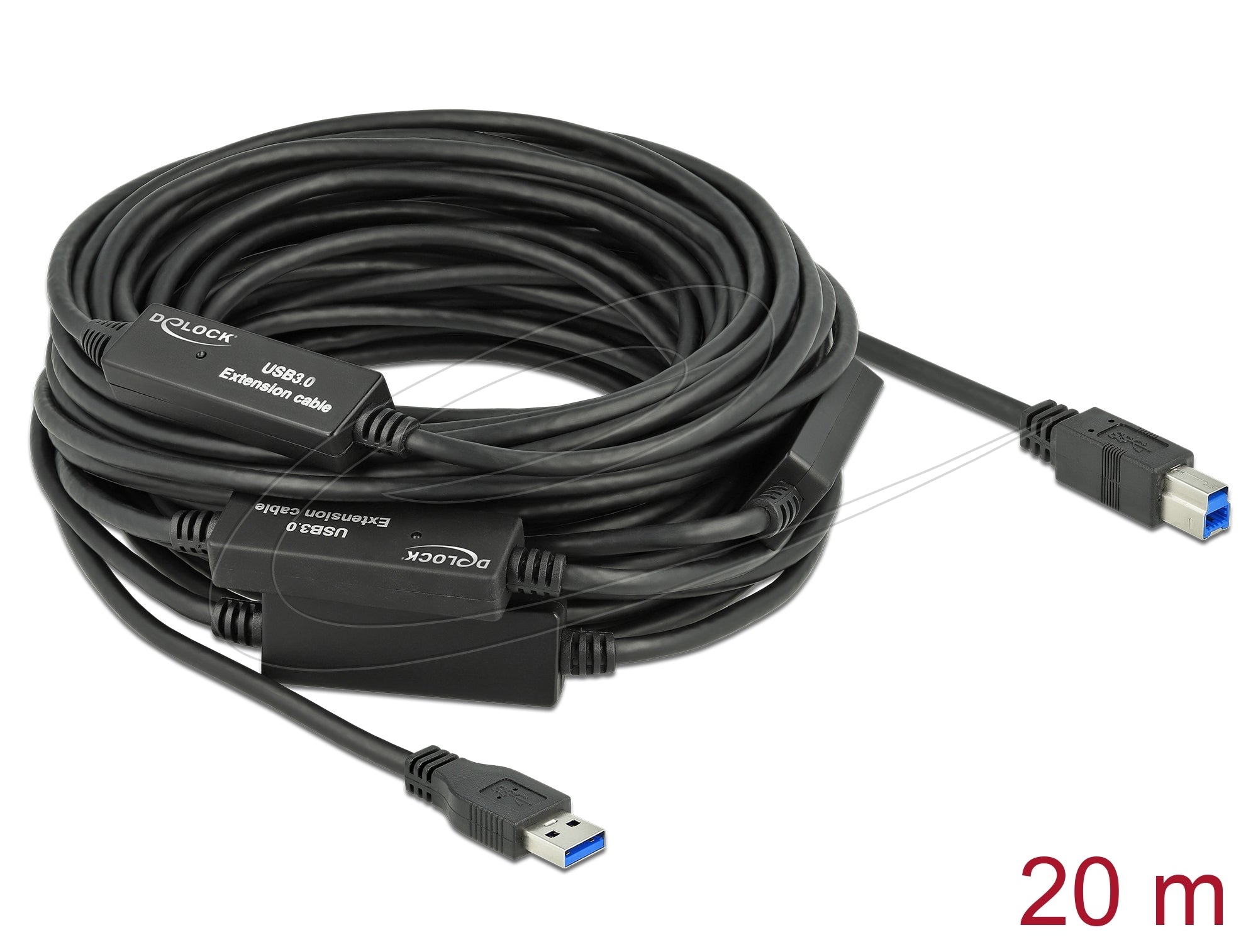
This is the Pegasus Astro Active USB 3.2 Gen 1 extension cable, a 20 metre powered run terminating in a USB Type-B connector. It is built for the situation where an ordinary USB cable simply stops working: the distance between your control computer and the camera or controller on the telescope. Signal boosting electronics are built into the cable itself, so it maintains USB 3.2 Gen 1 (5 Gbps) throughput across the full 20 metres rather than degrading part-way along it.
At 20 m this is the longest cable in the Pegasus Astro active range, and it supersedes the earlier 15 m version.
Who It's For
This is a good match if you:
- Run a permanent or semi-permanent observatory where the imaging PC lives indoors and the telescope sits on a pier some distance away.
- Image remotely from a warm room and need a single reliable data link rather than a chain of couplers.
- Use a USB Type-B device on the mount — a cooled CMOS camera, a powerbox, or a USB hub — and need it to enumerate reliably at the far end of a long run.
Key Features & Design
- Active signal boosting: built-in repeater electronics regenerate the USB signal, which is what allows a 20 m run to work where a passive cable cannot.
- USB 3.2 Gen 1 rated: 5 Gbps SuperSpeed throughput, sufficient for high-frame-rate and large-sensor camera downloads.
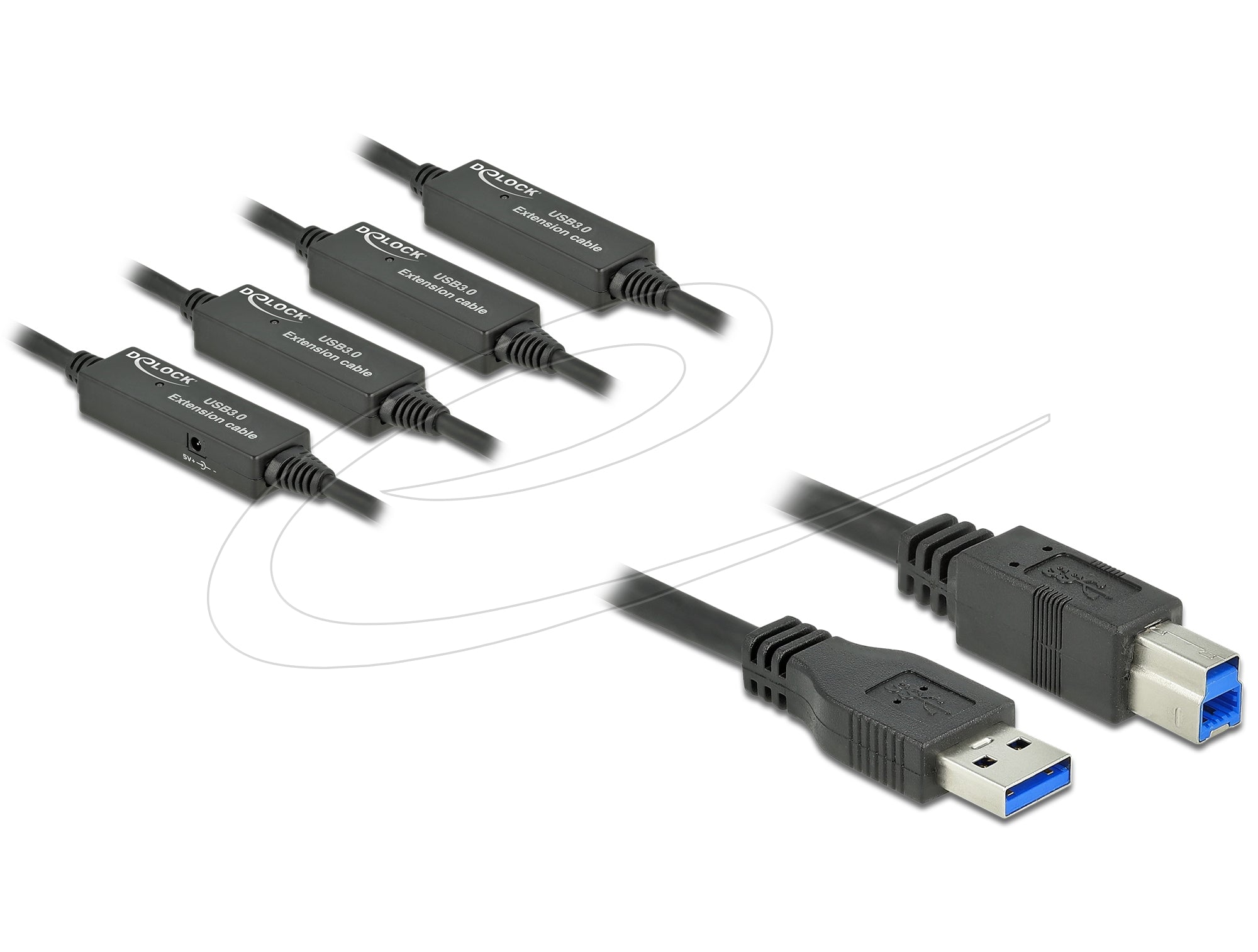
- Type-A to Type-B termination: the standard pairing for astronomy cameras, powerboxes and powered hubs.
- Directional by design: as an active cable it has a defined host end and device end, and must be oriented correctly.
- 20 metre length: the longest active option Pegasus Astro offers, replacing the discontinued 15 m variant.
Recommended Uses
- Linking an indoor imaging PC to a pier-mounted camera or powerbox in an observatory.
- Warm-room remote imaging where the run exceeds the roughly 5 m limit of passive USB 3.0.
- Feeding a powered USB hub at the telescope from a single long upstream cable, consolidating multiple device connections into one run.
Compatibility and Accessory Notes
- Connector pairing: USB Type-A at the host end, USB Type-B at the device end. Check that your device uses Type-B, not Type-C or Micro-B, before ordering.
- Works with USB 2.0 devices: USB 3.2 Gen 1 is backwards compatible, though a USB 2.0 device will run at USB 2.0 speed.
- Pairs with Pegasus Astro powerboxes and the USB Control Hub, all of which accept a Type-B upstream connection.
- Camera enumeration: some USB 3 cameras from QHY and ZWO negotiate over USB 2.0 before switching to USB 3. If your camera is documented as requiring a native USB 3-only port, confirm behaviour over an active extension with the camera manufacturer.
Good to Know Before You Order
- This is a data cable, not a power cable. It carries USB data and bus power only; your camera or controller still needs its own 12 V supply.
- Orientation matters. Active cables are directional — the Type-A end goes to the computer. Reversed, the link will not come up.
- Type-B only. If your device is USB-C, this is not the cable for it; the Pegasus USB-C active extension covers that case.
- Long runs benefit from a powered hub at the far end. If you are driving several devices at the telescope, feeding a powered hub over this cable is more dependable than splitting the run.
Frequently Asked Questions
Is it difficult to set up?
No. It is a single cable with two connectors — Type-A to the computer, Type-B to the device. There are no drivers and no configuration. The only thing to get right is the direction.
Why use an active cable instead of joining two passive cables?
Passive USB 3.0 becomes unreliable past roughly 5 m, and joining cables compounds the problem rather than solving it. An active cable regenerates the signal internally, which is why it holds up at 20 m.
Will it slow my camera down?
No. It is rated for USB 3.2 Gen 1 at 5 Gbps, the same as a short USB 3.0 cable, so download times are unaffected.
Can I use it with a USB 2.0 device?
Yes. It is backwards compatible, though the device will operate at USB 2.0 speed.
How is this different from the 15 m version?
It is the direct replacement, offering an extra 5 m of reach. The 15 m variant has been discontinued.
Bottom Line
In short: a 20 metre active USB 3.2 Gen 1 cable that solves the observatory distance problem for Type-B devices at full 5 Gbps speed. Get the direction right and confirm your device is Type-B, and it does exactly one job well.
| Product type | Active USB extension cable |
|---|---|
| USB standard | USB 3.2 Gen 1 (5 Gbps SuperSpeed) |
| Connectors | USB Type-A (host) to USB Type-B (device) |
| Length | 20 m |
| Signal boosting | Active - built-in repeater electronics |
| Directional | Yes - Type-A end to host computer |
| Backwards compatible | Yes - USB 2.0 devices operate at USB 2.0 speed |
| Weight | 1 lb |
| Compatibility | Pegasus Astro powerboxes, USB Control Hub, USB Type-B astronomy cameras |
| Replaces | PEG-USB3AEXT15M (15 m, discontinued) |
You may also like
Recently viewed
Recent Blog Posts
View all
Your Guide Graph Is Lying to You
Read More

D-Size vs V-Size: A Complete Guide to Telescope Dovetail Systems
Read More

What Is Back Focus in Astrophotography? Telescope Reducers, Flatteners, and Spacing Explained
Read More