


- Description
- Specifications
Product Overview
The Optolong L-eXtreme Nikon Z Full Frame ILDC Clip-in Filter is a dual-narrowband emission-line filter from Optolong Optics that installs directly in the throat of full-frame Nikon Z-series mirrorless bodies. It passes only two 7nm windows — centred on H-alpha (656nm) and OIII (496/500nm) — and blocks the rest of the 300–1000nm range with light-pollution line blocking greater than 99%. Peak transmission is above 90%. Because there is no transmission between the H-beta and OIII lines, where nebulae do not emit, the sky background stays dark while emission-nebula signal stays strong, even under city skies or moonlight.
Who It's For
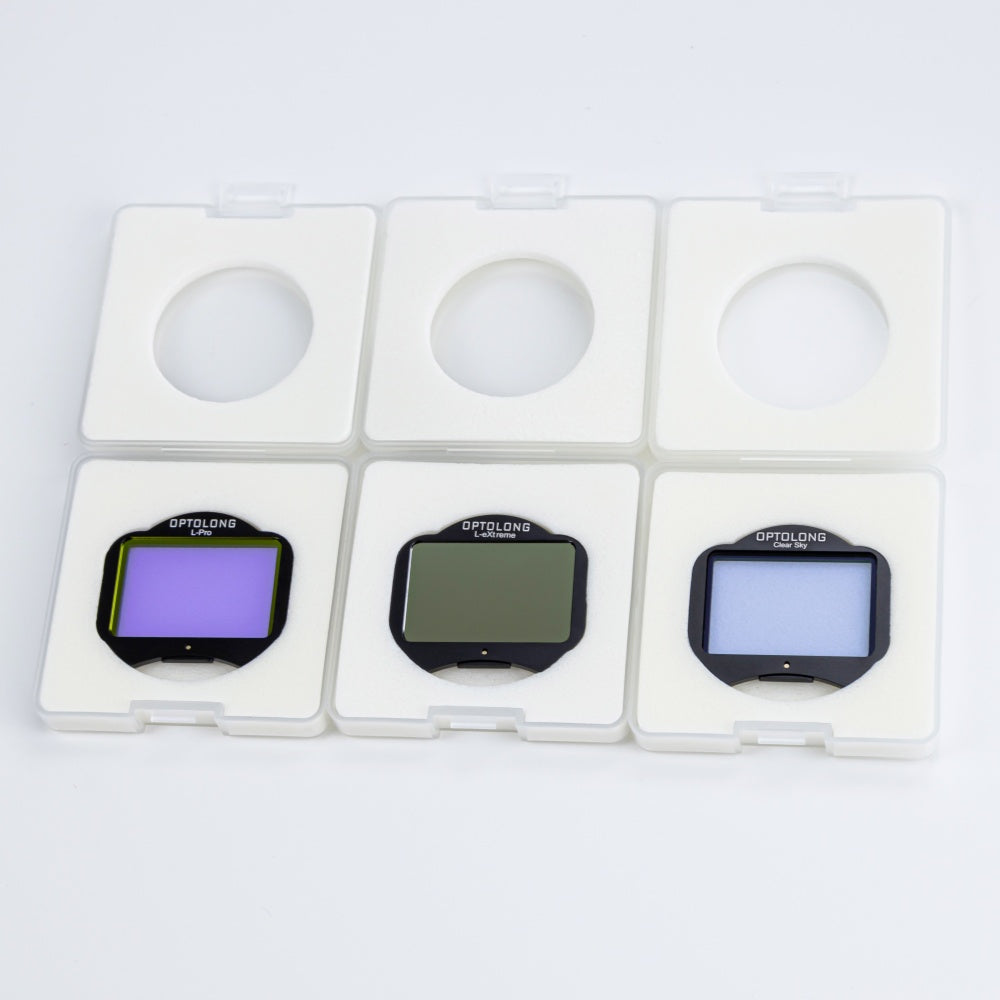
This is a good match if you image emission nebulae with a one-shot-colour full-frame Nikon Z camera from a light-polluted location, or want to keep imaging when the Moon is up. It suits fast lenses and telescopes and one-shot-colour deep-sky work on Ha/OIII targets such as the Orion, Rosette, Heart and North America nebulae. It is an imaging filter, not a broadband or visual filter — for galaxies, clusters and reflection nebulae, use the L-Pro instead.
Key Features & Design
- Dual 7nm narrowband: isolates H-alpha and OIII to maximise nebula contrast and signal-to-noise ratio.
- Deep out-of-band blocking: 300–1000nm rejection with line blocking greater than 99% keeps the background dark under heavy light pollution and moonlight.
- Optimised for fast optics: the passband is set to hold up with one-shot-colour cameras and fast focal ratios.
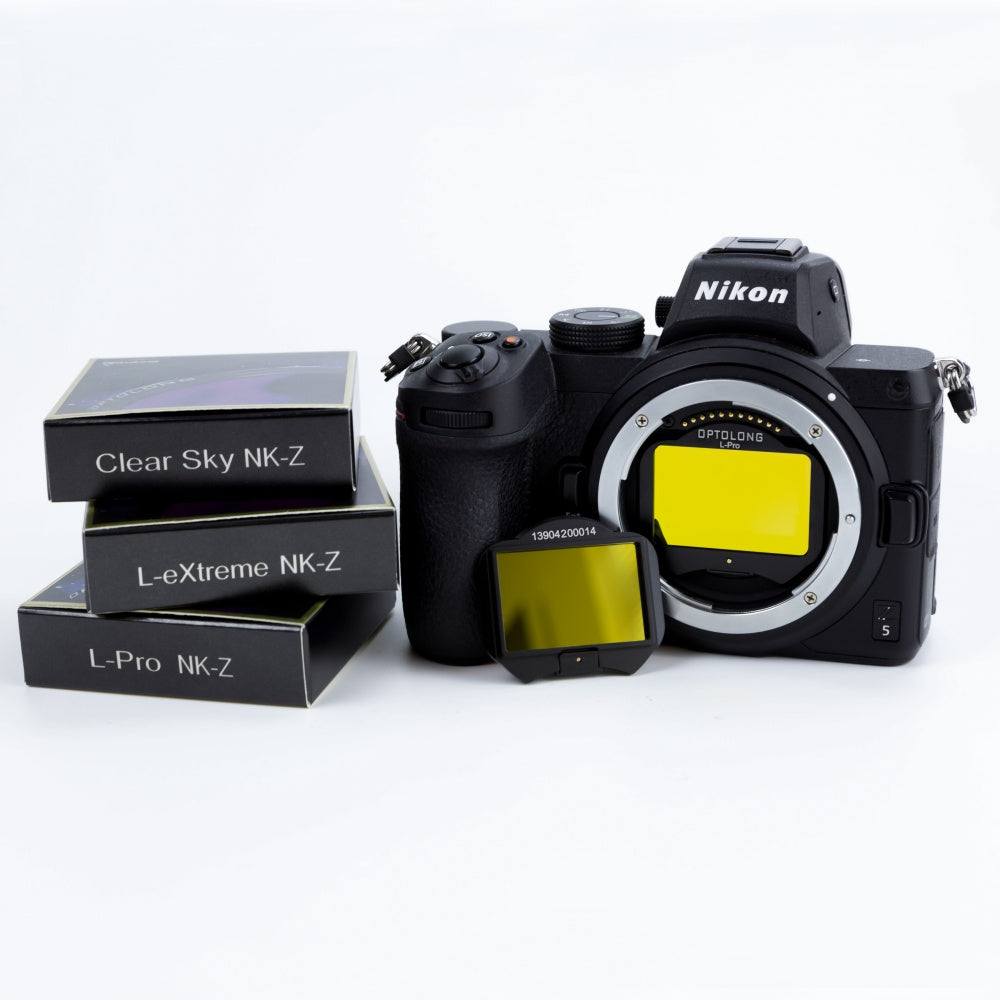
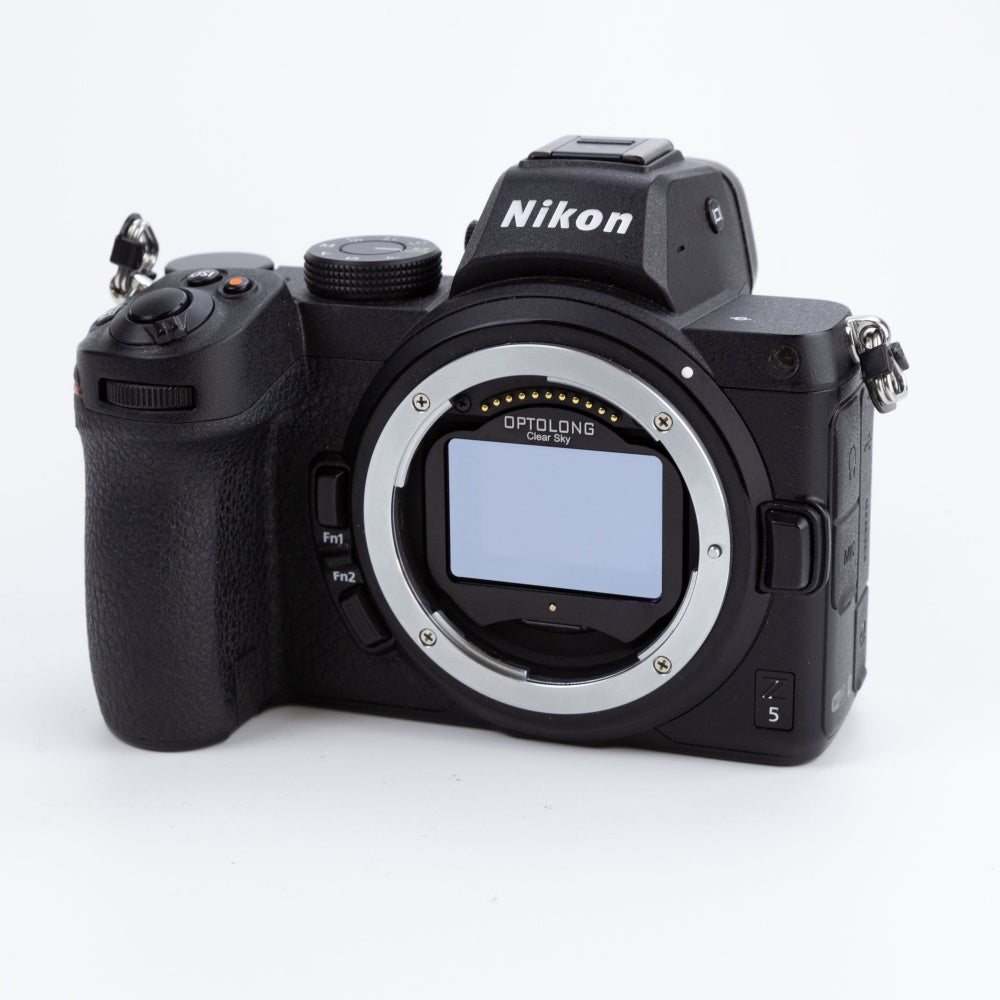
- Full-frame clip-in fit: seats in the Nikon Z throat ahead of the sensor and works behind any compatible lens with no threads.
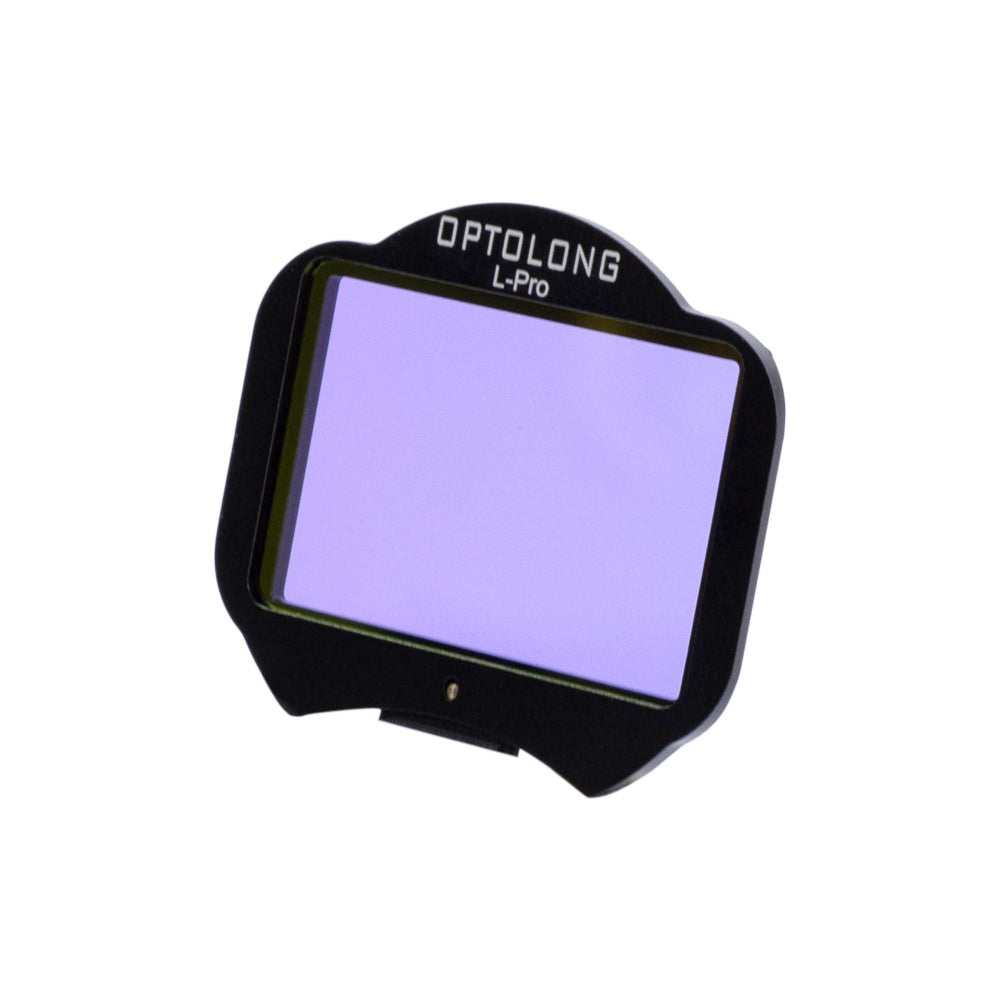
- Imaging-grade optics: B270 substrate, 1.85mm thick, λ/4 transmitted wavefront, 60/40 surface quality and 30-arcsec parallelism for tight stars.
Optical Design & Coatings
The L-eXtreme is a multi-layer interference filter built on a 1.85mm B270 substrate. Its two 7nm passbands are formed by stacked dielectric coatings applied with ion-assisted deposition, which is what allows such narrow bands to hold a stable central wavelength without drifting with temperature. The narrow bandwidth is deliberately matched to the H-alpha and OIII emission lines so that broadband light pollution — spread across the whole spectrum — is almost entirely rejected while the two nebula lines pass at high transmission. As with any interference filter, transmission is angle-dependent: performance is specified for roughly 50mm focal length and longer, and very fast cones or wide lenses can broaden and shift the effective band. The transmission curve below shows the two narrow passbands against the otherwise deep blocking.

Recommended Uses
- One-shot-colour imaging of emission nebulae (Ha/OIII) from light-polluted skies
- Deep-sky imaging through bright-moon periods
- Fast-system widefield and telescope astrophotography of HII regions
- Bicolour / narrowband-style processing from a single OSC camera
Compatibility and Accessory Notes
- Camera bodies: Nikon Z5, Z6, Z6II, Z7, Z7II, Z8, Z9 and ZF (full-frame Z mount).
- Lenses: all Z-series lenses; all F-series main and auxiliary lenses via the appropriate mount adapter/connector.
- Focal length: intended for use at 50mm and above; wider lenses may show an interference edge that can be cropped out.
- Focus and compose: the clip sits in front of the sensor, so use Live View.
Important Limitations
- Not a solar filter — never use it to view or image the Sun.
- Narrowband only — not for broadband targets; galaxies, clusters and reflection nebulae are better served by the L-Pro.
- Designed for astrophotography rather than general visual observing.
- Full-frame Z mount only; not for APS-C/DX or other mounts.
- Below ~50mm the interference edge may need cropping.
Frequently Asked Questions
Is this good for beginners?
It is best once you are comfortable with deep-sky capture and processing. If you are shooting broadband Milky Way scenes, the L-Pro is the easier starting point.
What is it best used for?
Imaging emission nebulae (H-alpha and OIII) from light-polluted skies or under moonlight with a one-shot-colour camera.
Is it for visual or astrophotography?
Astrophotography. The narrow dual-band design is optimised for imaging, not general visual use.
Which cameras does it fit?
Full-frame Nikon Z bodies: Z5, Z6, Z6II, Z7, Z7II, Z8, Z9 and ZF.
How is it different from the L-Pro?
The L-eXtreme is dual-narrowband (Ha/OIII) for emission nebulae in heavy light pollution. The L-Pro is broadband for galaxies, clusters and Milky Way work with natural colour.
Bottom Line
In short: a dual-narrowband 7nm Ha/OIII clip-in filter for full-frame Nikon Z cameras that pulls emission nebulae out of light-polluted or moonlit skies. Use it at 50mm and up with a one-shot-colour camera, and switch to the L-Pro for broadband targets.
| Filter Type | L-eXtreme dual narrowband (H-alpha + OIII), two 7nm bandpasses |
| Mount / Fit | Nikon Z Full Frame ILDC clip-in |
| Compatible Cameras | Z5 / Z6 / Z6II / Z7 / Z7II / Z8 / Z9 / ZF |
| Compatible Lenses | All Z-series lenses; all F-series main & auxiliary lenses (mount adapter required) |
| Substrate | B270 |
| Thickness | 1.85mm |
| Peak Transmittance | >90% |
| Blocking Range | 300–1000nm |
| Blocking Depth | Light pollution line blocking >99% |
| Surface Quality | 60/40 |
| Transmitted Wavefront RMS | λ/4 |
| Parallelism | 30 arcseconds |
| Coating | Multi-layer anti-reflection; ion-assisted deposition; non-cementing substrate coating |
| Recommended Use | Emission nebula (Ha/OIII) astrophotography in light-polluted skies, fast optical systems, one-shot-colour cameras |
You may also like
Recently viewed
Recent Blog Posts
View all
Your Guide Graph Is Lying to You
Read More
D-Size vs V-Size: A Complete Guide to Telescope Dovetail Systems
Read More
What Is Back Focus in Astrophotography? Telescope Reducers, Flatteners, and Spacing Explained
Read More