
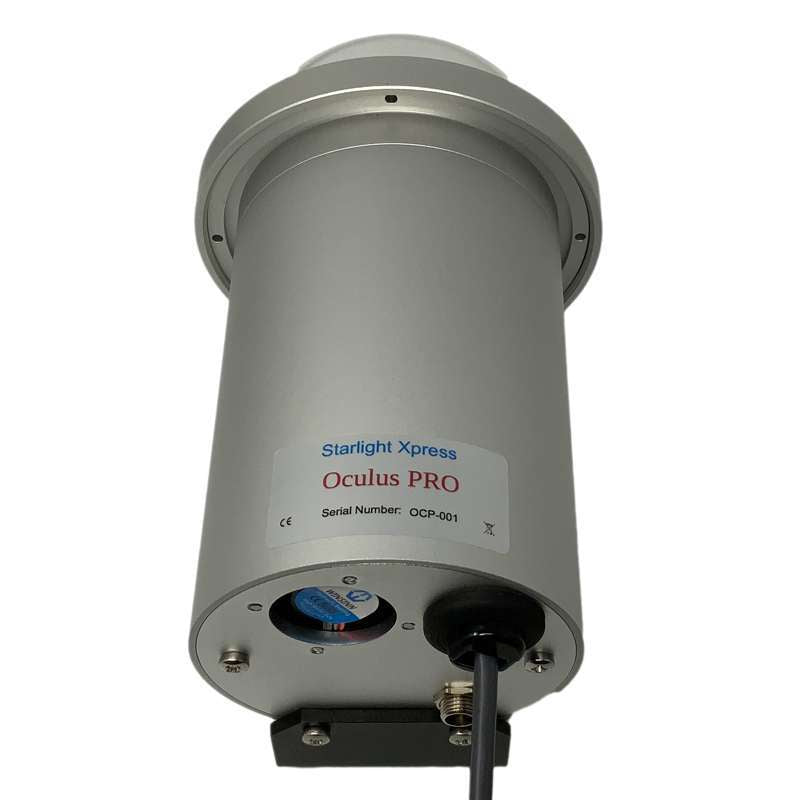
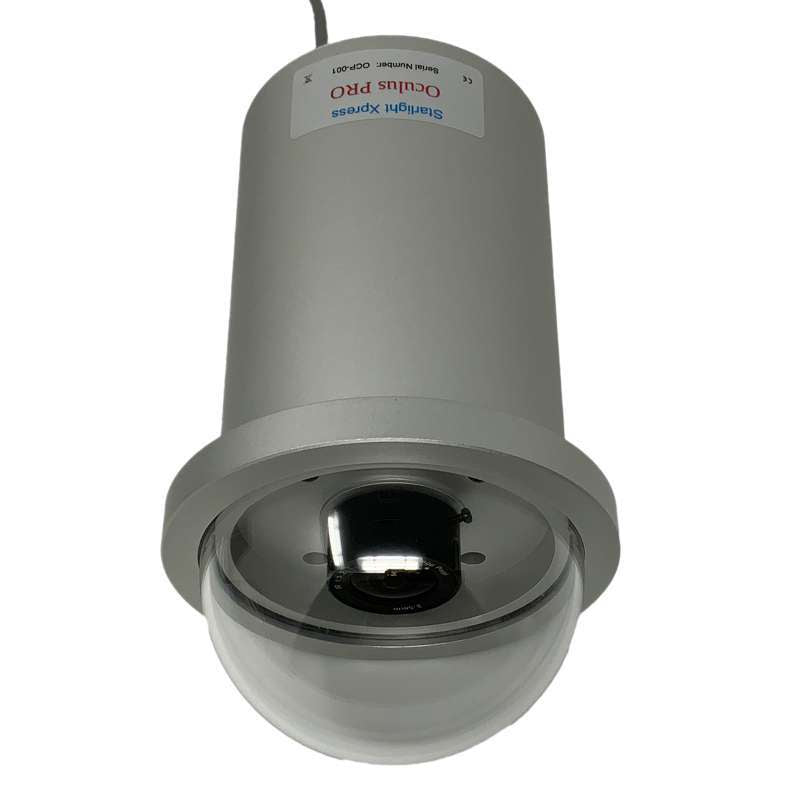
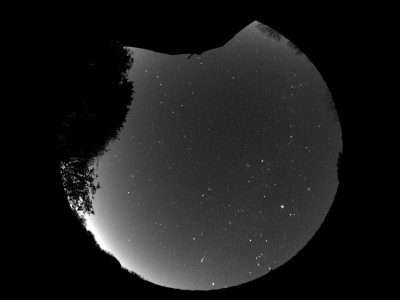
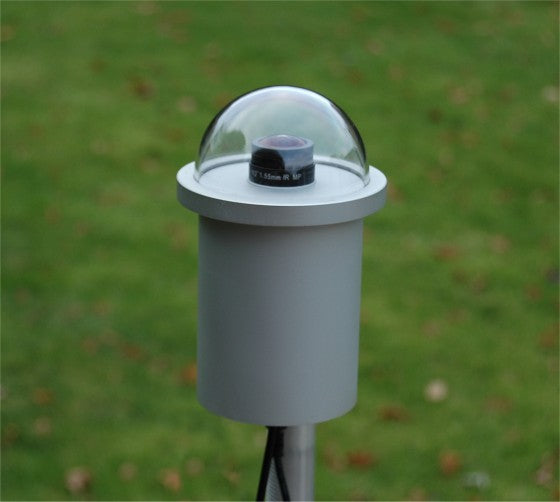


- Description
- Specifications
• CCD type: ICX205AL Sony SuperHAD interline CCD with low dark current and vertical antiblooming.
• CCD Full resolution pixel data: Pixel size: 4.65uM x 4.65uM, Image format: 1392 x 1040 pixels
• CCD quality: Grade 1 • Spectral Response: QE max at 520nM (~50%), 30% at 420nM and 670nM.
• Readout Noise: RMS - typically only 7 electrons. • Full-well capacity: Greater than 15,000 e- (unbinned)
• Anti-blooming: Overload margin greater than 1000x. • Dark current: Less than 0.1 electrons/second @ + 10C ambient.
• Data format: 16 bits. • Lens details: 2.5mm FL F/1.2 150 degree ‘Fish Eye’ • Computer Interface: Built-in USB 2.0 • Image download time: Typically 0.6 seconds at full resolution using USB 2.0.
• Power requirements: Camera is USB powered, dew heater requires 12v at 1 amp max. • Input connection: ‘Mini B’ USB socket for USB2.0 and a 2.1mm jack for +12v heater supply.
• Cooling system: Ambient air cooling.
• Overall size: 150mm tall x 95mm diameter, including the polycarbonate weather dome.
You may also like
Recently viewed
Recent Blog Posts
View all
Your Guide Graph Is Lying to You
You drove ninety minutes to dark sky, PHD2 held 0.4 arcseconds all night, and half your subs still have eggs for stars. Here are the three things your
Read More
Read More

D-Size vs V-Size: A Complete Guide to Telescope Dovetail Systems
What's the difference between D-size and V-size telescope dovetails? Here's everything you need to know.
Read More
Read More

What Is Back Focus in Astrophotography? Telescope Reducers, Flatteners, and Spacing Explained
What Is Back Focus in Astrophotography? Telescope Reducers, Flatteners, and Spacing Explained
Back focus is one of those astrophotography terms that c
Read More
Read More