


- Description
- Specifications
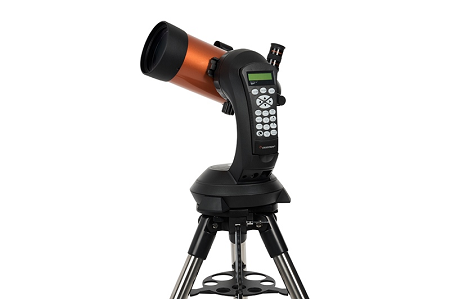
The Celestron NexStar 4SE Computerized Telescope is a compact 4-inch computerized Maksutov-Cassegrain telescope designed for visual observers who want GoTo object location, easy setup, and a highly portable telescope system. With a 102mm aperture, 1325mm focal length, f/13 optical system, StarBright XLT coatings, built-in flip mirror, and NexStar computerized mount, the NexStar 4SE is a strong choice for lunar, planetary, double-star, and bright-object observing.
Who Is This Product Best For?
The NexStar 4SE is best for beginners, casual observers, apartment or balcony astronomers, cottage users, and anyone who wants a compact computerized telescope that is easy to transport and store. It is especially well suited to customers who want help finding objects in the night sky without learning manual star-hopping first.
Its long focal length and Maksutov-Cassegrain optical design make it especially useful for the Moon, planets, and compact bright targets. It is smaller and lighter than the larger NexStar SE models, making it the easiest SE-series model to carry and set up.
Why Choose This Product?
- Compact 4-inch aperture: Provides satisfying views of the Moon, planets, brighter nebulae, star clusters, and double stars while remaining very portable.
- Maksutov-Cassegrain optical design: Delivers a long focal length in a compact optical tube, making it well suited to lunar and planetary observing.
- Computerized GoTo mount: Automatically locates and tracks objects selected from the NexStar database.
- 40,000+ object database: Gives users access to thousands of stars, planets, nebulae, clusters, and galaxies.
- SkyAlign technology: Lets users align the telescope using any three bright objects, including bright stars, planets, or the Moon.
- StarBright XLT coatings: Improve light transmission and image contrast.
- Built-in flip mirror: Allows straight-through or 90-degree viewing options.
- Portable single fork arm mount: Breaks down into manageable parts for transport and quick assembly.
Recommended Uses
- Lunar observing
- Planetary observing
- Double stars
- Bright star clusters
- Bright nebulae such as the Orion Nebula
- Compact backyard, balcony, and travel observing
- Introductory astronomy with computerized object location
Compatibility and Accessory Notes
The NexStar 4SE includes the computerized single fork arm mount, steel tripod, StarPointer red dot finder, 25mm eyepiece, and built-in flip mirror for straight-through or 90-degree viewing. It uses a CG-5 style dovetail bar and works with many Celestron visual accessories.
The computerized mount requires power. While the telescope can run from AA batteries, Ontario Telescope generally recommends using a suitable external 12V power supply or astronomy battery pack for more reliable observing sessions.
Useful optional accessories include a dew shield, external power supply, additional eyepieces, SkyPortal WiFi module, StarSense AutoAlign, and lunar/planetary camera accessories.
Important Limitations
The NexStar 4SE is best for visual observing and simple lunar or planetary imaging. It is not designed as a long-exposure deep-sky astrophotography platform. Its compact 4-inch aperture is very portable, but customers wanting brighter deep-sky views may prefer the NexStar 6SE or 8SE.
The f/13 focal ratio is excellent for lunar and planetary observing but gives a narrower field of view than shorter focal length refractors or Newtonians. Customers should also plan for power, alignment, and cooldown time for best results.
Frequently Asked Questions
Is the Celestron NexStar 4SE good for beginners?
Yes. It is beginner-friendly because it is compact, computerized, and uses SkyAlign to simplify setup. It still requires basic alignment and power, but it is one of the easiest SE-series models to transport and handle.
What can I see with the NexStar 4SE?
The NexStar 4SE is well suited for the Moon, Jupiter, Saturn, Mars when favourable, double stars, star clusters, and bright nebulae. Under darker skies, it can also show brighter deep-sky objects.
Can the NexStar 4SE find objects automatically?
Yes. Once aligned, the computerized GoTo mount can automatically slew to and track objects selected through the hand control.
Can the NexStar 4SE be used for astrophotography?
It is best for visual observing and basic lunar or planetary imaging. It is not recommended for long-exposure deep-sky astrophotography on the standard alt-azimuth mount.
Does it need power?
Yes. The computerized mount requires power. An external 12V power supply or battery pack is recommended for reliable use.
Our Recommendation
At Ontario Telescope and Accessories, we recommend the Celestron NexStar 4SE for customers who want the most compact and portable NexStar SE telescope for visual observing. Choose it for lunar, planetary, balcony, cottage, and grab-and-go computerized observing. Choose the NexStar 6SE or 8SE if your priority is brighter deep-sky views and more light-gathering power.
| Product Type | Computerized Maksutov-Cassegrain telescope |
|---|---|
| SKU | 11049 |
| Aperture | 102 mm / 4 inches |
| Focal Length | 1325 mm |
| Focal Ratio | f/13 |
| Optical Design | Maksutov-Cassegrain |
| Optical Coatings | StarBright XLT |
| Mount Type | Computerized single fork arm alt-azimuth mount |
| Alignment | SkyAlign |
| Object Database | 40,000+ objects with NexStar hand control |
| Finder | StarPointer red dot finderscope |
| Included Eyepiece | 25 mm eyepiece |
| Special Feature | Built-in flip mirror |
| Power | AA batteries or external 12V DC power source |
| Primary Use | Visual observing, lunar observing, planetary observing, double stars, and bright objects |
| Astrophotography Note | Best for visual observing and basic lunar/planetary imaging; not ideal for long-exposure deep-sky astrophotography |
You may also like
Recently viewed
Recent Blog Posts
View all
Your Guide Graph Is Lying to You
Read More

D-Size vs V-Size: A Complete Guide to Telescope Dovetail Systems
Read More

What Is Back Focus in Astrophotography? Telescope Reducers, Flatteners, and Spacing Explained
Read More