




- Description
- Specifications
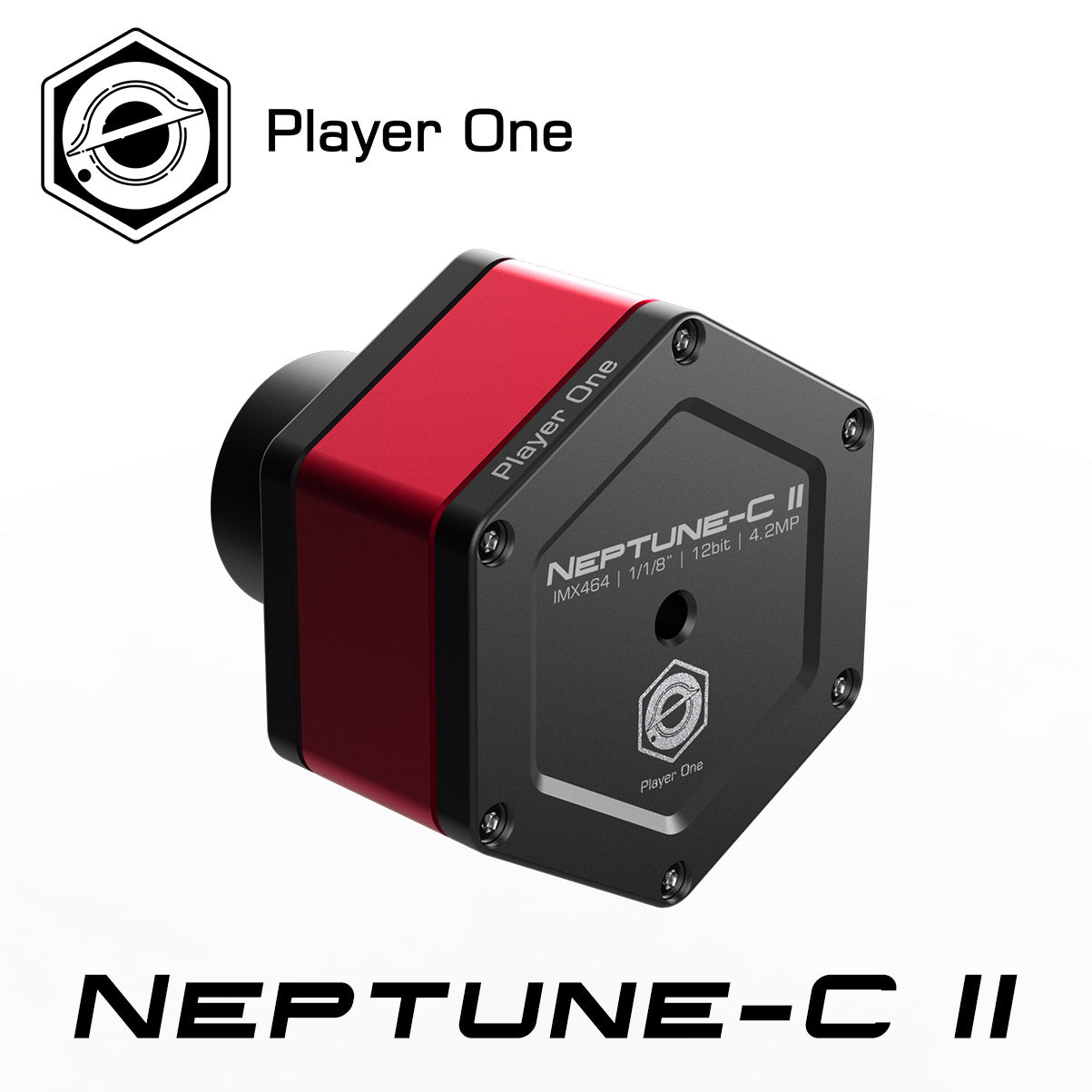
The Player One Neptune-C II is a USB3.0 colour camera built around the 1/1.8" Sony IMX464 back-illuminated CMOS sensor. Its 4.2-megapixel resolution and larger sensor make it a versatile planetary and lunar imager, giving you more field to work with than a 1/2.8" chip while keeping the fast frame rates that high-resolution solar-system work depends on.
Product Overview
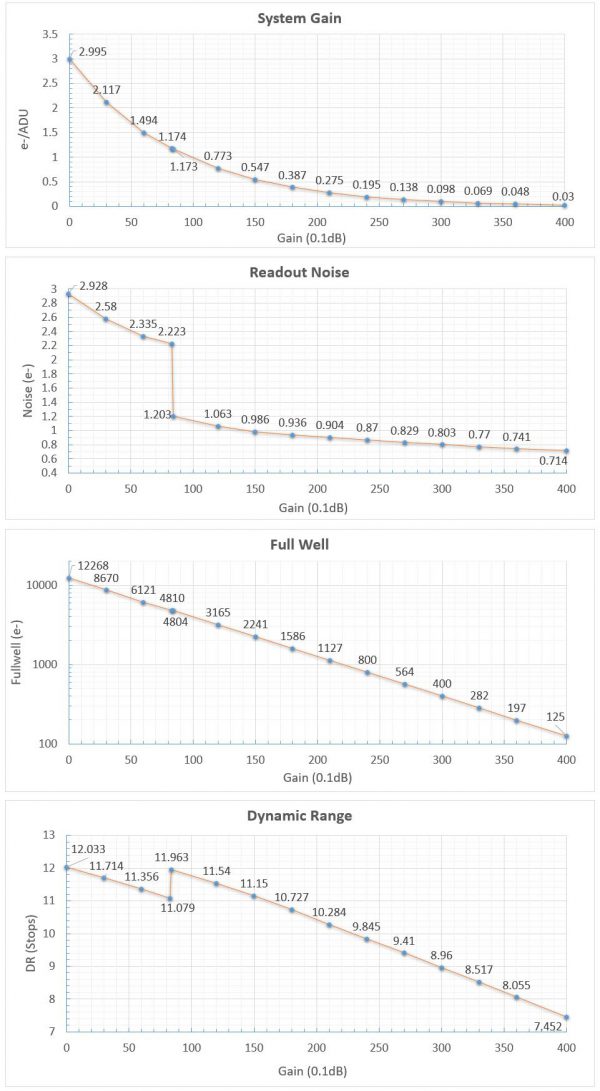
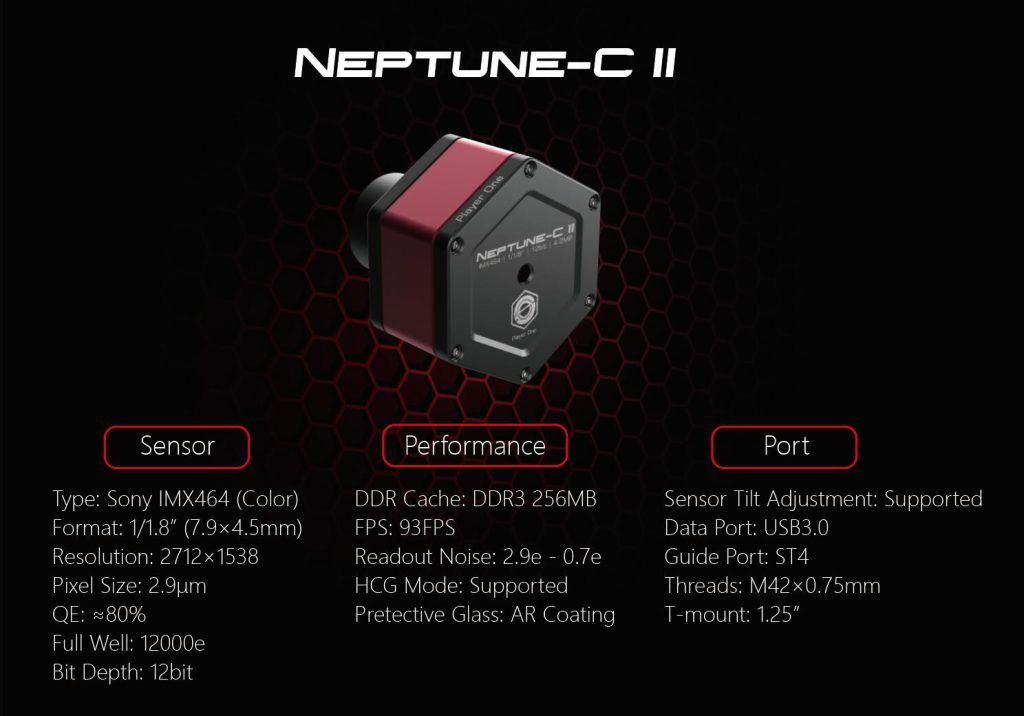
The IMX464 provides a 2712×1538 array of 2.9µm pixels across a 9 mm diagonal. Read noise falls to about 0.7 e⁻ at higher gain, the ADC is 12-bit, and peak QE is near 90%. Over USB3.0 it reaches 93 FPS at full resolution, so you can bank thousands of frames during a moment of steady seeing and stack them into a sharp result.
Who It's For
This is a good match if you image the Moon and planets and want a larger, higher-resolution colour sensor than the entry 1/2.8" cameras, with enough field to frame the whole lunar disc through a modest scope. It also works as an ST4 autoguider.
Key Features & Design
- Sony IMX464 colour sensor: 1/1.8" back-illuminated CMOS, 4.2 MP, with a 9 mm diagonal for a wider planetary and lunar field.
- Fast capture: up to 93 FPS in Raw8 at the full 2712×1538 resolution over USB3.0.
- Low read noise: down to about 0.7 e⁻ at higher gain.
- 256MB DDR3 buffer: stabilizes high-speed data transfer to avoid dropped frames.
- ST4 autoguide port: allows use as a guide camera.
- Protective window: D21×1.1 mm with AR Plus multi-layer anti-reflection coating.
Optical / Mechanical Design
The Neptune-C II uses a colour CMOS sensor with an RGGB Bayer matrix and 2.9µm pixels. Its 12k e⁻ full-well and 12-bit ADC are tuned for bright, high-cadence solar-system targets. The sensor sits at a 12.5 mm back focal distance, and the 66 mm body threads accept 1.25" and M42×0.75 (T-thread) adapters for a standard planetary imaging train. Exposures run from 32µs to 2000 s. The published weight is 180 g.
Recommended Uses
- High-resolution lunar and planetary imaging behind a Barlow or long-focal-length scope.
- Full-disc lunar framing through shorter focal lengths.
- Solar imaging with a suitable solar filter or dedicated solar scope.
- Autoguiding through the ST4 port.
Compatibility & Accessory Notes
The camera connects via 1.25" nosepiece or M42×0.75 threads and fits any telescope providing those interfaces. Planetary work typically adds a Barlow or telecentric to reach f/15–f/25. It captures over USB3.0 with common acquisition software, and the ST4 port accepts a standard autoguide cable to your mount.
Good to Know Before You Order
- Built for speed, not long exposures: this is an uncooled high-frame-rate camera at its best on the Moon, planets and Sun rather than faint deep-sky targets.
- USB3.0 for full frame rates: a USB3.0 port and cable deliver the headline capture speeds; USB2.0 works but caps throughput.
- A Barlow helps on planets: reaching a good image scale on the planets usually means adding a Barlow or telecentric to your scope.
Frequently Asked Questions
Is it difficult to set up?
No. It threads onto a 1.25" or M42 connection, installs its driver, and appears in your capture software. Setup time goes into framing and focus, not the camera.
What is it best used for?
High-frame-rate imaging of the Moon, planets and Sun, and autoguiding.
How is it different from the smaller Mars-C?
The IMX464 is a larger 1/1.8" sensor with more resolution and field, useful when you want to frame more of the Moon or capture a wider planetary region.
Can I use it for deep-sky astrophotography?
It is not intended for long-exposure deep-sky work; the uncooled sensor is optimized for bright solar-system targets.
Does it autoguide?
Yes, through its ST4 port with a suitable guide scope.
Bottom Line
In short: a 4.2 MP, 1/1.8" colour planetary camera that captures the Moon and planets at high frame rates with a generous field, connects through standard 1.25" and M42 threads, and doubles as an autoguider.
| Sensor | Sony IMX464 (1/1.8" back-illuminated CMOS, colour) |
|---|---|
| Resolution | 4.2 MP (2712 × 1538) |
| Pixel size | 2.9 µm |
| Sensor diagonal | 9 mm |
| Image size | 7.9 mm × 4.5 mm |
| Full-well capacity | 12k e⁻ |
| Read noise | 2.9 e⁻ ~ 0.7 e⁻ |
| ADC | 12-bit |
| Peak QE | ≈ 90% |
| Frame rate (full res) | 93 FPS (Raw8, 10-bit) |
| Exposure range | 32 µs – 2000 s |
| Back focal length | 12.5 mm |
| Data interface | USB3.0 / USB2.0 |
| Guide port | ST4 |
| Adapters | 1.25" / M42 × 0.75 |
| Protective window | D21 × 1.1 mm AR Plus multi-layer coating |
| DDR buffer | 256MB DDR3 |
| Diameter | 66 mm |
| Weight | 180 g |
You may also like
Recently viewed
Recent Blog Posts
View all
Your Guide Graph Is Lying to You
Read More
D-Size vs V-Size: A Complete Guide to Telescope Dovetail Systems
Read More
What Is Back Focus in Astrophotography? Telescope Reducers, Flatteners, and Spacing Explained
Read More