



- Description
1. L-eXtreme Introduction
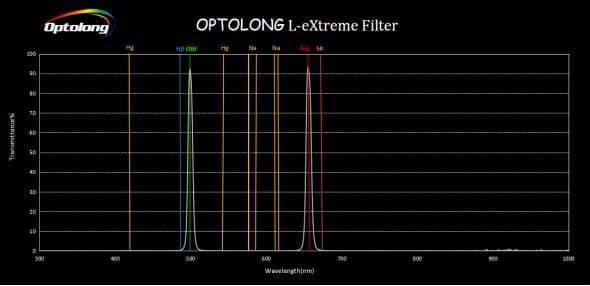
L-eXtreme is a two 7nm bandpass filter which can be used with one-shot color cameras like DSLR's (digital SLR), and monochrome CCD cameras, it is also more suited for fast systems. The convenience and cost effectiveness of this filter allows amateurs to image a rich emission nebulas, even in bright, light pollution skies. Optolong believes the design of L-eXtreme filter would be better choice for fast systems in competitive price. It isolates the H-Alpha, and Oxygen III nebula emission lines so that the contrast and signal-to-noise ratio between nebulae were maximized. For people who is living in very light polluted areas, or when the moon is out, the L-eXtreme will be a good filter.
Unlike the Optolong L-eNhance filter which is a tri-band (transmits Hb, Ha, and OIII), the L-eXtreme filter is dual band that passes Ha and OIII emission lines. The advantage of the L-eXtreme filter is that there is no transmission between the H-beta and OIII lines, as there is no nebula emission lines there. In this case, it isn't letting light pollution come through so that maximize nebulas signal and make the sky background darker while imaging. The L-eXtreme filter should better isolate the emission lines only and better protect from light pollution.
Hydrogen is the largest, the most primitive, the simplest, and the oldest element in the universe. Scientists consider that Hydrogen amounts to more than 90% of visible substance in space. Our sun is 5 billion years old, but so far hydrogen is still the key matter of nuclear fusion. While the sulfur element does not have much scientific significance, so keeping H and O is meaning for exploration of life.
Therefore, we highlight H-a, H-b, O3 and O2, and reduce the signal of sulfur.
2.Spectrum and Characteristic
Sbustrate: B270
Thickness: 1.85mm
Tpeak: T>90%
Blocking range: 300-1000nm
Blcoking depth: light pollution line blocking >99%
Surface quality: 60/40
Transmitted Wavefront RMS: ?/4
Parallelism: 30s
You may also like
Recently viewed
Recent Blog Posts
View all
Your Guide Graph Is Lying to You
You drove ninety minutes to dark sky, PHD2 held 0.4 arcseconds all night, and half your subs still have eggs for stars. Here are the three things your
Read More
Read More

D-Size vs V-Size: A Complete Guide to Telescope Dovetail Systems
What's the difference between D-size and V-size telescope dovetails? Here's everything you need to know.
Read More
Read More

What Is Back Focus in Astrophotography? Telescope Reducers, Flatteners, and Spacing Explained
What Is Back Focus in Astrophotography? Telescope Reducers, Flatteners, and Spacing Explained
Back focus is one of those astrophotography terms that c
Read More
Read More