


- Description
- Specifications
Product Overview
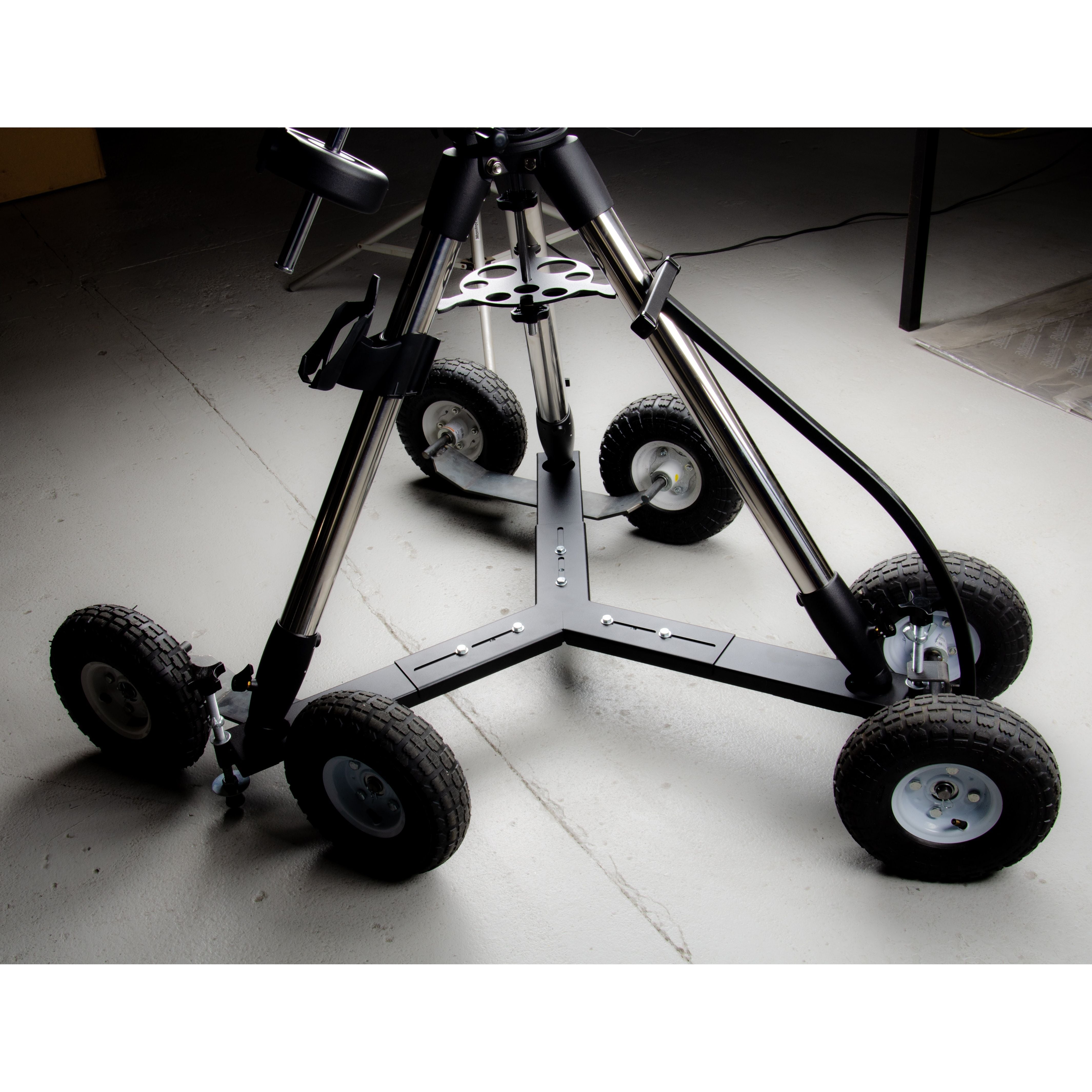
The JMI Sky Trekker 350 Wheeley Bar is a Dobsonian dolly for telescopes in the 12″ to 14″ class, built around ground boards measuring 28″ to 32″ across. The assembled Dob sits on a welded steel frame carried on four 10″ pneumatic all-terrain tires, which lifts the telescope roughly 4″ to 5″ off the ground and rolls it out in one piece. The frame measures 33″ wide at the rear wheels by 53″ front to back including the wheels, and ships at 40.0 lb. JMI designs and builds it in the USA.
Who It's For
This is a good match if you own a 12″ or 14″ Dobsonian — often a truss-tube model — whose rocker box has passed the point where carrying it out is something you do casually. It suits a telescope kept assembled in a garage, shed or observatory, where the aim is to open a door and roll the whole instrument to the pad rather than make two trips with the heavy end of it.
Key Features & Design
- Sized for 12″–14″ Dobsonians: Built around ground boards of 28″ to 32″ outside diameter.
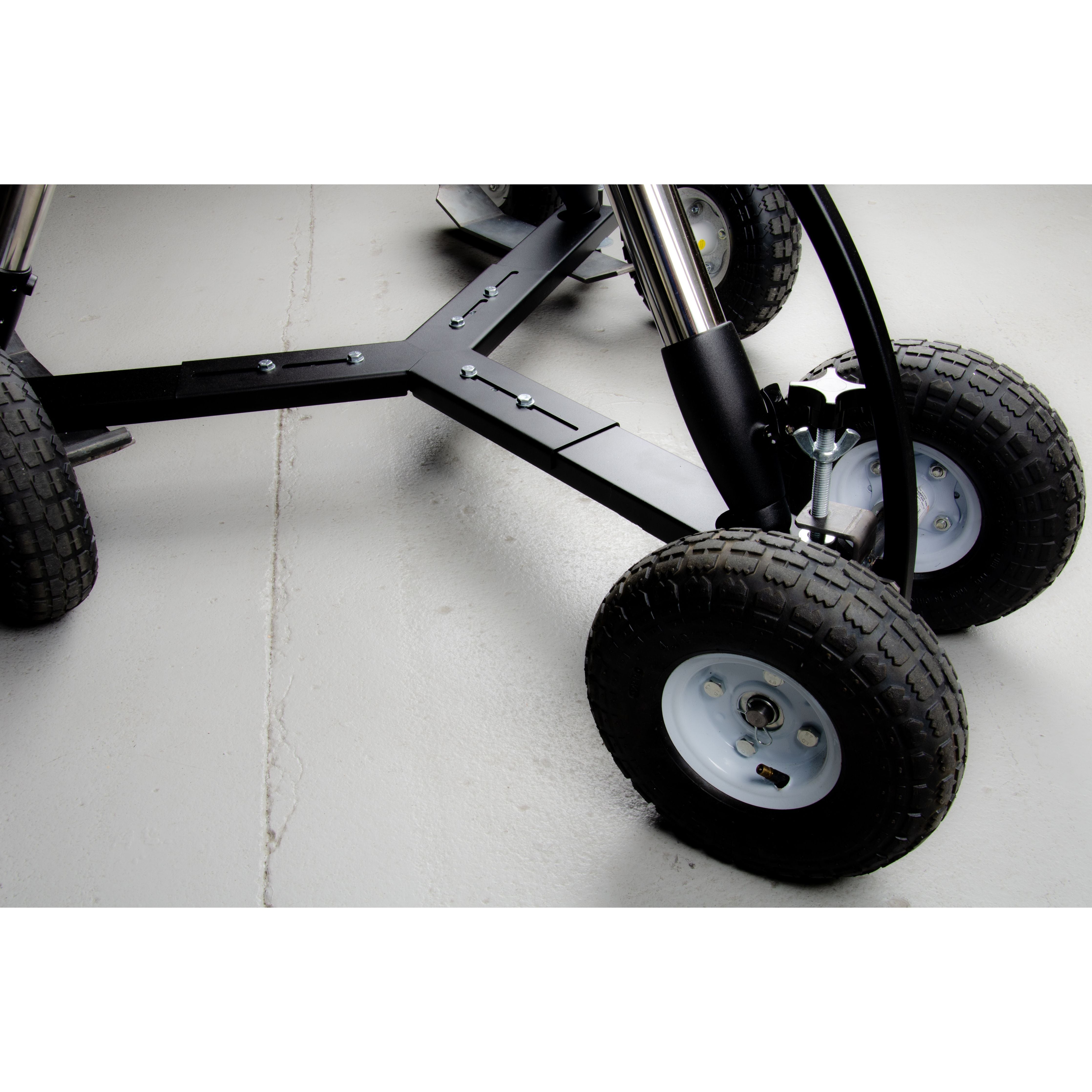
- Four 10″ pneumatic tires: All-terrain air-filled tires at all four corners, standard across the Sky Trekker series.
- 4″ to 5″ of lift: Raises the telescope higher off the ground than the smaller Sky Trekker models.
- 33″ × 53″ footprint: 33″ across at the rear wheels and 53″ front to back with the wheels included.
- Locking wheels: Lock the frame in place once the telescope is positioned.
- Leveling bolts: Bring the azimuth surface flat on sloping or uneven ground.
- Welded steel: Designed and built by JMI in the USA.
Mechanical Design
The Sky Trekker 350 differs from the 200 and 300 in more than scale. Where the smaller frames are specified by the spacing of the three feet under the ground board, the 350 is specified by the outside diameter of the board itself — 28″ to 32″ — and carries it on four 10″ pneumatic tires rather than a lighter arrangement. The longer 53″ frame puts distance between the front and rear axles, which is what keeps a tall truss-tube Dob settled while it is moving instead of rocking fore and aft over each bump. Lift rises to 4″ or 5″, clearing longer grass and deeper gravel than the 3.5″ of the smaller models, and the leveling bolts then take up whatever slope the observing surface has once the wheels are locked.
Recommended Uses
- Rolling an assembled 12″ or 14″ truss-tube Dobsonian from a garage or shed to an observing pad
- Keeping a large Dob permanently on its dolly so no rocker box lift is part of a session
- Moving a large-aperture telescope across grass, gravel or rough ground on air-filled tires
- Repositioning a heavy Dob during the night to clear a roofline, a tree or a light source
- Observatory and semi-permanent dark-sky setups where the telescope is rolled out on a regular schedule
Compatibility and Accessory Notes
The Sky Trekker 350 is specified for Dobsonian telescopes in the 12″ to 14″ class whose ground board measures between 28″ and 32″ outside diameter. JMI names the Orion SkyQuest XX12g, XX14g and XX14i among the telescopes it fits, along with other Dobsonians whose boards fall in that 28″ to 32″ range. The outside diameter of the ground board is the measurement that settles fit, rather than the aperture printed on the tube. The loaded frame is 33″ wide and 53″ long, which is what has to clear doorways, gates and the route out to the observing position. Smaller Dobsonians are covered by the Sky Trekker 200 and 300, and the 400 covers the 14″ to 16″ class above it. Tell us your telescope model or the outside diameter of its ground board, and we'll confirm the fit before you order.
Good to Know Before You Order
- Fit is set by ground board diameter. The published range is 28″ to 32″ outside diameter, and a board outside that sits outside the published fit.
- The frame is long as well as wide. At 33″ by 53″ including the wheels, the length matters as much as the width for doorways, turns and storage space.
- This is a Dobsonian dolly. It carries a Dobsonian ground board; tripod-mounted telescopes are served by the Universal Wheeley Bars.
- The tires are pneumatic. Air-filled tires hold pressure and are topped up like any other pneumatic tire.
- Lift is 4″ to 5″. The eyepiece rises by the same amount at any given altitude, which changes the observing height compared with the telescope on the ground.
- The dolly weighs 40.0 lb on its own, before the telescope is added.
- The 350 and 400 share a published footprint. JMI lists the same 33″ × 53″ frame and the same 28″–32″ board range for both, with the aperture class being the stated difference — we are glad to sort out which model suits your telescope.
Frequently Asked Questions
Is it difficult to set up?
The dolly is a welded steel frame, so setup means placing the Dobsonian's ground board onto it, winding the leveling bolts until the base sits flat, and locking the wheels at the observing position.
How do I know whether my Dob fits?
By the outside diameter of its ground board, which JMI specifies at 28″ to 32″ for this model. The Orion SkyQuest XX12g, XX14g and XX14i are named fits, and we are glad to check any other telescope against that range.
How does it differ from the Sky Trekker 300?
The 300 is specified by foot spacing for 10″ to 12″ Dobs on a 32″ × 38.4″ frame with 3.5″ of lift. The 350 is specified by a 28″–32″ ground board for the 12″ to 14″ class, on a longer 33″ × 53″ frame with four 10″ tires and 4″ to 5″ of lift.
Are there wheel options to choose?
No. Four 10″ pneumatic all-terrain tires are standard on this model, so there is no wheel upgrade to add.
Can it cross grass and gravel?
JMI specifies the tires as all-terrain, and the 4″ to 5″ of lift keeps the ground board clear of the surface, which is what the pneumatic tires are there for.
Does the telescope stay on it between sessions?
It can. Leaving the Dob on the dolly is the usual arrangement, since it removes the rocker box lift from the session entirely.
Bottom Line
In short: the Sky Trekker 350 is the Dobsonian dolly for the 12″ to 14″ class — a 33″ × 53″ welded steel frame on four 10″ pneumatic all-terrain tires, 4″ to 5″ of lift, locking wheels and leveling bolts, at 40.0 lb and built by JMI in the USA. Fit comes down to a ground board of 28″ to 32″ outside diameter, and we will happily check that figure with you.
| Brand | JMI |
|---|---|
| Model | Sky Trekker 350 Wheeley Bar |
| Vendor part code | TPWLB14 |
| Product type | Dobsonian telescope dolly |
| Fits | 12″–14″ class Dobsonian telescopes |
| Ground board | 28″ to 32″ outside diameter |
| Footprint | 33″ wide (at rear wheels) × 53″ long front to back including wheels |
| Lift height | Approximately 4″ to 5″ off the ground |
| Wheels | Four 10″ pneumatic all-terrain tires, locking |
| Leveling | Leveling bolts |
| Material | Welded steel |
| Weight | 40.0 lb |
| Known compatible models | Orion SkyQuest XX12g, XX14g, XX14i, and other Dobsonians with 28–32″ ground boards |
| Country of origin | United States |
You may also like
Recently viewed
Recent Blog Posts
View all
Your Guide Graph Is Lying to You
Read More

D-Size vs V-Size: A Complete Guide to Telescope Dovetail Systems
Read More

What Is Back Focus in Astrophotography? Telescope Reducers, Flatteners, and Spacing Explained
Read More