



- Description
- Specifications
Product Overview
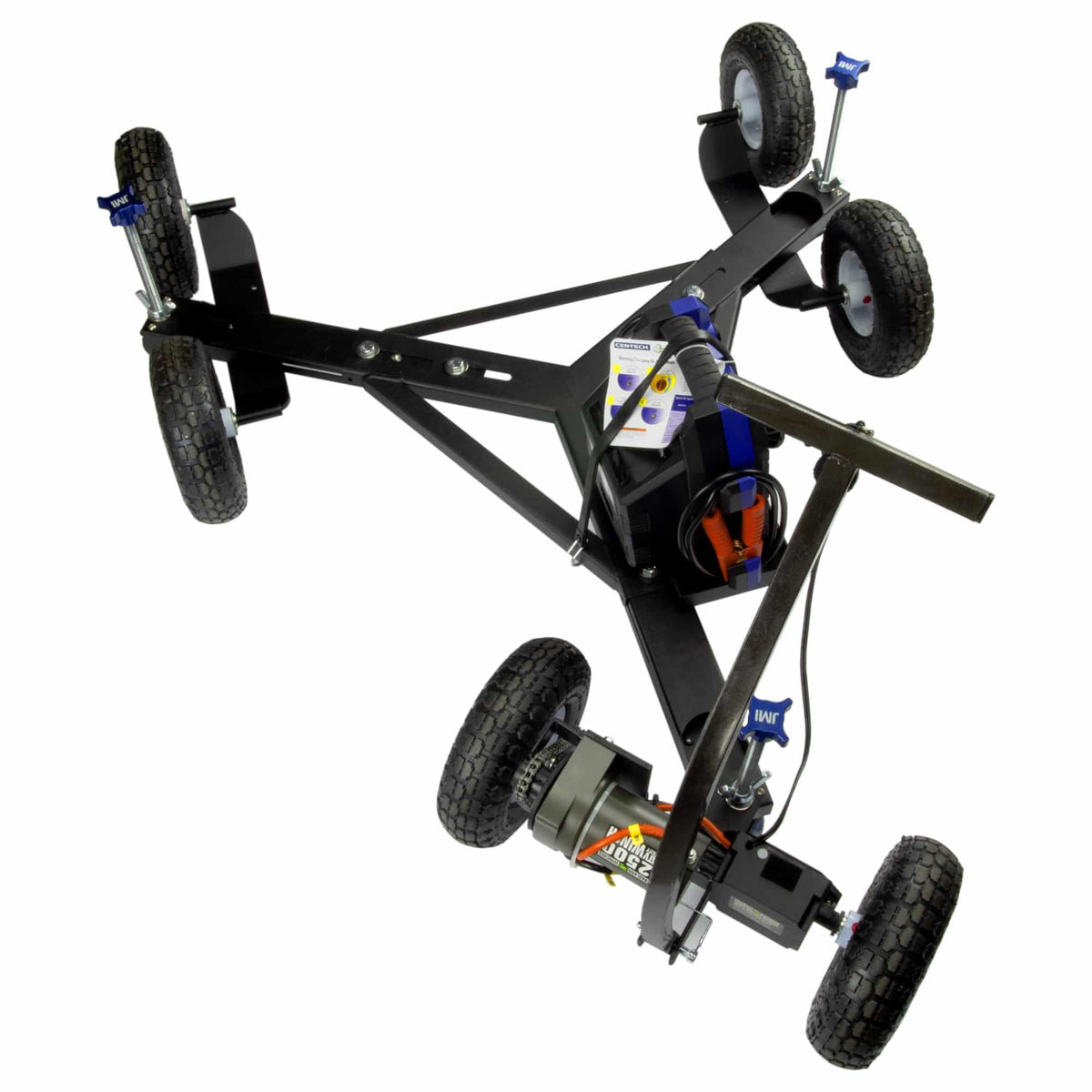
The JMI Motor Upgrade converts a Universal-style Wheeley Bar that already carries 10″ pneumatic wheels into a powered telescope dolly. The kit is a motor assembly, a remote control unit, and the installation hardware; it ships from JMI in Denver and is fitted by the owner. Power comes from a 12-volt supply of your own, with JMI recommending a minimum of 17 amp-hours, drawn from a battery riding in the Battery Pack Holder on the bar. Two versions cover the two leveling-screw arrangements JMI has built over the years. Made in the USA by JMI, part of the CXB Astro family.
Who It's For
This is a good match if the walk between where your rig lives and where it observes is long enough, uphill enough, or heavy enough that pulling the loaded bar by hand has become the limiting factor in getting set up. It suits permanent and semi-permanent installations where roll-out is a repeated nightly routine, imaging rigs whose total mass has grown past comfortable manual handling, and observers for whom moving that mass under muscle power is simply not the plan.
Key Features & Design
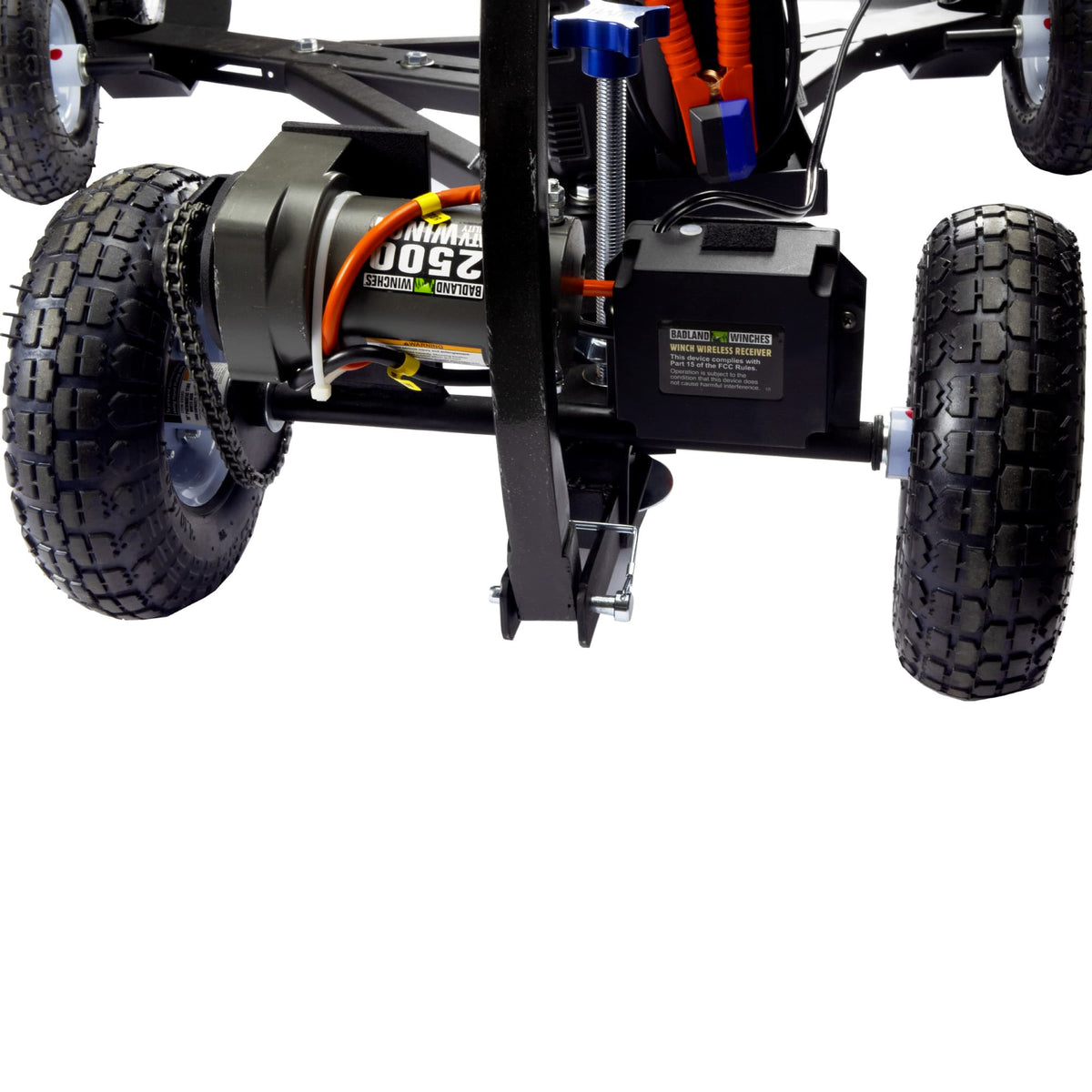
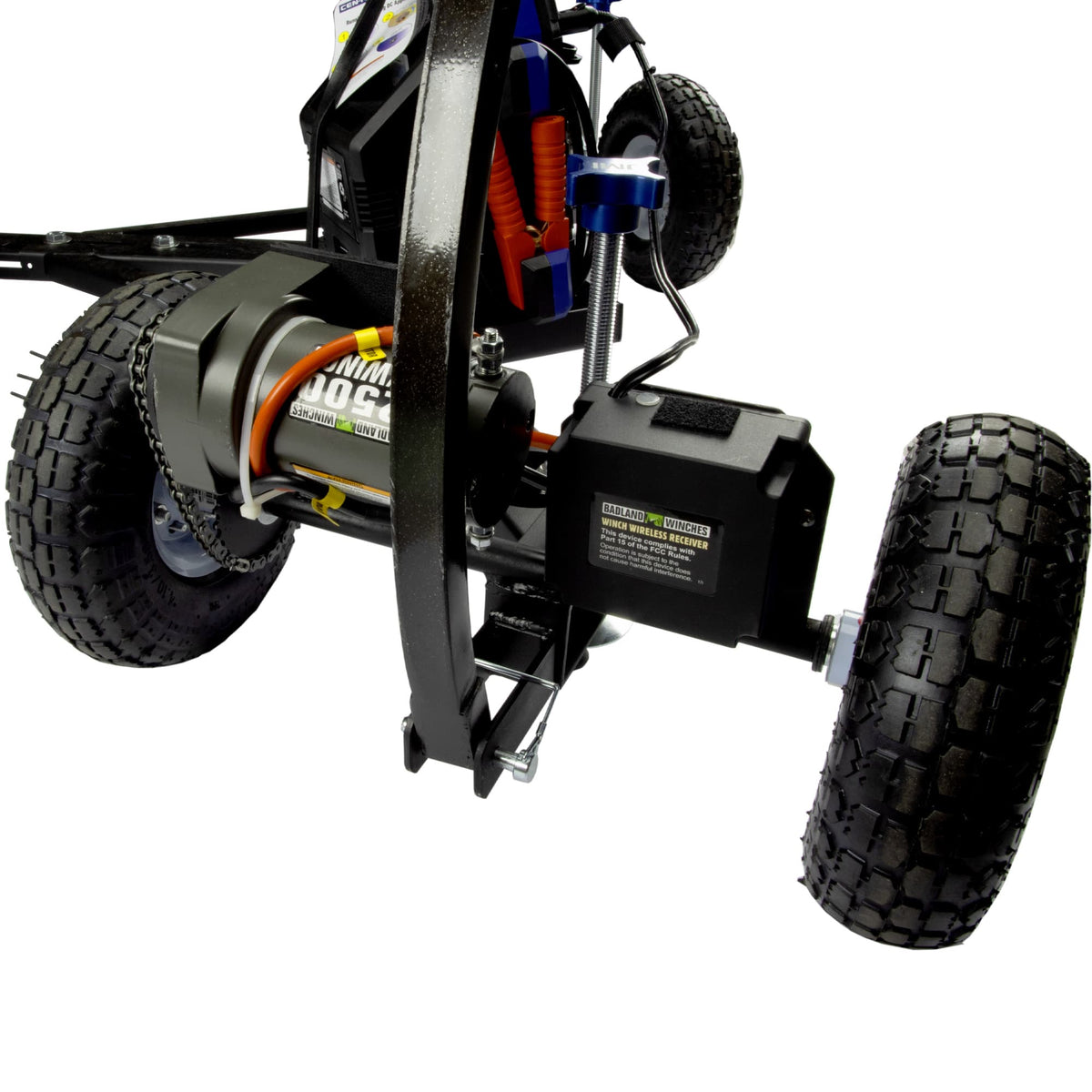
- Motor assembly: Drives the bar through the rear pneumatic wheels, so the 10″ wheel upgrade is part of the drivetrain rather than an option alongside it.
- Remote control unit: The bar is driven from a handset rather than from the frame, so you can walk beside the load and watch clearances.
- 12 V operation: Runs from a standard field battery; JMI recommends 17 Ah as a minimum capacity.
- Two leveling-screw versions: New style for screws threading through a metal block, old style for screws threading through a nut welded to the leg end.
- Owner-installed: The kit arrives complete with its installation hardware.
- Made in the USA by JMI, part of the CXB Astro family.
Mechanical Design
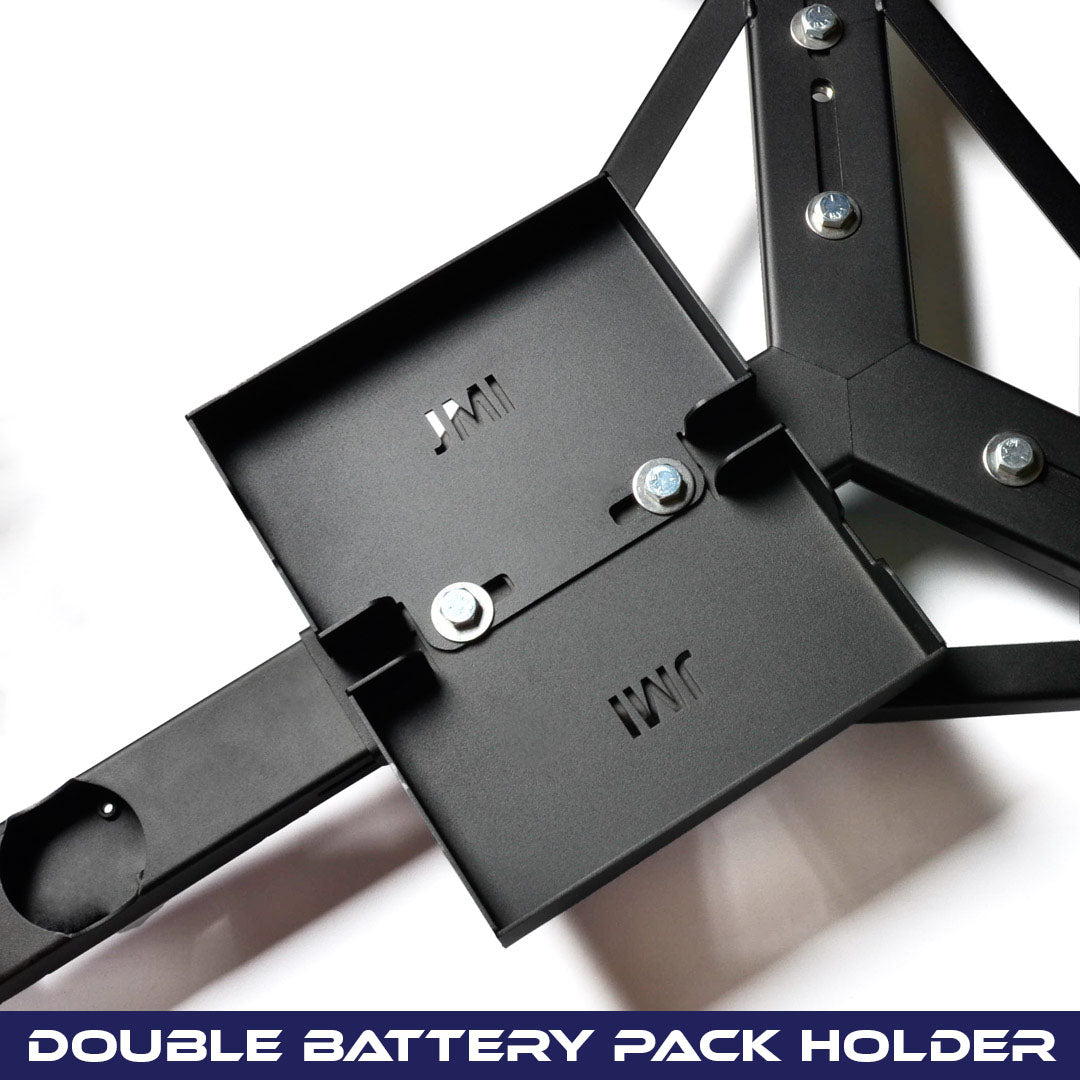
The drive works through the rear wheels of the 10″ pneumatic upgrade, which is why that upgrade is a prerequisite rather than a recommendation. Those rear wheels sit as dual inboard pairs and carry the bulk of the bar’s load, so they present both the traction and the contact area a powered wheel needs on turf or gravel; an air-filled tire flattens under load into a wide contact patch that can transmit torque to soft ground without spinning. Power is taken from a 12-volt battery sitting in the Battery Pack Holder, which is the second prerequisite — the supply travels with the dolly rather than trailing a cord, and the 17 Ah minimum reflects the current a drive motor pulls when starting a loaded bar from rest. Control is by handset, which keeps the operator free to walk alongside and steer the front swivel casters by hand. The two versions of the kit differ at the mounting interface: JMI has used a metal block for the leveling screw on current production and a nut welded to the leg end on older bars, and the motor bracket is cut for one or the other.
Recommended Uses
- Rolling a heavy imaging rig out of a garage, across a lawn, to a backyard pad every clear night.
- Moving a mount between a storage building and an observing position at a semi-permanent dark-sky site.
- Repositioning a large Losmandy HD Gen2 or Astro-Physics pier setup where manual handling of the loaded bar is impractical.
- Building a roll-out routine that one person can run alone regardless of the load on the bar.
Compatibility and Accessory Notes
JMI lists the Motor Upgrade for the Medium Heavy Duty (TPWUMEDHD), Large (TPWULG), Losmandy HD Tripod Gen2 (TPWUG11), and Astro-Physics Pier Mount (TPWUAP) Universal-style Wheeley Bars. Two prerequisites apply to all of them: the 10″ pneumatic wheel upgrade, because the motor drives those rear wheels, and the Battery Pack Holder, because the 12-volt supply rides on the dolly. Choosing between versions comes down to one look at the end of a leg — a leveling screw threading through a metal block calls for the new style kit (TPWMTR-NLS-UPG), and a leveling screw threading through a nut welded onto the leg end calls for the old style (TPWMTR-OLS-UPG). The Sky Trekker and Triangle Style bars use different frames and are outside this kit’s fitment. The battery itself is supplied separately. Send us a photo of your leg ends along with your bar model and we will confirm the version and check that both prerequisites are in place before anything ships.
Good to Know Before You Order
- Both prerequisites are structural. Without the 10″ pneumatic wheels there is nothing for the motor to drive, and without the Battery Pack Holder there is nowhere for the supply to ride.
- A 12-volt battery is not included. JMI recommends a minimum of 17 amp-hours; smaller packs may not deliver the starting current a loaded bar draws.
- The version depends on your leveling-screw arrangement, metal block or welded nut, and the two brackets are not interchangeable.
- The kit is owner-installed. It ships from JMI in Denver with its installation hardware.
- Availability and lead time vary. This item moves in small batches from the manufacturer, and we can give you the current position before you commit.
- Listed fitment is Universal-style bars only. Sky Trekker and Triangle Style models are not covered.
Frequently Asked Questions
Is it difficult to install?
The kit is designed for owner installation and arrives with its mounting hardware. The work is mechanical — the motor bracket goes on at the leveling-screw interface and the drive engages the rear pneumatic wheels. Matching the version to your leg ends before you start is the part that determines how smoothly it goes.
Which Wheeley Bars can take it?
The Medium Heavy Duty (TPWUMEDHD), Large (TPWULG), Losmandy HD Tripod Gen2 (TPWUG11), and Astro-Physics Pier Mount (TPWUAP) Universal-style bars, each with 10″ pneumatic wheels and a Battery Pack Holder already fitted.
How do I tell new style from old style?
Look at the end of a leg. A leveling screw running through a metal block is new style; a leveling screw running through a nut welded to the leg end is old style. A photo sent to us settles it either way.
What battery does it need?
A 12-volt supply that fits the Battery Pack Holder, with at least 17 amp-hours of capacity per JMI’s recommendation. We can suggest specific packs for your bar and holder.
Is any wiring or electrical work involved?
The kit connects to the battery riding on the dolly. There is no permanent wiring or fixed electrical installation beyond the mounting hardware supplied.
How is it operated?
Through the included remote control unit, which lets you drive the bar while walking alongside it.
Bottom Line
In short: a motor, a remote, and the hardware to fit them, turning a 10″-wheeled Universal Wheeley Bar with a Battery Pack Holder into a 12-volt powered dolly that moves a loaded mount under its own power, in the version matched to your leveling screws.
| What’s included | Motor assembly, remote control unit, installation hardware |
|---|---|
| Required first | 10″ pneumatic wheel upgrade and Battery Pack Holder, both already fitted to the bar |
| Power | 12-volt supply, not included; JMI recommends a minimum 17 amp-hour capacity |
| Compatible Wheeley Bars | Medium Heavy Duty (TPWUMEDHD), Large (TPWULG), Losmandy HD Tripod Gen2 (TPWUG11), Astro-Physics Pier Mount (TPWUAP) |
| New style version (TPWMTR-NLS-UPG) | Bars whose leveling screws thread through a metal block |
| Old style version (TPWMTR-OLS-UPG) | Bars whose leveling screws thread through a nut welded to the end of the leg |
| Installation | Ships from JMI in Denver and is installed by the owner |
| Weight | 1.0 lb (manufacturer’s published shipping figure) |
| Country of origin | United States |
| Manufacturer | JMI, part of the CXB Astro family |
You may also like
Recently viewed
Recent Blog Posts
View all
Your Guide Graph Is Lying to You
Read More

D-Size vs V-Size: A Complete Guide to Telescope Dovetail Systems
Read More

What Is Back Focus in Astrophotography? Telescope Reducers, Flatteners, and Spacing Explained
Read More