


- Description
- Specifications
Product Overview
The JMI Event Horizon EV2-C is a single-speed Crayford focuser that threads onto the rear port of a Schmidt-Cassegrain telescope and gives it a second, independent focus stage. It is the grip-knob model in the Event Horizon Cassegrain line: a friction drive with rubber grip knobs, 0.565″ (14.3 mm) of travel, an 8 lb load capacity, and a 2″ drawtube with a compression ring. The body is CNC-machined and each unit is assembled and tested individually in JMI's own facility in the United States. At 1.4 lb it adds very little to what the rear cell already carries.
Who It's For
This is a good match if you want the mechanical benefits of a Crayford stage on an SCT — no backlash, no image shift while focusing — without paying for a dual-speed knob you would not use. A single-speed friction drive is already far finer than a rack and pinion, and the rubber grip knobs give enough feel for careful focusing by hand.
The 8 lb capacity is the other reason to pick this one over the EV3-C: it is the model to choose when the back of the scope carries a full imaging train, or a 2″ diagonal with a heavy wide-field eyepiece in it. If you want a 10:1 reduction for high-magnification planetary work, that is the EV1-C; if you want the focusing automated, the EVRZ and EVRP take a ZWO EAF or Pegasus FocusCube 3.
Key Features & Design
- Single-speed friction drive: one knob, direct feel, and none of the backlash a rack-and-pinion focuser gives on reversal.
- Rubber grip knobs: positive grip in the cold and with gloves on, where a bare metal knob gets slippery.
- 0.565″ (14.3 mm) of fine-focus travel: enough range to cover focus drift through a night once the mirror has set rough focus.
- 8 lb load capacity: carries a camera, filter wheel and off-axis guider, or a 2″ diagonal and a heavy wide-field eyepiece.
- Compression ring: holds eyepiece and adapter barrels without marking them.
- Standard SCT rear thread: threads directly to the rear cell of Cassegrain, R-C and Maksutov telescopes that use standard SCT rear threads.
- 1.4 lb focuser weight: a small addition to the back end, and it sits close to the rear cell rather than out on a lever arm.
- CNC-machined and made in the USA: individually assembled and tested in JMI's own facility.
Mechanical Design
A Crayford focuser has no rack and no pinion. A polished steel drive shaft presses directly against the flat of a machined metal drawtube, and bearings on the opposite side carry the load and hold the tube square. Because the drive is a friction contact rather than meshing teeth, there is no tooth-to-tooth clearance to take up when you reverse direction — the drawtube starts moving when the knob does, and it moves along its own axis rather than tipping. That is what zero backlash and zero image shift describe in practice: a star stays on the same pixel as you rack through focus.
On a Schmidt-Cassegrain this matters twice over, because the telescope's own focus knob moves the primary mirror, and mirror movement is where SCT image shift and focus backlash come from. The Event Horizon threads onto the rear cell and adds a second, independent focus stage behind it. Rough focus happens once on the mirror; every critical adjustment after that happens on the Crayford, across 0.565″ (14.3 mm) of travel.
Recommended Uses
- Deep-sky visual observing with heavy 2″ eyepieces, held by the compression ring rather than a set screw.
- Manual focusing for imaging, on a Bahtinov mask or a live-stacked frame.
- Heavier back-end loads on an SCT — camera, filter wheel and off-axis guider together.
- Any SCT, classical Cassegrain, R-C or Maksutov where mirror-flop image shift makes precise focus tedious.
- Locking the primary mirror and doing all focusing behind it, on telescopes that have a mirror lock.
Compatibility and Accessory Notes
The base threads to the standard SCT rear port, so it fits Schmidt-Cassegrain, classical Cassegrain, Ritchey-Chrétien and Maksutov telescopes that use standard SCT rear threads. The drawtube is 2″ and holds eyepieces and camera adapters with a compression ring, so nothing gets a set-screw mark on the barrel.
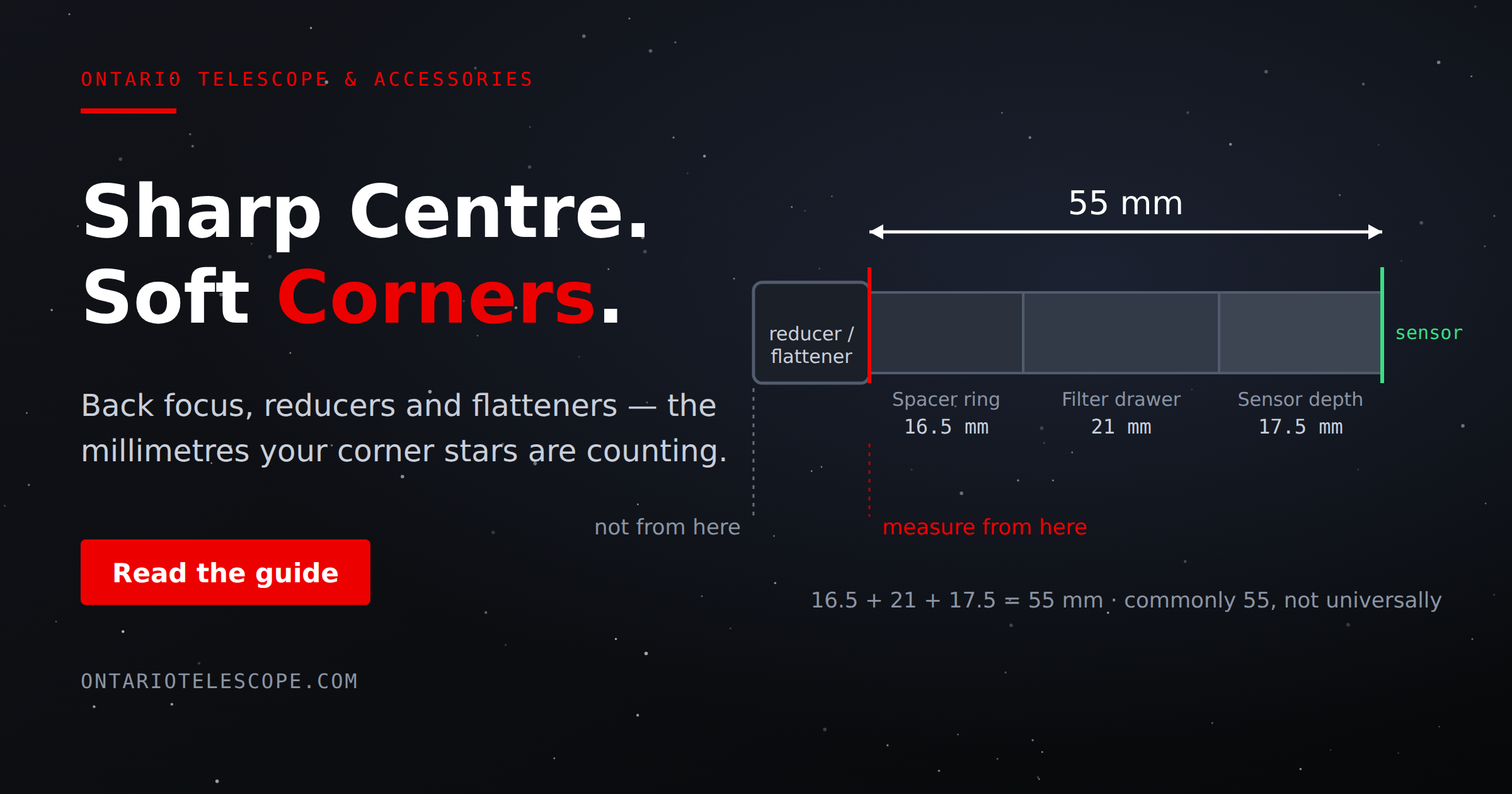
It adds length to the imaging train. Because it sits between the rear cell and everything behind it, a visual train reaches focus comfortably, while a camera train — especially one behind an SCT reducer or a corrector with a fixed back focus figure — needs its spacing budget checked before the focuser goes on. Focal reducers and field flatteners are unaffected optically: the Event Horizon is a mechanical stage with no glass in it.
Three optional adapters are made for the 2″ drawtube. Ontario Telescope does not stock them at the moment — if you want one alongside the focuser, send us a note and we will bring it in with the order.
- JMI ADPT2-1.25T combination 1.25″ eyepiece and T-thread adapter: mounts a T-threaded camera into the 2″ drawtube and doubles as a 1.25″ eyepiece adapter. Compression ring, with 48 mm filter threads on the focuser end.
- Lumicon LA1060 2″ male to SCT male adapter: drops into the 2″ drawtube and presents male SCT threads (2″ × 24 tpi) for SCT-threaded accessories such as an SCT diagonal. Includes 2″/48 mm filter threads.
- Farpoint FAV100 2″ to 1.25″ eyepiece adapter: a visual adapter with a non-marring compression ring, threaded for both 2″ and 1.25″ filters, with a stop that keeps long eyepieces clear of the filter.


Ask us if you are not sure it fits. The one thing worth checking before you order is whether your telescope's rear port is a standard SCT thread and whether you have the back focus to spare. Tell us the telescope and what you plan to hang off the back — diagonal and eyepiece, or camera, filter wheel and off-axis guider — and we will work it out with you.
Good to Know Before You Order
- It is single-speed. There is no 10:1 fine knob. For high-magnification planetary and double-star work where the last micron matters, the EV1-C adds that reduction on the same mechanism.
- It is a manual focuser. There is no motor and no electronics. For computer-controlled autofocus, the EVRZ (ZWO EAF) and EVRP (Pegasus FocusCube 3) versions of the same focuser are the ones to look at.
- The travel is fine-focus range, not full range. 0.565″ (14.3 mm) covers critical focus and a night's thermal drift. Rough focus still happens on the telescope's own mirror knob, which is how the focuser is meant to be used.
- It lengthens the imaging train. It sits behind the rear cell, so a camera train with a fixed back focus figure — behind a reducer or corrector — is worth adding up before you order. Send us your setup and we will check the numbers with you.
- Adapters are sold separately. The 2″ drawtube takes eyepieces and 2″ accessories directly; a T-threaded camera or a 1.25″ eyepiece needs one of the adapters listed above.
Frequently Asked Questions
Is it difficult to set up?
No. It threads onto the SCT rear port the same way a visual back does, and there is nothing to align, shim or calibrate. Set rough focus on the mirror once, then use the focuser from there.
Is single-speed fine for imaging?
Yes. What a camera needs from a focuser is that the drawtube move without backlash and without tilting, and the friction drive delivers that regardless of gearing. A reduction knob makes hand-focusing easier; it does not make the mechanism better.
Does this replace my telescope's focuser?
No, it works with it. The mirror knob still sets rough focus and covers the full focal range; the Event Horizon handles the critical adjustment at the end, without moving the mirror.
What is the difference between the EV2-C and the EV3-C?
Same mechanism and the same 14.3 mm of travel. The EV2-C adds rubber grip knobs and is rated to 8 lb; the EV3-C is the standard model rated to 4 lb.
Will it fix mirror flop?
It removes mirror movement from the focusing process, which is where most SCT focus-time image shift comes from. Mirror shift caused by slewing across the meridian is a separate matter, and a mirror lock is the tool for that.
Does it fit a Newtonian?
No — this is the Cassegrain base, which threads to an SCT rear port. JMI makes Newtonian-base versions of the Event Horizon; ask us and we will point you at the right one.
Bottom Line
In short: a single-speed friction-drive Crayford with an 8 lb capacity that puts a proper fine-focus stage behind an SCT rear cell. It brings 0.565″ (14.3 mm) of zero-backlash travel and grip knobs that stay usable in the cold, and it leaves the mirror where you set it.
| Model | JMI Event Horizon EV2-C |
|---|---|
| Type | Low-profile friction-drive Crayford focuser |
| Drive | Single-speed friction drive |
| Knobs | Rubber grip |
| Telescope interface | Standard SCT rear thread |
| Drawtube | 2″, machined metal, compression ring |
| Fine-focus travel | 0.565″ (14.3 mm) |
| Load capacity | 8 lb |
| Focuser weight | 1.4 lb |
| Compatible telescopes | Schmidt-Cassegrain, classical Cassegrain, Ritchey-Chrétien and Maksutov with standard SCT rear threads |
| Optional adapters | JMI ADPT2-1.25T · Lumicon LA1060 · Farpoint FAV100 (sold separately) |
| Construction | CNC-machined; individually assembled and tested in the USA |
| Country of origin | United States |
You may also like
Recently viewed
Recent Blog Posts
View all
Your Guide Graph Is Lying to You
Read More
D-Size vs V-Size: A Complete Guide to Telescope Dovetail Systems
Read More
What Is Back Focus in Astrophotography? Telescope Reducers, Flatteners, and Spacing Explained
Read More