
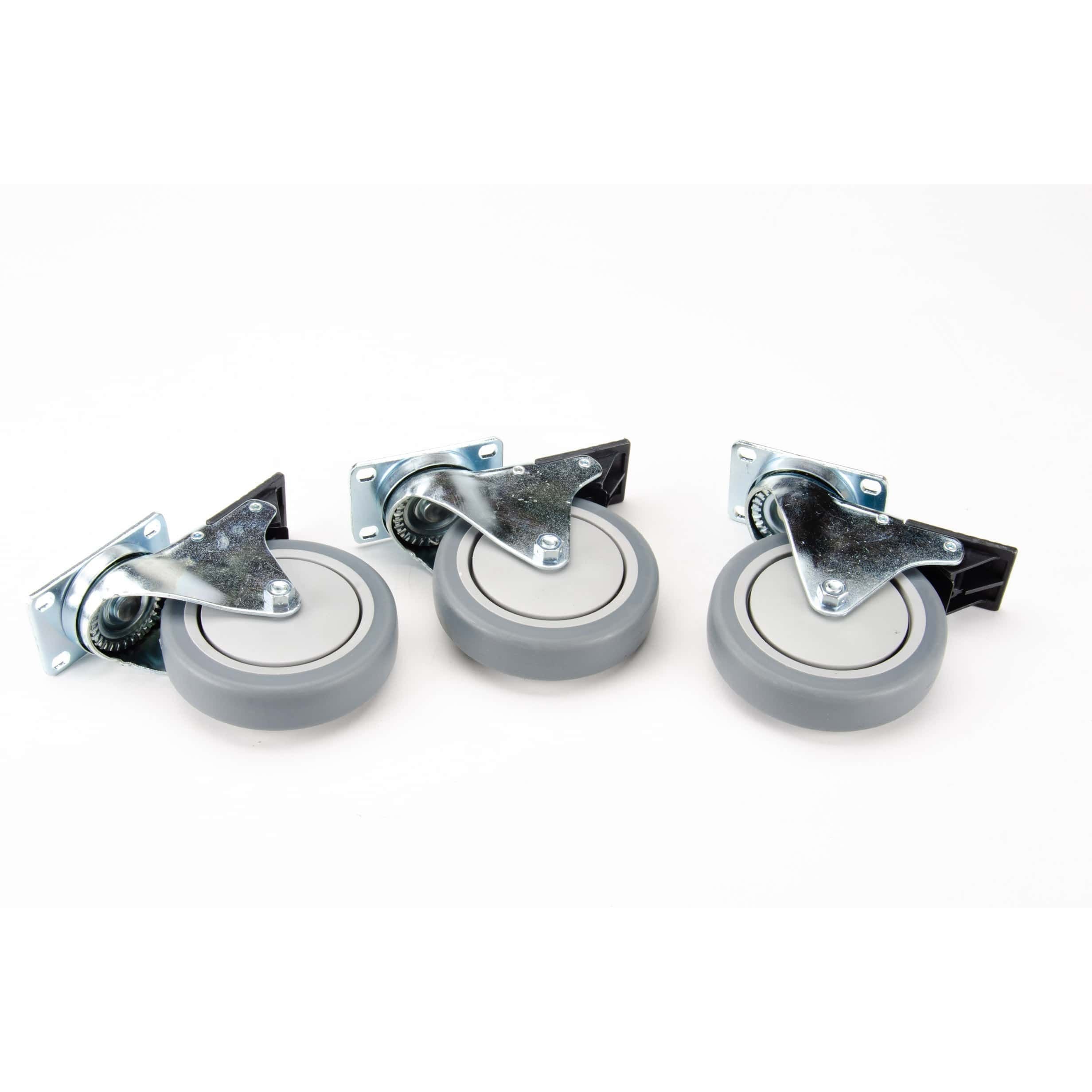
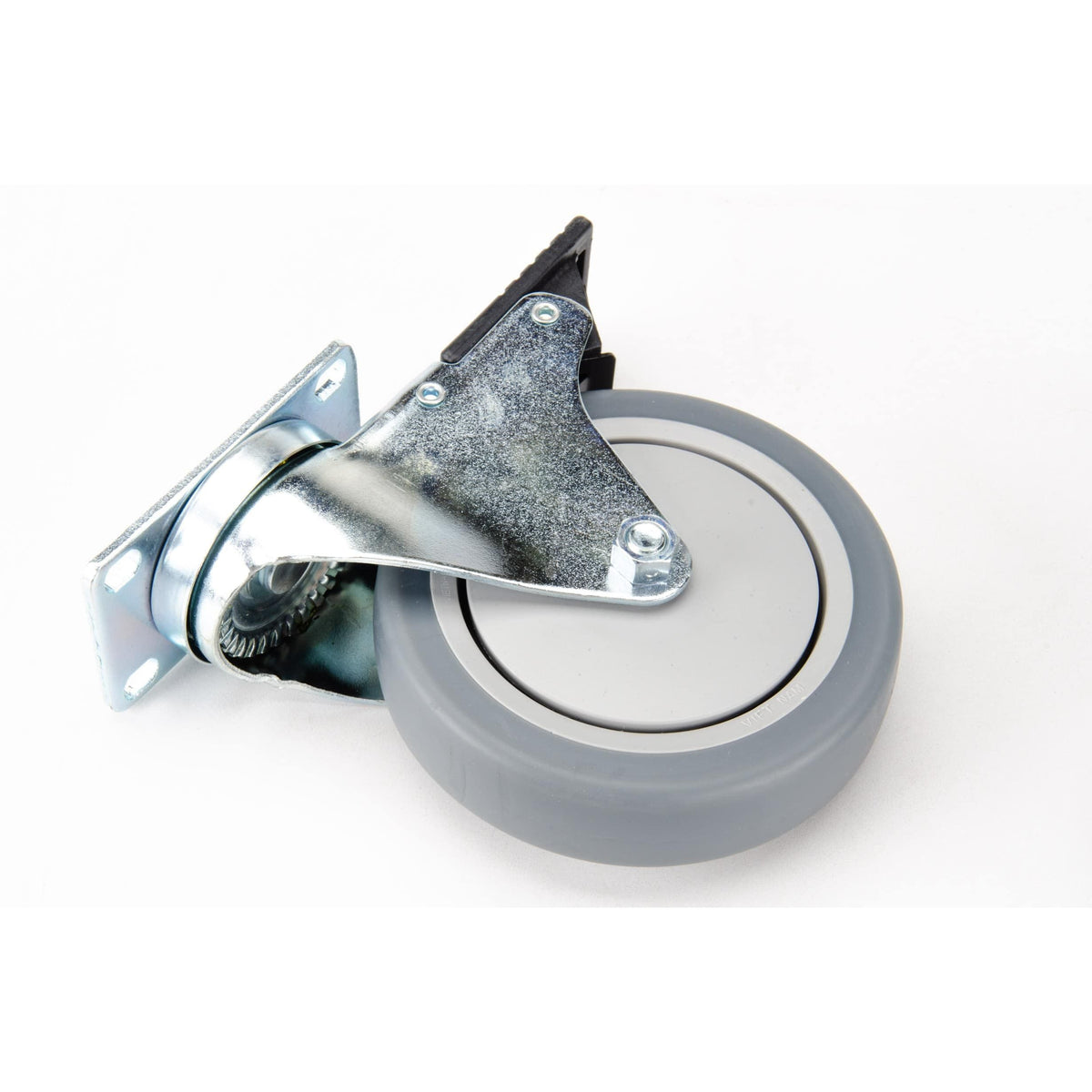
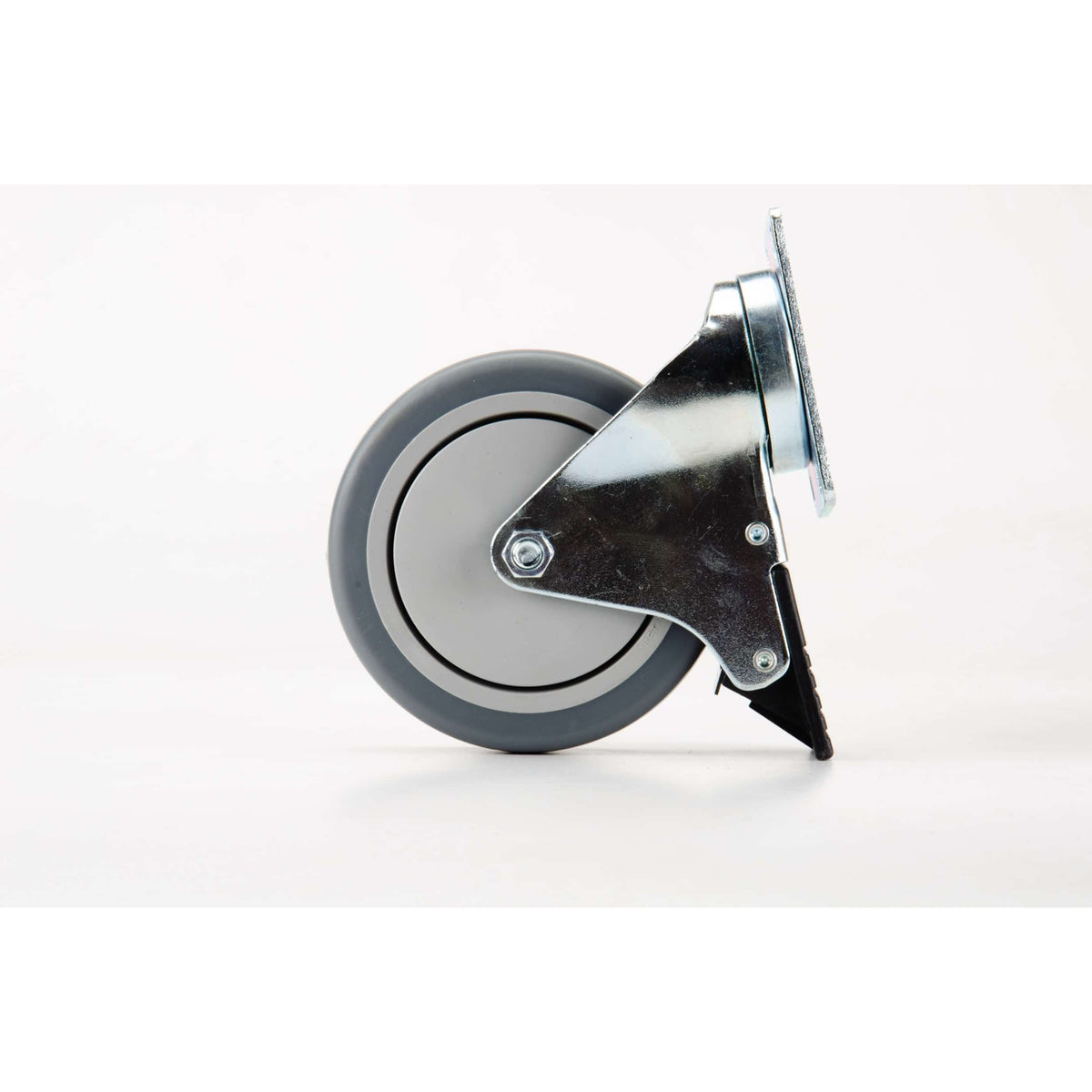


- Description
- Specifications
Product Overview
This kit swaps the factory 2⅜″ hard-rubber casters on a JMI Universal-style Wheeley Bar for three 5″ diameter polyurethane wheels, each with a full-locking brake, and includes all the mounting hardware. The larger diameter rolls over expansion joints and small obstacles that stop the stock casters, and the polyurethane tread runs quieter and gentler on finished concrete and garage epoxy. Installed, the wheels raise the mount 6⅜″ off the ground. Shipping weight is 9.0 lb. Made in the USA by JMI, part of the CXB Astro family.
Who It's For
This is a good match if you observe mostly on hard, reasonably flat surfaces — a driveway, a garage floor, an observatory floor or pad, paved ground — and the stock 2⅜″ casters are catching on seams and cracks on the way out. It also suits you if you want the bar to stay planted once it is leveled, since all three wheels lock. If your route crosses grass, gravel, mulch, or sand, the 10″ pneumatic upgrade is the one built for that ground.
Key Features & Design
- Three 5″ polyurethane wheels: More than double the 2⅜″ factory caster diameter, so expansion joints and small obstacles roll under rather than stop the bar.
- Full-locking brakes on every wheel: Each brake holds against wheel rotation and caster swivel together, so a leveled bar stays put even on a slight slope.
- Polyurethane tread: Quieter than hard rubber on concrete and garage epoxy, and it does not leave black scuff marks on a finished floor.
- 6⅜″ ride height: The manufacturer’s published figure for how far the kit raises the mount above ground.
- Leveling-screw agnostic: One kit fits Universal-style bars with either 1/2″ or 5/8″ leveling screws.
- Complete hardware: All mounting hardware ships with the wheels.
- Made in the USA by JMI, part of the CXB Astro family.
Mechanical Design
The Universal-style Wheeley Bar carries a three-wheel layout, one wheel under each tripod or pier leg, which matches the triangular footprint of the mount it carries and is the minimum count for stable rolling. This kit keeps that layout and simply enlarges each station. The brake on each caster is a full-locking type: rather than only stopping the wheel from turning, it also locks the swivel yoke, which removes the slow creep that a rotation-only brake allows when a loaded bar is nudged. Polyurethane is the tread material used on industrial equipment rolled indoors for exactly the reasons that matter here — it carries load without deforming, runs quietly, and does not transfer black marks to a coated floor. Because all three stations rise by the same amount, the bar keeps its level geometry and the mount simply sits 6⅜″ higher.
Recommended Uses
- Rolling a loaded imaging rig from a garage out to a driveway pad across expansion joints and seams.
- Moving a mount around a roll-off or dome observatory floor without marking the coating.
- Repositioning a heavy visual setup on a paved patio and locking it down once the target is framed.
- Replacing worn or noisy factory casters on an older Universal-style Wheeley Bar.
Compatibility and Accessory Notes
The kit is designed for JMI Universal-style Wheeley Bars: Standard Medium, HD Medium, HD Large, HD Shorty, and the AP Pier Mount bar. It is size-agnostic on leveling screws and fits both the 1/2″ and 5/8″ versions, unlike the 10″ pneumatic upgrade, whose included tow handle makes it leveling-screw specific. The Triangle Style Wheeley Bar uses a different frame and takes its own 5″ lockable caster upgrade, and the Sky Trekker series is outside this kit’s fitment. A tow handle is not part of this kit; standalone tow handles in 1/2″ and 5/8″ versions are made for the 5″ caster setup and can be added to match your leveling-screw size. If you are sizing a new Wheeley Bar to run these wheels, the 6⅜″ ride height is worth allowing for in the tip-to-tip measurement. Tell us which Wheeley Bar and which leveling screws you have and we will confirm the fit and the right tow handle.
Good to Know Before You Order
- These wheels are for hard, smooth surfaces. Concrete, asphalt, garage epoxy, and tile suit them; grass, gravel, mulch, sand, and rough ground are where the 10″ pneumatic upgrade takes over.
- No tow handle is included. The 1/2″ and 5/8″ standalone tow handles cover that separately.
- The kit raises the mount 6⅜″. That changes eyepiece height and matters when measuring tip-to-tip for a new bar.
- This is an upgrade kit for an existing Wheeley Bar, not a standalone dolly.
- Triangle Style bars take a different kit. The 5″ lockable caster upgrade for Triangle Style is sized for that frame.
- Three wheels, not four. That matches the Universal bar’s one-wheel-per-leg layout.
Frequently Asked Questions
Is it difficult to install?
No. The kit ships with all mounting hardware and each 5″ caster goes on where a factory 2⅜″ caster comes off, one station per leg. It is a hand-tool job with no drilling or modification to the bar.
Will these fit my bar regardless of leveling-screw size?
Yes. The 5″ wheel upgrade is size-agnostic and fits Universal-style bars with either 1/2″ or 5/8″ leveling screws.
Why three wheels instead of four?
The Universal-style bar uses a three-wheel layout with one wheel under each tripod or pier leg. Three is the minimum for stable rolling and it matches the bar’s triangular footprint.
Does the lock really hold the bar in place?
Each wheel has a full-locking brake that holds against both rotation and swivel. With all three engaged the bar stays put, including on a slight slope. Most factory Wheeley Bar casters do not lock at all.
Will polyurethane mark my garage floor?
No. Polyurethane is the standard tread for industrial equipment rolled indoors precisely because it does not leave the black scuff marks that hard-rubber casters do.
Can a tow handle be added later?
Yes. Both standalone tow handles — 1/2″ and 5/8″ — are designed for the 5″ caster setup, matched to your bar’s leveling screws.
Bottom Line
In short: three 5″ polyurethane casters with full-locking brakes, all hardware included, raising the mount 6⅜″ and turning a hard-surface Wheeley Bar into something that rolls quietly over seams and stays exactly where you park it.
| What’s included | Three (3) 5″ diameter polyurethane wheels with locking brakes, plus all mounting hardware |
|---|---|
| Replaces | Factory 2⅜″ hard-rubber casters |
| Wheel material | Polyurethane tread — quieter and gentler on finished floors than hard rubber, leaves no black scuff marks |
| Locking | Each wheel has a full-locking brake holding against both rotation and swivel |
| Ride height | Raises the mount 6⅜″ off the ground (manufacturer spec) |
| Tow handle | Not included — standalone 1/2″ and 5/8″ tow handles are sold separately |
| Designed for | JMI Universal-style Wheeley Bars: Standard Medium, HD Medium, HD Large, HD Shorty, AP Pier Mount (fits both 1/2″ and 5/8″ leveling-screw versions) |
| Best for | Driveway, garage, observatory floor, observatory pad, smooth pavement |
| Not compatible with | Triangle Style Wheeley Bar, Sky Trekker series |
| Weight | 9.0 lb |
| Country of origin | United States |
| Manufacturer | JMI, part of the CXB Astro family |
You may also like
Recently viewed
Recent Blog Posts
View all
Your Guide Graph Is Lying to You
Read More
D-Size vs V-Size: A Complete Guide to Telescope Dovetail Systems
Read More
What Is Back Focus in Astrophotography? Telescope Reducers, Flatteners, and Spacing Explained
Read More