
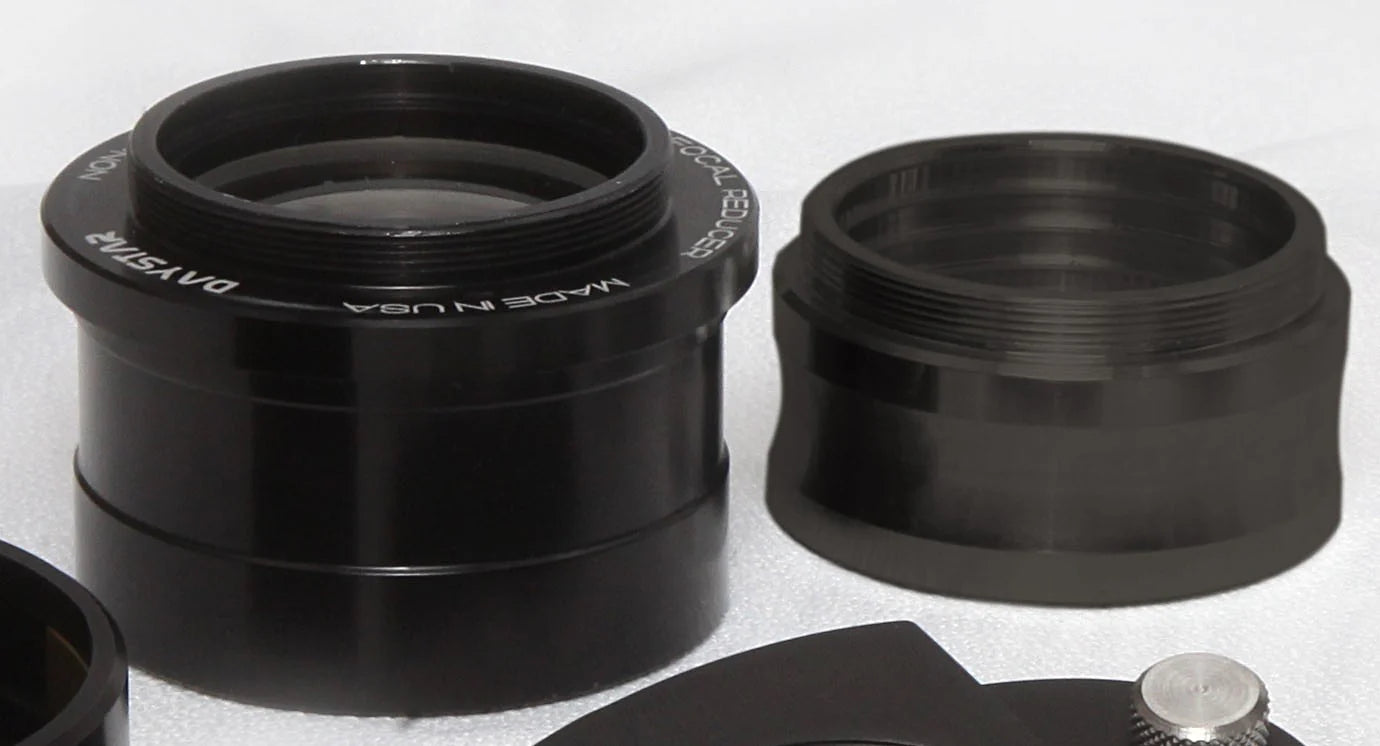

- Description
DayStar's Imaging Focal Reducer can give you more field of view in your images. 2" to T mount, with included T extension tube for even more reduction.
With a T-mount camera connected directly to the reducer, the focal length is cut in half - 0.5X. Add the 20mm extension tube for 0.33X. Even better is to combine the T-thread Interference Eliminator (sold separately) with the reducer for an interference-free 0.38X effect.
Please note that the obtainable field of view is usually limited by the etalon clear aperture; Quantum filters will result in a larger usable field than Quark or Ion.
Allows full disk imaging with SR127 and 2/3" monochrome CCDs such as ICX625, ICX655, IMX250, IMX264.
Focal reducer specifications:
Four elements in two groups.
36mm clear aperture.
Front: Male 2" eyepiece drawtube.
Rear: Male T thread (M42x0.75)
Flange to flange distance: 5mm.
Overall length: 38mm.
Extension tube specifications:
Front: Female T-thread (M42x0.75)
Rear: Male T-thread (M42x0.75)
Flange distance: 20mm
Overall length: 25mm
Knife edge baffles for superior contrast.
You may also like
Recently viewed
Recent Blog Posts
View all
Your Guide Graph Is Lying to You
Read More

D-Size vs V-Size: A Complete Guide to Telescope Dovetail Systems
Read More

What Is Back Focus in Astrophotography? Telescope Reducers, Flatteners, and Spacing Explained
Read More