


- Description
- Specifications
Product Overview
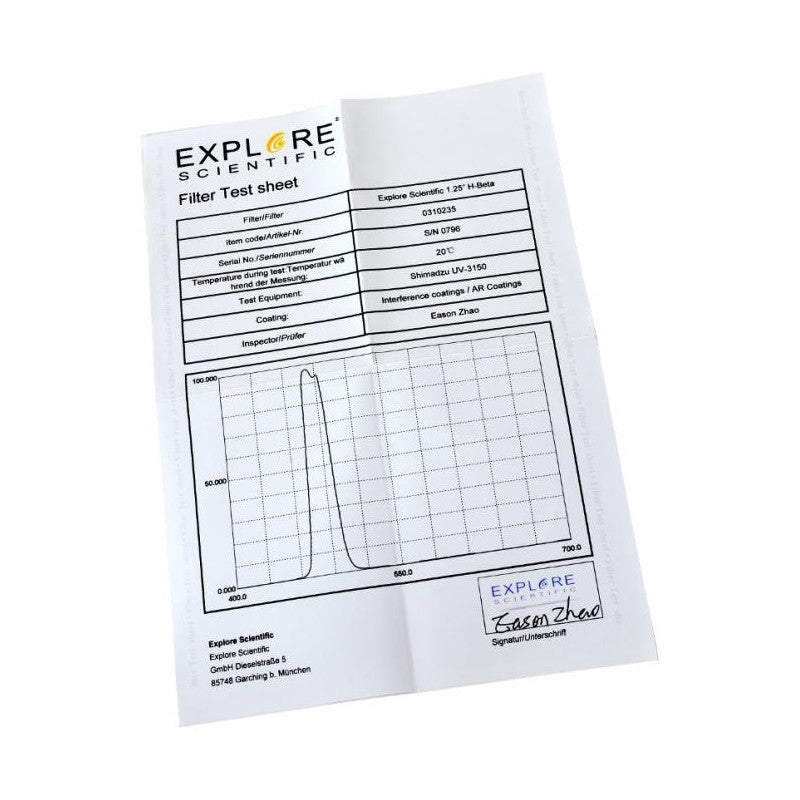
The Explore Scientific H-Beta is a 2.0-inch nebula filter built around a single emission line. Explore Scientific quotes 94.5% transmission across a 478nm to 496nm passband, peaking at 489nm. Everything outside that narrow window is blocked, which includes almost the whole spectrum of artificial lighting.
489nm is where hydrogen-beta sits — the second line of the Balmer series, emitted by ionised hydrogen throughout the interstellar medium. A filter this narrow throws away the sky and keeps the nebula, and the result on the right target is a rise in contrast that no amount of aperture on its own produces.
It is a 2.0-inch filter, so it threads into 2-inch eyepieces, 2-inch diagonals and standard filter wheels.
Who It's For
- Observers working under light-polluted skies on hydrogen-emission nebulae, where blocking everything outside 478–496nm removes most of the sky glow along with it.
- Observers with real aperture: a passband this narrow removes a great deal of light, and the objects it serves are faint to start with. The more aperture behind it, the more it delivers.
- People chasing the classic H-beta targets: the Horsehead and the California Nebula are the two objects most often cited as needing this filter specifically, and both emit strongly at hydrogen-beta.
- Observers who already own an oxygen-III or narrowband filter and want to cover the emission line those do not favour.
- Imagers building a filter set where a discrete hydrogen-beta channel is part of the plan.
Key Features & Design
- 94.5% quoted transmission at the passband — a high figure, which matters enormously when the filter is deliberately discarding most of the incoming light.
- 478nm to 496nm passband, peaking at 489nm: an 18nm window centred on the hydrogen-beta line.
- Blocks essentially everything outside the passband, including mercury, sodium and most LED street lighting, which fall well away from 489nm.
- 2.0-inch format, compatible with 2-inch eyepieces, 2-inch diagonals and standard filter wheels.
- Single-line design: unlike a broadband light-pollution filter that passes several regions, this one isolates a single emission line, which is what produces the contrast gain.
Recommended Uses
- Visual observing of hydrogen-emission nebulae from suburban and light-polluted sites.
- The Horsehead, the California Nebula and other objects traditionally associated with H-beta.
- Adding a discrete hydrogen-beta channel to an existing narrowband filter set.
- Comparative observing, where switching between an oxygen-III and an H-beta filter shows which part of a nebula emits where.
Compatibility and Accessory Notes
- Fits 2-inch eyepieces and 2-inch diagonals, threading into the base of the barrel in the usual way, and it fits standard 2-inch filter wheels.
- Telescopes with 1.25-inch focusers use the 1.25-inch version of the filter rather than this one; we stock both sizes.
- Pairs naturally with a low-power, wide-field eyepiece. Large emission nebulae benefit from field as much as from contrast, so a long-focal-length 2-inch eyepiece is the usual partner.
- Complements rather than replaces an oxygen-III filter. The two isolate different emission lines and favour different objects, which is why many observers carry both.
- Filter stacking is possible mechanically, though combining two narrow filters leaves very little light through. One at a time is how these are normally used.
Good to Know Before You Order
- An H-beta filter is a specialist instrument, not a general improvement. On star clusters, galaxies, the Moon and the planets it simply dims the view, because those objects emit across the spectrum rather than at 489nm. It earns its place on a specific and short list of targets.
- It works best behind aperture. An 18nm passband discards most of the light reaching the telescope, so the same filter that transforms the view in a large instrument may show very little in a small one. Tell us your aperture and we will give you a straight answer about what to expect.
- The view goes dark and monochrome. That is the filter doing exactly what it is designed to do, and letting your eyes readapt for a few minutes after fitting it is part of using it well.
- Explore Scientific publishes no specification table for this filter. Substrate, thickness, thread pitch and coating count are absent from the table below rather than estimated. If a physical dimension matters for your filter wheel or drawer, ask and we will measure the item we hold in stock.
- It is a 2.0-inch filter. A telescope with a 1.25-inch focuser takes the smaller version instead, which we also carry.
Frequently Asked Questions
Is it difficult to set up?
No — it threads onto the base of a 2-inch eyepiece barrel or into a 2-inch diagonal or filter wheel, and that is the whole of the installation. There is nothing to align or adjust, and it takes about fifteen seconds in the dark once you have done it once.
What does it actually do?
It passes light between 478nm and 496nm, peaking at 489nm, and blocks the rest. Because hydrogen-beta emission falls inside that window and street lighting does not, the nebula stays and the sky glow largely goes.
Which objects is it for?
Nebulae that emit strongly at hydrogen-beta. The Horsehead and the California Nebula are the two most commonly named, and it is worth trying on other emission nebulae to see how they respond.
Is it the same as an oxygen-III or a light-pollution filter?
No. An oxygen-III filter isolates a different pair of lines and suits a different set of objects; a broadband light-pollution filter passes much more of the spectrum and gives a gentler effect on a wider range of targets. The H-beta is the narrowest and most specialised of the three.
Will it help with galaxies?
Galaxies emit across the whole spectrum, so a filter that blocks all but 18nm of it dims them. A broadband light-pollution filter is the more useful tool there, and we stock those.
Can I use it for imaging?
Yes — a 2-inch H-beta filter fits standard filter wheels, and the narrow passband works the same way for a sensor as for an eye. Exposures run longer, which is the expected cost of a narrow bandpass.
Bottom Line
In short: a 2.0-inch hydrogen-beta filter passing 478nm to 496nm at a quoted 94.5% transmission, peaking at 489nm — a narrow, specialised filter that lifts a short list of emission nebulae out of a bright sky. If you would like help deciding whether an H-beta, an oxygen-III or a broadband filter suits the objects and the aperture you work with, tell us what you observe and we will give you our honest recommendation.
| Item Number | 310230 |
|---|---|
| Filter Type | H-Beta nebula filter |
| Size | 2.0-inch |
| Passband | 478nm to 496nm |
| Peak Wavelength | 489nm |
| Transmission | 94.5% |
| Compatibility | 2-inch eyepieces, 2-inch diagonals and standard filter wheels |
| Substrate | Not published by vendor |
| Thread Pitch | Not published by vendor |
| Thickness | Not published by vendor |
| Weight | Not published by vendor |
You may also like
Recently viewed
Recent Blog Posts
View all
Your Guide Graph Is Lying to You
Read More

D-Size vs V-Size: A Complete Guide to Telescope Dovetail Systems
Read More

What Is Back Focus in Astrophotography? Telescope Reducers, Flatteners, and Spacing Explained
Read More