


- Description
- Specifications
Product Overview
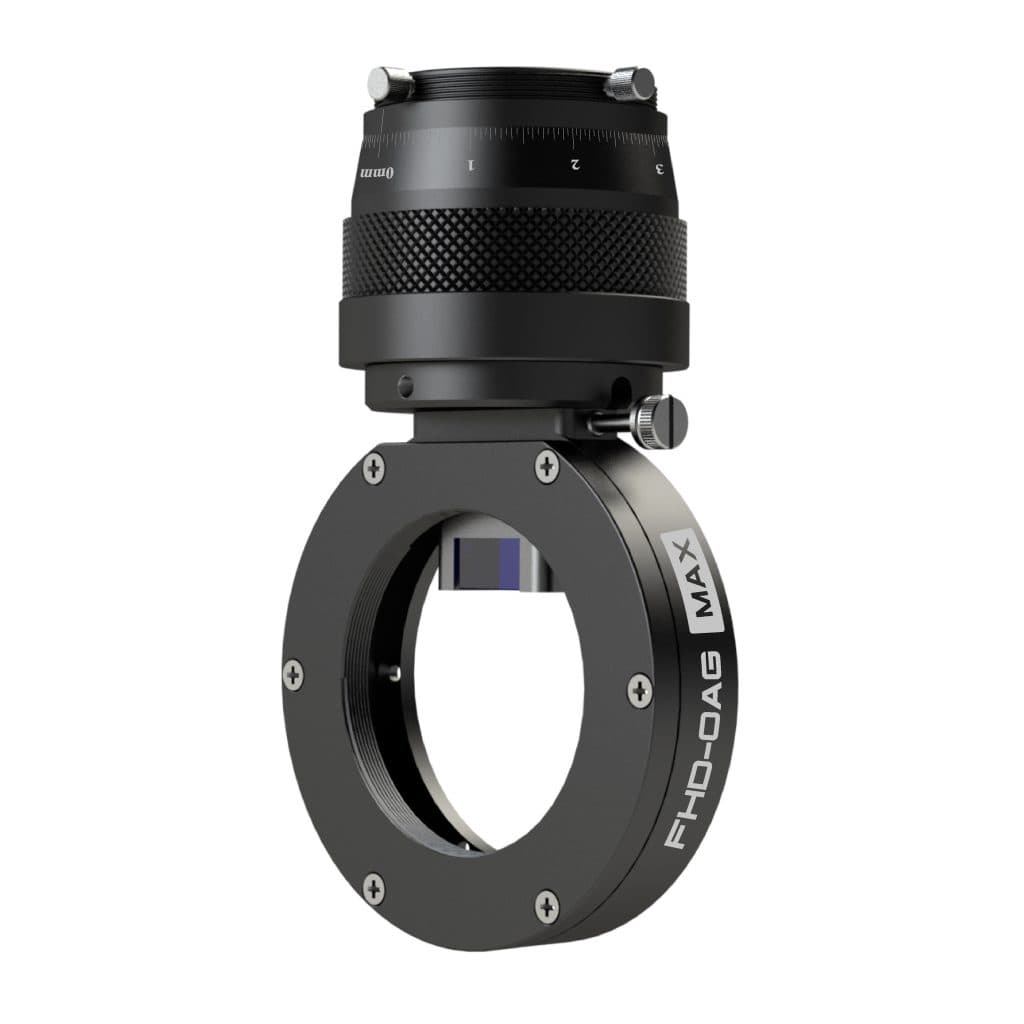
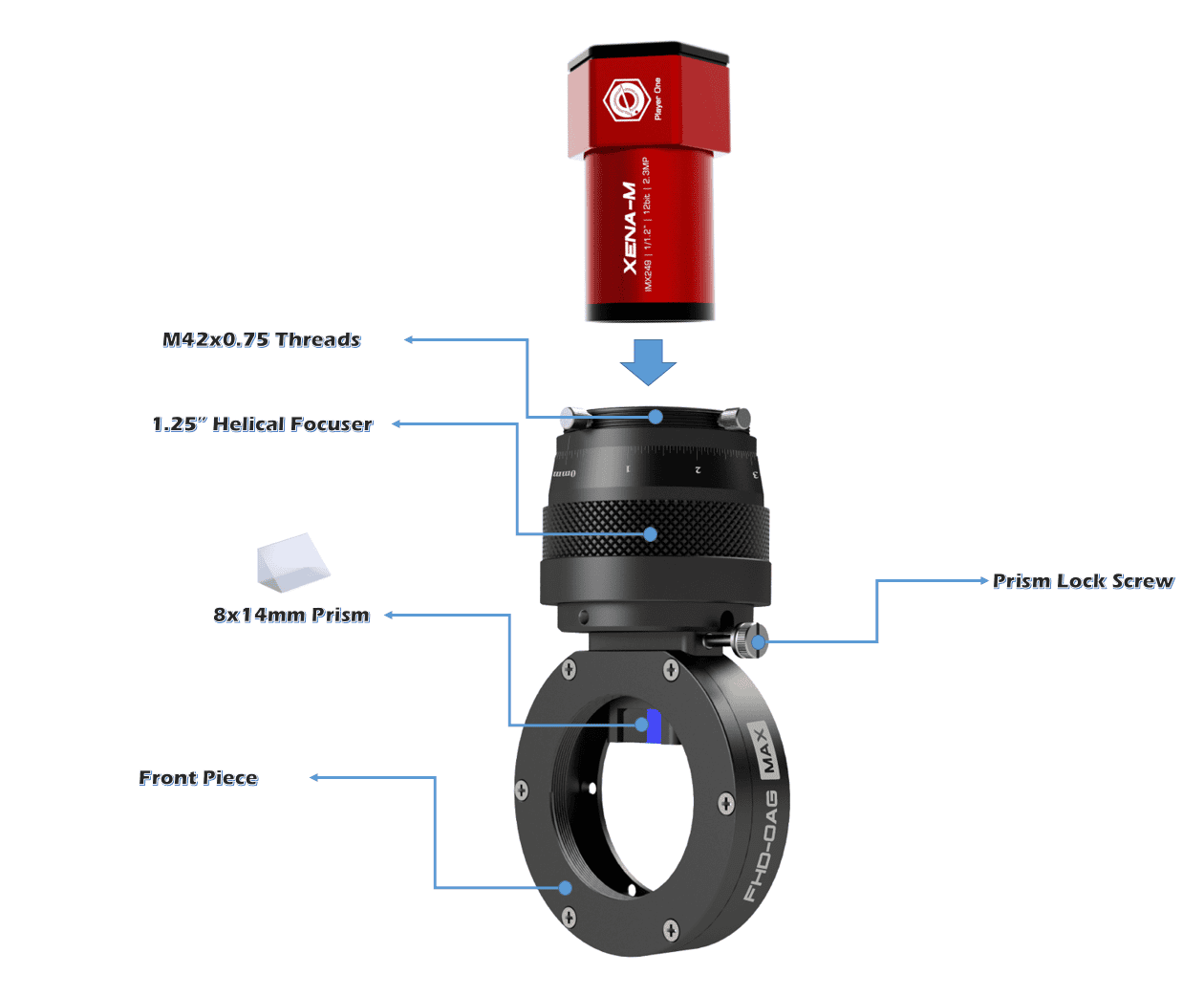
The Player One FHD-OAG MAX is an off-axis guider that places a pickoff prism into your imaging train so a guide camera sees the same light as your main sensor, the most reliable way to guide long deep-sky exposures without flexure between separate scopes. Its larger prism makes it easier to land a usable guide star, and the low-profile aluminum body keeps added spacing to a minimum.
Who It's For
This OAG is for deep-sky imagers using Player One's larger cameras who want tight, flexure-free guiding on longer focal-length instruments where a separate guide scope would drift relative to the main optics.
Key Features & Design
- Large 8 × 14 mm prism: the near 16:9 prism footprint sweeps more sky for guide stars, so you spend less time hunting for something to lock onto.
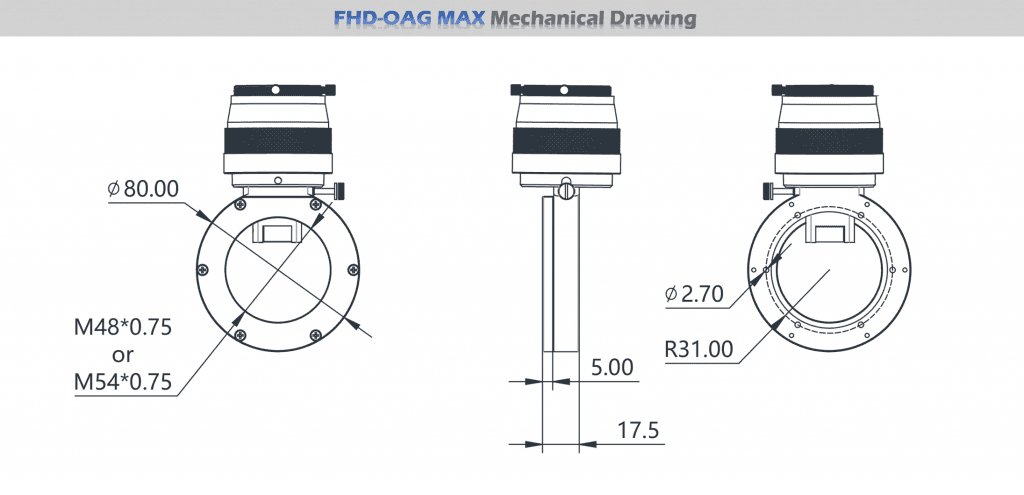
- Low 17.5 mm extension: the guider adds only 17.5 mm of optical length, leaving more of your backfocus budget for filters and spacers.
- Aluminum 6061-T6 body: aircraft-grade aluminum keeps the unit stiff and light so the prism holds its position under load.
Optical & Mechanical Design
The pickoff prism stands 8 mm tall and measures 8 × 14 mm in a wide, near-16:9 orientation. That shape matters: a wider prism scans a larger patch of the field just outside your sensor, which raises the odds of finding a bright guide star without rotating the guider. Because the whole assembly adds only 17.5 mm of optical length, it fits into imaging trains where backfocus is tight.
Recommended Uses
Use the FHD-OAG MAX for long-exposure deep-sky astrophotography, especially at longer focal lengths where off-axis guiding outperforms a separate guide scope by eliminating differential flexure.
Compatibility & Accessory Notes
- Camera compatibility: Player One lists the MAX as supporting its Poseidon, Zeus, and Artemis series cameras.
- Filters and spacing: the low 17.5 mm profile helps you stay within backfocus when combining the OAG with a filter drawer or wheel.
Good to Know Before You Order
- Player One does not publish the guider's thread standard, exact backfocus, or weight; if you need to confirm it fits a specific imaging train, contact us and we will help you check spacing.
- You supply your own guide camera; the OAG provides the prism and pickoff, not the sensor.
FAQ
Is it difficult to set up? It is straightforward for anyone comfortable assembling an imaging train: you thread the OAG into your train, position your guide camera at the prism's focus, and match it to your main camera's focus.
Why choose an OAG over a guide scope? An off-axis guider shares your main optics, so there is no flexure between a separate guide scope and the imaging scope, a real advantage at long focal lengths.
Which cameras does it fit? Player One lists support for its Poseidon, Zeus, and Artemis series.
Bottom Line
The FHD-OAG MAX pairs a generous 8 × 14 mm prism with just 17.5 mm of added length, making flexure-free guiding easier to achieve on demanding long-focal-length rigs.
| Prism | 8 × 14 mm (near 16:9 orientation) |
|---|---|
| Prism height | 8 mm |
| Extension length | 17.5 mm |
| Material | Aluminum 6061-T6 |
| Compatible cameras | Poseidon, Zeus, Artemis series |
You may also like
Recently viewed
Recent Blog Posts
View all
Your Guide Graph Is Lying to You
Read More
D-Size vs V-Size: A Complete Guide to Telescope Dovetail Systems
Read More
What Is Back Focus in Astrophotography? Telescope Reducers, Flatteners, and Spacing Explained
Read More