


- Description
- Specifications
Product Overview
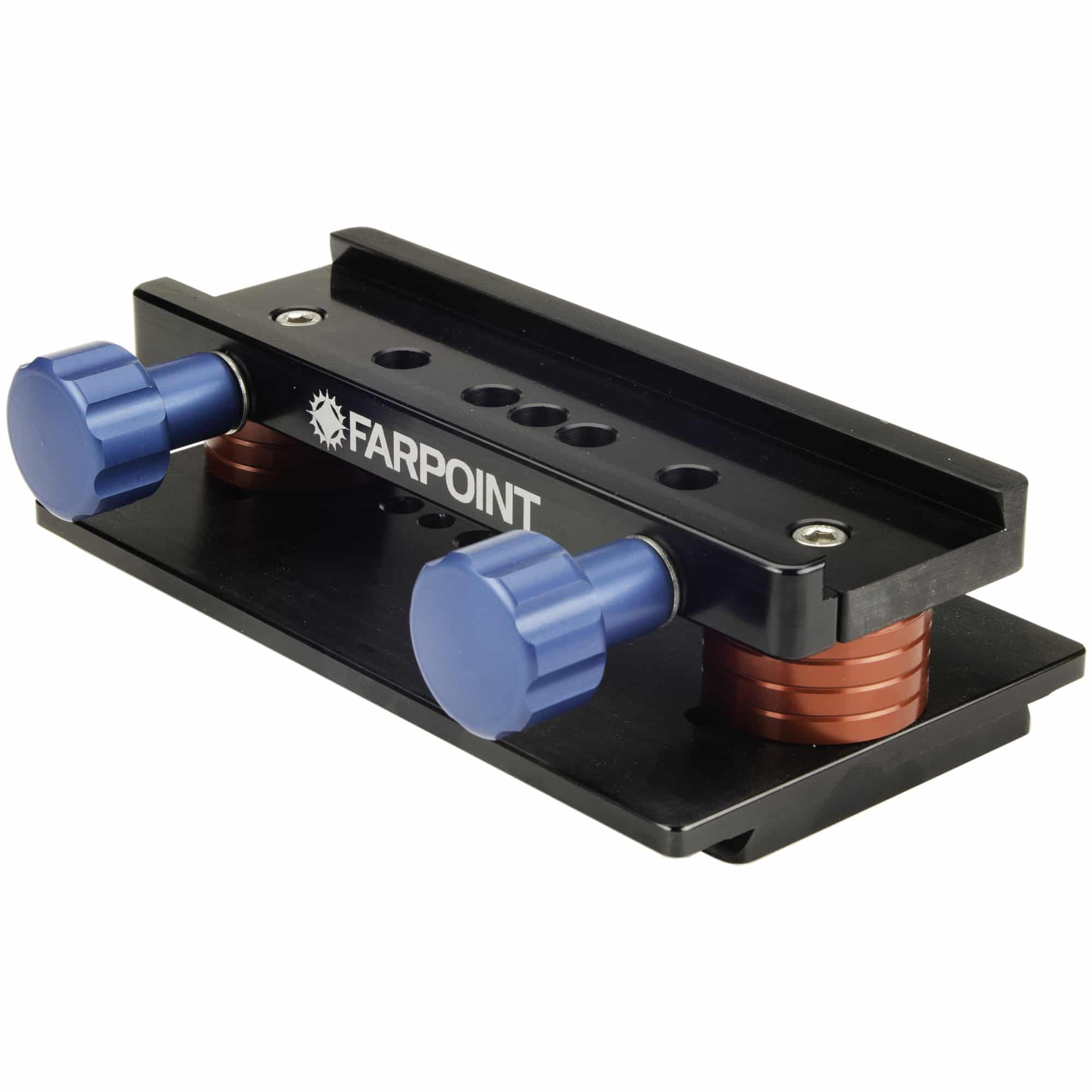
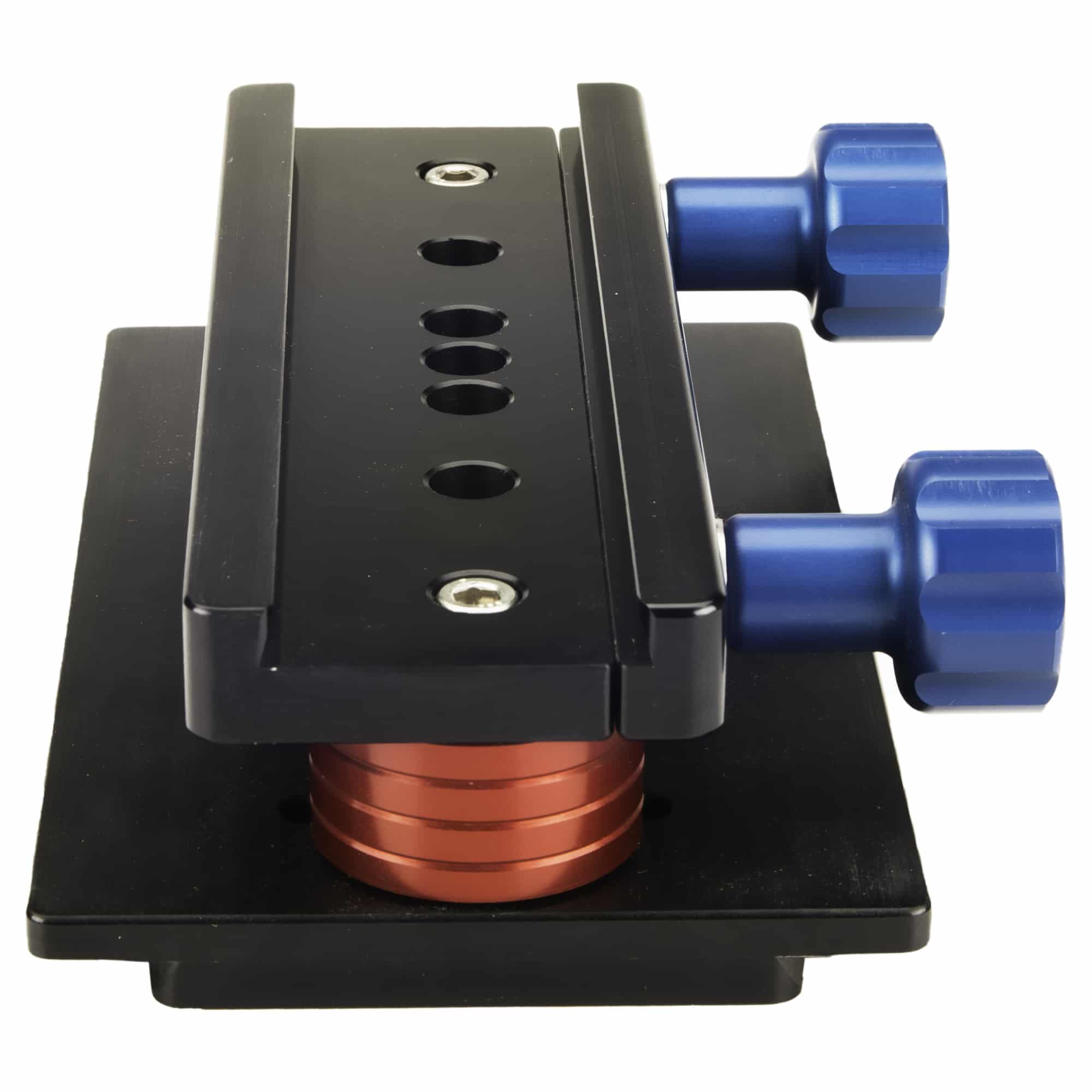
The Farpoint V-to-D Dovetail Adapter Saddle bridges the two common telescope dovetail standards in one direction: a telescope carrying a V-size (Vixen-style) bar rides on a mount whose saddle is D-size (Losmandy-style). The underside is cut as a D dovetail and drops into the mount’s saddle; the top side is a V saddle that clamps the telescope’s existing bar. Spacer pucks are included. It is machined from aluminum with a black anodized finish, CNC-machined in the United States, and weighs 2.625 lb.
Who It’s For
This is a good match if you…
- have moved to a heavier mount with a D-size saddle while your refractor or small SCT still carries a Vixen bar.
- want the same telescope to go on both a D-size mount at home and a V-size mount when travelling.
- would rather not re-bar or re-drill a tube that is already set up and balanced.
- need a little extra height at the saddle to reach the mount’s clamping knobs.
Key Features & Design
- One-piece two-standard body: a D-size dovetail foot below and a V-size clamping saddle above, in a single machined part.
- Spacer pucks included: they raise the saddle where a mount’s clamping knobs or motor housings sit close under it.
- Black anodized aluminum: takes handling wear and keeps reflections down near the mount head.
- CNC-machined in the United States: both dovetail profiles are machined rather than fettled to fit.
- 2.625 lb: the figure to add to the payload when budgeting the mount’s capacity.
Mechanical Design
The two dovetail standards differ mainly in width, so the interesting part of any adapter is what happens to the load path between them. Here the D foot spans the full width of the host saddle, which is where the stiffness comes from, and the V clamp sits centred above it so the telescope’s load runs straight down through the body rather than out along a cantilever. That matters at the eyepiece: a tall or narrow adapter is a spring in the middle of the rig, and vibration introduced anywhere above the mount takes longer to damp. The spacer pucks address a separate, practical problem. On several mounts the D saddle’s clamping knobs sit close under whatever is clamped, and once a V adapter is in place there is little room for fingers. Adding the pucks lifts the assembly enough to work the knobs, at the cost of a small increase in the moment arm — which is why they are supplied loose rather than built in, and left off where the clearance is already there.
Recommended Uses
- Putting a Vixen-barred refractor on a Losmandy-saddle equatorial mount.
- Running a small SCT on a heavy mount without changing the tube’s existing dovetail.
- Keeping one telescope usable across a portable V-size mount and a permanent D-size one.
- Carrying a V-barred guide scope or camera assembly on a D-size side plate.
Compatibility and Accessory Notes
- Direction of conversion: V bar onto a D mount. The reverse case — a D-barred telescope on a V-size mount — is served by the D-to-V adapter assembly instead.
- Mount side: any saddle cut to the D-size (Losmandy-style) standard.
- Telescope side: any V-size (Vixen-style) dovetail bar.
- Spacer pucks: supplied in the box, fitted where the mount’s knob clearance calls for the extra height and left off where it does not.
- Material: black anodized aluminum, CNC-machined in the United States.
Tell us your scope and mount and we’ll confirm the fit.
Good to Know Before You Order
- It converts one way. This puts a V-bar telescope on a D-size mount; the opposite conversion is a different part.
- It adds height. Any adapter raises the telescope above the saddle, which lengthens the moment arm slightly and moves the balance point; the pucks add a little more where they are used.
- It counts against the payload. Its own 2.625 lb sits between the mount and the telescope.
- The telescope keeps its own bar. A V-size dovetail on the tube is what this clamps; the adapter does not supply one.
- A native D bar is the stiffer route. Where a tube can be re-barred to D-size, that removes a joint from the stack; the adapter exists for the cases where re-barring is not wanted.
Frequently Asked Questions
Is it difficult to install?
It goes on in about a minute with no tools. The adapter drops into the mount’s D saddle and clamps like any D-size bar, and the telescope’s V bar then slides into the saddle on top. Fitting the spacer pucks adds a few screws.
Which direction does it convert?
It puts a telescope with a V-size (Vixen-style) bar onto a D-size (Losmandy-style) mount. It clamps into the mount’s D saddle and grips the telescope’s V bar on top. The opposite conversion is the D-to-V adapter assembly.
Why run a V-bar scope on a D-size mount?
It is the common upgrade path. The mount moves up to a heavy-duty head with a D-size saddle while the refractor or small SCT still carries its Vixen bar. This bridges the gap with no re-barring and no drilling, and the telescope still drops onto smaller V-size mounts when it travels.
What are the spacer pucks for?
They raise the saddle for extra clearance, which makes the mount’s clamping knobs easier to reach in some configurations. They are used where the height is wanted and left off where it is not.
Does it change where the telescope balances?
Slightly. The telescope sits a little higher than it would on a native D bar, so the counterweight and fore-and-aft positions are worth re-setting after the first fit.
Bottom Line
In short: a 2.625 lb machined adapter that lets a Vixen-barred telescope ride a Losmandy-saddle mount, with spacer pucks in the box for the mounts where knob clearance is tight.
| Function | Mounts V-size (Vixen-style) dovetail bars on D-size (Losmandy-style) mounts |
|---|---|
| Clamps | V-size (Vixen-style) dovetail bars |
| Mounts to | D-size (Losmandy-style) saddles |
| Includes | Spacer pucks |
| Material | Black anodized aluminum |
| Construction | CNC-machined in the USA |
| Weight | 2.625 lb |
| Country of origin | United States |
You may also like
Recently viewed
Recent Blog Posts
View all
Your Guide Graph Is Lying to You
Read More

D-Size vs V-Size: A Complete Guide to Telescope Dovetail Systems
Read More

What Is Back Focus in Astrophotography? Telescope Reducers, Flatteners, and Spacing Explained
Read More