
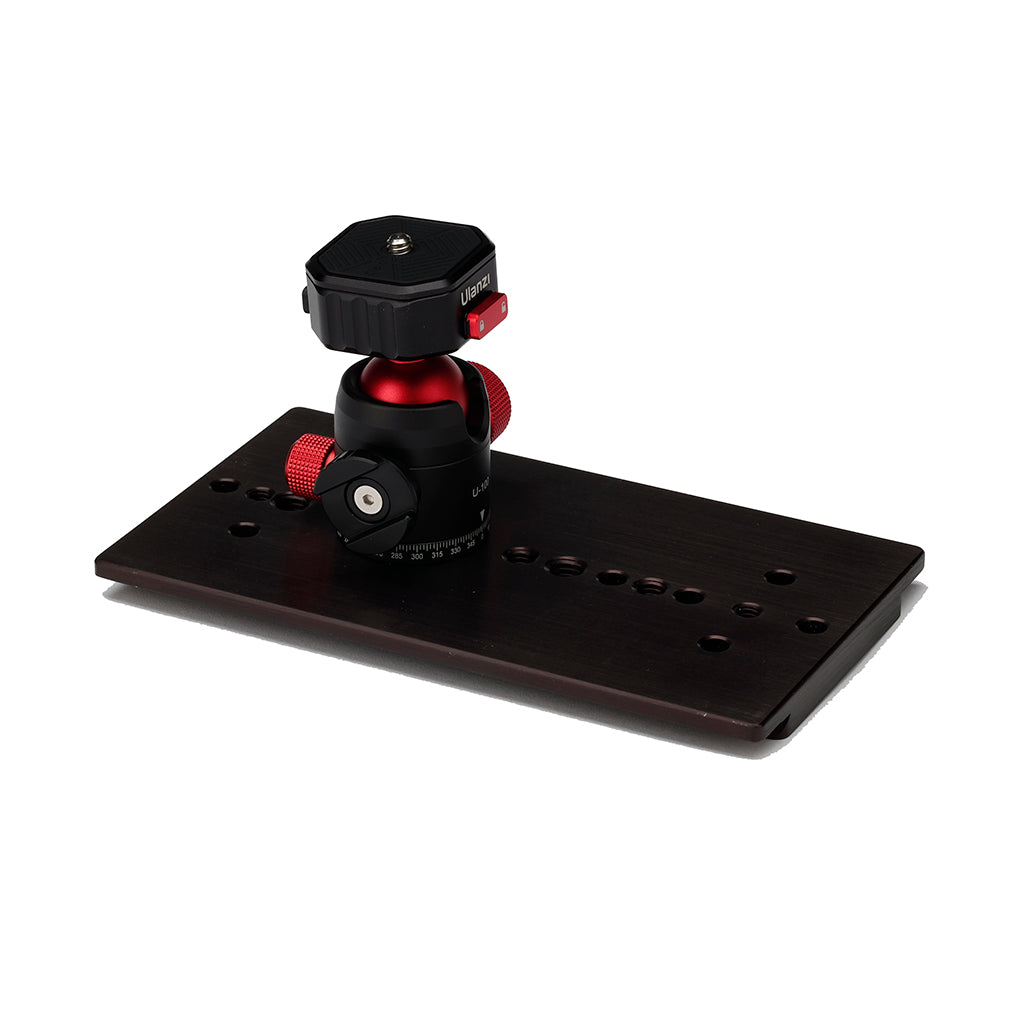
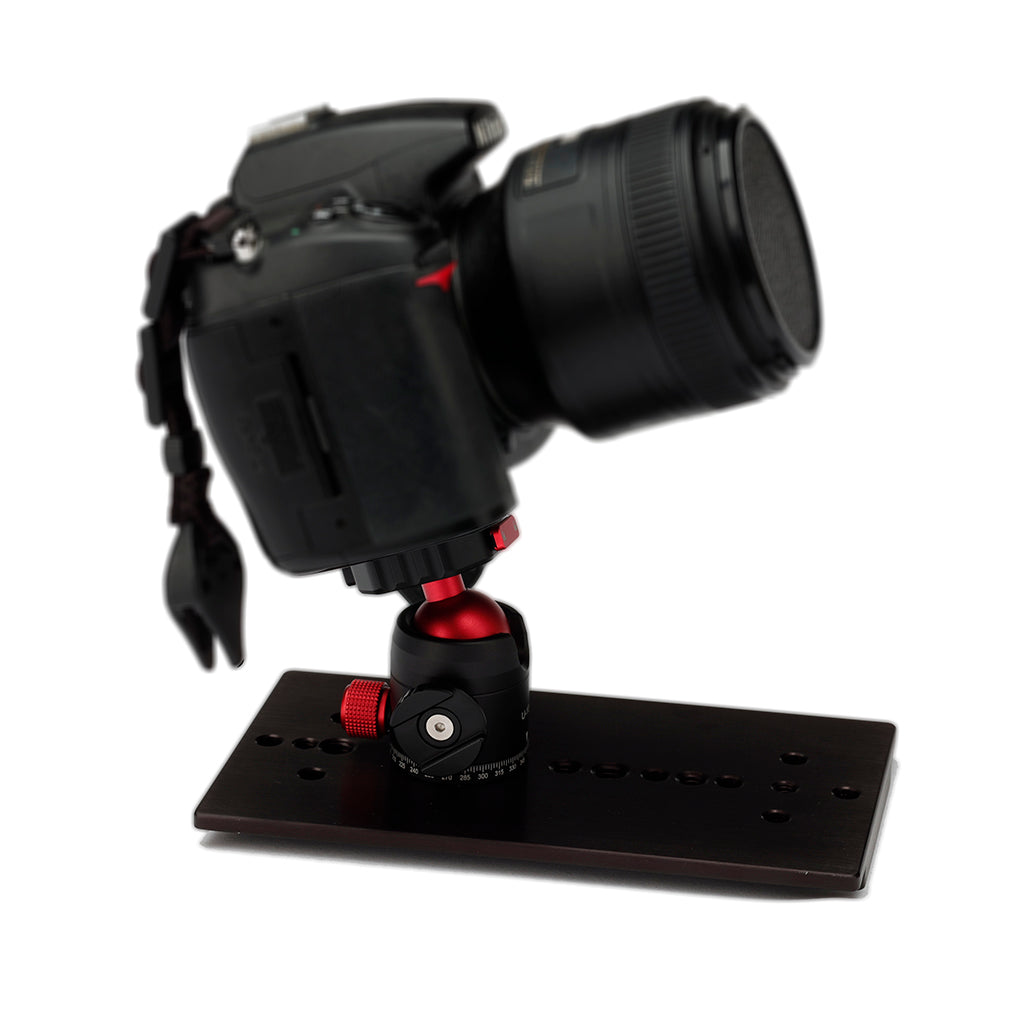


- Description
- Specifications
Product Overview
The Farpoint FDUPSBHCM puts a camera on a tracking mount without a telescope in the path. It attaches to a Farpoint FDUPS D-size (Losmandy-compatible) dovetail and carries a DSLR on a ball head, so the camera can be aimed at any part of the sky while the mount tracks on its own axis. Made in the USA, it ships at 2 lb.
Who It's For
This is a good match if you shoot wide-field astrophotography — Milky Way arcs, constellation fields, large nebulae with a camera lens — and want the mount's tracking without framing being dictated by where the polar axis points. It also suits a rig where the main telescope is already on the saddle and a second camera needs somewhere to ride, or a night where a camera and lens is the whole payload.
Key Features & Design
- Ball head mount: the camera pivots freely and locks at any attitude, independent of the mount's axis orientation.
- FDUPS dovetail interface: designed for the Farpoint FDUPS D-size bar, which itself drops into any D-size saddle.
- Tracking-mount workflow: compose, lock the ball, and let the equatorial mount carry the exposure.
- Recomposition without disturbing the mount: the ball releases and re-locks while the mount stays polar aligned and tracking.
- Made in the USA: built alongside the rest of the Farpoint dovetail hardware.
Mechanical Design
A camera bolted directly to a dovetail points wherever the dovetail points, which on an equatorial mount means the framing is tied to the declination and hour angle the mount happens to be holding. Placing a ball joint between the two breaks that link: the mount's axis stays where polar alignment put it, and the camera aims independently through the full range of the ball. Locking the ball transfers the camera's load back into the dovetail as a rigid assembly, so during the exposure the camera and the bar move as one piece and the tracking correction applies cleanly to the sensor.
Recommended Uses
- Tracked wide-field exposures with a camera lens rather than a telescope.
- Milky Way and constellation framing where composition matters more than pointing accuracy.
- Carrying a second camera alongside a telescope already mounted on a D-size saddle.
- Time-lapse and star-trail sequences taken on a mount that is already polar aligned.
- Travel setups where a mount head, a dovetail and a camera are the entire kit.
Compatibility and Accessory Notes
The adapter is designed to mount on the Farpoint FDUPS D-size (Losmandy-compatible) dovetail. That bar, in turn, rides in any saddle cut for the D-size profile — the wider of the two common dovetail standards, also called Losmandy-style. A mount fitted only with a narrow V-size (Vixen-style) saddle takes a D-size saddle or a V-to-D adapter saddle first. The camera attaches through the ball head; the camera body and lens are separate. If you'd like the interface checked against the dovetail and camera you already own, we're glad to look at it before you order.
Good to Know Before You Order
- The dovetail is separate. This is the ball head adapter; the FDUPS D-size bar it mounts to is its own item.
- D-size interface. The assembly is built around the wide Losmandy-style profile rather than the narrow V-size one.
- Payload is a camera. The ball head is sized for a DSLR and lens, not for an optical tube.
- Tracking still depends on alignment. The ball sets framing; exposure length on a given lens follows from how well the mount is polar aligned and how well it tracks.
- Shipping weight. 2 lb, which counts toward the mount's total payload alongside the camera and lens.
Frequently Asked Questions
What is this for?
Wide-field astrophotography without a telescope. The adapter rides on an FDUPS D-size dovetail in the mount's saddle, the ball head holds the camera, and the mount tracks the sky through the exposure.
Why a ball head instead of a fixed thread?
A fixed thread aims the camera wherever the mount aims. The ball head allows any framing — including composing at an angle — while the mount keeps tracking on its own axis, and it allows recomposition between frames without touching the mount.
Is it difficult to set up?
The adapter goes onto the FDUPS dovetail, the dovetail goes into the saddle, and the camera threads onto the ball head. Framing is then a matter of releasing the ball, aiming, and locking it — a few minutes from case to first exposure once the mount is aligned.
Will it fit my mount?
It works with any mount carrying a D-size saddle, by way of the FDUPS dovetail. Mounts with a small Vixen saddle can take a D-size saddle or adapter saddle to accept it.
Bottom Line
In short: a 2 lb ball head adapter that turns a Farpoint FDUPS D-size dovetail into a free-aiming camera platform, so an equatorial mount can track any framing you choose.
| Mounts to | Farpoint FDUPS D-size (Losmandy-compatible) dovetail |
|---|---|
| Camera attachment | Ball head camera mount |
| Dovetail standard | D-size (Losmandy-style) |
| Use | Long-exposure DSLR photography on an equatorial tracking mount |
| Construction | Made in the USA |
| Weight | 2 lb |
| Country of origin | United States |
You may also like
Recently viewed
Recent Blog Posts
View all
Your Guide Graph Is Lying to You
Read More

D-Size vs V-Size: A Complete Guide to Telescope Dovetail Systems
Read More

What Is Back Focus in Astrophotography? Telescope Reducers, Flatteners, and Spacing Explained
Read More