
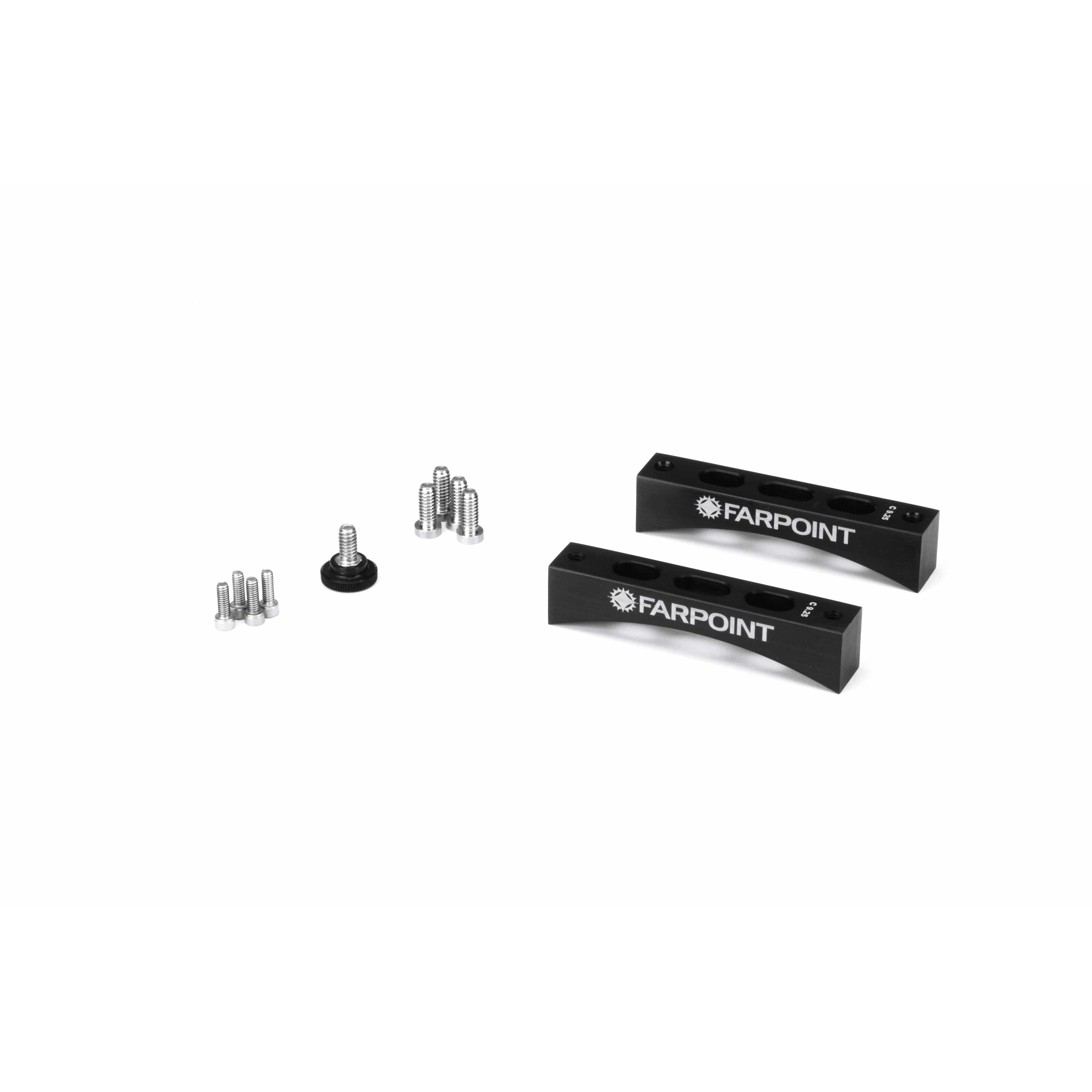

- Description
- Specifications
Product Overview
The Farpoint FDC9.25R is a set of dovetail radius blocks machined to match the Celestron 9.25″ SCT optical tube. The blocks sit between a D-size (Losmandy-style) dovetail bar and the round tube, so a bar you already own can be moved onto the 9.25″ SCT rather than buying a second complete kit. They are CNC-machined in the USA from aluminum with a black anodized finish and weigh 0.688 lb.
Who It's For
This is a good match if you…
- already own a D-size (Losmandy-style) dovetail bar and want to move it onto a Celestron 9.25″ SCT.
- are changing tubes and need the tube-side interface rather than a whole new bar and screw set.
- keep one bar in the mount saddle and swap optical tubes onto it.
- are replacing radius blocks that came off an older mounting setup.
Key Features & Design
- Machined to the Celestron 9.25″ SCT: the block radius is cut to that tube's curve, and it fits that tube only.
- Works with your existing bar: the blocks are the tube-side half of the interface; the D-size bar is supplied by you.
- Black anodized aluminum: machined from aluminum stock with an anodized surface finish.
- CNC-machined in the USA: cut at Farpoint's own shop.
- 0.688 lb: a small addition to the tube-side mass.
Mechanical Design
A dovetail bar has a flat mounting face and a telescope tube is round, so bolting one directly to the other concentrates the clamping load at the bolt holes. A radius block bridges that gap: its underside is machined to the tube's own curve and its top face is flat where the bar lands. With the curve matched, the clamping force spreads across the whole contact area instead of loading a few points, which is what keeps the bar seated square to the tube and the assembly rigid under the mount's slewing and tracking loads. Because the fit depends on that curve, each block set is cut for one specific tube diameter — this set for the Celestron 9.25″ SCT.
Recommended Uses
- Transferring a D-size bar from one telescope to a Celestron 9.25″ SCT.
- Setting up a shared bar that two different optical tubes can each carry.
- Rebuilding a mounting assembly where the original blocks have gone missing.
- Adding a second dovetail position along a 9.25″ tube for balance adjustment.
Compatibility and Accessory Notes
These blocks are cut for the Celestron 9.25″ SCT optical tube and that tube alone; a different SCT aperture has a different tube diameter and takes the block set machined for it. On the bar side they pair with D-size hardware — the Losmandy-style standard, the wider of the two common dovetail profiles. Farpoint also sells the complete Celestron 9.25″ SCT kit, which supplies the bar, the blocks, and the mounting screws together, for setups starting without a bar. Send us your telescope model and serial and we will check which block set matches your tube.
Good to Know Before You Order
- This item is the blocks only. The dovetail bar is not included; it is the one you already own.
- Tube-specific fit. The radius is machined for the Celestron 9.25″ SCT, so it matches that tube diameter and not other apertures.
- Mounting screws follow the bar. Screw length depends on the bar and block stack, so the hardware from your existing kit is what carries over.
- The complete kit is the alternative. Setups without a D-size bar are covered by the full Celestron 9.25″ kit, which bundles bar, blocks, and screws.
- Shipping weight rounds up. At 0.688 lb the set sits under a pound, and shipping systems round to the next whole pound.
Frequently Asked Questions
What do radius blocks do?
They bridge the gap between a flat dovetail bar and a round optical tube. Each set is machined to the exact curve of a specific tube, so the clamping load spreads across the contact surface instead of concentrating at the bolt holes.
Will these fit my telescope?
They are machined for the Celestron 9.25″ SCT only. A different model or aperture takes the block set matched to its own tube, and we can point you to the right one.
Do I need anything else?
Your existing D-size dovetail bar, which the blocks install between and the optical tube. Setups without a bar are covered by the complete Celestron 9.25″ kit, which includes bar, blocks, and screws.
Is it difficult to install?
Installation is bolting the blocks to the tube's mounting holes and then the bar to the blocks, using hand tools. Nothing on the telescope is modified.
Can I use them with a Vixen bar?
These are made to pair with D-size (Losmandy-style) bars. A V-size Vixen setup on the 9.25″ SCT is covered by Farpoint's Vixen kits for that tube.
Bottom Line
In short: a 0.688 lb set of black anodized radius blocks, CNC-machined in the USA to the Celestron 9.25″ SCT tube curve, that lets a D-size Losmandy dovetail bar you already own carry that telescope.
| Fits telescope | Celestron 9.25″ SCT only |
|---|---|
| Use with | Your existing D-size (Losmandy-style) dovetail bar |
| Material | Aluminum, black anodized finish |
| Construction | CNC-machined in the USA |
| Weight | 0.688 lb |
| Country of origin | United States |
You may also like
Recently viewed
Recent Blog Posts
View all
Your Guide Graph Is Lying to You
Read More

D-Size vs V-Size: A Complete Guide to Telescope Dovetail Systems
Read More

What Is Back Focus in Astrophotography? Telescope Reducers, Flatteners, and Spacing Explained
Read More