
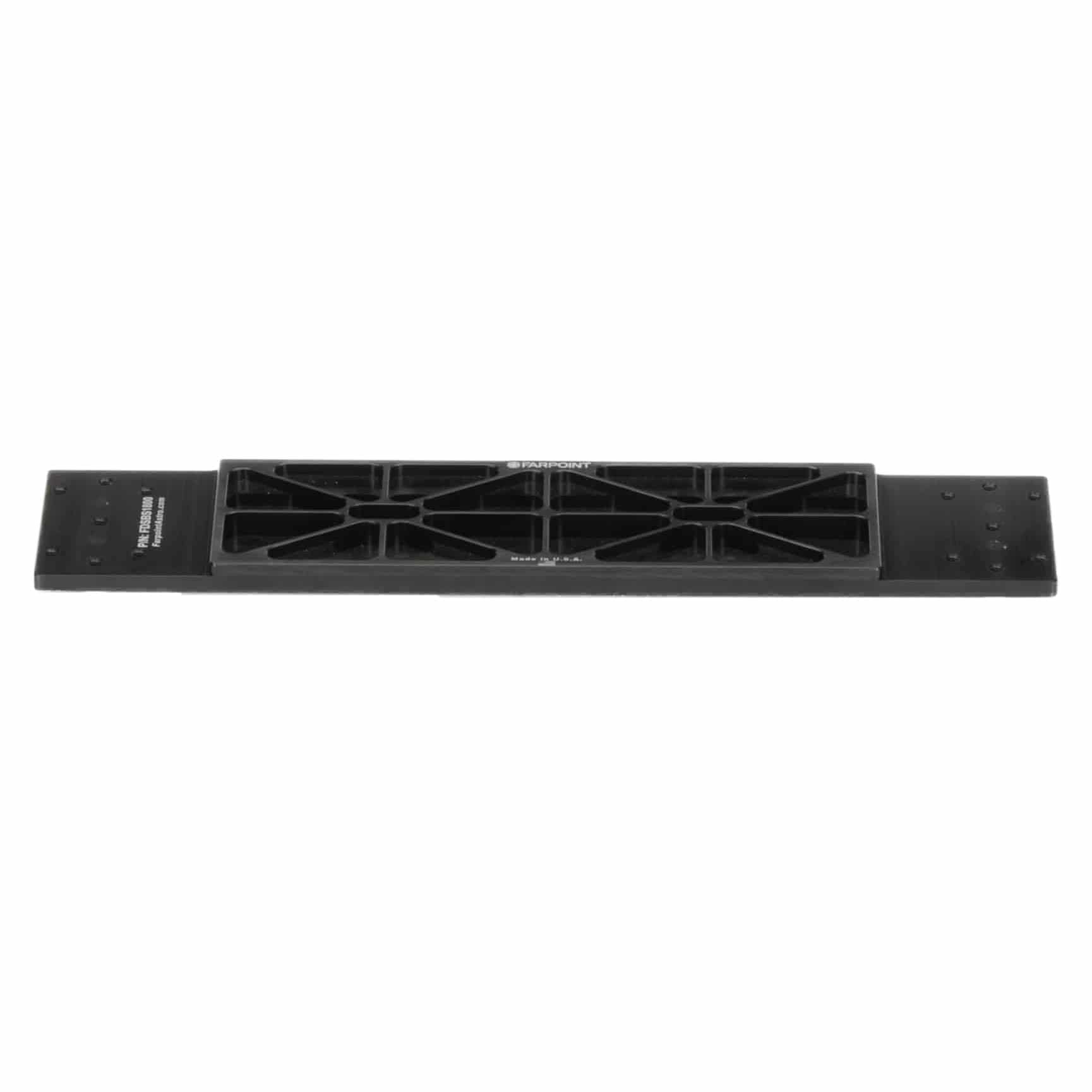

- Description
- Specifications
Product Overview
The Farpoint FDSBS2200 is a 22″ side-by-side tandem connecting bar, the longest in the Farpoint tandem line. It clamps into a D-size-compatible mount saddle the way an ordinary dovetail bar does, then carries two saddles of its own on top — so two optical tubes ride on one mount head with the widest separation the line offers. The bar is CNC-machined in the USA from aluminum with a black anodized finish, and Farpoint publishes a shipping weight of 4.438 lb.
Who It's For
This is a good match if you want to run two instruments on a single mount and the tubes are large — big dew shields, wide refractors, or a pair of tubes that would foul each other on a shorter bar. It is the length to reach for when the 18″ bar leaves the two tubes closer than you want them.
Key Features & Design
- 22″ working length: the longest bar in the Farpoint tandem line, above the 14″ and 18″.
- Maximum tube separation: the extra span is what lets larger optical tubes and dew shields sit beside each other.
- Takes two saddles: D-size, V-size, or one of each, so the two tubes need not share a dovetail standard.
- Mounts like a dovetail bar: the underside is a D-size profile that clamps into a D-size-compatible mount saddle.
- Black anodized aluminum: an anodized finish over machined aluminum, matching the rest of the Farpoint dovetail line.
- Machined in the USA: CNC-machined by Farpoint.
Mechanical Design
A tandem bar turns one mount saddle into two mounting stations, and everything above it hangs off that single clamped joint. The bar is machined as one continuous piece of aluminum rather than a jointed assembly, and the D-size profile underneath puts the widest available bearing surface into the mount's saddle — which matters more at 22″ than at shorter lengths, because a longer bar places its loads further from the clamped centre. Saddle position along the span is what sets the balance: sliding the two saddles in or out trims the load either side of the mount's axis, and 22″ gives the most travel in the line for balancing two tubes of unequal weight.
Recommended Uses
- Running two large optical tubes side by side where dew shields would otherwise collide.
- Pairing a wide refractor with a second imaging tube on one equatorial mount.
- Carrying an imaging scope and a guide scope with generous clearance for cameras, focusers and cabling.
- Dual-band or dual-focal-length capture on the same target through two instruments at once.
- Adding a second station to an existing D-size mount without changing the mount head.
Compatibility and Accessory Notes
The bar clamps into any mount with a D-size-compatible saddle. The two saddles it carries are sold separately and can be D-size, V-size, or one of each — the choice follows whatever dovetail bar each of your telescopes already carries, so a V-size refractor and a D-size SCT can share the bar. The bar measures 22″, and the usable separation between tubes is that span less the width of the two saddles. Farpoint makes the same bar in 14″ and 18″ lengths for tighter rigs. If you would like a check on whether 22″ clears your two tubes, send us the models and we'll work it through with you.
Good to Know Before You Order
- Saddles are sold separately. This is the connecting bar alone; the two saddles that hold the telescopes are chosen and bought to suit the tubes.
- The mount needs a D-size-compatible saddle. A mount with only a narrower V-size saddle takes a D-size saddle conversion before this bar fits.
- Length carries a leverage cost. At 22″ the two tubes sit further from the mount's axis than on the shorter bars, which asks more of the mount in both payload and stiffness.
- Two tubes double the load. The combined weight of both tubes, saddles and this bar sits on the mount's payload figure.
- Farpoint publishes a shipping weight of 4.438 lb. The bar ships as one carton.
Frequently Asked Questions
Are the saddles included?
No — this is the connecting bar only. It carries two saddles of your choice: D-size, V-size, or one of each, depending on what dovetail bar each telescope carries.
Is it difficult to install?
It goes on the way a dovetail bar does. The tandem bar clamps into the mount's saddle, the two saddles bolt to the top of the bar, and the telescopes drop into those. The fiddly part is balance rather than assembly: the saddles slide along the bar until both axes sit even, and that is done by hand with the clamps loose.
What mount do I need?
A mount with a D-size-compatible saddle. The tandem bar clamps in just like a regular D-size dovetail bar, then carries the two scope saddles on top.
Which length should I choose?
The 22″ bar gives maximum separation for larger tubes and dew shields. For tighter rigs the 18″ adds spacing over the 14″, which suits compact dual setups.
Bottom Line
In short: a 22″ USA-machined tandem bar — the longest Farpoint makes — that converts one D-size mount saddle into two mounting stations with the most room in the line between the two tubes.
| Length | 22″ |
|---|---|
| Carries | Two saddles — D-size, V-size, or one of each (saddles sold separately) |
| Mounts to | A D-size-compatible mount saddle |
| Material | Black anodized aluminum |
| Construction | CNC-machined in the USA |
| Weight | 4.438 lb |
| Country of origin | United States |
You may also like
Recently viewed
Recent Blog Posts
View all
Your Guide Graph Is Lying to You
Read More

D-Size vs V-Size: A Complete Guide to Telescope Dovetail Systems
Read More

What Is Back Focus in Astrophotography? Telescope Reducers, Flatteners, and Spacing Explained
Read More