
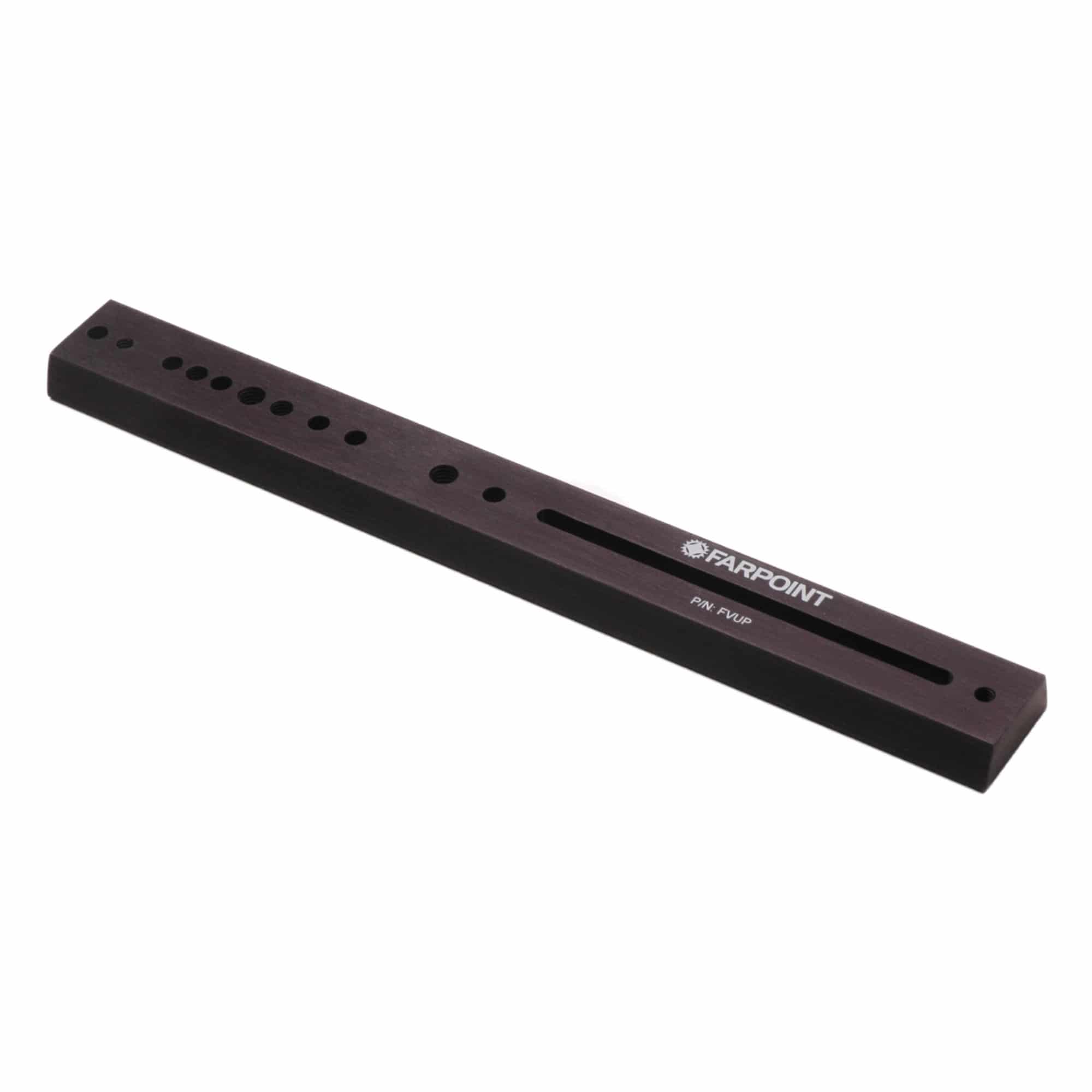

- Description
- Specifications
Product Overview
The Farpoint FVUP is a 14″ V-size (Vixen-style) dovetail bar machined from aluminum with a black anodized finish. It carries a range of mounting hole options rather than a pattern cut for one telescope, so it takes optical tubes, accessories and general-purpose loads. CNC-machined in the USA, with a published weight of 1.25 lb.
Who It's For
This is a good match if you have a longer optical tube or a rig that needs balance range in a Vixen saddle, or if you are building a mounting arrangement from scratch and want hole options rather than a fixed pattern.
Key Features & Design
- 14″ length: the longest of Farpoint's universal Vixen bars, giving the most travel for balancing in the saddle.
- Multiple hole options: a variety of mounting holes covers different mounts, accessories and general-purpose jobs, and the published product drawing shows the full layout.
- V-size profile: drops into any Vixen-style saddle.
- Black anodized aluminum: sturdy aluminum with an anodized finish.
- Published weight: 1.25 lb, CNC-machined in the USA.
Recommended Uses
- Mounting a long refractor or similar tube where balance range matters.
- Carrying accessories — guide scopes, cameras, counterweight hardware — along a single bar.
- Replacing a short bar that runs out of travel at one end of the saddle.
- General-purpose mounting where a fixed hole pattern would not line up.
Compatibility and Accessory Notes
The bar is the V-size (Vixen-style) standard and drops into any Vixen saddle; wider D-size (Losmandy-style) saddles take Farpoint's D-size universal bars instead. Tube rings, mounting feet and accessories bolt through the bar's hole options, and the published product drawing gives the hole pattern and measurements. Farpoint also offers this bar in 7″ and 4″ lengths for compact payloads. If you would like the hole pattern checked against your tube or rings, we can compare the drawing for you.
Good to Know Before You Order
- Bar only. Screws, rings and tube hardware are separate items.
- The hole pattern is generic. The holes cover a range of common spacings rather than matching one telescope's factory pattern, so the drawing is the reference for a given tube.
- The standard is V-size. A Vixen bar does not seat in a Losmandy-only saddle without an adapter.
- Length carries bulk. At 14″ the bar extends past shorter tubes, which is what gives it the balance range.
Frequently Asked Questions
What makes it universal?
Rather than a hole pattern matched to one telescope, the bar carries a variety of mounting hole options, so one bar covers different mounts, accessories and general-purpose mounting jobs. The product drawing shows the full layout.
Which length suits my scope?
The 14″ bar suits longer optical tubes and rigs that need balance range, since more length means more room to slide the assembly in the saddle. The 7″ and 4″ bars cover accessories and compact payloads with less bulk.
Is V-size the same as Vixen?
Yes. V-size is the Vixen-style dovetail, the narrower of the two common standards; the wider one is D-size, or Losmandy-style.
Is it difficult to install?
The bar bolts to the tube or rings through its existing holes and then slides into the saddle. Where the tube's holes line up with the bar's options, no drilling is involved.
Bottom Line
In short: a 1.25 lb, 14″ black anodized Vixen bar with multiple hole options and the most balance travel in Farpoint's universal V-size range.
| Length | 14″ |
|---|---|
| Bar standard | V-size (Vixen-style) |
| Dovetail standard | V-size (Vixen-style) |
| Mounting holes | Variety of hole options for telescope mounts, accessories, and general-purpose uses — see product drawing |
| Material | Aluminum |
| Finish | Black anodized |
| Construction | CNC-machined in the USA |
| Weight | 1.25 lb |
| Country of origin | United States |
You may also like
Recently viewed
Recent Blog Posts
View all
Your Guide Graph Is Lying to You
Read More

D-Size vs V-Size: A Complete Guide to Telescope Dovetail Systems
Read More

What Is Back Focus in Astrophotography? Telescope Reducers, Flatteners, and Spacing Explained
Read More