


- Description
- Specifications
Product Overview
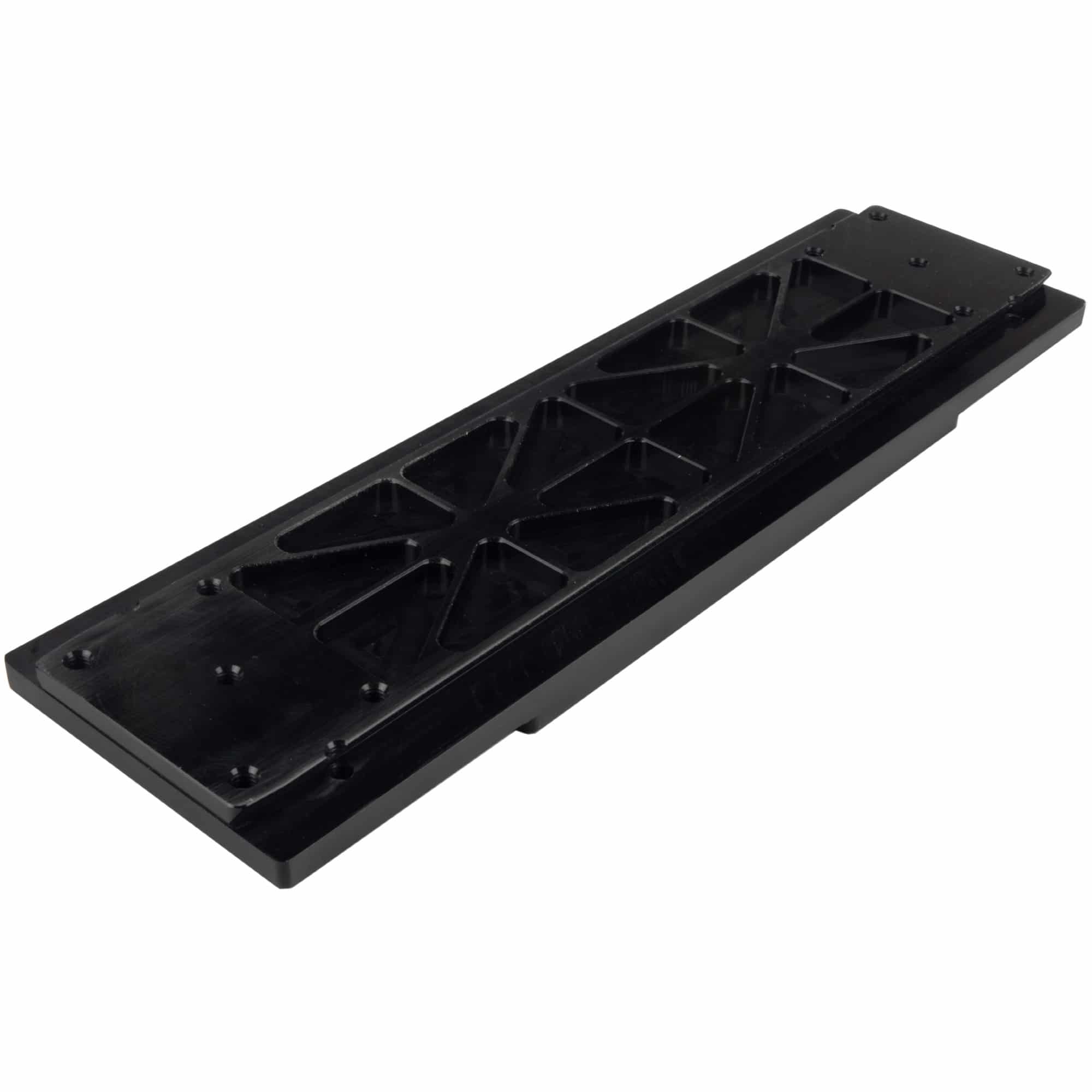
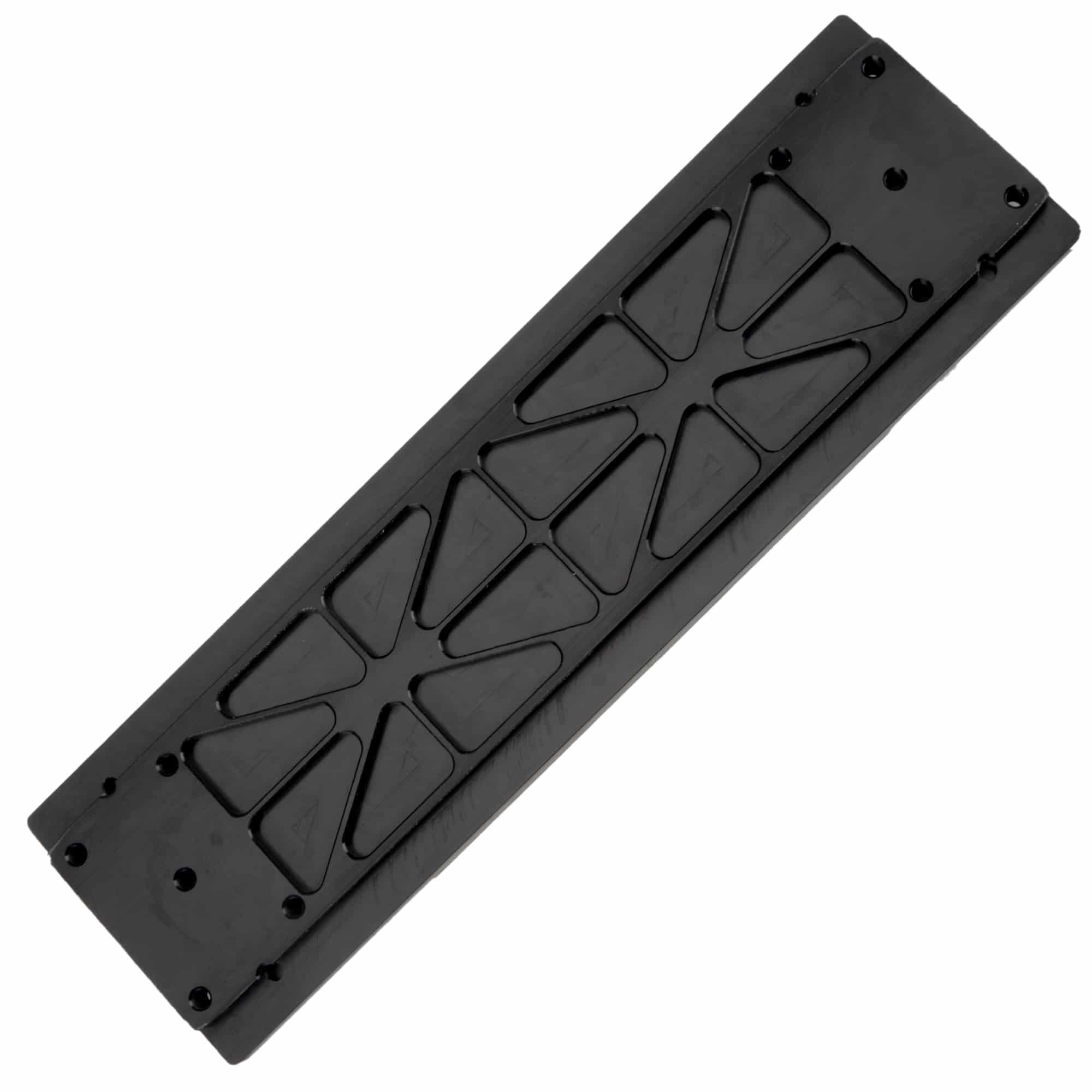
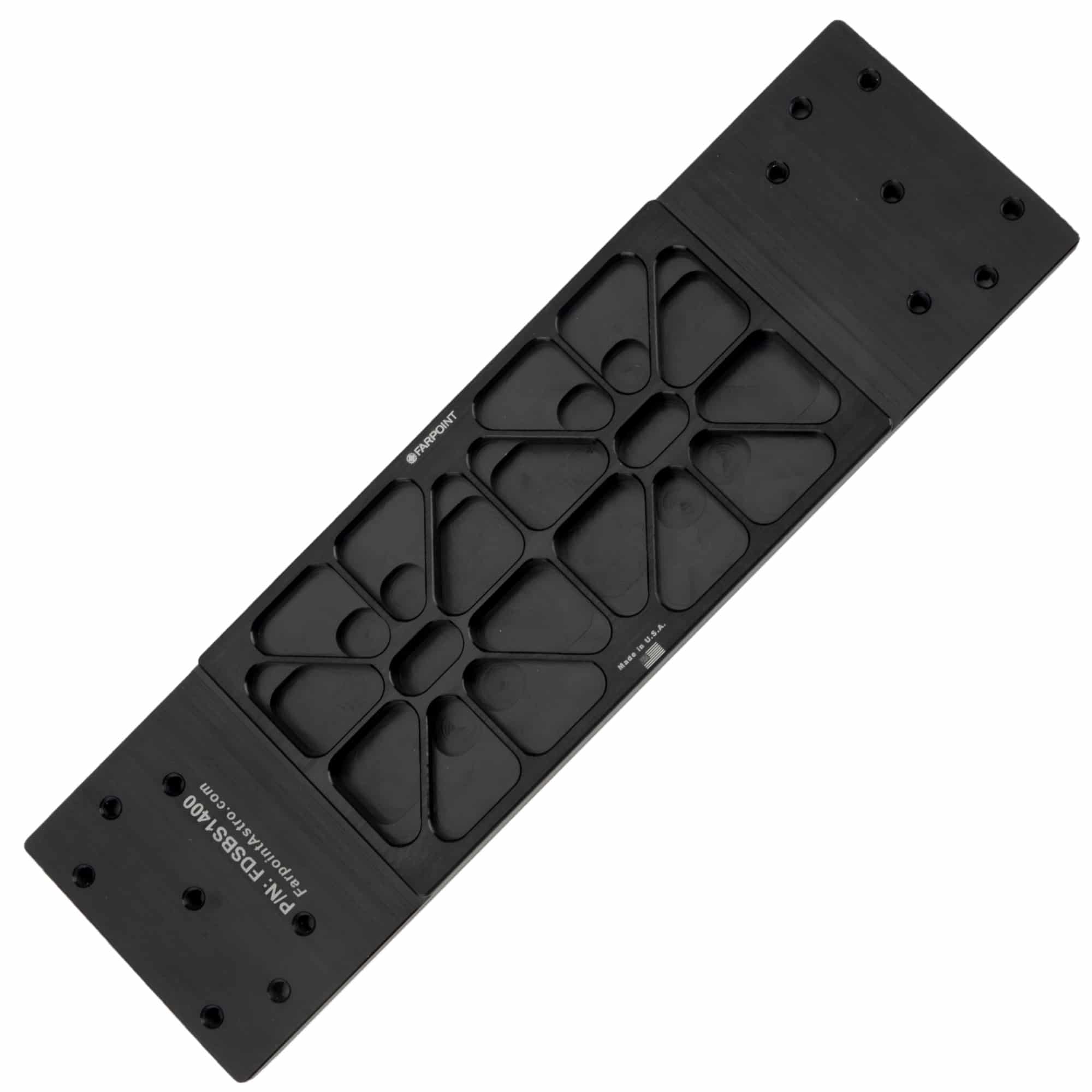
The Farpoint FDSBS1400 is a 14″ connecting bar that puts two telescopes on one mount head. It clamps into a D-size-compatible mount saddle the way a regular D-size dovetail bar does, and carries two saddles of your choice on its upper face — D-size, V-size, or one of each. The bar is machined from aluminum with a black anodized finish, CNC-machined in the USA, at a published weight of 2.688 lb.
Who It's For
This is a good match if you…
- want an imaging scope and a guide scope carried side by side rather than stacked piggyback.
- run two optical tubes on one mount and want each on its own saddle.
- have a mount with a D-size-compatible saddle and spare payload capacity.
- are working with compact tubes where 14″ of separation is enough clearance.
Key Features & Design
- 14″ length: the shortest bar in the Farpoint tandem line, suited to compact dual-scope setups.
- Two saddle positions: the upper face carries two saddles, in D-size, V-size, or a mixed pair.
- D-size clamping foot: the underside seats in a D-size-compatible mount saddle like a standard Losmandy-style bar.
- Black anodized aluminum: a non-reflective finish over machined aluminum.
- Saddles sold separately: the item is the connecting bar itself, which lets the saddle standard be matched to each tube.
- CNC-machined in the USA: produced by Farpoint in the United States.
Mechanical Design
A side-by-side bar changes where the load sits. In a piggyback arrangement the second tube rides above the first, raising the centre of gravity and adding a lever arm the mount has to fight. A tandem bar places both tubes at the same height on either side of the mount's mechanical axis, so their masses can be balanced against each other and the combined centre of gravity stays low and close to the axis. The bar itself is the structural element between them: it clamps into the mount saddle along its underside and presents a flat, drilled upper face where the two scope saddles bolt down. Bar length is the design trade-off — 14″ keeps the pair close in, which is stiffer and easier to balance, while the 18″ and 22″ bars in the same line buy separation for wider tubes and dew shields at the cost of a longer unsupported span.
Recommended Uses
- Running a dedicated imaging refractor and a guide scope as separate tubes on one mount.
- Pairing a wide-field astrograph with a longer focal length tube for the same target.
- Carrying a visual tube and a camera tube together so a session can switch between them.
- Mounting a tube alongside a counterbalancing accessory load at equal height.
- Compact dual-scope travel rigs where overall length matters.
Compatibility and Accessory Notes
The bar's underside is a D-size (Losmandy-style) dovetail, so it goes into any mount with a D-size-compatible saddle. On top it takes two saddles, sold separately — a D-size saddle for a tube carrying a Losmandy-style bar, a V-size saddle for a tube carrying a Vixen-style bar, or one of each for a mixed pair. Farpoint offers the same bar in 18″ and 22″ lengths for setups that want more spacing; the useful measure is the width of both tubes plus the working room between them, since wider tubes and dew shields eat into the 14″ span. Payload is the other half of the picture: the bar, the two saddles, and both tubes all count against the mount's rated capacity. If you would like a second opinion on whether 14″ clears your two tubes, we are glad to look at it — the tube diameters, dew shield diameters, and your mount model are all we need.
Good to Know Before You Order
- Saddles are sold separately. This item is the connecting bar only; the two saddles it carries are chosen and bought to match each tube's dovetail standard.
- The mount saddle needs to be D-size compatible. The bar's clamping foot is a D-size dovetail, so a V-size-only saddle does not accept it.
- 14″ is the shortest bar in the line. Two wide tubes, or tubes with large dew shields, may sit closer together than is comfortable at this length; the 18″ and 22″ bars exist for that case.
- Payload adds up quickly. The bar's own 2.688 lb, two saddles, and two optical tubes all draw on the mount's rated capacity.
- Balance works in two axes. A tandem load is balanced both along the declination axis and across the bar, so both tubes end up positioned relative to each other as well as fore and aft.
Frequently Asked Questions
Are the saddles included?
No — this is the connecting bar only. It carries two saddles of your choice: D-size, V-size, or one of each, depending on the bars your telescopes already have.
What mount do I need?
A mount with a D-size-compatible saddle. The tandem bar clamps into it like a regular D-size dovetail bar, then carries the two scope saddles on top.
Which length should I choose?
The 14″ bar suits compact dual setups. The 18″ gives more spacing between scopes, and the 22″ gives maximum separation for larger tubes and dew shields.
Is it difficult to set up?
The bar goes into the mount saddle in one motion, the two saddles bolt to its upper face with hex hardware, and the rest of the work is balancing the pair. Once the saddles are positioned they can stay bolted down, so later sessions are a single clamp-in.
Can it carry a D-size scope and a V-size scope together?
Yes — one D-size saddle and one V-size saddle on the same bar is a supported configuration.
Bottom Line
In short: a 14″ black anodized aluminum tandem bar, machined in the USA and weighing 2.688 lb, that clamps into a D-size mount saddle and carries two scope saddles side by side.
| Length | 14″ |
|---|---|
| Carries | Two saddles — D-size, V-size, or one of each (saddles sold separately) |
| Mounts to | Your D-size-compatible mount saddle |
| Material | Black anodized aluminum |
| Weight | 2.688 lb |
| Construction | CNC-machined in the USA |
| Country of origin | United States |
You may also like
Recently viewed
Recent Blog Posts
View all
Your Guide Graph Is Lying to You
Read More

D-Size vs V-Size: A Complete Guide to Telescope Dovetail Systems
Read More

What Is Back Focus in Astrophotography? Telescope Reducers, Flatteners, and Spacing Explained
Read More