


- Description
- Specifications
Product Overview
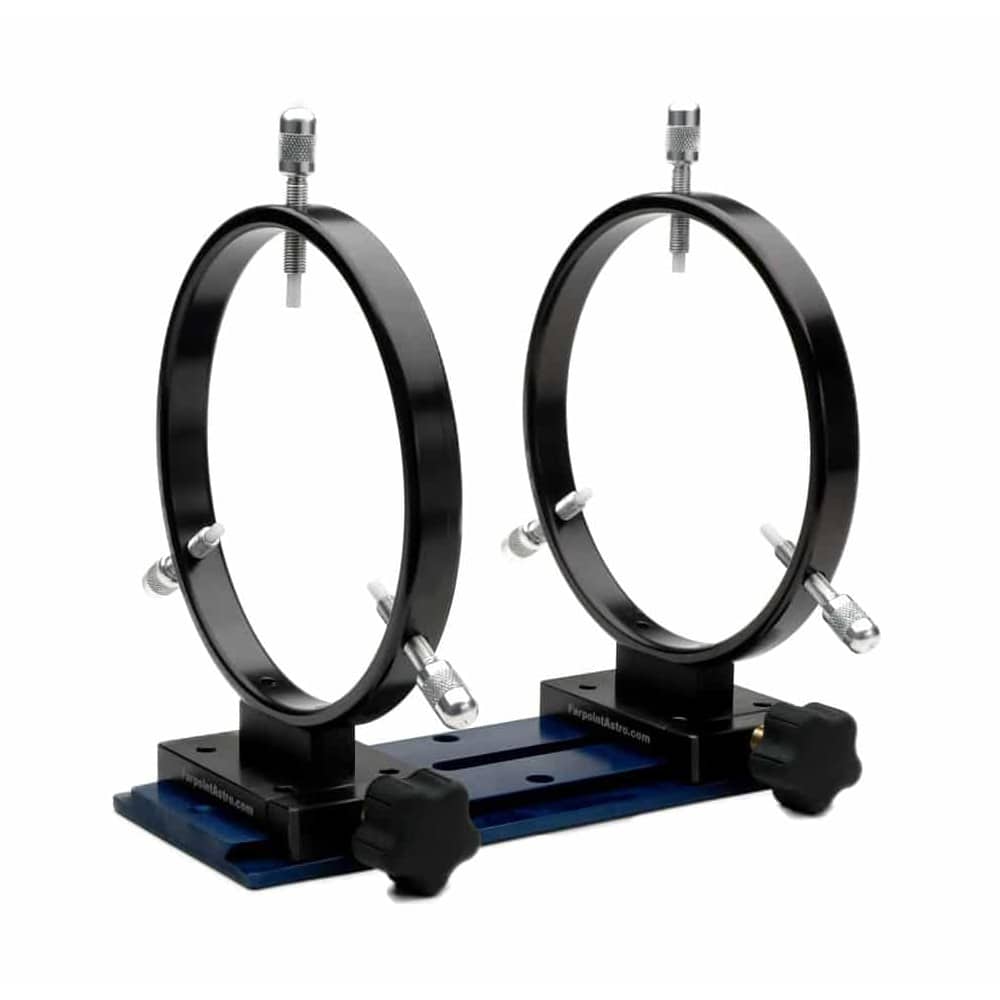
The Farpoint FDR125 is a pair of rings with a 125mm inner diameter that bolt to a D-size (Losmandy-style) dovetail plate and carry a guide scope, finder, or other optical accessory above the main telescope. Three adjustment screws per ring centre the tube, hold it, and set where it points. The pair ships with standard 1″ screws, CNC-machined in the USA, at a published weight of 2.313 lb.
Who It's For
This is a good match if you…
- are adding a guide scope to a rig that already runs a D-size dovetail.
- have a guide scope or finder with a tube outer diameter below 115mm.
- want the guide scope aimable rather than fixed, so a guide star can be brought onto the sensor.
- are replacing plastic or single-screw ring clamps with machined aluminum rings.
Key Features & Design
- 125mm inner diameter: sized to hold tubes with an outer diameter below 115mm, leaving the screws room to work.
- Three-point adjustment per ring: six screws across the pair centre the tube and set its aim.
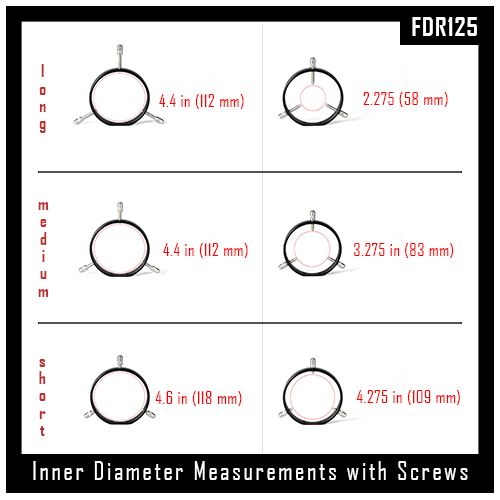
- Standard 1″ screws included: short .5″ and long 1.5″ screw sets are sold separately for tubes near the working limit or well under it.
- D-size mounting: the rings bolt onto a Losmandy-style dovetail plate.
- Supplied as a pair: two rings, so the tube is supported at two points along its length.
- CNC-machined in the USA: produced by Farpoint in the United States.
Mechanical Design
Each ring carries three screws spaced around its circumference rather than a single pinch bolt. Three points of contact define the position of a cylinder, so the tube is centred by geometry rather than by being squeezed against one side of the ring. Turning the screws differentially tilts the guide scope within the ring by small amounts, which is how a guide star is walked onto the sensor without moving the main telescope. Because the adjustment range depends on how far the screws reach inward, screw length is matched to tube diameter: a tube close to the 115mm working limit sits near the ring wall and suits the short .5″ screws, while a much smaller tube needs the long 1.5″ screws to reach it. The underside of the rings bolts to a D-size dovetail plate, so the whole guide scope assembly clamps into the mount as one rigid unit.
Recommended Uses
- Carrying an autoguider scope alongside a main imaging telescope on a D-size plate.
- Mounting a wide-field refractor piggyback for dual-scope imaging.
- Holding a large finder or a rich-field spotting scope on top of a Newtonian or SCT.
- Aiming a guide scope onto a suitable guide star during a framing session.
- Building a permanent imaging train where the guide scope stays aligned between nights.
Compatibility and Accessory Notes
The rings mount to D-size (Losmandy-style) dovetail plates, which are sold separately — Farpoint's universal D-size dovetail bars are the usual pairing. On the tube side, a ring works with any tube whose outer diameter is below 115mm; Farpoint's guidance is to pick a ring at least 10mm larger than the tube O.D. so the adjustment screws have travel to centre it. The rest of the line covers other diameters: 90mm rings for tubes below 80mm, 108mm rings for tubes below 98mm, and 160mm rings for tubes below 150mm. Ring screws come in .5″, 1″, and 1.5″ lengths to match screw reach to tube diameter. A V-size (Vixen) rig takes Farpoint's Vixen scope rings instead. If you are unsure which ring size suits your guide scope, we are glad to work it out — the tube's outer diameter and your dovetail standard are all we need.
Good to Know Before You Order
- The dovetail plate is sold separately. The rings bolt to a D-size plate you supply; the plate is not part of this item.
- Tube outer diameter below 115mm. A 125mm ring leaves roughly 10mm of working clearance, which is the span the adjustment screws take up.
- Standard 1″ screws ship with the rings. The .5″ and 1.5″ sets are separate purchases for tubes at the edges of the range.
- D-size mounting pattern. The rings are drilled for Losmandy-style plates; a Vixen rig takes the V-size rings from the same line.
- Published weight is 2.313 lb for the pair. That figure is worth adding to the payload total when the mount is near its capacity.
Frequently Asked Questions
Will these fit my guide scope?
They hold any tube with an outer diameter below 115mm. The ring works best with at least 10mm over the tube O.D. so the three screws per ring can centre and grip it. For a tube much smaller than the ring, the long 1.5″ screws add reach.
Is the dovetail bar included?
No — the rings bolt to a D-size (Losmandy-style) dovetail plate, which is a separate item.
What is the 3-point adjustment for?
Each ring has three screws spaced around the tube. They centre the guide scope, hold it, and let you fine-tune where it points, which is how a guide star is placed on the sensor.
Is it difficult to install?
The rings bolt to the dovetail plate with hex hardware, then the guide scope drops in and the three screws per ring are snugged evenly. It is a hand-tool job, and the rings can stay on the plate between sessions once set.
Can they hold something other than a guide scope?
Yes — finders, small refractors, and other accessories within the 115mm tube limit all sit in the same rings.
Bottom Line
In short: a machined pair of 125mm D-style rings with three-point adjustment per ring, carrying guide scopes and finders below 115mm tube O.D. on a Losmandy-style dovetail, at a published 2.313 lb.
| Includes | Two rings with 3-point adjustment screws (standard 1″ length) |
|---|---|
| Ring inner diameter | 125mm |
| Holds | Guide scopes, finders, and accessories with tube O.D. below 115mm |
| Mounts to | D-size (Losmandy-style) dovetail plates — dovetail not included |
| Adjustment | 3-point screws per ring — also available in short .5″ and long 1.5″ lengths |
| Weight | 2.313 lb |
| Construction | CNC-machined in the USA |
| Country of origin | United States |
You may also like
Recently viewed
Recent Blog Posts
View all
Your Guide Graph Is Lying to You
Read More

D-Size vs V-Size: A Complete Guide to Telescope Dovetail Systems
Read More

What Is Back Focus in Astrophotography? Telescope Reducers, Flatteners, and Spacing Explained
Read More