


- Description
- Specifications
Product Overview
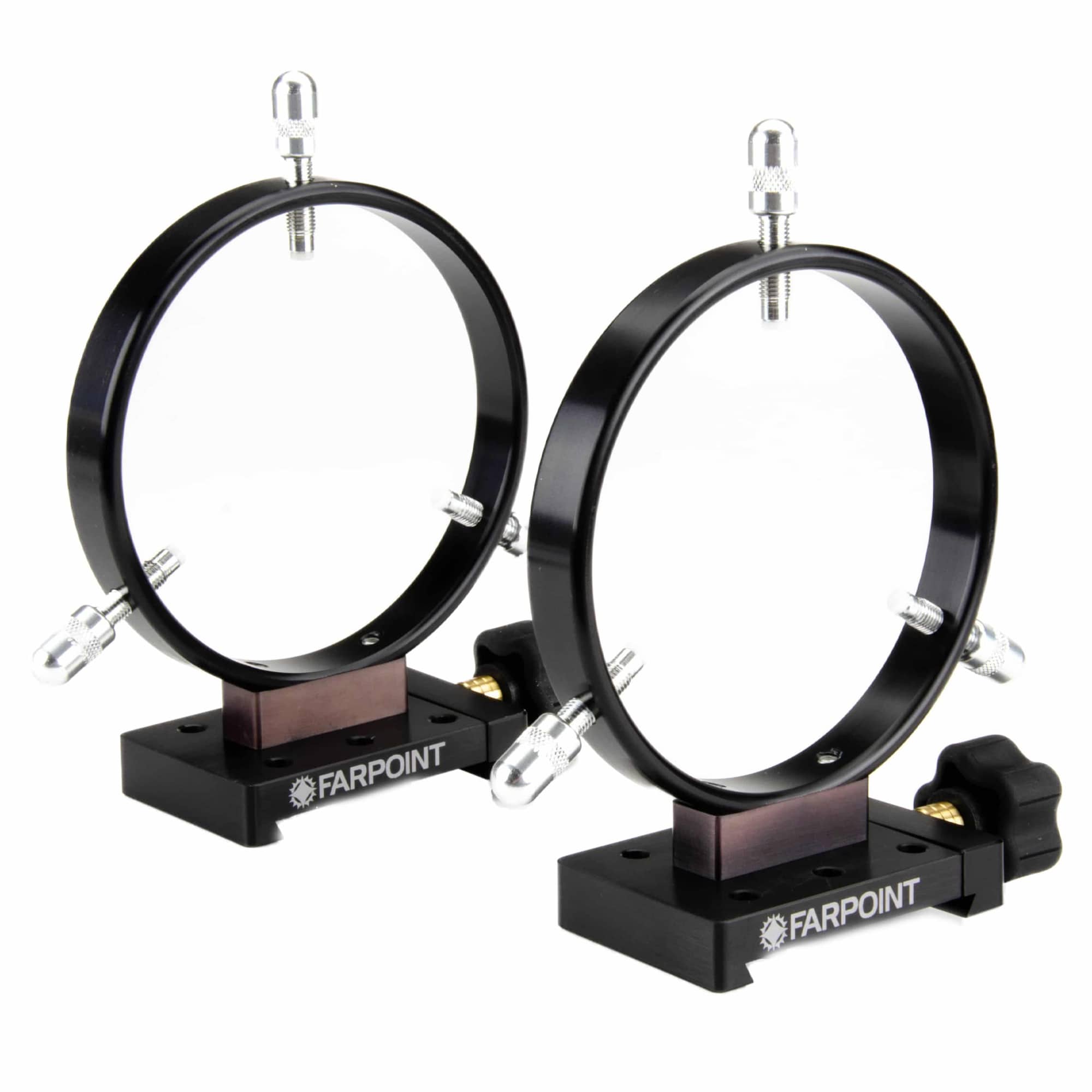
The Farpoint 108mm D Style Dovetail Rings are a pair of rings with a 108mm inner diameter that bolt to a D-size (Losmandy-style) dovetail plate and carry a guide scope, finder or other optical accessory above the main telescope. Three adjustment screws per ring center the tube, grip it and set where it points. The pair is CNC-machined in the USA and published at 2.313 lb.
Who It's For
This is a good match if you…
- have a guide scope, finder or small astrograph with a tube outer diameter below 98mm
- already run a D-size (Losmandy-style) dovetail plate and want to add a second optic to it
- autoguide and need to move a guide star onto the sensor by aiming the guide scope
- found the 90mm rings too small for the tube you want to carry
Key Features & Design
- 108mm inner diameter: holds tubes with an outer diameter below 98mm, leaving at least 10mm for the adjustment screws to work in.
- Three-point adjustment per ring: the screws center the tube, hold it and fine-tune its aim.
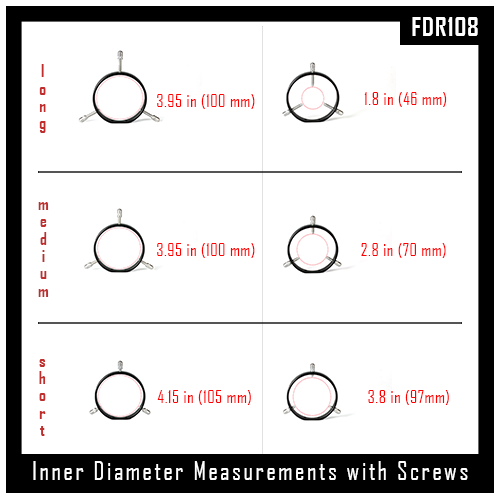
- Standard 1″ screws included: short .5″ and long 1.5″ screw sets are published separately for tubes near the working limit or well under it.
- D-size mounting: the rings bolt to a D-size (Losmandy-style) dovetail plate.
- Sold as a pair: two rings with their adjustment screws.
- Made in the USA: CNC-machined in the USA.
Mechanical Design
Three screws spaced around a ring locate a cylinder kinematically: the tube seats against all three regardless of how far under 108mm it is, so the guide scope stays centered instead of resting on the bottom of the ring. Adjusting the screws differentially tilts the tube within the ring, and tilting both rings together shifts where the guide scope points relative to the main telescope — the mechanism by which a guide star is walked onto the guider's sensor. Screw length sets the usable range: 1.5″ screws reach further inward for a small tube, .5″ screws suit a tube close to the ring's 98mm limit.
Recommended Uses
- Carrying an 80mm to 98mm guide scope or short refractor above an imaging telescope.
- Mounting a large finder or a wide-field piggyback optic on a D-size plate.
- Adding a second tube to a dual-rig imaging setup where the 90mm rings are undersized.
- Holding a camera lens or small astrograph that falls inside the 98mm limit.
Compatibility and Accessory Notes
- Tube diameter: tubes with an outer diameter below 98mm. Farpoint's guidance is to pick a ring at least 10mm larger than the tube O.D.
- Dovetail standard: D-size (Losmandy-style) plates. The dovetail plate itself is a separate item, and Farpoint publishes universal D-size dovetail bars for this.
- Other ring sizes: 90mm rings hold tubes below 80mm, 125mm rings hold tubes below 115mm, and 160mm rings hold tubes below 150mm.
- V-size setups: a Vixen-style (V-size) rig uses the Vixen scope rings in the same line.
- Screw sets: .5″, 1″ and 1.5″ adjustment screws are sold separately to tune reach to the tube diameter.
Tell us your guide scope and dovetail plate and we’ll confirm the fit.
Good to Know Before You Order
- The dovetail plate is not included. The rings bolt to a D-size plate supplied separately.
- 98mm is the working ceiling. A tube at or above 98mm O.D. leaves too little room for the screws, and the 125mm rings cover that range.
- Tubes much smaller than 108mm need longer screws. The 1.5″ screw set adds the reach; the rings ship with 1″ screws.
- Published weight is 2.313 lb for the pair. Shipping is calculated at 3 lb, the next whole pound.
Frequently Asked Questions
Will these fit my guide scope?
They hold any tube with an outer diameter below 98mm. The ring needs at least 10mm over the tube O.D. so the three adjustment screws can center and grip it. For a tube much smaller than that, the long 1.5″ screws add reach.
Is it difficult to install?
It is a bolt-and-adjust job. The rings bolt to the D-size dovetail plate, the guide scope drops in, and the three screws per ring are brought up evenly until the tube is centered and held. Aiming is done afterwards with the same screws.
Is the dovetail bar included?
No — the rings bolt to a D-size (Losmandy-style) dovetail plate supplied separately. Farpoint's universal D-size dovetail bars cover this.
What is the 3-point adjustment for?
Each ring has three screws spaced around the tube. They center the guide scope, hold it and let you fine-tune where it points, which is how a guide star is brought onto the sensor. The rings ship with standard 1″ screws; .5″ and 1.5″ sets are available separately.
Bottom Line
In short: a CNC-machined pair of 108mm D-size rings with three-point adjustment, holding tubes below 98mm O.D. on a Losmandy-style dovetail plate, published at 2.313 lb.
| Includes | Two rings with 3-point adjustment screws (standard 1″ length) |
|---|---|
| Ring inner diameter | 108mm |
| Holds | Guide scopes, finders and accessories with tube O.D. below 98mm |
| Mounts to | D-size (Losmandy-style) dovetail plates — dovetail not included |
| Adjustment | 3-point screws per ring; also available in short .5″ and long 1.5″ lengths |
| Weight | 2.313 lb |
| Construction | CNC-machined in the USA |
| Country of origin | United States |
You may also like
Recently viewed
Recent Blog Posts
View all
Your Guide Graph Is Lying to You
Read More

D-Size vs V-Size: A Complete Guide to Telescope Dovetail Systems
Read More

What Is Back Focus in Astrophotography? Telescope Reducers, Flatteners, and Spacing Explained
Read More