
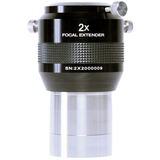

- Description
- Specifications
Product Overview
The Explore Scientific 2x Focal Extender is a 2-inch telecentric amplifier that doubles the effective focal length of the telescope it is fitted to. The body is 118mm long and 66mm wide, and Explore Scientific's current spec sheet gives its weight as 20 oz (0.57 kg). Explore Scientific describes it as compatible with both 1.25-inch and 2.0-inch eyepiece barrel sizes, for visual observing and for imaging.
The optics use multiple precision elements in a telecentric arrangement, with EMD coating on the air-to-glass surfaces and edge-blackened elements to hold contrast. Because the design is telecentric rather than a simple negative Barlow, the amplification factor stays at 2x regardless of how far the eyepiece or camera sits behind it.
Practically, that means one focal extender doubles every eyepiece you own. A 20mm becomes a 10mm, a 14mm becomes a 7mm, and the apparent field and eye relief of each eyepiece carry through unchanged.
Who It's For
- Observers filling gaps in a set: two eyepieces plus this extender cover four magnifications, which is a compact way to build a range.
- Planetary and lunar observers: reaching high power by doubling a longer eyepiece keeps the eye relief of the longer eyepiece rather than the cramped eye position of a very short one.
- Eyeglass wearers: Explore Scientific specifically notes the telecentric design's benefit here, because eye relief is inherited from the eyepiece rather than compressed by the amplifier.
- Planetary imagers: doubling focal length raises image scale on the Moon and planets, and telecentricity keeps that factor predictable regardless of camera spacing.
Key Features & Design
- 2x amplification, telecentric: the factor holds constant no matter what spacing the eyepiece or camera sits at, which a conventional Barlow does not do.
- 2.0-inch barrel for 2-inch focusers and diagonals, with compatibility for both 1.25-inch and 2-inch eyepieces as published by Explore Scientific.
- Multiple precision elements in the optical group; Explore Scientific does not publish the element count.
- EMD coating on the air-to-glass surfaces, which is where a multi-element amplifier gains or loses transmission and contrast.
- Edge-blackened elements to suppress the internal scatter that otherwise shows as a lowered contrast floor on planetary detail.
- Published dimensions: 118mm long, 66mm wide, 20 oz (0.57 kg).
Optical Design
A conventional Barlow lens is a negative group placed ahead of focus. It works, but its amplification factor depends on the distance between the lens and the eyepiece field stop — move the eyepiece further back and a nominal 2x becomes 2.3x or 2.5x. Anything that changes that distance, such as a diagonal inserted between the two or a different eyepiece with a deeper field stop, changes the effective magnification and makes the resulting figure an estimate.
A telecentric design adds a positive group after the negative one, so the light leaving the assembly travels as a bundle of rays parallel to the optical axis. Two things follow. The amplification stays at exactly 2x whatever the spacing behind it, so the arithmetic on magnification and image scale remains exact. And the light entering the eyepiece arrives as though it came from a much slower telescope, which is easier on eyepiece designs that show edge aberrations at steep light cones.
The eyepiece keeps its own characteristics through the extender. Apparent field is unchanged, eye relief is unchanged, and the true field simply halves along with the doubling of magnification. That is why doubling a 14mm to reach 7mm is more comfortable than using a 7mm directly — the eye position belongs to the 14mm.
Recommended Uses
- High-power lunar and planetary observing without buying very short focal length eyepieces.
- Splitting double stars, where the extra magnification is what opens a tight pair.
- Planetary imaging, where doubling focal length raises image scale on a small sensor.
- Use with fast telescopes, where the telecentric output is gentler on eyepiece edge performance.
Compatibility and Accessory Notes
- Fits 2-inch focusers and diagonals. Explore Scientific publishes compatibility with both 1.25-inch and 2.0-inch eyepiece barrel sizes.
- Magnification: double whatever the eyepiece gives on its own. In a 714mm telescope, a 20mm eyepiece goes from 36x to 71x; a 9mm goes from 79x to 159x.
- Effective focal ratio: doubles as well. An f/5 telescope behaves as f/10 behind it, an f/7 as f/14 — which is the figure that matters for planetary imaging exposure.
- Imaging: because the factor is spacing-independent, a camera can sit at whatever backfocus the train needs and the image scale stays predictable.
- Focus travel: an extender shifts the focus point outward, so the focuser racks in further than it would without it. Most telescopes have the travel; a very short-travel focuser is worth a check, and we can look at that with you.
- Filters: the 2-inch barrel accepts standard 2-inch threaded filters, so a lunar or minus-violet filter can sit ahead of the optics rather than at the eyepiece.
Good to Know Before You Order
- Doubling magnification also doubles the effect of atmospheric turbulence. On an unsteady night the extended view softens, which is seeing rather than the optics. On a steady night it is where the aperture shows what it can do.
- It needs a 2-inch focuser or diagonal. A telescope with only a 1.25-inch focuser is outside its range, and Explore Scientific makes a 1.25-inch focal extender for exactly that case — tell us your focuser and we will point you at the right one.
- Explore Scientific publishes two weight figures across revisions. The current spec sheet lists 20 oz (0.57 kg); an earlier sheet listed 752 grams (26.5 oz). Both are recorded as published rather than averaged into one number.
- The element count is not published, so that row reads as not published below rather than carrying a guess. We can ask our Explore Scientific rep if it matters to you.
- An extender adds length to the imaging train. At 118mm it needs room behind the focuser, which is worth a look on a compact refractor with a short drawtube. Send us the telescope and we will check the geometry with you.
Frequently Asked Questions
Is it difficult to set up?
No — it slides into a 2-inch focuser or diagonal, and the eyepiece slides into it. Refocusing after fitting it is the only step, and there is nothing to align or adjust.
What is the difference between this and a Barlow?
A Barlow's amplification varies with the spacing behind it, so a nominal 2x can drift to 2.5x depending on the eyepiece and whether a diagonal is in the path. This is telecentric, so 2x stays 2x at any spacing, and the exit light is parallel to the axis rather than converging.
Will it work with my 1.25-inch eyepieces?
Explore Scientific publishes compatibility with both 1.25-inch and 2.0-inch eyepiece barrels. The unit itself seats in a 2-inch focuser or diagonal.
Does it change my eye relief?
No. The eyepiece keeps its own eye relief and apparent field — only the magnification changes. That is why doubling a longer eyepiece is more comfortable than using a very short one.
Can I use it for photography?
Yes, particularly for the Moon and planets, where doubling focal length raises image scale. The telecentric design keeps the factor exact regardless of where the camera sensor sits.
Bottom Line
In short: a telecentric 2x focal extender with a 2-inch barrel, EMD-coated and edge-blackened elements, 118mm long at 20 oz, that doubles every eyepiece in your case while leaving apparent field and eye relief untouched. If you would like to know exactly which magnifications it will open up with the eyepieces you already own, send us the list and your telescope's focal length and we will work them out.
| Item Number | FE02-020 |
|---|---|
| Type | 2x telecentric focal extender |
| Barrel Size | 2.0-inch |
| Eyepiece Compatibility | 1.25-inch and 2.0-inch barrels |
| Length | 118mm |
| Width | 66mm |
| Weight | 20 oz; 0.57 kg (earlier sheet: 752 grams; 26.5 oz) |
| Coatings | EMD on air-to-glass surfaces |
| Element Treatment | Edge-blackened |
| Element Count | Not published by vendor |
| Filter Thread | Standard 2-inch |
You may also like
Recently viewed
Recent Blog Posts
View all
Your Guide Graph Is Lying to You
Read More

D-Size vs V-Size: A Complete Guide to Telescope Dovetail Systems
Read More

What Is Back Focus in Astrophotography? Telescope Reducers, Flatteners, and Spacing Explained
Read More