

- Description
- Specifications
Product Overview
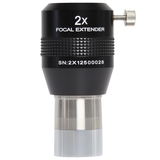
The Explore Scientific 2x Focal Extender is a 1.25-inch Barlow-type accessory that doubles the magnification of whatever eyepiece is placed in it. It is 96mm long, 45mm wide and weighs 260 grams (9.1 oz), and it is built on a telecentric optical layout using multiple precision lens elements rather than the single negative lens a simple Barlow uses.
The practical consequence of that layout is consistency. In a classic Barlow, the amplification factor depends on how far the eyepiece's field stop sits from the negative lens, so a 2x Barlow becomes a 2.3x or a 2.7x when spacing changes — when a diagonal goes in between, for instance, or when a different eyepiece design puts its field stop somewhere else. A telecentric design produces an exit beam whose rays run parallel to the optical axis, which holds the magnification factor at 2x regardless of spacing and keeps the eyepiece's own eye relief and image quality intact.
The result is that one 2x extender effectively doubles the number of magnifications your eyepiece set delivers: a 20mm becomes a 10mm-equivalent power, a 15mm becomes 7.5mm, a 30mm becomes 15mm — each while keeping the eye relief characteristics of the longer eyepiece.
Who It's For
- Eyeglass wearers: this is the most useful case of all. Short-focal-length eyepieces are where eye relief runs out; using a longer eyepiece behind a telecentric extender gives high magnification while retaining the comfortable eye position of the longer eyepiece.
- Lunar and planetary observers who need to reach the magnifications where surface detail lives on the nights when seeing allows it.
- Planetary imagers: doubling the focal length increases the image scale at the sensor, which is how a small planetary disc is made to cover enough pixels to resolve detail.
Key Features & Design
- Telecentric optical layout: the defining feature. Multiple precision lens elements produce a parallel exit beam, holding the 2x factor constant regardless of the distance to the eyepiece.
- Consistent 2x amplification: the number on the barrel is the number you get, in a diagonal or straight into the focuser.
- Preserves eye relief: the eyepiece behaves as it normally would, so its comfortable eye position carries through to the higher magnification.
- 1.25-inch barrel: fits any standard 1.25-inch focuser or diagonal, and accepts any 1.25-inch eyepiece.
- Published dimensions: 96mm long, 45mm wide, 260 grams (9.1 oz).
Optical Design
A Barlow lens is a diverging optical group placed ahead of focus. It makes the converging light cone from the telescope shallower, which pushes the focal point further back and increases the effective focal length — and therefore the magnification. In its simplest form a single negative lens does the job, and it does it well enough for most purposes.
The weakness of the simple form is that the amount of amplification depends on where the eyepiece's field stop lands relative to that negative lens. Move the eyepiece further back and the factor rises. Insert a star diagonal between the Barlow and the eyepiece and the factor rises again. That is why a nominal 2x Barlow can end up delivering anywhere from 2x to nearly 3x depending on how it is used, which makes it hard to know what magnification you are actually observing at.
A telecentric design solves this with a multi-element group that does more than diverge the beam. It re-forms the light so the chief rays exit parallel to the optical axis, which means the eyepiece behind it sees essentially the same geometry no matter where it sits. The amplification factor stays at 2x, the eyepiece's designed eye relief is preserved rather than compressed or stretched, and the correction the eyepiece was designed to deliver is not disturbed by the extra optics ahead of it.
There is one physical consequence worth understanding. Doubling the effective focal length also doubles the effective focal ratio: an f/6 telescope behaves like an f/12 one behind this extender. That halves the exit pupil for any given eyepiece and reduces image brightness accordingly, which is why focal extenders belong to lunar, planetary and double-star observing rather than to faint deep-sky work.
Explore Scientific does not publish the exact element count for this extender, describing it as multiple precision lens elements, and does not publish a filter thread specification. Those rows are marked unpublished below rather than estimated.
Recommended Uses
- High-power lunar observing, where doubling a mid-range eyepiece reaches crater-floor detail along the terminator.
- Planetary observing on steady nights — Jovian belt structure, the Cassini division, Martian surface markings.
- Planetary and lunar imaging, where doubling the focal length gives the image scale a small planetary disc needs.
Compatibility and Accessory Notes
- Fits any 1.25-inch focuser or diagonal, and accepts any 1.25-inch eyepiece. In a 2-inch focuser it seats in a 2-inch to 1.25-inch adapter.
- Magnification: telescope focal length × 2 ÷ eyepiece focal length. In a 952mm telescope, a 20mm eyepiece goes from 48x to 95x; a 12mm from 79x to 159x.
- Effective focal ratio: doubles. An f/6 telescope works at f/12 behind the extender, and an f/10 at f/20.
- Exit pupil: halves for a given eyepiece, which is why the extender pairs best with mid and long focal length eyepieces rather than the shortest one in the case.
Good to Know Before You Order
- Doubling magnification halves image brightness for a given eyepiece. That is fine on the Moon and the planets, and it is why deep-sky observing generally stays at native focal length. The extender is a Solar System and double-star tool.
- Seeing sets the ceiling, not the optics. On a turbulent night, higher magnification enlarges the turbulence along with the target. The extender earns its keep on steady nights, which is exactly what it was made for.
- Pairing it with your shortest eyepiece often overshoots. A 2x extender behind a 5mm in a metre-focal-length telescope produces magnification most apertures cannot support. Mid-range eyepieces are the productive partners, and the results are visibly better.
- Explore Scientific does not publish the element count or a filter thread figure for this extender, so those rows read as unpublished rather than estimated. If either matters, ask and we will check with our Explore Scientific rep.
Frequently Asked Questions
Is it difficult to set up?
No — the extender goes into the focuser or diagonal and the eyepiece goes into the extender. There is nothing to adjust, and because the design is telecentric, the spacing does not need to be set precisely to get the stated 2x.
What is the difference between this and a regular Barlow?
A simple Barlow's amplification factor changes with spacing, so a nominal 2x can become 2.5x or more once a diagonal or a different eyepiece is involved. A telecentric design produces a parallel exit beam, so it stays at 2x regardless, and it preserves the eyepiece's own eye relief instead of altering it.
What magnification will I get?
Double whatever the eyepiece gives on its own. Telescope focal length × 2, divided by eyepiece focal length. A 1000mm telescope with a 20mm eyepiece goes from 50x to 100x.
Is it good for eyeglass wearers?
It is one of the best answers there is. Instead of buying a very short eyepiece with minimal eye relief, you use a longer, more comfortable eyepiece behind the extender and get the same magnification with the eye relief the longer eyepiece was designed around.
Bottom Line
In short: a 1.25-inch 2x focal extender with a telecentric multi-element design that holds its amplification factor and its eye relief regardless of spacing, at 96mm long and 260 grams. It doubles the number of magnifications your eyepiece set delivers and is particularly useful if you observe with glasses on. If you would like a second opinion on which of your eyepieces it pairs with best, send us the list and your telescope's focal length and we will work it through with you.
| Description | 2x Focal Extender; 1.25-inch O.D. Barrel |
|---|---|
| Item Number | FE02-125 |
| Magnification Factor | 2x |
| Optical Design | Telecentric, multiple precision lens elements |
| Barrel Size | 1.25-inch |
| Length | 96mm |
| Width | 45mm |
| Weight | 260 grams; 9.1 oz |
| Element Count | Not published by vendor |
| Filter Thread | Not published by vendor |
You may also like
Recently viewed
Recent Blog Posts
View all
Your Guide Graph Is Lying to You
Read More

D-Size vs V-Size: A Complete Guide to Telescope Dovetail Systems
Read More

What Is Back Focus in Astrophotography? Telescope Reducers, Flatteners, and Spacing Explained
Read More