


- Description
Product Overview
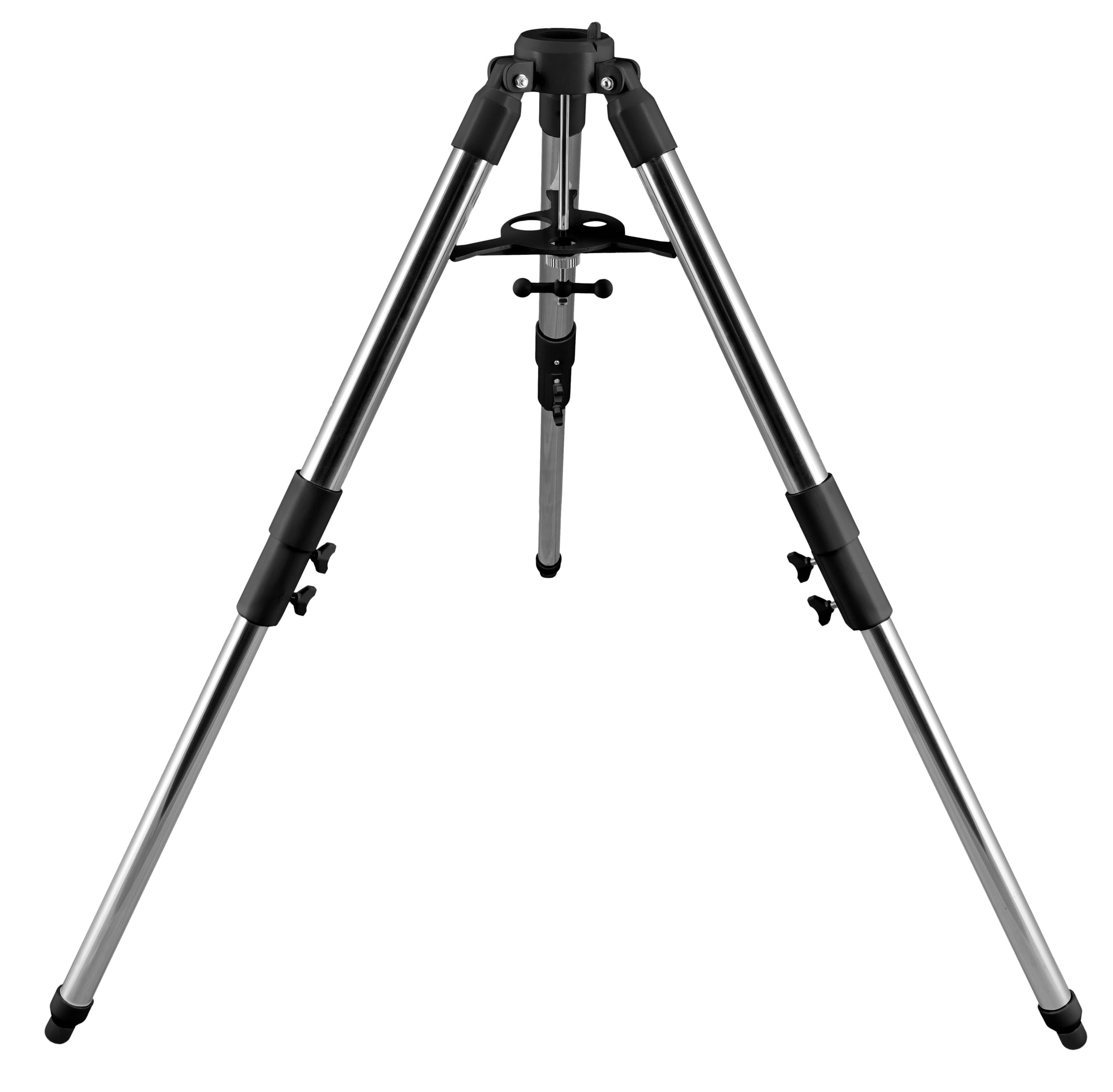
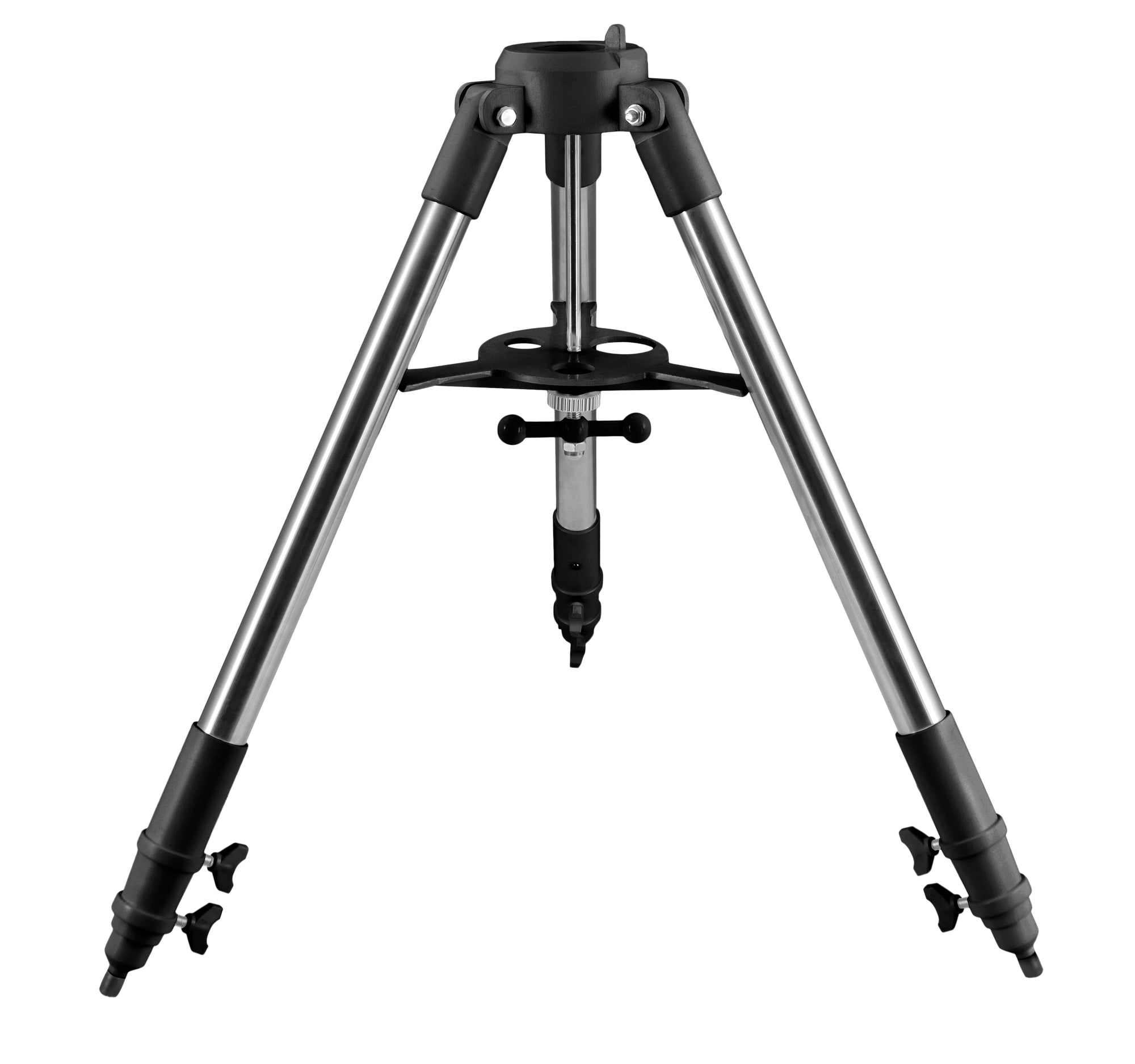
The Explore Scientific Twilight Medium Duty Tripod, item ES-ST2BLK, is the black version of Explore Scientific's stainless steel field tripod. It stands on three fully adjustable 1.5-inch stainless legs, tied together by a die cast aluminium spreader tray drawn up against them with a threaded T-bar. Explore Scientific publishes a weight of 11 pounds, or 5.0 kilograms, a height of 29.5 inches fully collapsed, 25 inches open with the legs retracted, and 42 inches with the legs fully extended, at which point the footprint also measures 42 inches. It is sold as a stability and capacity upgrade for the iEXOS-100.
Who It's For
This is for the observer who has stopped blaming the optics. If you have an iEXOS-100 on its standard support and you have watched a star smear across the field every time you touch the focuser, or seen the image ring for several seconds after a gust, the mount head is rarely the culprit — it is the three legs underneath it. A tripod is a spring, and a light one with slender legs stores and releases the energy you put into it slowly enough that you spend a real fraction of the night waiting for the view to settle. Moving the same mount onto 1.5-inch stainless legs shortens that settling time noticeably, which is the difference between focusing by feel and focusing by eye.
It also matters if you are adding load. Explore Scientific positions this tripod as the way to hang more weight off an iEXOS-100 without giving up performance, which is the situation you are in once a guide scope, a camera, a dew heater, and the cabling that comes with them go onto the saddle. Imagers feel this first, because a two or three second exposure will forgive a wobble but a five minute sub-exposure taken through a soft tripod records every truck that passes. Visual observers at high magnification feel it just as much, in a different way.
Key Features & Design
- Fully adjustable 1.5-inch stainless steel legs, independently extendable for levelling on uneven ground
- Die cast aluminium spreader tray that doubles as an eyepiece and accessory holder
- Threaded T-bar that draws the tray up against the legs to lock the geometry solid
- Explore Scientific publishes a weight of 11 pounds, or 5.0 kilograms
- Working height of 25 inches with legs retracted and 42 inches fully extended
- Collapses to 29.5 inches for transport
- 42-inch footprint at full extension for a wide, stable stance
- Black finish, supplied as Explore Scientific item ES-ST2BLK
Mechanical Design
Two things decide whether a tripod settles quickly: how stiff it is and how well it dissipates energy. Stiffness in a tubular leg rises with roughly the fourth power of its diameter, so the step up to 1.5-inch tubes buys far more rigidity than the modest increase in size suggests. Stainless steel contributes on the other side of the equation, being both stiff and dense, and the added mass raises the amount of energy needed to set the tripod moving in the first place. The spreader tray is doing more work than it appears to. Tightening the threaded T-bar preloads the three legs against the tray so the whole assembly behaves as one triangulated structure rather than three independent cantilevers, and preloaded joints cannot rattle the way loose ones do. One practical consequence follows from all of this: extending the legs lowers the resonant frequency and lengthens the damping time, so if the eyepiece height is comfortable with the legs part way in, leave them there. The 25-inch retracted position is meaningfully steadier than the 42-inch one, and it costs you nothing but a seat.
Recommended Uses
- Upgrading the support under an iEXOS-100 for visual or imaging work
- Long-exposure astrophotography where damping time directly affects the keeper rate
- High-magnification lunar and planetary observing, where vibration is most visible
- Windy or exposed observing sites that punish a light tripod
- Transportable setups that need a rigid base but still have to collapse to 29.5 inches
Compatibility and Accessory Notes
Explore Scientific designed this tripod around the iEXOS-100, and it is the upgrade path they publish for that mount. There is one thing to know before ordering: pairing an iEXOS-100 with this tripod requires an azimuth adjuster adapter, which Explore Scientific sells separately and does not include here. This tripod has no built-in azimuth pin, so without that adapter you have no positive stop to push the mount against when you make fine azimuth corrections during polar alignment, and the head will simply rotate on its bolt. Explore Scientific does not publish the top plate bolt pattern or a load rating on this page, so if you are hoping to put a mount head from another maker on it, contact us with the details of your head and our team in Bolton will check the interface before you order.
Good to Know Before You Order
This is the tripod only. No mount head, no counterweight shaft, and — the one that catches people out — no azimuth adjuster adapter, which you will want alongside it if you are fitting an iEXOS-100. Explore Scientific publishes no load capacity figure for this tripod, so we cannot quote one; what they do say is that it lets you add weight to an iEXOS-100 without compromising performance, and the mount's own payload rating remains the governing limit. At a published 11 pounds it is a genuine step up in mass from a light aluminium tripod, which is the source of its steadiness and also something to consider if you carry your gear any distance. The tripod is also offered in white, so check you are ordering the finish you want.
Frequently Asked Questions
Do I need anything else to use this with an iEXOS-100? Yes. Explore Scientific states that the pairing requires an azimuth adjuster adapter, sold separately. Ask us to include one with your order if you do not already have it.
How tall does it stand? Explore Scientific publishes 25 inches open with the legs retracted and 42 inches with them fully extended, collapsing to 29.5 inches for transport.
How much does it weigh? Explore Scientific publishes a weight of 11 pounds, or 5.0 kilograms.
Does the spreader hold eyepieces? Yes. The die cast aluminium spreader tray doubles as an accessory holder as well as bracing the legs, so it earns its place twice.
Bottom Line
Most of the shake people blame on their mount comes from the legs it is standing on, and 1.5-inch stainless with a preloaded aluminium spreader is a real answer to that. It is the tripod Explore Scientific points iEXOS-100 owners toward when they start adding weight to the saddle. Contact us if you would like the azimuth adjuster adapter added to your order and we will make sure you have everything you need in one shipment.
You may also like
Recently viewed
Recent Blog Posts
View all
Your Guide Graph Is Lying to You
Read More

D-Size vs V-Size: A Complete Guide to Telescope Dovetail Systems
Read More

What Is Back Focus in Astrophotography? Telescope Reducers, Flatteners, and Spacing Explained
Read More